
InSight’s power level goes up!

InSight's power levels as of September 5, 2022

The most recent status update on the Mars lander InSight, released today, shows a slight rise in the amount of power generated by its dust-covered solar panels.

As shown on the graph to the right, on August 27, 2022 the power level was 400 watt-hours generated per Martian day. On September, 5, 2022, the power level was 410 watt-hours per Martian day, the first power increase since late July. At the same time, the dust in the atmosphere continued to clear, going from a tau level of .88 to 0.8. Outside of the winter dust season tau is usually between 0.6 and 0.7.

The slight power increase continues to suggest that the lander’s death might be delayed. At 400 watt-hours per day, it has been able to run its seismometer since the beginning of July. With this slight increase, the chance increases that InSight will finally get that one gust of wind or dust devil that will blow the dust off its solar panels and allow it to recover some power and operate for longer.

1 comment

Crazy badlands in the equatorial region of Mars

Badlands in the equatorial regions of Mars
Click for full image.

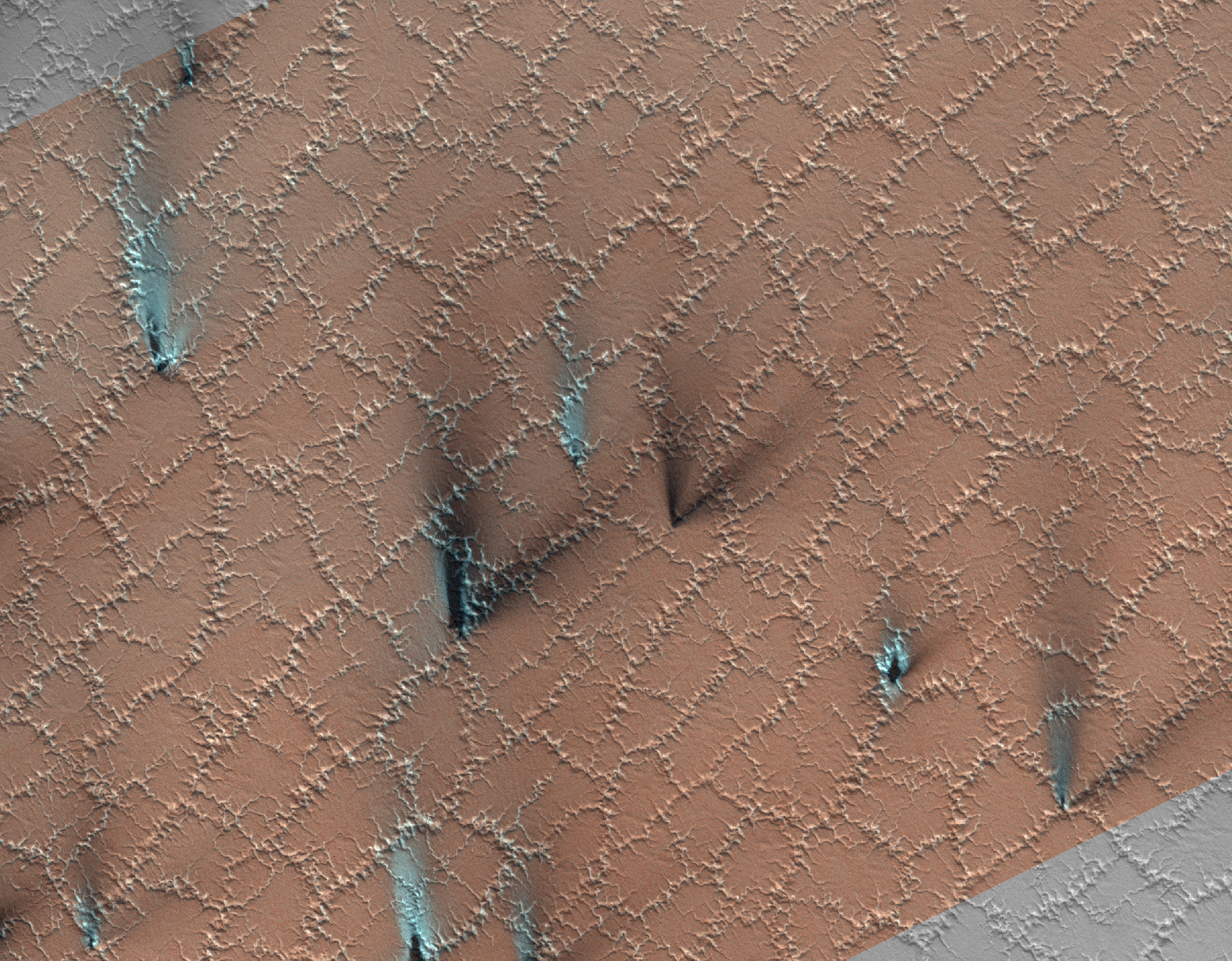
Cool image time! The photo to the right, rotated and cropped to post here, was taken on June 17, 2022 by the high resolution camera on Mars Reconnaissance Orbiter (MRO). The section highlighted is at full resolution, in order to make clear the absolutely crazy and complex terrain seen in the full image.

This terrain is not glacial, as the location is only about 1 degree south of the Martian equator. There might have been surface or near surface ice here once in the past, but there is none now.

Could we be looking at some form of lava flow? This is possible, because a close look at the context map at the image link suggests this region has been partly covered by some material, obscuring some craters to the east and west. However, there is no visible evidence anywhere in this region of a volcanic vent or caldera. If this covering material was volcanic it is very unclear where it came from.

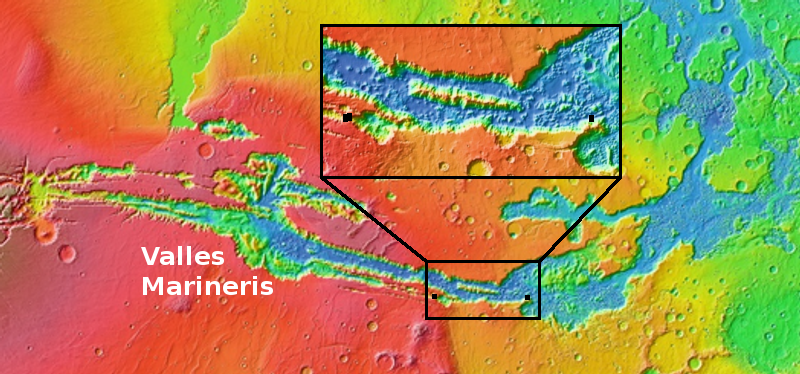
The overview map below does not really provide any answers, but at least gives the context.
» Read more

5 comments

September 12, 2022 Quick space links

Courtesy of stringer Jay.

0 comments

Blue Origin suborbital flight aborted during ascent

Capitalism in space: For what appeared to be an engine issue in the booster during the ascent phase, Blue Origin was forced to abort an unmanned New Shepard suborbital flight today.

I have embedded the live steam below, cued to just before the abort. It appears that something went seriously wrong with that first stage booster. The abort system immediately activated, separating the capsule and firing the capsule’s abort engines to take it safely away, with its parachutes bringing it down safely. That first stage booster was likely destroyed.

This particular suborbital flight fortunately was the first carrying no passengers since Blue Origin began commercial flights. Its payloads were a variety of experiments and commercial packages.

Regardless of the issue, Blue Origin will not be doing suborbital flights now for a considerable time, pending an investigation into this failure.

» Read more

16 comments

The Ukraine’s big victory this past week was no accident

The Ukraine War as of August 30, 2022
The Ukraine War as of August 30, 2022. Click for full map.

The Ukraine War as of September 11, 2022
The Ukraine War as of September 11, 2022. Click for full map.

In the past week the Ukraine has scored a major victory in its effort to drive Russia from its territory, pushing the Russians back across a wide swath in the areas north and east of the city of Kharkiv. The two maps to the right, created by the Institute for the Study of War (ISW) and simplified, reduced, and annotated to post here, show these gains, with the top map from their August 30, 2022 analysis and the bottom from their September 11, 2022 update. Red or pink areas are regions controlled by the Russians. Blue areas are regions retaken by the Ukraine. Red-striped areas are regions captured by Russian in its 2014 invasion. Blue-striped areas are regions inside Russian-occupied territories that have seen strong partisan resistance.

The green lines on both maps mark rivers that act as important military barriers. The blue arrows on the lower map east of Kharkiv show the Ukrainian military push this past week, first to the east to the river Oskil. From there the forces moved north and south. To the south the Ukrainians used the Oskil river to their left as a wall protecting them from Russian forces. That same river acted to pin the Russians down in the south, forcing them in the past day to quickly retreat to the east across the one remaining bridge under their control, but in the process abandoning large amounts of armaments that the Ukrainians can now use.

In the south, the Dnipro River also acts as a barrier for the Russian occupying forces north of Kherson.
The Ukrainians have spent the last month or so aggressively attacking the handful of bridges that cross this river, thus restricting Russian transport to and from its northern forces. As the Ukrainians made these attacks, they were remarkably public about their plans to follow up with a major campaign in the south to retake Kherson and all territory north of the Dnipro.

In that public campaign lies the key to this whole counter-offensive. As ISW noted in its update of September 11, 2022:
» Read more

50 comments

Firefly scrubs launch of Alpha rocket

UPDATE: September 12th launch scrubbed due to weather. No word on when the next launch attempt will be scheduled.

Original post about September 11th scrub:
————–
After making two attempts, engineers at Firefly yesterday finally scrubbed the launch of their Alpha rocket, rescheduling the next attempt for today with a four hour launch window opening at 3 pm (Pacific).

Firefly has yet to make orbit. Their first launch attempt last year of Alpha failed when one first stage engine shut down prematurely due to a loose connection.

If you wish to watch the launch, I will embed the live stream below, once it goes live later today.

UPDATE: I have embedded the live stream below, with it beginning at 1:30 pm (Pacific).
» Read more

0 comments

CAPSTONE in safe mode

The lunar orbiter CAPSTONE, presently on its way to the Moon, went into safe mode on September 8th at the end of a mid-course correction engine burn.

The CAPSTONE mission team has good knowledge of the state and status of the spacecraft. The mission operations team is in contact with the spacecraft and working towards a solution with support from the Deep Space Network.

Under such conditions engineers almost always recover the spacecraft so that the mission proceeds as normal. No guarantees of course, but it is not unreasonable to expect the same with CAPSTONE.

0 comments

SpaceX launches 34 Starlink satellites plus commercial satellite for AST Mobile

Capitalism in space: SpaceX today successfully used its Falcon 9 rocket to launch 34 additional Starlink satellites into orbit. It also launched another customer’s communications satellite, AST Mobile’s BlueWalker-3.

The first stage successfully completed its record 14th flight, the most times a Falcon 9 first stage has been reused. It landed on a drone ship in the Atlantic. In addition, the two fairing halves completed their 4th and 5th flights, respectively. As of this writing, the satellites have not yet deployed from the upper stage.

The leaders in the 2022 launch race:

41 SpaceX
36 China
11 Russia
6 Rocket Lab
5 ULA

American private enterprise now leads China 56 to 36 in the national rankings, and the entire world combined 56 to 55. That U.S. lead stands a good chance of increasing this weekend, as tomorrow SpaceX plans another Starlink launch, but more significantly, Firefly will make the second attempt to complete the first launch of its Alpha rocket, almost a year after the first failed attempt.

4 comments

Defense to help Commerce create its own ability to track orbital objects

The Defense and Commerce departments yesterday signed an agreement where Defense will help Commerce create its own capability for tracking of all objects in orbit, from satellites to space junk.

The agreement, the Commerce Department said in a statement, defines how the two departments will work together to implement provisions of Space Policy Directive (SPD) 3 in 2018 that directed commerce to provide space situational awareness (SSA) and space traffic management (STM) services, such as conjunction warnings, currently provided by the U.S. military.

The result of this is that the federal government is now creating a second bureaucracy to do what the military has been doing quite capably for more than a half century. Commerce intends to obtain its data by awarding contracts to private companies, who will do the actual tracking. The irony is that it is very possible the military will eventually sign similar contracts with the same companies, thus paying them twice for the same service. Meanwhile, Washington has an excuse for hiring more people.

Even more ironic, this policy directive was issued during the Trump administration. It might have intended for Commerce to replace the military, but under the Biden administration the federal bureaucracy is being allowed to interpret the policy more broadly, thus allowing both agencies to do the work.

I also guarantee that the Republicans will almost certainly do nothing to change this, should they take over Congress. For the past thirty years this so-called party of small government has done nothing to earn that title. Instead, it has simply engineered the growth of government, in a more subtle and deliberate manner.

2 comments

FAA and NTSB sign deal dividing turf for investigating space accidents

FAA & NTSB agreement

Turf war! The FAA and the National Transportation Safety Board (NTSB) yesterday signed an agreement that divides up the responsibilities for investigating accidents that occur in or by space entities.

You can read that agreement here [pdf]. A screen capture of the key clauses is to the right. Essentially, the NTSB will lead any investigation that either causes death or injury, or involves damage to property not related to the space operation itself, while the FAA will lead all other investigations.

The agreement also has a lot of clauses describing how the two agencies will work together in dividing up this turf before, during, and after investigations. Above all, the agreement now authorizes both agencies to “conduct its own analysis and determine its respective conclusions and recommendations in accordance with its authorities.”

The agreement stems from an effort by the NTSB to take over all space-related accident investigations it proposed in November 2021 that both the FAA and industry strongly opposed. This agreement however shows that the Biden administration ignored those objections in order to give the NTSB a wider range of power, while also giving bureaucrats in both agencies more power as well. Under this agreement, every space incident is now going to be investigated twice, with both the NTSB and FAA doing their own investigations.

Expect this agreement to be used by the Washington bureaucracy to slow or shut down innovation and new technology. The NTSB is designed to investigate incidents caused in the long established and robust airline industry, not developing cutting-edge experimental work. It will naturally act to discourage such experimental work.

Meanwhile, the FAA will chime in with its own investigation and analysis. The competing results will only cause confusion and disorder, thus further acting to discourage any new and risky innovations.

4 comments
1 63 64 65 66 67 192