
Camille Saint-Saëns – The Swan
An evening pause: Mischa Maisky on the cello, backed by the Verbier Festival Chamber Orchestra. Performed live 2015.
Hat tip Judd Clark.
An evening pause: Mischa Maisky on the cello, backed by the Verbier Festival Chamber Orchestra. Performed live 2015.
Hat tip Judd Clark.
Courtesy of BtB’s stringer Jay. This post is also an open thread. I welcome my readers to post any comments or additional links relating to any space issues, even if unrelated to the links below.

Click for original image.
Cool image time! The picture to the right, cropped and reduced to post here, was taken by the Hubble Space Telescope as part of a study of the dusty clouds inside star-forming regions. From the caption:
Stars in a star cluster shine brightly blue, with four-pointed spikes radiating from them. The centre shows a small, crowded group of stars while a larger group lies out of view on the left. The nebula is mostly thick, smoky clouds of gas, lit up in blue tones by the stars. Clumps of dust hover before and around the stars; they are mostly dark, but lit around their edges where the starlight erodes them.
This cluster sits inside the Large Magellanic Cloud, about 160,000 million light years away and the largest of the several known dwarf galaxies to orbit the Milky Way. It is the second largest such star-forming region with that dwarf galaxies, and thus is a prime research target for studying the birth of stars.
I especially like this image because of the small dust clouds that sit in the foreground, blobs of material that is slowly being ionized away by the radiation from the stars.

Click for original.

Click for interactive map
In reviewing the pictures downloaded today by the Mars rover Curiosity, I noticed something very intriguing in the pictures taken by rover’s two navigation cameras. One such picture is above, taken by the right navigation camera and looking west across the boxwork ridges that Curiosity has been traversing for the past two months. You can see two such ridges in the right foreground, cutting diagonally from left to right.
The overview map to the right gives the context, with the blue dot marking Curiosity’s position. The white and red dotted lines indicate its actual and planned routes respectively, with the top inset zooming in to show the recent travels more clearly. The yellow lines show the approximate area covered by the picture above.
Note the dark streak in the lower right of the picture. The bottom inset on the overview map shows this streak more closely. To my eye, it strongly resembles a slope streak, a strange geological feature unique to Mars.
If I am right, expect the rover team to focus in on this streak. The cause of slope streaks remains unknown. From orbit, the streaks look like avalanches at first glance, but they don’t change the topography, have no debris pile at their base, and sometimes even travel up and over rises as they head downhill. They can occur randomly throughout the year, can be bright or dark, can occur anywhere, and fade with time.
There are a number of theories (see here, here, and here) attempting to explain their cause, but none has been confirmed. If this is a streak, it will be the first that any scientist can see up close.
It is also very likely my guess is wrong, and this is not a streak. Stay tuned for updates.
EchoStar today announced it has sold two of its spectrum licenses to SpaceX for $17 billion, in a deal that will also allow EchoStar’s customers to access Starlink.
EchoStar has entered into a definitive agreement with SpaceX to sell the company’s AWS-4 and H-block spectrum licenses for approximately $17 billion, consisting of up to $8.5 billion in cash and up to $8.5 billion in SpaceX stock valued as of the entry into the definitive agreement. Additionally, the definitive agreement provides for SpaceX to fund an aggregate of approximately $2 billion of cash interest payments payable on EchoStar debt through November of 2027.
In connection with the transaction, SpaceX and EchoStar will enter into a long-term commercial agreement, which will enable EchoStar’s Boost Mobile subscribers – through its cloud-native 5G core – to access SpaceX’s next generation Starlink Direct to Cell service.
Essentially, in exchange for the spectrum EchoStar is investing in SpaceX.
EchoStar also today canceled a contract it had signed in early August with the satellite company MDA to build its own 100 satellite constellation designed to provide direct-to-cellphone service, competing with Starlink and AST SpaceMobile. EchoStar will no longer build a rival constellation.
Wall Street apparently liked this deal, as EchoStar’s stock value quickly rose about 19%. It also appears the deal resolves questions the FCC had raised about EchoStar recent activities.
As expected, SpaceX and China completed launches today.
First SpaceX launched another 24 Starlink satellites, its Falcon 9 rocket lifting off from Vandenberg in California. The first stage completed its 20th flight, landing on a drone ship in the Pacitic.
Next, China placed an unspecified “group” of “remote sensing” satellites into orbit, its Long March 6A rocket lifting off from its Taiyuan spaceport in northeast China. No word on where the rocket’s lower stages crashed inside China.
The leaders in the 2025 launch race:
114 SpaceX
51 China
12 Rocket Lab
11 Russia
SpaceX still leads the rest of the world in successful launches, 114 to 88.
China yesterday successfully completed two launches using different rockets from two different spaceports in the country’s interior.
First, its Long March 3C rocket launched a classified technology test satellite, the rocket lifting off from its Xichang spaceport in southwest China. No real information about the satellite was released, though its name, Shiyan, is part of a series of satellites that tests new designs for communications and remote sensing.
Next, the pseudo-company Galactic Energy placed three satellites into orbit, its solid-fueled Ceres-1 rocket lifting off from the Jiuquan spaeport in northwest China. Once again, little information was released about the satellites’ purpose.
With each launch, China’s state-run press also provided no information about where the lowers stages of both rockets landed inside China. This is especially of concern for the Long March 3C, which uses very toxic hypergolic fuels that can dissolve the skin.
The leaders in the 2025 launch race:
113 SpaceX
50 China
12 Rocket Lab
11 Russia
SpaceX still leads the rest of the world in successful launches, 113 to 87.
These numbers should change again by the end of today, with both SpaceX and China planning an additional launch each.
An evening pause: Someday relatively soon, this prototype will be available for purchase, though at present it does not appear to me to be ready for prime time.. Where would you go this weekend if you had one?
Hat tip Cotour, who adds, “I bet you did not know that there is now a flying barbeque. I like mine medium rare.”

While much of the entire “controversy” over the decision by Cracker Barrel to change and then restore its old logo seemed to me to be a tempest in a teapot, the fact that the firestorm itself quickly forced Cracker Barrel to back down tells us something far more important: The alternative press (mostly conservative) is no longer confined to the fringes of culture, but now has real reach throughout society.
This cultural change can’t be underlined enough. For most of my long life, conservative news and cultural outlets had little impact on the general culture. They would make their points, often cogently and based on facts, and find themselves generally ignored. Only a decade ago, when conservatives complained about the leftward drift by major corporations or universities into racial quotas, bigotry, blacklists, censorship, and totalitarian Marxism, few noticed and more significantly, the companies or universities shrugged off the criticisms nonchalantly, as if the complaints were nothing more than a tiny gnat flying about in the air.
I speak from experience, because a decade ago I was posting regularly about this drift in both universities and corporations, was getting my posts picked up by many conservative news aggregates, and yet those posts had no impact at all. Nothing changed. If anything, the corporations and universities cited actually accelerated their racial quotas and their emphasis on bigotry, blacklists, censorship, and totalitarian Marxism.
No more. In the past four years the general culture and how it gets its information has fundamentally changed. That culture now listens to the right, and the result is fast and immediate change.
The Cracker Barrel kerfuffle proves this. Cracker Barrel proudly announced its logo change on August 19, 2025. In less than 24 hours numerous conservatives across the entire internet were lambasting the company about it, accusing the company of abandoning its past and going woke. This comment was quite typical:
» Read more
Courtesy of BtB’s stringer Jay. This post is also an open thread. I welcome my readers to post any comments or additional links relating to any space issues, even if unrelated to the links below.
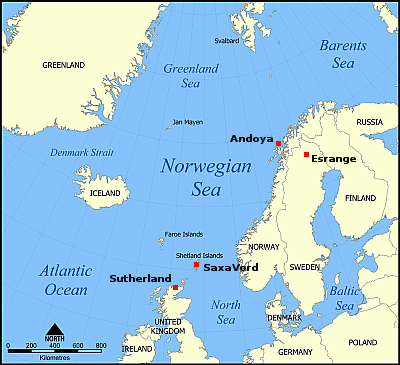
Proposed spaceports surrounding Norwegian Sea
The American lunar lander startup Astrobotic (which is now also a rocket startup) has signed a launch deal with Norway’s Andoya spaceport, where the company intends to launch its proposed reusable Xodiac rocket.
Astrobotic will perform their initial European Xodiac launch campaign operations from Andøya Space starting in 2026. Andøya Space will provide various services, including ground operations, flight preparation, and infrastructure support.
It will be wise to remain skeptical about Astrobotic’s rocket. The company owns the rights and technology of the vertical take-off-and-landing hopper developed and successfully tested by Masten Space System (which Astrobotic took over in 2022), but it also claimed in 2024 it would begin flying an upgraded suborbital version by 2025. No such flights appear on the horizon at this moment.
At the same time, developing a new rocket always involves delays. It will be quite exciting if Astrobotic succeeds in entering the launch market in the next year or so.
As for the Andoya spaceport, it continues to be in the lead among the four spaceports proposed surrounding the Norwegian Sea. Norway has made its licensing arrangement smooth and easy, the spaceport is well located, and it already has another launch contract with the German rocket startup Isar Aerospace, which attempted its first launch there earlier this year (albeit a failure). Moreover, Andoya has signed an agreement with the U.S. allowing American commercial companies to launch there, which is likely why Astrobotic made its deal.
Esrange’s location in the interior places it at a disadvantage, while red tape have badly stymied the two spaceports proposed in the United Kingdom.
Hat tip to BtB’s stringer Jay.
A British company is selling a very simple phone device for young children that allows them to stay in contact with their parents, including GPS location, without giving them a touchscreen and any access to the web.
The Messenger, from London-based outfit Karri, is meant to help kids aged 5-13 become more independent, while giving their parents peace of mind. It’s designed entirely around voice messaging, so you can chat with your child one-on-one, or connect them with other family members in a group conversation.
This is actually the company’s second-generation Messenger with an improved design over the first from 2023. It features a dot matrix display, a speaker, and most importantly, a “slide to talk” button in the center. Slide it down to listen to a voice message you’ve just received, slide up and hold to record a reply, and short slide up to send it off.
Considering the increasing evidence that smartphones do real damage to kids during their development ages, this kind of option makes sense. So does a simple flip phone, but this device provides a simpler and more limited alternative.
Amazon yesterday signed up its first airline customer, JetBlue, the airline agreeing to provide in-flight WiFi to its passengers using the Kuiper constellation.
Amazon’s satellite internet service, Project Kuiper, will partner with JetBlue to provide in-flight Wi-Fi starting in 2027. It’s Project Kuiper’s first deal with an airline as it aims to keep up with the SpaceX-owned Starlink, which has already snagged satellite internet agreements with United Airlines, Hawaiian Airlines, Air France, and several others.
JetBlue must have gotten a truly great deal to go with Kuiper. It could start providing Starlink to passengers now if it wished, instead of waiting until 2027 with Kuiper. And even that date remains uncertain, considering how few satellites Amazon has so far launched (just over a hundred) when it needs at least 1,600 by next July to meet its FCC license requirements.
SpaceX in the wee hours last night successfully placed another 28 Starlink satellites into orbit, its Falcon 9 rocket lifting off from the Kennedy Space Centery in Florida.
The first stage completed its 27th flight, landing on a drone ship in the Atlantic. SpaceX now has one booster with 30 flights and three with 27 flights, putting these stages in the same league with the three most flown space shuttles, Discovery (39), Atlantis (33), and Columbia (28). Expect these boosters to all pass Discovery in the near future, with several more Falcon 9 boosters about to enter this league as well.
The leaders in the 2025 launch race:
113 SpaceX
48 China
12 Rocket Lab
11 Russia
SpaceX now leads the rest of the world in successful launches, 113 to 85.
An evening pause: Performed live 2015. Stay with it. Though the opening is less appealing, it gets far better.
Hat tip Judd Clark.

Click for original image.
Cool image time! The picture to the right, reduced and sharpened to post here, was released today by the science team of the Webb Space Telescope. It shows in infrared false colors a spectacular star-forming region about 5,500 light years away, surrounded by glowing clouds.
Called Pismis 24, this young star cluster resides in the core of the nearby Lobster Nebula, approximately 5,500 light-years from Earth in the constellation Scorpius. Home to a vibrant stellar nursery and one of the closest sites of massive star birth, Pismis 24 provides rare insight into large and massive stars. Its proximity makes this region one of the best places to explore the properties of hot young stars and how they evolve.
At the heart of this glittering cluster is the brilliant Pismis 24-1. It is at the center of a clump of stars above the jagged orange peaks, and the tallest spire is pointing directly toward it. Pismis 24-1 appears as a gigantic single star, and it was once thought to be the most massive known star. Scientists have since learned that it is composed of at least two stars, though they cannot be resolved in this image. At 74 and 66 solar masses, respectively, the two known stars are still among the most massive and luminous stars ever seen.
…Super-hot, infant stars –some almost 8 times the temperature of the Sun – blast out scorching radiation and punishing winds that are sculpting a cavity into the wall of the star-forming nebula. That nebula extends far beyond NIRCam’s field of view. Only small portions of it are visible at the bottom and top right of the image. Streamers of hot, ionized gas flow off the ridges of the nebula, and wispy veils of gas and dust, illuminated by starlight, float around its towering peaks.
The universe is truly beautiful, if we look at it the right way.

Obama pontificating just before his election in 2012.
The change he brought was to toss the Constitution
in the trash heap.
Doug Ross has created a very readable six-part series, with illustrations, outlining in great detail and in dramatic form the corruption of the FBI and the entire intelligence community in the latter years of the Obama administration, beginning first with an extensive cover-up of Hillary Clinton’s illegal use of a private server for sending classified emails, followed by the initial stages of the Russian collusion hoax against Trump that was also used to justify spying on his campaign.
The series admits to be being a dramatization, but is also is based entirely on actual facts that are now documented and known. Nothing of substance or importance here has been made up. And by giving the story a slight patina of drama it becomes much more readable and understandable.
Take a short bit of time and read it all. The actions of numerous dishonest and power-hungry individuals in the FBI, the Justice Department, the Obama White House, and other agencies, will leave you appalled. And heading the list is Barack Obama, taking actions that were unquestionable illegal, immoral, and above all treasonous. He conspired with federal workers to not only cover up crimes, but to attempt to overthrow the elected president of the United States.
The key quote that describes quite succinctly the unconstitutional nature of this scandal comes from part 4, by Rick Ledgett, then deputy director of the National Security Agency.
“This is evidence of systematic violation of Americans’ constitutional rights.”
All six parts can be found at the links below. The series presently ends in May 2016, but Ross fully intends to continue it through the 2016 election and beyond, covering the entire Russian collusion hoax created by the intelligence community, under orders of Barack Obama, that worked to undermine and overthrown Donald Trump’s election as president.
Every American should read it all. It gives a good picture of the initial process that allowed utter evil to take over the entire Democratic Party.
Time for this month’s sunspot update. To do this each month I begin by taking NOAA’s own monthly update of its graph of sunspot activity and annotating it with extra information to illustrate the larger scientific context.
This annotated graph showing the August activity is below, and for the third month in a row sunspot activity increased (as indicated by the green dot), so that the August number of sunspots now closely matched the April 2025 prediction by NOAA’s panel of solar scientists that the Sun was finally beginning its ramp down from solar maximum.
» Read more
Click for original image.
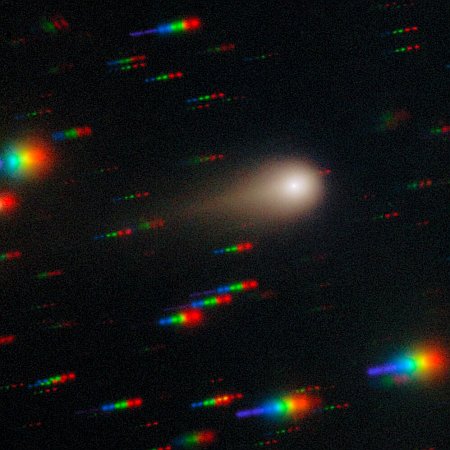
Using the Gemini South telescope in Chile, astronomers have taken new images of interstellar Comet 3I/Atlas as it moves through the solar system, this time capturing the slow growth of its tail.
The picture to the right, cropped, reduced, and sharpened to post here, shows that tail trailing off to the left. The stars are streaks because it required four exposures in different wavelengths to produce the image. The comet was held steady while the stars shifted after each exposure.
In the images captured during the session, the comet displays a broad coma — a cloud of gas and dust that forms around the comet’s icy nucleus as it gets closer to the Sun — and a tail spanning about 1/120th of a degree in the sky (where one degree is about the width of a pinky finger on an outstretched arm) and pointing away from the Sun. These features are significantly more extended than they appeared in earlier images of the comet, showing that 3I/ATLAS has become more active as it travels through the inner Solar System.
So far, all the evidence continues to show that though 3I/Atlas has an interstellar origin, it is a relatively ordinary comet, simply unique in the manner all objects of a category are unique. As the scientists pour over the comet’s spectroscopy we might find its make-up is somewhat different than comets from our own solar system, but the data so far suggests that the differences are not likely to be that startling.

Ted Cruz, a typical Congressional porkmeister
The Senate hearing that was held yesterday, entitled “There’s a Bad Moon on the Rise: Why Congress and NASA Must Thwart China in the Space Race”, was clearly organized by Senator Ted Cruz (R-Texas) to promote a continuation of the SLS, Orion, and Lunar Gateway parts of NASA’s Artemis program. And he was able to do so because senators from both parties felt the same way. They all want to continue this pork, and don’t really care whether those expensive assets can really accomplish what they promise.
Furthermore, the hearing was also structured to allow these politicians to loudly proclaim their desire to beat China back to the Moon, using this pork. They want the U.S. first, but they are almost all want to do this through a government-run program.
As such, the choice of witnesses and the questions put to them were carefully orchestrated to push this narrative. To paraphrase: “We have to beat China to the Moon! And we have make sure a NASA program runs the effort! And above all, we mustn’t let Donald Trump cut any of NASA’s funding, anywhere!”
It was therefore not surprising that the most newsworthy quote from the hearing was the comments by former NASA administrator Jim Bridenstine about Starship and how its choice as a manned lunar lander was a bad one, and that it was likely going to the prime reason China will put humans back on the Moon ahead of us.
» Read more