
March 18, 2022 Zimmerman/Batchelor podcast
Embedded below the fold in two parts.
To listen to all of John Batchelor’s podcasts, well worth your time, go here.
» Read more
Embedded below the fold in two parts.
To listen to all of John Batchelor’s podcasts, well worth your time, go here.
» Read more
A evening pause: The orchestra is the Chopin University of Music Orchestra, with Klaudia Abramczuk on the bassoon.
Hat tip Dan Morris.

A witch hunt: The mainstream media’s modern approach to discourse.
Persecution is now cool! The computer repair shop owner who found and made public Hunter Biden’s laptop prior to the election has found himself harassed, threatened, and even driven to bankruptcy because of that entirely legal act.
The Delaware computer repair shop owner who alerted the FBI to Hunter Biden’s infamous laptop before ultimately taking it to Rudy Giuliani says he’s faced harassment from Big Tech, the IRS and other government agencies ever since, and now faces bankruptcy.
“I was getting a lot of death threats,” John Paul Mac Isaac said. “I had to have a Wilmington trooper parked in front of my shop all the time.
“There were multiple situations where people came in and you could tell they were not there to have a computer fixed. And if there were not other people in the shop, I don’t know what would have happened,” he told The Post. “I was having vegetables, eggs, dog s–t thrown at the shop every morning.”
The threats and violence got so severe in November 2020 that Isaac had to shutter his shop and flee Delaware and live in hiding for more than a year. When he later tried to file for unemployment Delaware bureaucrats kept closing his case without resolution so that he received no checks and had use some of the money in his 401K to pay his bills. The Delaware unemployment department only finally acted after he sent a letter to the state’s governor.
» Read more

Click for full image.

Click for full image.
Cool image time! The science team for the high resolution camera on Mars Reconnaissance Orbiter (MRO) today released a new orbital photo that shows the entire journey on Mars of China’s Zhurong rover, since it landed in May 2021. That image, reduced to post here, is to the right. From the caption, written by Alfred McEwen of the Lunar & Planetary Laboratory in Arizona:
This HiRISE image, acquired on 11 March 2022, shows how far the rover has traveled in the 10 months since it landed.
In fact, its exact path can be traced from the wheel tracks left on the surface. It has traveled south for roughly 1.5 kilometers (about 1 mile). This cutout highlights the rover and the rover’s path (with contrast enhanced to better reveal the tracks).
The white curves that the rover has apparently been inspecting as it moved south are called megaripples, mid-size sand dunes from three to six feet in height that are generally found to be inactive, though not always. From a recent report about Zhurong’s findings:
“The examples Zhurong has visited appear very bright-toned in satellite images taken from orbit, and the team thinks that this is because the megaripples are covered with a layer of very fine dust,” says Matt Balme at the Open University, UK, who wasn’t involved in the analysis. “This means these features are probably currently inactive, as any present-day windblown sand would tend to remove the dust.”
That report used data from the rover’s first sixty days on Mars, after it had passed its first megaripple and had just reached the parachute and backshell. It does not include any later data in the past eight months, as Zhurong rolled past another nine megaripples and several small craters.
It also doesn’t include any data obtained as the rover skirted the wide apron that surrounds the large depression in the lower left. That depression looks like a crater at first glance, but because it appears to be on top of a mound it could instead by an old pitted cone. There are a lot of these cones in this region of the northern lowland plains of Mars, and planetary scientists really want to know whether they were formed from erupting ice, lava, or mud.
The Chinese have so far not released any data on what they have found in these later travels. We shall have to wait for further published papers.
The wider elevation overview map to the right, first published on August 24, 2021 and cropped and annotated to post here, shows Zhurong’s future potential geological targets to the south. The cone to the southwest as well as the nearest scarp to the south are probably the rover’s primary goals.
Though the released results have hinted that the geology here was shaped by both wind and water, direct evidence for water has not been found, or revealed by the Chinese. Zhurong has a radar sensor that could detect evidence of near surface underground ice, if it was there. As far as I know at this point, no results from that instrument have as yet been published.
At a press conference yesterday officials from the European Space Agency (ESA) officially announced that the partnership with Russia to launch its Franklin rover to Mars has ended, and the launch will not happen in ’22.
The program is not cancelled, but “suspended.” ESA is looking for alternatives to get its Rosalind Franklin rover to the Red Planet. Earth and Mars are correctly aligned for launches only every 26 months, so the next opportunities are in 2024, 2026, and 2028. Aschbacher said it is not feasible to be ready by 2024, so it will be one of the later dates.
Since Russia had been providing both the launch rocket and Mars lander, ESA cannot simply find a different rocket. It needs to come up with its own lander, or find someone else to build it. For example, one of many new private American companies building lunar landers for NASA might be able do it, though ESA would likely prefer a European company. If it did decide to go with an American company, it would certainly not hire one until it succeeds in completing successfully at least one planetary landing.
The officials also outlined ESA’s need to find new launch rockets for many other missions it had planned to launch on Russia’s Soyuz-2 rocket. That need will also be an opportunity for American rocket companies, but more significantly it could be a blessing for Arianespace’s Ariane 6 rocket. The Ariane 6 has struggled to find customers because of its high cost. The loss of Russia as a launch option will likely drive some ESA business to it.
Roscosmos’ head Dmitry Rogozin in turn announced that it will go ahead with its own Mars mission, using the lander on an Angara rocket
“True, we will lose several years, but we will replicate our landing module, make an Angara rocket for it and carry out this research mission from the newly-built Vostochny spaceport on our own. Without inviting any ‘European friends’, who prefer to keep their tails between their legs the moment they hear their American master’s angry voice,” Rogozin said on his Telegram channel.
Whether Russia will actually do this is questionable. For the last two decades Roscosmos has promised all kinds of numerous planetary missions and new rockets and new manned capsules, none of which has ever seen the light of day. To make such a thing happen now seems even more doubtful.
Capitalism in space: In a tweet today Elon Musk announced 2029 as his present target date for the first Starship manned mission to Mars.
This target date should not be considered firm, though it must be taken seriously. Musk’s past predictions tended to be optimistic, but also not unrealistic. If Starship development proceeds at the pace SpaceX is presently maintaining, this date is wholly doable.
The article at the link also said that the first Starship orbital test flight “is expected to take place within the next month.” That certainly matches with Musk’s previous statements, but ignores the bureaucratic delays from the FAA that at the moment prevent it from happening.
Russia today successfully launched three astronauts to ISS on its Soyuz-2 rocket, the first time the crew on a Russian launch to ISS was entirely Russian.
The docking at the station is expected three hours after launch.
The reason for the all-Russian crew has nothing to do with the Ukraine War. Initially NASA and Roscosmos were negotiating to have an American on this flight as part of a barter deal, whereby astronauts from the two space agencies fly on each other’s capsules in an even trade to gain experience with each. In October both agencies agreed to hold off the first barter flight until ’22. With the on-going sanctions however it is now unknown whether that barter deal will go forward.
The leaders in the 2022 launch race:
10 SpaceX
6 China
3 Russia
2 ULA
The U.S. still leads China 16 to 6 in the national rankings, with SpaceX having a scheduled Starlink launch this evening.
Capitalism in space: Sierra Space has now partnered with Japan’s Mitsubishi for developing technology to be used on the private commercial Orbital Reef space station project.
The companies did not elaborate on the technologies they will consider for Orbital Reef under the agreement. MHI does have extensive experience in International Space Station operations as the manufacturer of the Kibo laboratory module, which was installed on the station in 2008. The company also built the HTV cargo spacecraft and H-2 launch vehicle that launched those spacecraft to the station.
…Sierra Space’s role in Orbital Reef includes providing inflatable modules called the Large Integrated Flexible Environment (LIFE) Habitat. The company’s Dream Chaser vehicle under development will transport cargo and crew to and from the station.
A consortium led by Blue Origin announced Orbital Reef last October. In addition to Blue Origin and Sierra Space, Boeing will provide a science module, CST-100 Starliner commercial crew vehicle and support for station operations, while Redwire Space will handle microgravity research and manufacturing, payload operations and deployable structures.
This deal suggests that the project wants more experience in its stable. Also, by partnering with Mitsubishi, it likely garners political support in Japan.
Capitalism in space: Orbit Fab has won a $12 million contract to outfit U.S. military satellites with its refueling port.
The funding includes $6 million from the U.S. Air Force and U.S. Space Force, and $6 million from Orbit Fab’s private investors. The contract is for the integration of Orbit Fab’s fueling port, called RAFTI — short for rapidly attachable fluid transfer interface — with military satellites. The port allows satellites to receive propellant from Orbit Fab’s tankers in space.
At present there are no refueling missions scheduled, simply because the satellites that could be refueled are not yet in orbit. Orbit Fab and the military however are discussing an in-orbit demo mission.
NASA’s SLS rocket finally arrived at its launch site early this morning after an 11 hour journey on its mobile launcher from the Vehicle Assembly Building (VAB), in preparation for a dress rehearsal countdown on April 3, 2022.
The approximately two-day test will demonstrate the team’s ability to load cryogenic, or super-cold, propellants into the rocket, conduct a launch countdown, and practice safely removing propellants at the launch pad. After wet dress rehearsal, engineers will roll the rocket and spacecraft back to the Vehicle Assembly Building for final checkouts before launch.
The launch is presently scheduled for late May, but we must not be surprised if it is delayed to June, or July.
An evening pause: Hat tip Chris Boswell.
Much of the reporting about the war in the Ukraine has been either based on individual anecdotal events, or propaganda being churned out by both sides in an effort to influence events and public opinion to their cause.
All of this information is generally useless in determining what is really happening.
A better way to understand the actual state of the war, who is winning and who is not, is to find sources that don’t look at individual events, but try to compile all the reliable and confirmed stories into an overall whole.
One source that does this routinely and with great success is the Institute for the Study of War. I have relied on their maps and reports for a clear understanding of the various Middle Eastern conflicts now for years. One week ago I posted a link to the Institute’s March 9, 2022 update on the Ukraine War, because I believed it provided the best review, well documented and sourced, covering Russia’s entire military operation in the Ukraine, as well as the effort of the Ukraine to fight back. At that time, the known data strongly suggested that though Russia appeared to be very slowly capturing territory, it was also meeting heavy resistance everywhere. Furthermore, Russia’s effort was hampered by a lagging logistics and supply operation. All told, this data suggested that Russia’s take-over of the Ukraine was going to take a lot longer than expected by Putin and his generals, and might even get bogged down into a long quagmire similar to what the Soviet Union experienced in Afghanistan in the late 1970s.
A week has passed, and the Institute has issued several updates since. By comparing today’s March 17th update with last week’s we can quickly get a sense of what has happened in that week.
» Read more

How the CDC determines its mask policies
Don’t comply: Ten pilots from three different American airlines — American, Southwest, and JetBlue — have now sued the CDC over the Biden administrations mask mandate requiring everyone to wear masks on airplanes.
A group of commercial airline pilots filed a lawsuit against the Centers for Disease Control and Prevention (CDC) in an attempt to lift the federal transportation mask mandate.
In court paperwork, the 10 commercial airline pilots – who work for American JetBlue and Southwest – argued that the CDC issued an order “Requirement for Persons to Wear Masks While on Conveyances & at Transportation Hubs” on Feb. 1, 2020 “without providing public notice or soliciting comment.”
The pilots are asking the court to “vacate worldwide the FTMM (federal transportation mask mandate)” calling the move an “illegal and unconstitutional exercise of executive authority.”
Biden’s edict was first imposed on February 1, 2021, shortly after he took power. It has been extended several times since, the most recent extension keeping it in force through April 18, 2022. At no time, however, has any data been put forth by the CDC demonstrating that the required masks accomplish anything, while we already have decades of data showing that the masks are useless against viruses like the Wuhan flu.
This new lawsuit is the eighteenth filed against the mandate, though it is the first filed by those who work on the planes.
The pilots claim above that the CDC did not follow federal law when it imposed the mandate is almost certainly correct. » Read more
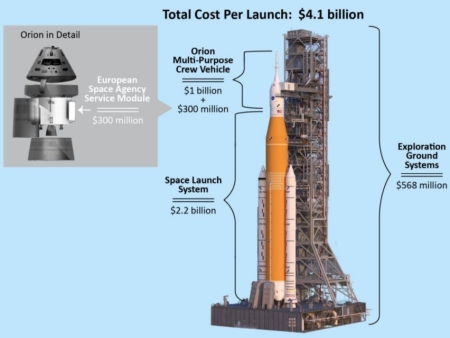
The expected real per launch cost of SLS and Orion
The big news in the mainstream press today is the planned rollout from the Vehicle Assembly Building (VAB) of NASA’s SLS rocket this evening in preparation for its dress rehearsal fueling and countdown planned for April 3rd.
This article by Newsweek is very typical. It glows with facts lauding SLS’s gigantic size and the monumental systems designed to slowly transport it the four miles from the VAB to the launchsite.
At a height of 322 feet (ft), making it taller than the 305ft Statue of Liberty, the SLS will be the largest rocket to move to a launchpad since the Saturn V launched on its last mission in 1973, when it carried the Skylab space station into orbit around Earth. Its size has seen NASA dub it a Mega-Moon rocket.
NASA says that the four-mile journey from the Vehicle Assembly Building to the launch pad at NASA’s Kennedy Space Center in Florida, where the SLS was recently adorned with the NASA logo, will take between 6 and 12 hours. It will be carried on the back of NASA’s 6.6-million-pound crawler vehicle. [emphasis mine]
If that April 3rd countdown dress rehearsal goes well, SLS will be rolled back to the VAB and then prepped for its first launch, presently scheduled tentatively for May ’22, though more likely in June or July.
For NASA the rollout today is somewhat of a relief. SLS was originally supposed to launch in 2015, making it seven years behind schedule. It has also been enormously expensive, costing close to $30 billion to build, if one does not count the $20 billion cost of the Orion capsule it carries. That the agency finally has this rocket assembled and almost ready to launch, after so many delays and cost overruns, means that NASA might finally be able to prove it is a reality, not simply a boondoggle designed by Congress to funnel cash through NASA to their constituents.
The Newsweek article however strangely ignores the launchpad stacking of another equally gigantic rocket that occurred yesterday. » Read more
In its on-going project to upgrade and refurbish the antenna dishes of its Deep Space Network communications, used to communicate with planetary probes beyond Earth orbit, NASA yesterday announced that the fourth of six planned new antennas is now online in Madrid.
DSS-53 is the fourth of six antennas being added to expand the DSN’s capacity and meet the needs of a growing number of spacecraft. When the project is complete, each of the network’s three ground stations around the globe will have four beam waveguide antennas. The Madrid Deep Space Communications Complex is the first to have completed its build-out as part of project. Construction on DSS-53 began in 2016.
The Deep Space Network has needed an upgrade for about a decade, and has been especially under strain as the number of missions to Mars increased during that time. After many years of delay, almost all due to budget decisions by both NASA and Congress, the upgrade began in earnest in 2016.
China today successfully launched its second Yaogon military reconnaissance satellite, using its Long March 4C rocket.
The leaders in the 2022 launch race:
10 SpaceX
6 China
2 ULA
2 Russia
The U.S. lead over China in the national rankings is now 16 to 6. Note too that tomorrow Russia is scheduled to launch another crew to ISS, using its Soyuz-2 rocket, while SpaceX plans another Starlink launch.
Embedded below the fold in two parts.
To listen to all of John Batchelor’s podcasts, well worth your time, go here.
» Read more
An evening pause: Pachelbel’s Canon in D is one of the most beautiful short pieces of music ever written, which of course is why it has been an evening pause a half dozen times before. I’ve posted a version of musicians jamming it at 3 am when they have nothing better to do, singing it a capella in a stairway, spectacularly on a guitar, as heavy metal, by a chicken (you have to watch it to understand), and played as a tango, bluegrass, gypsy, and practically any musical style you can imagine.
The rant below gives us the perspective of someone who has played the piece, and it is a perspective that might surprise you. After watching it enjoy all the other versions above, but above all make sure you watch the last one. You will then understand best what the cello player is thinking.

Click for full image.
Astronomers and engineers have now successfully completed the alignment of the eighteen segments in the primary mirror of the James Webb Space Telescope.
On March 11, the Webb team completed the stage of alignment known as “fine phasing.” At this key stage in the commissioning of Webb’s Optical Telescope Element, every optical parameter that has been checked and tested is performing at, or above, expectations. The team also found no critical issues and no measurable contamination or blockages to Webb’s optical path. The observatory is able to successfully gather light from distant objects and deliver it to its instruments without issue.
The picture to the right shows that alignment, focused on a single star. As noted in the caption:
While the purpose of this image was to focus on the bright star at the center for alignment evaluation, Webb’s optics and NIRCam are so sensitive that the galaxies and stars seen in the background show up.
After many years delay and an ungodly budget overrun, thank goodness Webb appears to be working better than expected.
It will still be several months before actual science observations begin. Further more precise alignment adjustments need to be done for all its instruments and mirrors.
R.I.P. Solar scientist Eugene Parker, whose research revolutionized solar science in the 20th century and for which the Parker Solar Probe was named, has passed away at the age 94.
As a young professor at the University of Chicago in the mid-1950s, Parker developed a mathematical theory that predicted the solar wind, the constant outflow of solar material from the Sun. Throughout his career, Parker revolutionized the field time and again, advancing ideas that addressed the fundamental questions about the workings of our Sun and stars throughout the universe.
Parker belonged to the past generations of scientists who followed the principles of the Enlightenment and believed that science was fundamentally the search for truth. He understood he could always be wrong, which brought a certain muscular strength to any ideas he proposed. He could not be lazy in any way, or his work would fail. Instead, it shone, and made what little we know of the Sun today possible.
Sadly, such men are one-by-one going from us. I wonder if the new generations will understand his mindset.