
CHVRCHES – Never Ending Circles
An evening pause: Performed live 2016.
Hat tip Dan Morris.
An evening pause: Performed live 2016.
Hat tip Dan Morris.
I did a short nine minute segment with Robert Pratt of Pratt on Texas today, discussing the Biden administration’s apparent effort to block SpaceX’s Starship operations in Texas. If you want to listen the podcast can be found here. My segment begins at 22:50 minutes, though the rest of Robert’s show is definitely worth listening to as well.
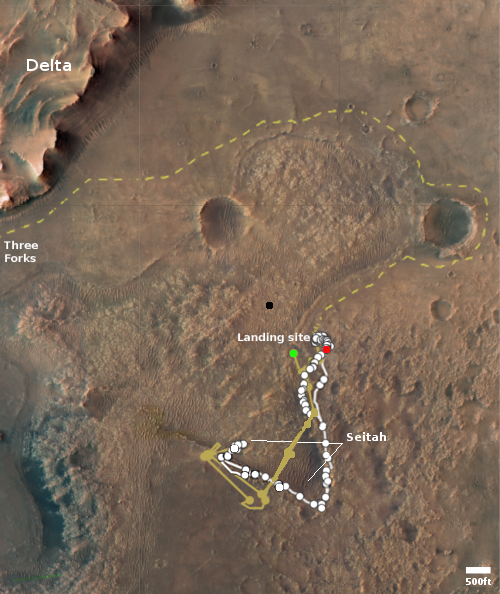
Click for interactive map.
According to a tweet today from JPL, the Mars helicopter Ingenuity has successfully completed its 21st flight on Mars, traveling 1,214 feet in two minutes and nine seconds at an average speed of 12.6 feet per second.
The red dot on the map to the right shows Perseverance’s location as of today. The green dot indicates Ingenuity’s position before the 21st flight. Since neither the Perseverance nor the helicopter teams have posted any updates describing the 21st flight, it is difficult to indicate a precise location for its landing site. All we know is that the helicopter is supposed to fly to the northwest, cutting across the rougher region while the rover follows the tan dotted line around that rough region, with both targeting the delta to the northwest.
As a guess, I have placed a black dot about 1,200 feet to the northwest.

The new dark age of silencing: Today’s blacklist story is interesting in that it proves the blacklist culture that is engulfing what was once a free America is not simply attacking those on the right. The level of intolerance has grown so pervasive that people are being blackballed for saying practically anything.
In this case, Collin College in Texas has now been sued by three different teachers because each had had the audacity to express a public opinion that the college administrations disagreed with. The list is quite intriguing because the teachers fired expressed opinions from the left side of the political aisle:
The on-going dark age: NASA yesterday released a statement announcing the completion of an email test project at the Goddard Space Flight Center that allowed employees to include their preferred gender pronouns in email display fields.
NASA’s short statement, quoted in full below, illustrates where the space agency’s real priorities lie.
Through an effort to create a more inclusive workplace, NASA recently completed an IT project at Goddard Space Flight Center that allowed approximately 125 employees to test the option of including their gender pronouns in NASA’s email display fields — which currently includes each employee’s name, center, and an organizational code. The learnings from this test will be used to inform the advancement of diversity, equity, inclusion, and accessibility.
NASA is fully committed to supporting every employee’s right to be addressed by their correct name and pronouns. All NASA employees currently have the option and flexibility to include their gender pronouns in their customized email signature blocks. This option remains unchanged and is supported by NASA leadership so that employees can share their gender identities and show allyship to the LGBTQIA+ community.
To put this in honest language, NASA’s management is gearing up the legal process to give the power of one group of people (the “LGBTOIA+” community) to impose their beliefs on others, and to force others to promote those beliefs in writing, whether they agree with them or not.
What this has to to with NASA’s core mission, to explore space, I have no idea. But then I am rational and our government today is not.
This article at Space News today provides a nice summary of the number of launches that Russia’s Roscosmos will likely lose in the next three years due to the break off of commercial operations against that country because of its invasion of the Ukraine.
According to the article, Russia will lose sixteen launches. The list however misses one South Korean satellite scheduled for launch on an Angara rocket later this year. The total breakdown of this lost business is therefore as follows:
13 launches lost in 2022
3 launches lost in 2023
1 launch lost in 2024
The entities impacted are as follows:
Government launches:
Europe: six launches in ’22 and ’23, totaling eight satellites
South Korea: two launches in ’22
Sweden: one launch in ’22
Commercial launches:
OneWeb: six launches in ’22, totaling 199 satellites
Axelspace: one launch, totaling four satellites
Synspective: one launch
If the Ukraine War were to end today, it is possible that most of the government launches would be reinstated. The commercial companies however are almost certainly going to find other launch providers, no matter what. OneWeb for example is hardly going to trust its business to Russia after that country cancelled the launches and (at least at this moment) has confiscated the already delivered satellites.
If the war continues for another two or three months, then all this business will vanish for good, as alternative rocket companies will likely be found.
This list however does reveal one interesting fact. It appears that very few private companies have been interested in buying Russian launch services, with or without the Ukraine War. Most of Russia’s international customers have been other governments. Even OneWeb falls partly into this category, as it is half owned by the United Kingdom.
This fact suggests that Russia’s product has simply not been competitive against the new commercial market. The governments meanwhile probably had political motives in addition to economics to throw their business Russia’s way. Those political motives are now gone.
Capitalism in space: A small startup company, Astrolab, yesterday unveiled its concept for a manned lunar rover, designed for NASA’s Artemis program.
The company has already built a full scale prototype, which it tested in Death Valley. It also intends to try to win NASA’s contract for building it, with bidding expected to begin in only a few months.
Astrolab will likely have major competition for the LTV contract. Lockheed Martin announced in May 2021 a partnership with General Motors to design lunar rovers but said at the time their concept was still in the early stages. Northrop Grumman announced in November it was working with several companies on a lunar rover design but also provided few technical details.
By contrast, Astrolab, based in Hawthorne, California, is a 15-person company founded two years ago after [Jaret Matthews, the founder of the company,] left SpaceX.
In a rational world, Astrolab’s small size and newness would not matter, if its design was best. In the strange world of our modern federal government, however, the political clout of big companies like General Motors and Northrop Grumman could easily be more important, even if their designs are mediocre and cost much more. Their designs might not be inferior, but their clout cannot be ignored. It will make Astrolab’s success far more difficult, requiring this startup to offer something much more superior to have a chance of winning.
At the same time, the competition might very well force the older big space companies to up their game, which will be all to the good, for everyone.
Capitalism in space: Acme Atronomatic, a software company that developed the MyRadar weather app that has been downloaded 50 million times, is now planning to launch 250 satellite weather constellation, with the first test satellites scheduled for launch in April.
The satellites, scheduled to launch in April on a Rocket Lab Electron from New Zealand, are designed to test and validate hardware for Orlando, Florida-based Acme’s Hyperspectral Orbital Remote Imaging Spectrometer (HORIS) constellation.
Environmental data captured by the HORIS constellation will be paired with artificial intelligence and machine learning to create data-fusion products for the company’s government and commercial customers. Acme also intends to draw on data and imagery from the HORIS constellation to enhance its MyRadar weather app.
The first batch of Acme satellites set to launch in April are PocketQubes, satellites measuring 5 centimeters on each side. The “batch consists of our own satellite and two others that we have informally helped design and build,” Acme CEO Andy Green told SpaceNews by email. “We’re mostly focusing on the primary satellite, MyRadar1,” which is a HORIS constellation prototype.
Private weather satellites like this are the future, rather than government-built satellite, which has been the norm for sixty years. That shift is also apparently being encouraged by Congress, which the House has passed and the Senate is considering. In it NOAA’s budget to build its own weather satellites was trimmed by about 25%, from the requested $1.68 billion to $1.29 billion.
This trim is hardly painful to NOAA’s weather satellite program, which remains well funded. It does indicate however that our spendthrift Congress is interested in ways to save money in this area.
An evening pause: Performed live 1986.
Hat tip Diane Zimmerman.
Though nothing at this moment is certain, this update report yesterday from the Institute for the Study of War is likely the best quick summary, including a very informative map.
Russian operations to continue the encirclement of and assault on Kyiv have likely begun, although on a smaller scale and in a more ad hoc manner than ISW expected. The equivalent of a Russian reinforced brigade reportedly tried to advance toward Kyiv through its western outskirts and made little progress. Smaller operations continued slowly to consolidate and gradually to extend the encirclement to the southwest of the capital. Russian operations in the eastern approaches to Kyiv remain in a lull, likely because the Russians are focusing on securing the long lines of communication running to those outskirts from Russian bases around Sumy and Chernihiv in the face of skillful and determined Ukrainian harassment of those lines. The battle for Kyiv is likely to continue to be a drawn-out affair unless the Russians can launch a more concentrated and coherent attack than they have yet shown the ability to conduct.
The Russian military is clearly struggling to mobilize reserve manpower to offset losses and fill out new units.
Russia appears to be very very very slowly gaining ground, but meeting heavy resistance everywhere, while struggling with its own lagging logistics and cumbersome military.
What strikes me as most strange about this entire war is the relatively little use of air forces by either side. Russia’s air bombing efforts have paled compared to other recent wars.
The Ukraine’s has even been less active. Consider: Russia had a forty-mile-long convoy in plain sight backed up for days on the main road from Russia to Kiev. What a sitting target! The Ukraine apparently had no air force capability to hit it.
Based on the present known data, this war will drag on for a very long time, even if Russia eventually takes control of the Ukraine. In the meantime it has made itself a pariah with the rest of the world’s nations for its unjustified invasion of a neighboring country, not unlike Saddam Hussein’s invasion of Kuwait in 1990. This in turn is crashing the Russian economy.
All in all, even at its best a victory in this Russian war will be a Pyrrhic victory.

Click for full image.
Cool image time! Among the many strange and unexplained geological features that scientists have identified on Mars, the thumbprint feature is one of the most intriguing. The photo to the right, cropped and reduced to post here, is a fine example, and was taken on September 10, 2021 by the high resolution camera on Mars Reconnaissance Orbiter (MRO).
The thumbprints are the lighter splotches, and are generally found near curved ridges located mostly in Martian lowlands. All appear to have crater-like features in them, though these craters are not impact craters, but likely (though not confirmed) caused by some form of underground eruption, be it mud, ice, lava or something else. Though scientists do not yet really understand the process that formed the thumbprints, the data strongly suggests that they formed in connection with glacial events. From this 2003 paper [pdf]:
TT [thumbprint terrain] as well as the associated trough systems were formed by a glacial mechanism. [Elevation] data show that the trough systems consistently lie topographically above the TT; this implies that if they were they formed by the same glacier, the troughs must have formed before the glacier retreated and formed the TT.
The splash apron around the crater near the bottom of the photo supports the glacial theory, implying the presence here of underground ice.
Scientists have also theorized wind processes and cinder cones as explanations for these features.
These particular thumbprints are located, as shown in the overview map below, in the same general area as a previous cool image of thumbprints, from April 2019.
» Read more

Matthew Perna, now dead because he simply expressed an opinion
They’re coming for you next: After demanding that conservative protester Matthew Perna be sentenced to many years of imprisonment for daring to peaceably walk through the Capitol building for less than ten minutes on January 6, 2020 — demands that caused Perna to commit suicide — the FBI has now quietly dropped those trumped up charges, without comment.
Perna was looking at 51 months in federal prison for entering the Capitol for five to ten minutes, snapping selfies, and chanting “USA” in an apparently seditious way. He also tapped a window with a pole but didn’t break it or anything else. He didn’t hit a cop.
The FBI magnanimously decided to drop their charges against Perna on Wednesday.
Capitalism in space: While competing spaceports are now being constructed in Scotland and hope to launch this year, Virgin Orbit yesterday signed a deal with the Wales company Space Forge to launch its satellite from Cornwall, England, in ’22.
Because Virgin Orbit is already operational, while the rockets planned for the two Scottish spaceports in Shetland and Sutherland are still being developed, it appears that Cornwall will win the race to complete the first launch from UK soil in more than a half century.
Space Forge’s business plan is in itself most intriguing.
Space Forge recently announced that, along with partners, it is developing a world-first service incorporating both launch and return of a new small class of vehicle – the ForgeStar – that can be deployed from conventional launchers to provide rapid, reliable and reusable in-space infrastructure. This inaugural mission will see Space Forge’s ForgeStar-0 platform launched for the first time and will test future return from space technology.
Aiming to unlock the next steps on the path to market expansion, dedicated in-space manufacturing, coupled with proof of reliable return, will allow Space Forge to leverage the benefits of the space environment, namely: microgravity, vacuum, and temperature, to create products impossible to manufacture on Earth.
How exactly this satellite will safely return its space-manufactured goods is not yet clear, but if it does so successfully Space Forge will have created a product that at present would be unique. While you can now get your products back from ISS, such a process is very complicated and not very cost effective. Space Forge, if successful, would simplify that process, allowing customers to launch, manufacture products in space, and get those products back, all in one package.
Capitalism in space: Blue Origin yesterday revealed that it is hiring 300 more engineers and expanding the rocket engine factory in Alabama in order to produce flight worthy BE-3 and BE-4 engines.
Blue Origin in Huntsville spent the pandemic supporting the company’s main engine plant in Kent Washington with parts for the company’s BE-3 and larger BE-4 engines, [site lead Nathan] Harris said. “We are now actually in the process of building our first set of complete engines through our facility,” he said. Those first engines will be produced this year.
…“We’re getting very close,” Harris said. “They’re still doing quite a bit of retrofitting. As you learn, anytime you retrofit something that’s over 60 years old, it takes a little bit more and there’s a little bit more that you unearth that was undiscovered.”
Harris said he expects to be testing the BE-3 “in the next couple of months followed shortly by the BE-4.” [emphasis mine]
This may be good news for both ULA’s Vulcan rocket as well as Blue Origin’s own New Glenn rocket. Both need the BE-4 engine, and both have been delayed years because it has not been ready on time. While the engine problems appear to have been resolved, Blue Origin had not put any thought into developing a practical and affordable manufacturing process that would allow it to build enough engines to serve both itself and ULA.
This expansion at the engine factory suggests the company is finally moving into its production phase. The highlighted sentence above however also tells us that the first flight worthy BE-4 engines are still months away, which will further delay launch of Vulcan and New Glenn. It is now certain that neither will launch this year, putting both rockets more than three years behind schedule.
In response to Russia’s invasion of the Ukraine, the United Kingdom yesterday announced new sanctions, banning all space-related exports as well as increased sanctions on aviation.
For Russia, this component of these new space sanctions might be the most painful, should something go wrong on one of its launches:
The space export ban includes all related services, including insurance or reinsurance services, U.K. officials said. “This means cover is withdrawn on existing policies and UK insurers and reinsurers will be unable to pay claims in respect of existing policies in these sectors,” wrote in the statement.
This restriction also means that any satellite customers will not be able to claim damages. Thus, customers like South Korea, which still has two launches planned on Russia rockets, will lose everything if the launch fails. Because of this, it is almost certain that it will cancel these launches,
Embedded below the fold in two parts.
To listen to all of John Batchelor’s podcasts, well worth your time, go here.
» Read more
A evening pause: Performed live 2012.
Hat tip Dan Morris.

Eating their own: Leftist protesters at Vassar College have forced Jeh Johnson, who was Secretary of Homeland Security during the Obama administration, to back out of giving the college’s May 22nd commencement speech.
Johnson was replaced by an actor, illustrating once again the growing vapidness of modern academia. The accusations against Johnson also illustrate this bankruptcy by their empty slogans and shallow cliches:
The switch in commencement speaker has sparked heated online debate among students and alumni, with one camp opposed to what one student called Johnson’s “violence on marginalized peoples” and the other camp complaining of runaway “woke” politics.
The controversy deepened after a story that had quoted students referring to Johnson as guilty of “war crimes” — and which warned of “protest and disruption” should he speak — was deleted from Vassar’s student newspaper website, the Miscellany News. [emphasis mine]
The deleted article appears to be available here. This quote in particular from it demonstrates the empty-headed and intolerant thinking in today’s academia, aided by the intellectual dishonesty of an agenda-driven reporter:
» Read more
The residents of Camden County in Georgia yesterday voted by a margin of 72% to 28% to end the county’s project to build a project there.
There are hints that county officials might still try to proceed, having already spent more than $10 million on the project. There are also strong indications that if they do, they will be blocked legally on many fronts.
What this vote suggests is that Americans continue to be uninterested in more commerce, and are easily convinced to put environmental claims first in any political battle. The opponents of the spaceport had said that the spaceport threatened local wildlife — something that clearly doesn’t happen based on more than a half century of data at Cape Canaveral — and the voters in Camden were quick to agree. The voters also probably had a bit of not-in-my-backyard behind their vote as well.
Whether Camden would have succeeded as a spaceport of course is unknown. There are a lot of such facilities being proposed and built, and it is unclear if their number fits the actual launch demand.
Capitalism in space: SpaceX this morning successfully placed 48 Starlink satellites into orbit, using its Falcon 9 rocket.
The first stage landed successfully, completing its fourth flight. The fairings were new.
SpaceX continues to maintain a one-launch-per-week pace in ’22, suggesting it will succeed in completing more than 50 launches this year, as predicted by the company.
The leaders in the 2022 launch race:
10 SpaceX
5 China
2 ULA
2 Russia
The U.S. now leads China 15 to 5 in the national rankings. Note that Russia had predicted it would complete about 27 launches in ’22. With the loss of all of its international customers due to its invasion of the Ukraine, that number is likely cut by two-thirds. If Russia completes more than a dozen launches this year we should be surprised.