Endeavour Crater at last!

The science team for the rover Opportunity have released their first image taken from the rim of Endeavour Crater.

Since this picture looks south from Spirit Point less than a football field’s distance from the rim, it appears to look into the crater, the mountains on the right being the crater’s rim. What looks like a debris field running across the center of the image looks to me to be a combination of exposed patches of bedrock and boulders on the plateau above the rim. For the scientists, those boulders will be the prime research targets, as they are possibly ejecta produced at crater impact and could therefore be material thrown out from deep within the Martian crust.

a view of Endeavour Crater

0 comments

Getting closer to Vesta

close-up thumbnail

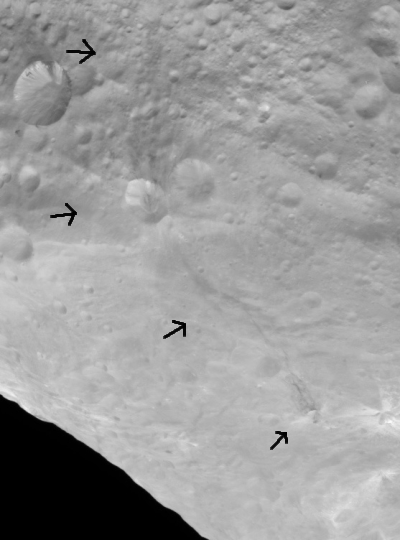
The Dawn mission team released another image today of the giant asteroid Vesta, this time taken from about 2,300 miles away. At this distance the resolution is still somewhat coarse, with the smallest visible detail about 0.43 miles in size.

To the right is a cropped section of the full image, focusing in on what appears to be a very strange geological feature, indicated by the arrows. From what I can tell, the dark meandering streak looks like a rille or flow coming out of the mound or peak near the bottom of the image. Yet, this dark meander continues directly across a crater as if it were a wind-blown dust streak.

I really have no idea what geological process created this. I also suspect that the scientists don’t quite know yet either, though I am sure they have some good theories, mostly based on the very light gravity that should exist on a world only 330 miles in diameter. As I’ve already noted, however, it is going to take them a couple of months to digest the data they are getting and come up with some reasonable conclusions. It will be fun to finally find out what they have learned.

7 comments

It’s the coverup, not the crime

A new Rasmussen poll finds that 69% of the public now believe that climate scientists falsified data to support their own theories about global warming. Moreover, these numbers are up ten points since December 2009, which happens to be just after the climategate emails were released.

These terrible numbers are further evidence that the willingness of the scientific community to whitewash their investigations of the climategate scientists, what I consider to be the equivalent of a community-wide cover-up, has done serious harm to science and its reputation.
» Read more

4 comments

Dawn begins science operations in orbit around Vesta

The Dawn science team today released what they are calling “the first full-frame image” of Vesta. The image is shown below the fold.

The picture was taken from 3,200 miles, and shows a pockmarked irregularly shaped world. While many features that resemble the Moon (the craters, the rays radiating out from those craters), that Vesta itself is not spherical makes it very much unlike the Moon. It is probably going to take scientists several months at least to decipher the data they are getting and come up with some concrete conclusions about this strange dwarf planet.
» Read more

1 comment

John Marburger: The passing of a scientific gentleman

Guest post by Phil Berardelli

John H. Marburger III, former science adviser to President George W. Bush and head of the White House Office of Science and Technology Policy, died this past week from non-Hodgkins lymphoma. He was 70.

Just about every news article reporting the death describes Dr. Marburger, a physicist and former head of the Brookhaven National Laboratory, as a controversial figure. This article, for instance, in The New York Times, said the following about Marburger:

In a critical editorial in April 2004, The New York Times, addressing accusations that the Bush administration had distorted or suppressed scientific information that would conflict with its policy preferences, acknowledged the respect Dr. Marburger commanded, calling him β€œa respected physicist and lifelong Democrat who would not seem an automatic apologist for this administration.” But it added, β€œThe question yet to be answered is whether he is speaking from conviction when he claims that the critics are off base or is serving as a frontman for an administration whose activities in this area are sometimes hard to defend.”

Apparently, because Marburger — a Democrat and one of the longest-serving members of the administration — supported some of the positions espoused by the Bush White House, that made him controversial. But in my 40 years as a journalist and 15 years of covering science, I can’t think of a person I encountered who was more earnest and straightforward.
» Read more

0 comments

The Painted Desert of Mars

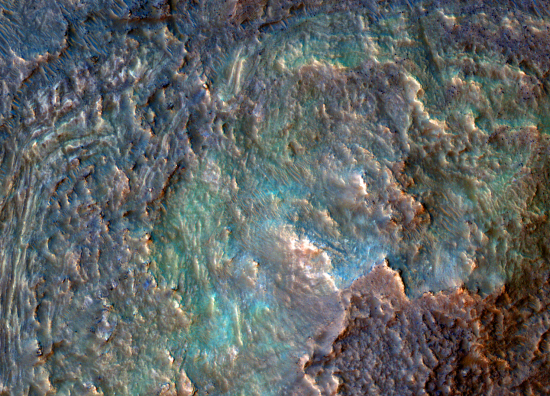
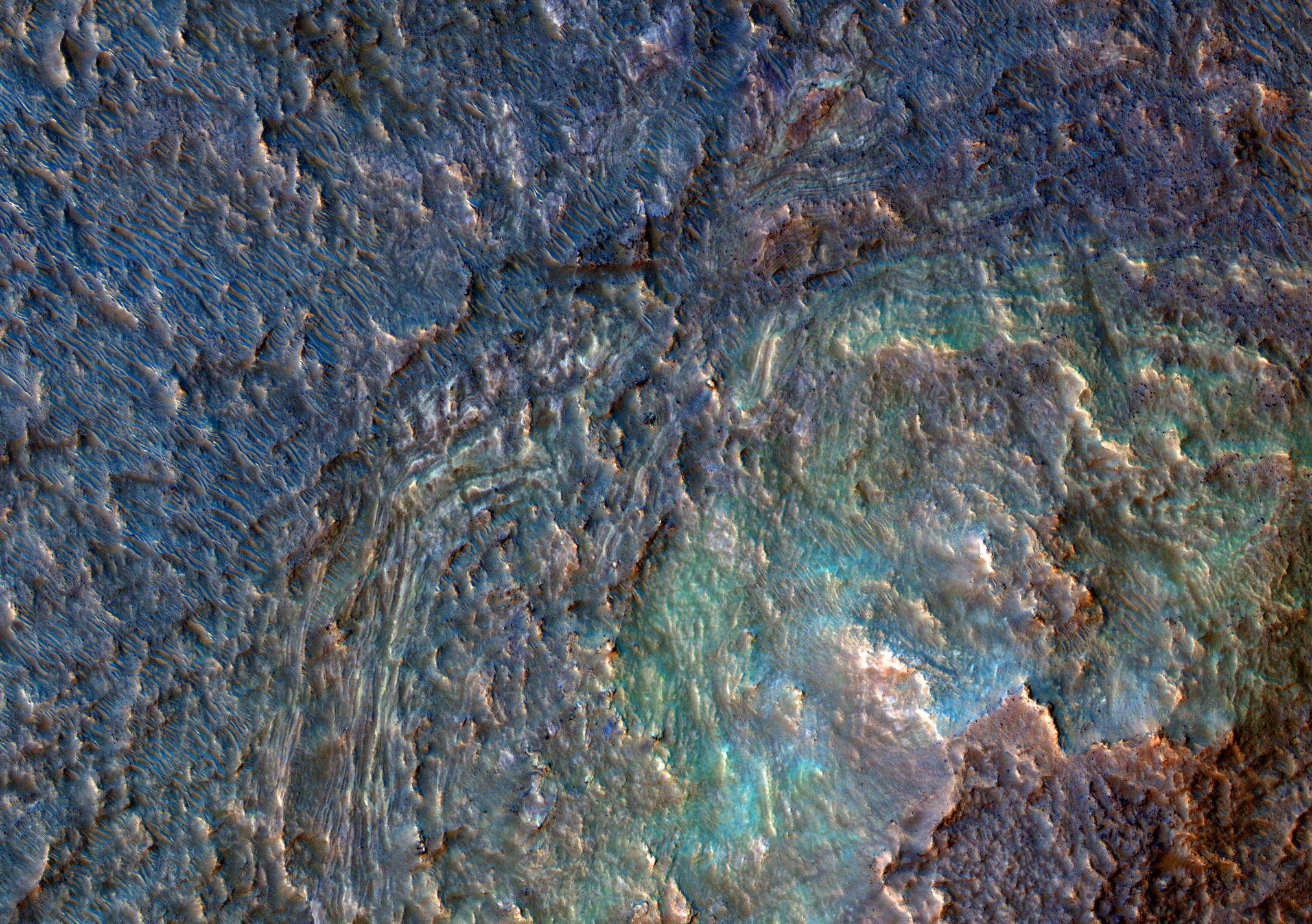
Mars Reconnaissance Orbiter released this picture yesterday of what the Orbiter’s scientists have labeled “The crazy floor of Hellas Basin.” Below you can see a cropped image of only one part of the large higher resolution image. The NASA caption says that the wild colors probably “indicate that diverse minerals are present,” meaning that any settlers of the red planet will probably take a close look at this location with the reasonable hope of finding the resources they need to colonize a planet.

To me, these colors also indicate that this place on Mars would probably one of its most popular tourist spots. As I look at the image my eye instinctively wants to trace out the best trail route along the ridges and down into the gullies in order to give hikers the best view of this colorful terrain.

Hellas Basin

0 comments

Junk journalism

In a piece today at the Huffington Post, science journalist Seth Borenstein declares the wonders of NASA’s next mission: to send astronauts to an asteroid by 2025, as declared by President Obama.

If you believe this is going to happen, then I have a bridge I want to sell you. To do it we need a spaceship in which people can live for at least a year, and a rocket to get that ship into orbit. Not only do we not yet know how to build such a spaceship, we no longer have the capability of putting it into orbit. In case you’re unaware (Borenstein acts like he is), the space shuttle no longer exists. And under this administration and Congress, any replacement we get isn’t going to be able to launch such an interplanetary spaceship anywhere in the near future, especially faced as we are with the present federal debt.

The disgraceful thing about this article, however, is the lack of skepticism shown by Borenstein.
» Read more

5 comments

In color from Mercury

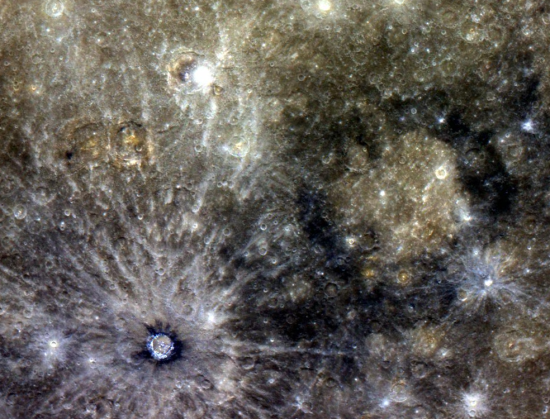
The Messenger spacecraft has now been in orbit around Mercury since the end of March, almost four months. During that time the probe has sent back many fascinating images, showcasing a hot, alien planet whose surface was formed by impacts, volcanic activity, and some processes that no one as yet understands.

Most of the released images, however, have been in black and white, which at first glance makes one think that Mercury is not unlike the Moon. This week the Messenger team released a color image, demonstrated clearly how false this assumption is. The image below shows two very different craters, a dark-haloed crater named Basho at the bottom left of the image, and a very bright crater, Kalidasa crater, near the top left. On the right of the image is a dark haloed Tolstoj basin. For an uncropped full resolution version go here.

color image from Mercury
» Read more

1 comment

The sun, climate change, and censorship

The chief of CERN has prohibited its scientists from drawing any conclusions from a major experiment that appears to prove that solar activity and the resulting ebb and flow of cosmic rays has a direct effect on the climate.

Two points:

First, the results described provide strong evidence that the sun is a much more important component in climate change than any climate model has previously predicted. These results could help explain the Little Ice Age, which took place around 1700 at exactly the same time the sun became very quiet and stopped producing sunspots for decades. They could explain the Medieval Warm Period around 1000 AD, when cosmic ray activity declined (which also suggests the sun become more active) and the earth apparently warmed. And they might very well even explain the recent cooling during the past decade, which also took place during a period of solar inactivity and a comparable increase in cosmic ray activity.
» Read more

1 comment

A flag in the dust

Bumped: I posted this essay last July 20th on the anniversary of the Apollo 11 landing on the moon. I think it is worth rereading again, even as the shuttle is about to return to Earth for the last time.

Today, July 20th, is the anniversary of the Apollo 11 landing on the Moon, the first time ever that a human being arrived on another planet. Americans love to celebrate this event, as it symbolizes one of the finest moments in our history, when we set out to achieve something truly great and noble and succeeded far better than we could have imagined. Not only did we get to the Moon as promised, over the next three and a half years we sent another five missions, each with increasingly sophisticated equipment, each sent to explore some increasingly alien terrain. Forty-plus years later, no one has come close to matching this achievement, a fact that emphasizes how difficult it was for the United States to accomplish it.

There is one small but very important detail about the Apollo 11 mission, however, that most Americans are unaware of. In mounting the American flag, the astronauts found the lunar surface much harder than expected. They had a great deal of trouble getting the flagpole into the ground. As Andrew Chaikin wrote in his book, A Man on the Moon, “For a moment it seemed the flag would fall over in front of a worldwide audience, but at last the men managed to steady it.” Then Armstrong took what has become one of the world’s iconic images, that of Buzz Aldrin standing on the lunar surface saluting the flag of the United States of America.
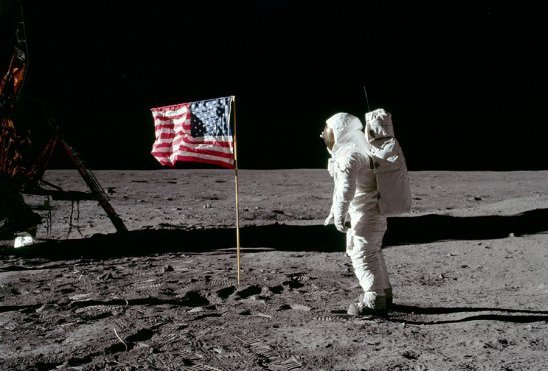
Aldrin saluting the flag

What people don’t know, however, is that when Armstrong and Aldrin blasted off from the lunar surface, the blast wave from the Lunar Module’s rocket knocked the flag over. As Chaikin also wrote, “Outside, a spray of gold foil and debris from the descent stage flew away in all directions. The flag toppled to the dust.”

Thus, for the last four decades this American flag, shown so proudly unfurled on the surface of the Moon, has actually been lying unceremoniously on the ground, in the lunar dust.

It might actually be possible to see this, though the photos at this time remain unclear and quite blurry.
» Read more

4 comments

Opportunity’s journey on Mars tops 20 miles

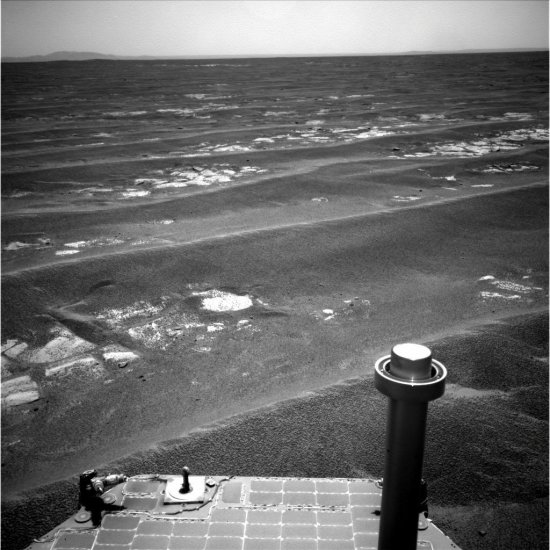
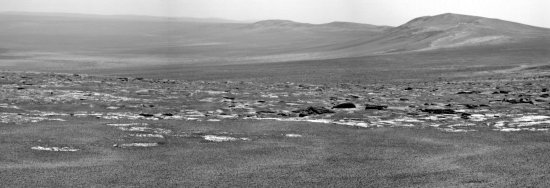
On July 17 the Mars rover Opportunity passed the twenty mile mark on its now seven year journey on Mars. The image below was taken on that day. In the distance, now only about 4,000 feet away, can be seen the rim of Endeavour Crater, fourteen miles wide. Opportunity has been traveling toward that crater now since 2008.

With the rover able to travel about 300 to 500 feet each sol, it should be reaching the crater’s rim sometime in the next few weeks.

Opportunity looks at Endeavour Crater from .8 miles away

0 comments
1 115 116 117 118 119 139