Rosetta detects its first dust grains

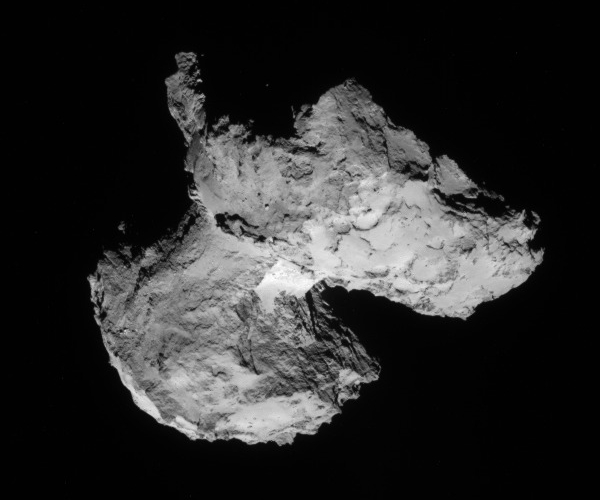
67P/C-G on August 12, 2014

The Rosetta science team announced today that the spacecraft’s Grain Impact Analyser and Dust Accumulator (GIADA) has captured its first dust grains from Comet 67P/C-G.

Earlier this month, GIADA detected the first four dust grains in its Impact Sensor. The first detection was made on 1 August, when Rosetta was 814 km from 67P/C-G, and about 543 million kilometres from the Sun. Further impacts from three more dust grains were detected on 2, 4, and 5 August, at distances of 603, 286, and 179 km from the comet, respectively.

There is still too little data to come to any firm conclusions about the density and make-up of the coma, but this announcement confirms that the instrument is working as designed. When the comet zips past the Sun at its closest point on August 13, 2015, this instrument will then be able to give us a very good assessment of this particular comet’s behavior as it slowly evaporates.

Meanwhile, the images keep coming. The picture at the top of the post was taken on August 12 from about 64 miles.
0 comments

Rosetta arrives

Rosetta has successfully achieved orbit around Comet 67P/C-G and has transmitted its first close up images. More information here and here about the rendezvous and what science the mission scientists plan to do as they orbit the comet.

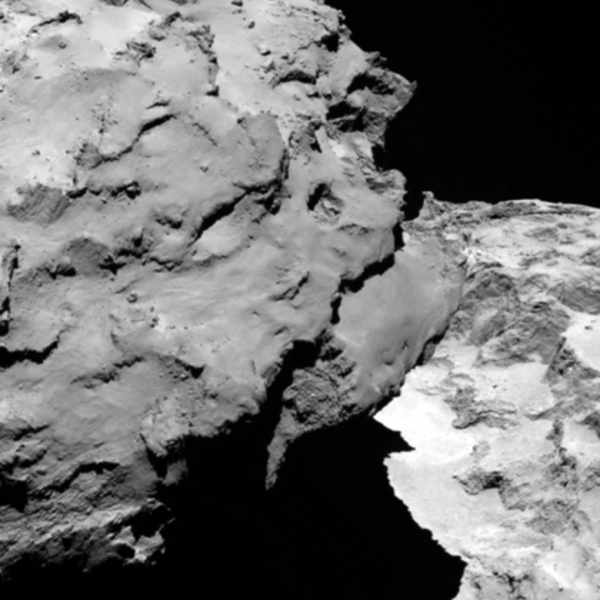
The image below is looking down and past the comet’s smaller component as it casts a shadow on the neck and the larger component beyond. As with the earlier images, the comet’s pitted and corroded surface, lacking any obvious craters, is reminiscent to me of a pile of dirty snow that has been dissolving away. In fact, when I lived in New York I would see this kind of look every winter. When the city would get a big snowfall snowplows would push it into large mounds on the side of the road. As time passed these piles would get dirty from the city’s soot and grime, and also slowly melt away. After several weeks it would look almost exactly like the surface of Comet 67P/C-G.

The images and data that will come down from Rosetta over the next year and half as it orbits the comet in its journey around the Sun will be most fascinating. Stay tuned!

67P/C-G up close

12 comments

The lingering weak solar maximum

On Monday NOAA posted its monthly update of the solar cycle, showing the sunspot activity for the Sun in July. As I do every month, I am posting it here, below the fold, with annotations to give it context.

For the first time in four months the decline in sunspots ceased, though the sunspot count hardly rose either. Instead the numbers stayed almost the same in July as they were in June. This was during a month that began with lots of sunspots, and yet saw the first blank sun in almost three years. In fact, the Sun’s activity in July was a roller coaster, as noted by the Solar Influences Data Analysis Center (SIDC) of the Royal Observatory of Belgium.
» Read more

1 comment

Video of the Falcon 9 first stage doing a soft splashdown

Video taken from a chase plane during the July 14 Falcon 9 launch shows the first stage appearing from out of the low clouds, engines firing, vertical and ready for landing. The video, below the fold, also shows the stage slowing just before it hits the water, much like the test vehicles Grasshopper and Falcon 9R do.

Though SpaceX has already claimed their first stage had done this during the July 14 launch, this video proves it. All they need to do now to recover their first stage is to direct it to a land-based landing site.

Hat tip to Doug Messier and Parabolic Arc for this story.
» Read more

3 comments

Getting closer

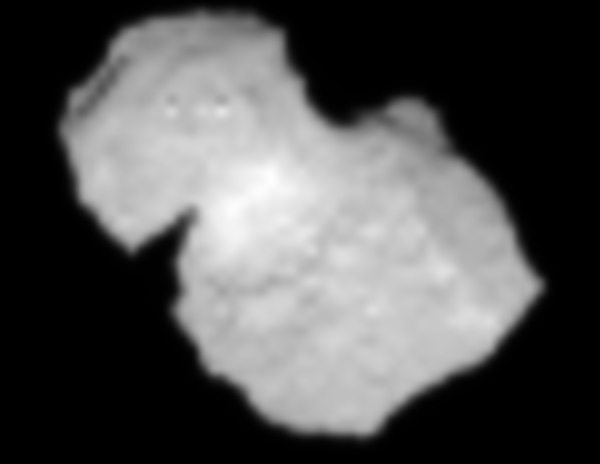
Comet 67P on July 31

This image of Comet 67P from Rosetta was taken yesterday. Though it has not been processed like the image I posted yesterday, more details continue to come out as the spacecraft each day gets closer to the comet. This image was taken from a distance of 825 miles, 375 miles closer than the previous day.

Very soon these close-up images will become too large to show the entire nucleus in one image. Rosetta will instead begin to snap images of specific features.

Meanwhile, the Rosetta science team released its first temperature readings of the comet.
» Read more

0 comments

The loss of skepticism in science

In April I taped a half hour television interview with George Noory for his subscription-based video show, Beyond Belief. Below is a clip from that interview, where I describe the terrible state of climate research, and how politics is destroying the very heart of what science stands for. Too many people are no longer open-minded. Rather than relay on the data they push their theories instead.

Robert Zimmerman discusses the truth about climate change with George Noory!

2 comments

Going back to the Canyon

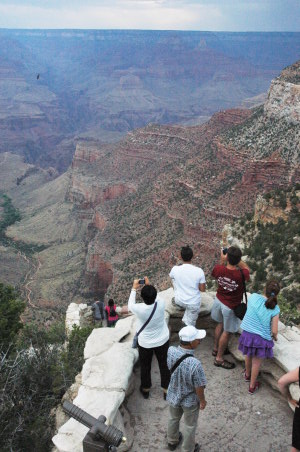
Grand Canyon
The black dot in the upper left is a condor.

As we did last year Diane and I are heading back to the Grand Canyon today. We will hike down to Phantom Ranch on Tuesday and return on Thursday, with one day at the bottom to do additional hiking. We then head to Grand Canyon Caverns to participate in a dig project there trying to find additional virgin passage. (When we were there last year we broke into approximately 250 feet of previously unknown passage.)

Obviously, posting will be impossible while we are in the Canyon. I should be able to post on the other days, though not as frequently as normal.

The Evening Pause, however, will appear each night this week, with thanks to my readers for helping me find some really interesting videos.

1 comment

Looking Forward

In the past week there must have been a hundred stories written celebrating the 45th anniversary of Apollo 11. Here’s just a small sampling:

These articles try to cover the topic from all angles. Some looked at the wonders of the achievement. Others extolled the newspaper’s local community and their contribution. Some used the event to demand the U.S. do it again.

None of this interests me much. Though I passionately want humans, preferable Americans, back on the Moon exploring and settling it, this fetish with celebrating Apollo is to me becoming quite tiresome.
» Read more

2 comments

The next Proton and Angara launches

The competition heats up: Russia has set September 28 as the next launch date for its troubled Proton rocket.

The most interesting detail gleaned from this article however is this:

The Proton-M carrier rocket previously launched on May 16 from Baikonur space center collided with communications satellite Express ะะœ4R and burned up in the atmosphere above China, leaving Russia without its most powerful telecommunications satellite.

Previous reports had not been very clear about the causes of the May launch failure. All they would say is that “a failed bearing in the steering engineโ€™s turbo pump” had caused the failure about nine minutes into the flight. This report suggests that this failure occurred after separation of the payload and that it then caused the upper stage to collide with the satellite.

Russia is also about to ship its new Angara 5 rocket to the launch site for a planned December launch. This will be the first launch of the Angara configuration that is expected to replace the Proton rocket, and is expected to place a dummy payload into geosynchronous orbit.
» Read more

2 comments

Website upgrade

Update: The upgrade is mostly finished. There are still a few tweaks that either I or Shane will do over the weekend but essentially the site is up and running.
——————–
This evening Behind the Black will be undergoing a significant upgrade. For this reason posting will cease beginning with this post at 3 pm (Pacific) until the upgrade is completed later tonight. When completed the site will be slightly different. Most of the changes will be irrelevant to readers, as I have tried in this upgrade to keep the website how I like it, clean, thoughtful, and not cluttered with unnecessary internet stuff.

Two issues will affect my readers.

  • The spam filter for comments will once again be working. In addition, comments will not be accepted until the commenter completes a Captcha screen. Once this is done, however, the comment will then be instantly approved. I will no longer have to manually approve each comment. This will speed the dialogue. It will also mean that comment threads will remain open forever. Since the spam filter failed in January I have had to close comments on posts after three weeks.
  • The look of the website will change somewhat. These changes are mostly designed to increase traffic, which will not only increase my readership but will help pay for this site. For example, it will be easier to share a post from Behind the Black in many other venues, such as Facebook and Twitter.

To complete the upgrade my software guy, Shane Rolin of Amixa, and I will have to do a number of tweaks and changes after the new site goes live. Thus, be prepared for a short period on Friday where things might not work as they should. By the end of the evening, however, all should be fixed and working properly. If you see a problem after that please feel free to comment here, describing what you see and what you think could be done to fix it. Also feel free to comment here with any additional suggestions for making Behind the Black a better experience. I am always open to new ideas.

17 comments

The sun continues its ramp down

On Monday NOAA posted its monthly update of the solar cycle, showing the sunspot activity for the Sun in June. As I do every month, I am posting it here, below the fold, with annotations to give it context.

The decline in sunspots continued for the fourth month in a row, increasing the likelihood that the peak of solar maximum has finally come and gone and that we now seeing the beginning of the ramp down to solar minimum. This resulting solar maximum comes close to matching the science community’s final prediction (indicated by the red line), though that prediction was not detailed enough to include the distinct and unusual double peak for this maximum.
» Read more

5 comments

More fraud in peer-reviewed science

The science journal Nature today announced the retraction of two controversial stem cell papers.

The two papers reporting the stimulus-triggered acquisition of pluripotency (STAP) phenomenon appeared online on 29 January. Questions about the papers arose almost immediately, leading to an investigation by RIKEN, the headquarters of the network of the nationally funded laboratories that is based in Wako near Tokyo. Investigators documented several instances of fabrication and falsification in the papers and concluded that some of these constituted research misconduct on the part of [Haruko] Obokata [the lead author].

Japanese media recently reported that authors had agreed to retract the papers but were discussing the wording of the notice. In the note that appeared today, the authors point to errors previously identified by RIKEN investigations in supplementary documents. They also identify additional errors in both papers, including mix-ups in images, mislabeling, faulty descriptions, and “inexplicable discrepancies in genetic background and transgene insertion sites between the donor mice and the reported” STAP cells. [emphasis mine]

The list of errors now documented sound astonishing. In fact, I can’t see how any serious review by any competent specialist in this field could have missed them all, which suggests that for this research at least the peer-review process is mostly a sham. In fact, in the article Nature admits that its
» Read more

7 comments
1 92 93 94 95 96 139