
China heads for the Moon and Mars.

The competition heats up: In several different news stories today China touted its future plans in space.

The landing test described in the first story above will also be the first test flight of China’s new heavy lift rocket, Long March 5.

That China is both politically and culturally serious about this effort can be seen by the nationalistic enthusiasm for this space effort that permeates these stories. They also can’t help comparing their plans to U.S. efforts.
» Read more
3 comments

The late arrival of Russia’s first private satellite

The competition heats up? The Dnepr rocket launch of 37 satellites yesterday also included the launch of the first private Russian satellite.

TabletSat-Aurura owned by the company SPUTNIX weighs 26.2 kg and is made to operate for one year. It is intended for remote Earth sensing in the interests of a private company. The satellite was made using Russian technologies and a minimum of foreign components. Its cost is about one million US dollars.

Igor Komarov, the head of the United Rocket and Space Corporation, said “the launch of Aurora, the first Russian private satellite, is a successful example of public-private partnership in the field of space exploration as private companies clearly cannot fulfill their strategic tasks without the state. ,,, I am confident that cooperation between the state and private aerospace agencies in designing and manufacturing high-tech craft will become an important stimulus for further development of Russian competitive technologies.”

SPUTNIX Director-General Andrei Potapov said his companyโ€™s plans included “creating a cluster of small spacecraft and craft for super high-definition aerial video surveying and imaging with a resolution of down to one meter per pixel”. [emphasis mine]

Why do I have doubts about this Russian achievement? The reasons are twofold.
» Read more

1 comment

Is the Sun’s strange double-peaked solar maximum finally ending?

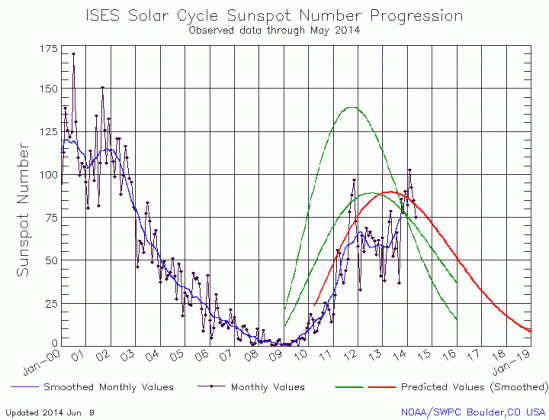
Last week NOAA posted its monthly update of the solar cycle, showing the sunspot activity for the Sun in April. As I do every month, I am posting it here, with annotations to give it context.

May Solar Cycle graph

The graph above has been modified to show the predictions of the solar science community. The green curves show the community’s two original predictions from April 2007, with half the scientists predicting a very strong maximum and half predicting a weak one. The red curve is their revised May 2009 prediction.

For the third month in a row the Sun continued its drop in sunspots, with the total finally slipping below the 2009 prediction for this moment in the solar cycle. If this decline continues through to solar minimum, the shape of the solar maximum will essentially have been established, double-peaked with the second peak stronger than the first, something that solar scientists have never seen before.

At the moment I await word from the scientists that the Sun has completed the flip of its magnetic field polarity in the southern hemisphere. This flip has already occurred in the northern hemisphere, and when the south follows, the maximum will be officially over and we will officiallybegin the ramp down to solar minimum.

0 comments

Website software expert needed

I am in need of someone willing to manage the backroom software aspects of Behind the Black. My first software designer found he no longer had the time to do it, and the person I found to replace him decided suddenly that he didn’t like my political opinions and unless I wrote my opinions the way he liked he couldn’t do it.

The work wouldn’t be difficult nor very time consuming, but there are several areas of the website software that need cleaning up. If you are familiar with WordPress and website design and would like to help me keep this website up and running, please comment here. I will email you immediately.

This post will remain at the top of the site for the rest of today.

13 comments

The Sun settling down?

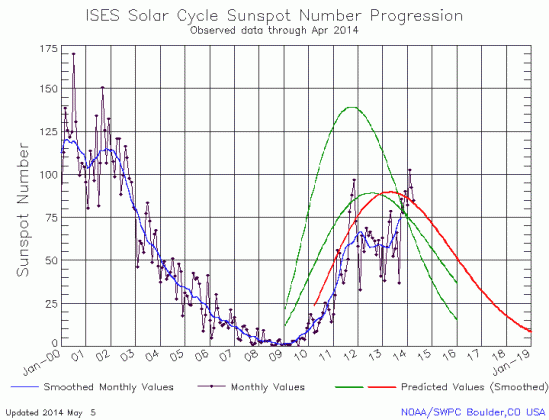
Two weeks ago NOAA posted its monthly update of the solar cycle, showing the sunspot activity for the Sun in April. I have been remiss about doing my monthly post about this, so here it is now, posted below with annotations.

April Solar Cycle graph

The graph above has been modified to show the predictions of the solar science community. The green curves show the community’s two original predictions from April 2007, with half the scientists predicting a very strong maximum and half predicting a weak one. The red curve is their revised May 2009 prediction.

The Sun continued the drop in sunspots seen the previous month, though the total number remains above the 2009 prediction for this moment in the solar cycle. As already noted, that the second peak of this double peaked solar maximum has been much stronger than the first remains unprecedented.

Overall, the maximum continues to be the weakest seen in a hundred years. Whether this is an indicator of future events or an anomaly can only be discovered after the Sun completes this solar solar cycle and begins the ramp up to its next solar maximum, at least five years away.

The next update is only a few weeks away. Stay tuned.

5 comments

Russia fights back

Much has been made about the sanctions the Obama administration has imposed on any cooperation with Russia due to the situation in Ukraine and how those sanctions might damage the commercial and manned space efforts of the United States.

So far, all evidence has suggested that the sanctions have little teeth. The Obama administration exempted ISS from the sanctions. It also appears to be allowing the shipment of all commercial satellites to Russia for launch. Even a court injunction against using Russia rocket engines in U.S. military launches was lifted when the Obama administration asked the judge to do so.

The Russians now have responded. Why do I take their response more seriously?
» Read more

10 comments

The porksters arrive!

A draft bill in Congress is proposing the Pentagon develop an engine for the Atlas 5 engine to replace the Russian engine now used.

The legislation passed by a House subcommittee Wednesday calls for up the U.S. military to spend up to $220 million next year to kick off full-scale development of the engine, which could be ready for flights no later than 2019. The bill states the Defense Department “should develop a next-generation liquid rocket engine that is made in the United States, meets the requirements of the national security space community, is developed by not later than 2019, is developed using full and open competition, and is available for purchase by all space launch providers of the United States.”

There is no reason for this funding gift to the aerospace industry. For one thing, there are two rockets that already exist that use all U.S. parts, the Delta family of rockets and the Falcon 9. For another, if Congress stays out, the private sector will take care of this need and do it for a lot less and far quicker, while costing the taxpayers relatively little. By making this a government project we guarantee it will be expensive and take forever, thus keeping the pork flowing to Congressional districts without solving the problem.

And speaking of keeping pork flowing to Congressional districts, pork king Senator Richard Shelby (R-Alabama) today ripped into NASA for trying to trim a little from the budget of SLS (which sends a lot of cash to Alabama). He also condemned NASA’s manned commercial effort.
» Read more

8 comments

The Sun continues to hiccup

It’s sunspot time again! On Monday NOAA posted its monthly update of the solar cycle, showing the sunspot activity for the Sun in February. I am once again posting it here, below the fold, with annotations.

Like it did in January, the Sun’s second peak of the solar maximum continued to beat its first peak, an unprecedented event. Though activity dropped slightly, it still remained above prediction and was only slightly below the first peak’s maximum. Overall, the second peak has been much stronger than the first, something that scientists have never seen before. In the past, when the Sun had a double peaked solar maximum, the second peak was always weaker. Not this time!
» Read more

1 comment

The road to hell

Back on December 31, 2013, I put up a post about a New York Times article in which it was reported that Americorps volunteers were losing their health insurance plans because of Obamacare, much to their chagrin.

In reading the article, the quote that stood out to me was this one from one volunteer named Sarah Sklaw.

Sarah L. Sklaw, a 22-year-old Vista member from New York City, said: โ€œI really support the Affordable Care Act, and I donโ€™t want to be a naysayer. But it was surprising and frustrating to be told that our health coverage would not meet the lawโ€™s standards, especially because the Corporation for National and Community Service told us at orientation in August that we did not need to worry about the issue.โ€

My reaction? “In other words, she supported Obamacare, partly because she was told “if she liked her health plan, she could keep her health plan. Period.” She has now discovered that this was a lie and is angry. Who wudda thunk it?”

Last week Sarah Sklaw emailed me. She was very unhappy about my post because in her mind I misrepresented her feelings about the situation. This is her email:
» Read more

10 comments

The Sun goes boom again!

On Monday NOAA posted its monthly update of the solar cycle, showing the sunspot activity for the Sun in January. As I do every month, I am posting it here, below the fold, with annotations.

January was the most active month for sunspots this entire solar cycle, exceeding the predictions of the solar scientists, an event that has been quite rare during this generally weak solar maximum. In fact, the Sun was so active that for the first time, the second peak in a double-peaked solar maximum exceeded the first peak in sunspot activity.
» Read more

3 comments

Contempt for the law

As I am taking a break from sightseeing and visiting relatives here in Israel, I thought I’d answer a question raised by one of my regular readers, Patrick Ritchie, in a comment a few weeks ago.

Patrick had noticed what seemed a contradiction in my posts and asked me about it. First, he noted my disgust at university officials in South Carolina who were refusing to follow a law requiring them to teach students about the Constitution because they thought it “inconvenient.”

Patrick wrote, “In the post above you state, ‘It might inconvenient, and the law itself might be foolish, but it isnโ€™t up the administrators to decide this. They should be fired.'”

He then cited an earlier post in which I celebrated the Connecticut gun owners who were refusing to register their weapons under that state’s new very oppressive and senseless gun control law. There I had written that “When the law has contempt for freedom, then the only answer is contempt for the law.”

Patrick then asked, “I would appreciate it if you could elaborate on how, in your mind, these two situations are different. More specifically: when (if ever) do you think it is OK for citizens to disregard or break the law?”
» Read more

13 comments
1 93 94 95 96 97 139