Today’s blacklisted American: Coach fired by Vermont school for simply expressing some facts during a civil conversation

Vermont: Where you are only allowed to say things that support the queer agenda
Vermont: Where the only speech allowed must
support the queer agenda

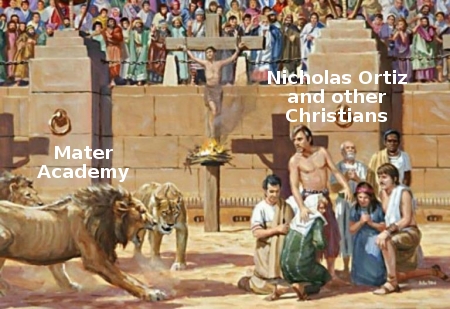
They’re coming for you next: Despite founding the snowboarding program at Woodstock Union High School in Vermont in 2011 and heading it for its entire history, David Bloch was immediately fired without due process by his school the day after he had a very civil private conversation with his students about males claiming to be female and competing against women.

This is what he did, according to his non-profit legal firm, the Alliance Defending Freedom:

In February [2023], Bloch and his team were waiting in the lodge for a competition to start. That day, Bloch’s team was set to compete against a team that had a male snowboarder who identifies as a female and competes against females. During downtime in the lodge, Bloch overheard a conversation between two of his athletes about that male competing against females. Bloch joined the conversation to comment that people express themselves differently and that there can be masculine women and feminine men. He also affirmed that as a matter of biology, males and females have different DNA, which causes males to develop differently from females and have different physical characteristics, and that those biological differences give males an advantage in athletic competitions.

The conversation was respectful among all parties and lasted no more than three minutes. It took place entirely outside the presence of the male snowboarder who identifies as female, and Bloch’s team and the other team went on to compete without incident. After the competition, the two teams and their coaches, including Bloch, shared a bus home.

The very next day the superintendent of the Windsor Central Supervisory Union, Sherry Sousa, called Bloch into her office to tell him he was fired, even though the investigation against him was incomplete.
» Read more

19 comments

Is this the source of the sand for the giant dune sea that surrounds the Martian North Pole?

Overview map

Circling the north pole of Mars is a gigantic dune field dubbed Olympia Undae, with its densest regions (marked in red on the overview map to the right) estimated to be 700 miles long and covering 120 degrees of longitude.

Where does all the sand come from that created this dune ocean? We now have a rough idea. The arrows on the map to the right indicate the direction of the prevailing winds, as recently determined by scientists studying the orientation of dunes. From this it appears that much of the dust comes from the north polar icecap itself, from its lower layers where dust and ice are cemented together. The prevailing winds, especially in the canyons that cut into the icecap, drive that dust out from the lower layers, where it over eons has piled up in that circular ocean of sand.

The white cross marks the location of today’s cool image, an attempt by scientists to photograph at high resolution one of the sources of this sand, on the edge of the icecap.
» Read more

0 comments

Hubble data shows expansion of supernova remnant

Cygnus loop filament

Astronomers have created a four-second long movie using Hubble images collected over twenty years that shows the expansion of one filament in the Cygnus Loop supernova remnant, the explosion of which is thought to have occurred 20,000 years ago.

The picture above is one frame of that movie. The filament is estimated to be two light years in length.

By analyzing the shock’s location, astronomers found that the shock hasn’t slowed down at all in the last 20 years, and is speeding into interstellar space at over half a million miles per hour – fast enough to travel from Earth to the Moon in less than half an hour. While this seems incredibly fast, it’s actually on the slow end for the speed of a supernova shock wave.

Two versions of the movie are at the link, with the longer providing excellent context.

2 comments

Parker completes 17th close fly-by of the Sun, setting new records

The Parker Solar Probe on September 27, 2023 completed its seventeenth close fly-by of the Sun, setting new speed and distance records.

Set up by a gravity-assist flyby of Venus on Aug. 21, the close approach (known as perihelion) occurred at 7:28 p.m. EDT, with Parker Solar Probe moving 394,736 miles per hour (635,266 kilometers per hour) around the Sun – another record. The milestone also marked the midway point in the mission’s 17th solar encounter, which began Sept. 22 and continues through Oct. 3.

It zipped past the Sun at a distance of only 4.51 million miles, also a record.

Whether it survived this fly-by will not be confirmed until October 1, when it is able to safely send its first data back after moving far enough away from the Sun to reopen communications.

3 comments

Orbital Reef partnership between Blue Origin and Sierra Space in trouble

According to anonymous sources, CNBC reports that the partnership between Blue Origin and Sierra Space to build the private commerical Orbital Reef space station is possibly breaking up.

The companies announced Orbital Reef as a co-led project in 2021, but updates about the project dried up in the past year. The pair of private space companies are now navigating a potential end to the Orbital Reef partnership, according to three people who spoke to CNBC about the situation.

Those people, speaking on the condition of anonymity to discuss nonpublic matters, emphasized that discussions are ongoing and described the situation as fluid. But other development projects with more significant current contracts – such as Blue Origin’s Blue Moon lunar lander and Sierra Space’s Dream Chaser spaceplane – have taken higher priority for both companies, those people said.

To readers of Behind the Black, this possible break-up is not a surprise. In June Sierra’s announcement of its own independent space station based on its LIFE modules suggested it had its own doubts about Orbital Reef. Then in August, when Sierra announced a partnership with Redwire to launch LIFE as an independent station, I wrote this:

What struck me about this deal is the shrinking mention of Blue Origin. Originally that company was listed as one of the major players in building this private space station, dubbed Orbital Reef, in which LIFE is only the first module. In the past year however its participation seems less and less significant in every subsequent press release. It appears to still be part of the project, but it is Sierra Space that is leading the effort, and appears to be making things happen.

But then, the track record of Blue Origin is to not make things happen. It could very well be that events are once again overtaking it. Sierra Space can’t wait for Blue Origin to slowly get its act together. It is finding ways to get things done, even if that means Blue Origin gets left behind.

Today’s CNBC story reinforces this conclusion. So does its timing with the removal of Blue Origin’s CEO, Bob Smith, earlier this week. It could be that the failure of Blue Origin in the Orbital Reef partnership was the final straw for Jeff Bezos.

The problem for NASA in this is that the agency awarded a $130 million contract to the Orbital Reef partnership, with Blue Origin listed as the lead contractor which controls the contract. If that partnership ends, that contract must get renegotiated or cancelled, or gets transferred from Blue Origin to Sierra Space (the most likely outcome).

2 comments

Ispace wins $55 million NASA contract for lunar landing mission

The Japanese company Ispace, which is also establishing operations in the U.S., has won a $55 million NASA contract to send a lunar landing plus communications relay satellites to the Moon in 2026.

Ispace’s Hakuto-R1 lander attempted a landing on the Moon in April, but crashed. The company has a second Hakuto-R mission presently targeting launch next year. The NASA contract would the company’s third, which will be built in its new U.S. facility and be called Apex-1.

In today’s briefing, Ispace representatives announced that the primary customer for its upcoming Mission 3 is NASA, which has selected the company as part of its Commercial Lunar Payload Services program (CLPS). Ispace stated during the briefing that it has signed a $55 million contract with NASA for Mission 3 in order to land near the lunar south pole carrying approximately 210 pounds (95 kg) of scientific payloads.

But that’s not all the mission will do. On its way to the lunar surface, Mission 3 will deliver relay satellites that will remain in orbit around the moon to serve as communication relays.

Though it will not be surprising if these launch dates slip, Ispace is in a strong position to succeed, considering it is presently the only private company to launch a Moon lander, and got very close to putting it down on the lunar surface successfully.

2 comments

California school district blacklists Christian club from elementary school

Hayward Unified School District: hostile to religion

They’re coming for you next: Despite allowing the Good News Clubs of the Child Evangelism Fellowship to meet in its Fairview Elementary School for years prior to the COVID lockdowns, the Hayward Unified School District has since blocked further meetings with no explanation, even as it has allowed many other similar but secular clubs to return.

As a result, the non-profit legal firm Liberty Council has sent a demand letter [pdf] to Hayward, threatening it with legal action if it does not immediately allow the Good News Clubs meeting space. As the letter notes,

California law and District policies do not permit the District to deny the use of facilities to
the GNC [Good News Club], particularly where such are made available to Scouts and GOTR [Girls on the Run]. District practice has been to make facilities freely available to these and other groups similarly situated to the GNC, immediately after school. Moreover, the First Amendment to the United States Constitution, made applicable to the States (and the District) by the Fourteenth Amendment, also prohibits discriminatory denials of facilities use based on unbridled administrator discretion, or based upon religious viewpoint.

» Read more

5 comments

A gully in Mars’ glacier country

Overview map

A gully in Mars' glacier country
Click for original image.

Cool image time! The picture to the right, cropped, reduced, sharpened, and brightened to post here, was taken on July 8, 2023 by the high resolution camera on Mars Reconnaisance Orbiter (MRO).

The white dot in the southwest corner of 146-mile-wide Lyot Crater on the overview map above marks the location, smack dab in the middle of the 2,000-mile-long northern mid-latitude strip I dub glacier country, since practically every high resolution picture shows some glacial features. This picture is no different. The material in the upper right of the picture appears to be ice that fills the crater and laps up against its interior slope. The gully appears to suggest a drainage down into that ice that partly covered it.

The elevation change from the high to low points is about 4,500 feet. What drained down this slope to carve this gully however remains an unsolved mystery, though most scientists presently favor some form of water or brine flow in the past and no longer active.

0 comments

The global wind patterns on Mars, determined by the orientation of dunes

Mars global wind patterns

Wind patterns at the Martina North Pole

Scientists have now roughly determined the global wind patterns on Mars, based on the orientation of one type of crescent-shaped dune called barchan dunes.

The global map above and the north pole map to the right come from figure 2 of the paper. The colored letters indicate the location of additional close-up images. On the polar map Olympia Undae is Mars’ largest dune field. From the abstract:

Crescent-shaped sand dunes are prevalent across the deserts of Mars. Here, we use the physical relationship between the shape of these dunes and the winds that form them to infer the directions of surface winds on Mars on a global scale. We find that dunes typically adhere to the global circulation patterns of Mars’ atmosphere, and that local topographic winds are mostly important in areas with high topographic roughness such as inside deep impact craters. Our global wind map can serve to calibrate numerical climate models, which in turn can help us learn about the recent and modern-day climate of Mars.

The arrows on both maps indicate the direction of the prevailing winds. This data will also help clarify the orientation of many surface features seen by Mars Reconnaissance Orbiter’s high resolution camera. This data also helps explain why the lander InSight never got a burst of wind to clear the dust from its solar panels, while the rovers Spirit and Opportunity did. The rovers were located in regions with clear prevailing winds. InSight was not.

1 comment

Webb takes an infared look at Saturn

Webb's five images of Saturn
Webb’s five images of Saturn. Click for original.

Using the Webb Space Telescope, scientists have obtained five infrared images of Saturn to get a more detailed look at the gas giant’s atmosphere and the molecules within it.

The image to the right is Figure 1 from the paper, showing the location of those five images on Saturn, placed over a much higher resolution Hubble Space Telescope optical image. The graph on the bottom shows the molecules revealed from spectroscopic data obtained by Webb’s infrared view. From the abstract:

We show evidence that a stratospheric circulation pattern detected by Cassini during northern winter has now fully reversed in northern summer, with the low-latitude stratosphere being cool and depleted in aerosols due to summertime upwelling. MIRI [Webb’s mid-infrared instrument] provides access to spectral regions that were not possible with the Cassini spacecraft, particularly in the 5–7 μm region where reflected sunlight and thermal emission blend together. Ammonia and phosphine are enriched at Saturn’s equator, suggesting strong mixing from the deeper troposphere. MIRI’s high sensitivity enables the first identification of previously unseen emission propane bands, along with the first measurements of the distribution of several gaseous species: tropospheric water, and stratospheric ethylene, benzene, methyl, and carbon dioxide.

The paper notes that this work still has uncertainty because when the infrared images were taken engineers were still working out the kinks for using Webb. Nonetheless, the results illustrate the large potential for future planetary discoveries from Webb.

1 comment

Another retraction looms of research claiming the discovery of superconductivity at room temperature

A March research paper that claimed the discovery of a compound that allowed superconductivity at room temperature is now facing retraction, making it the third superconductivity paper in which physicist Ranga Dias of University of Rochester was the lead author.

On 1 September, Nature attached an editor’s note to the March paper, warning readers that “the reliability of data presented in this manuscript is currently in question.” A week later, eight of the co-authors on the 11-person paper submitted a letter to Nature requesting the study be retracted, The Wall Street Journal first reported on Tuesday. Science has obtained the letter and additional documents, which raise concerns about the reliability of the data and Dias’s treatment of his co-authors. “We respectfully request and recommend that Nature issue a retraction,” conclude the signatories, who include five recent graduate students of Dias’s.

The article at the link is worth reading, as it details at length the bullying efforts of Dias to intimidate his co-authors by threatening legal action.

Before the co-authors sent their letter to Nature, Dias sent a cease-and-desist letter to six of them—five of his former graduate students and one U of R faculty member. He warned them about the “potential legal consequences of your actions and to consider the ethical implications of making baseless allegations against a colleague and fellow scientist.” Dias has previously sent cease-and-desist letters to other critics of his work.

This is not all. It appears that Dias used his position of authority to prevent an honest appraisal of his work, actions that are in utter violation of ethics and the scientific method.

While it is good that Dias’s chickens are now coming home to roost, his corrupt behavior is unfortunately too common now in the academic world, as indicated by the increase in retractions by 13,750% since 2000.

The good news however is that these retractions are helping to clean out that corruption. Though cleaning house will take time, it does appears to be happening. For example, according to the article, absolutely no students have enrolled in any of Dias’s classes at the University of Rochester.

2 comments
1 496 497 498 499 500 2,916