
Shoe Salesman
An evening pause: From the Carol Burnett Show, a skit staring Don Rickles, Nanette Fabray, and Harvey Corman.
Hat tip Phill Oltmann.
An evening pause: From the Carol Burnett Show, a skit staring Don Rickles, Nanette Fabray, and Harvey Corman.
Hat tip Phill Oltmann.

Click for full image.
The Hubble science team today released a new global image the telescope took of Jupiter on June 27, 2019. The photograph on the right is that image, reduced and cropped to post here. As noted by the press release about the Great Red Spot,
The Great Red Spot is a towering structure shaped like a wedding cake, whose upper haze layer extends more than 3 miles (5 kilometers) higher than clouds in other areas. The gigantic structure, with a diameter slightly larger than Earth’s, is a high-pressure wind system called an anticyclone that has been slowly downsizing since the 1800s. The reason for this change in size is still unknown.
A worm-shaped feature located below the Great Red Spot is a cyclone, a vortex around a low-pressure area with winds spinning in the opposite direction from the Red Spot. Researchers have observed cyclones with a wide variety of different appearances across the planet. The two white oval-shaped features are anticyclones, like small versions of the Great Red Spot.
Another interesting detail is the color of the wide band at the equator. The bright orange color may be a sign that deeper clouds are starting to clear out, emphasizing red particles in the overlying haze.
In many ways Hubble’s images of Jupiter are comparable to those taken by Juno, except that Hubble can’t zoom in as close.
In recent weeks I have grown so horrified by the blatant hate being screamed by Democrats and leftists in the mainstream press against Republicans, conservatives, and Trump supporters that I have found myself unable to write about this stuff.
It is just too disgusting. Here are just a few examples that barely represent the full gamut of anger and hate being expressed by Democrats and their willing accomplices in the press:
All of the accusations against Trump and Republicans in these stories are outright lies, worthy of Joseph Goebbels. And the actions of Democratic politicians like Biden and Castro to attack and smear Trump and his supporters is equally vile, and worthy of the worst form of scapegoating done by anti-Semites. Worse, these people are using terrible mass murders, committed by clearly unstable and sick individuals, to score political points. Such behavior is beyond the pale.
One might, if one was willing to stretch the truth beyond the breaking point, to find some justification in the criticisms of Trump. However, though Trump’s twitter comments are often ugly and crude and insulting, the one thing a careful reading of all those statements reveals is that he has always tried to state the truth, honestly and bluntly. Moreover, there is no evidence of racism in any of his comments. He has merely been attacking those who deserve attacking.
The Democratic attacks, however, on the decency of the American population, especially its non-minority population, are especially vile and dishonest. Remember, this is the same population that only a few years ago twice voted for a black president. For Democratic politicians and mainstream press pundits to accuse it of being in favor of white supremacy is more than just absurd, it is a lie and slander.
The problem I have is that I try to be a decent human being. I don’t like to give these liars and slanderers a platform to spread their hateful lies. In fact, I don’t even wish to read or discuss their childish and mean-spirited behavior. Thus, I have posted nothing until now about the mass murders that occurred this past weekend and the reactions to them.
» Read more

Click for full image.
Cool image time! In the July release of images from the high resolution camera of Mars Reconnaissance Orbiter (MRO) was the image to the right, cropped to post here, showing what I suspect is a relatively young crater located in the lowest part of Hellas Basin, what I call the bottom of Mars.
Though this crater is not located at the lowest point in Hellas, it is not far off from there. What makes it important to geologists are two facts. First, there are not a lot of craters in Hellas, which helps indicate it is a relatively young feature. Second, and more important, the impact has made accessible material from below the surface, indicated by the different colors in this image. From this information they can better constrain their theories about the Basin’s formation and where it fits in Mars’s overall geological history.
Make sure you take a look at the full photograph by clicking of the image, and compare it with the earlier Hellas Basin images I posted here. The surface of Hellas appears to have a lot of flow features, as if it was laid down by volcanic activity, or by the motion of water that covered it. In either case that would explain the overall lack of craters.
Capitalism in space: In an effort to ease its bureaucratic obstacles to private enterprise, the FCC has streamlined its licensing process for new smallsats, while cutting its licensing fees by more than 90%.
Under the optional licensing regime, which stands to take effect this year, smallsat operators with spacecraft that meet certain criteria will be able to obtain a spectrum license about twice as fast and pay only $30,000 instead of nearly $500,000. A maximum of 10 satellites at a time can be licensed under the streamline process.
…Operators will be able to use the streamlined licensing for satellites that weigh 180 kilograms or less, operate below 600 kilometers (or have propulsion) and will deorbit within six years, among other criteria.
One component of these new regulations is that they require new smallsats to never be smaller than 10 centimeters on their smallest dimension, thus essentially forbidding the launch of nanosats smaller than that.
China Central Television has released a very short video showing the grid fins used during the July 26 launch of China’s Long March 2C rocket in order to better control the descent of that rocket’s expendable first stage.
I have embedded the video below the fold. It shows the four grid fins unfolding, but not much else. It also reveals that the Chinese very clearly were inspired by SpaceX’s Falcon 9 grid fin design.
The video also gives me the impression that the Long March 2C first stage does not have any thrusters, which were SpaceX’s primary mode for controlling its first stages, the grid fins added later when they understood better the engineering required. Thus I suspect that the fins were not very successful in controlling that stage’s flight.
Nonetheless, the Chinese are doing these tests during operations, which means they are only a first step on a path to success.
» Read more
Capitalism in space: Vector has signed its first Air Force launch contract for an orbital cubesat launch in 2021.
The Air Force must know something about Vector’s rocket development that we don’t. The company had planned a suborbital test launch for March/April, delayed it until June, and has still not flown it. These delays put the company behind its original launch schedule by a considerable amount, which originally had called for its first orbital launch in 2018.
Hopefully we shall soon see some actually progress from Vector. At the moment however their lack of launches has allowed a number of other smallsat rocket companies to gain on them from behind.
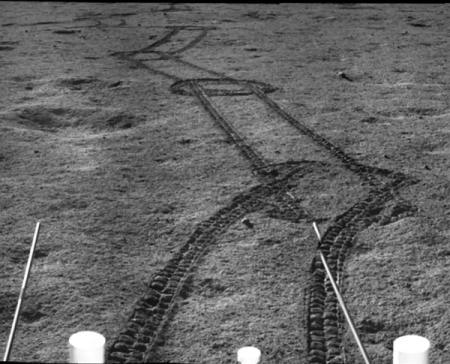
Both Yutu-2 and Chang’e-4 have been put in dormant mode after completing their eighth lunar day on the far side of the Moon.
The article at the link provides a lot of new details about what both spacecraft have learned and done since they landed, including a nice detailed map showing Yutu-2’s exact path during those eight lunar days. The image to the right, reduced to post here, was taken by Yutu-2, and shows the rover’s tracks during what appears to be its seventh lunar day. It appears that the rover periodically stopped and did a pirouette, probably to obtain a 360 degree mosaic of the surrounding terrain.
Yutu-2’s travels have tended west from Chang’e-4, and on its eighth lunar day it continues that route, traveling 271 meters. After a period of short traveling days, they have now upped the distance traversed by a considerable amount. Since the planned nominal mission for both spacecraft had been three lunar days, both are demonstrating that the Chinese have figured out how to do this, and are now pushing Yutu-2 hard as a result.
The article vaguely describes some of the science obtained so far, but in general the Chinese remain tight-lipped about most of their discoveries.
Early this morning ULA used its Atlas 5 rocket to successfully launch an Air Force military communications satellite.
This was the third ULA launch this year, which means they remain off the leader board below. This number of launches is also below the pace set the last two years, where they completed eight launches per year.
The leaders in the 2019 launch race:
12 Russia
11 China
10 SpaceX
6 Europe (Arianespace)
4 India
The U.S. now leads in the national rankings 17 to 12.
An evening pause: I really have no idea who is performing this, as the Vimeo link provided no information. Web searches also came up dry. I couldn’t even find the lyrics.
Nonetheless, it is beautiful, and worth more than one listen.
UPDATE: I have finally located a description of this work of art. It is called The Wound in the Water,
music by Kim André Arneson (2016); libretto by Euan Tait (August 2015). This is from part 2, “The cry of the exile” and is called “Song of the Sea Exile.” The lyrics:
I, the exile,
my heart burning,
my lost life
a terrible fire,
songs of loved ones
crying all around me.
Oh endless,
endless home, the sea.
Oh my missing,
I am listening,
yet your silence
cannot answer me.
There, we left
our singing unfinished,
and our lives now
fall into the endless sea.
This the broken
gift of love:
the exile calls,
remembered names.
What you were
scorched on me,
your wounded names
sung to the endless sea.
Waves like voices
roar around you:
we’re not silenced,
but cry out like the
sea.
Your anger,fiery, living
is like love
that bleeds
like the endless sea.
Oh our exile,
torn by love,
singing words
you can no longer sing,
where’s the shores,
the harbour, the horizon,
wanderer,
calling to the endless sea
calling to the endless sea?
Hat tip Edward Thelen.
Capitalism in space: The new smallsat rocket company Orbex today announced the signing of two different launch deals, one with In-Space and the other with Innovative Space Logistics both with companies focused on procuring launch services for smallsat companies.
Both are for its as yet untested Prime rocket, which they hope to launch by 2021 from the United Kingdom’s new spaceport in Scotland.
Northrop Grumman’s Cygnus cargo capsule has undocked from ISS, but will remain in orbit until December.
First, the capsule, dubbed the S.S. Roger Chaffee, will deploy a bunch of cubesats and nanosats. Then,
Northrop Grumman plans several months of long-duration spaceflight experiments using the Cygnus spacecraft after release of the CubeSats. Four miniaturized control moment gyroscopes are flying on the cargo freighter for the first time, and engineers will assess their performance in controlling the spacecraft’s pointing without consuming rocket fuel.
Ground teams also want to evaluate how the Cygnus spacecraft’s avionics function on a long-duration mission, and Northrop Grumman plans to demonstrate dual Cygnus operations for the first time after the launch of the company’s next resupply mission — NG-12 — in October.
Northrop Grumman has gotten a NASA contract to use Cygnus as the basis for the habitable module of NASA’s Lunar Gateway project, and this extended flight is a way to test the engineering for that module now during operations.
Though I continue to have many doubts about Gateway, I laud Northrop Grumman for this approach. It speeds things up and saves money.
The new colonial movement: India today signed its first customer for its new and still untested SSLV rocket, designed to provide orbital launch services for the burgeoning smallsat market.
Spaceflight announced Aug. 6 that it will purchase the first commercial launch a new Indian vehicle scheduled to make its debut later this year. Spaceflight said it will launch payloads for an undisclosed U.S. satellite constellation customer on a flight of the Small Satellite Launch Vehicle (SSLV), a derivative of the existing, larger Polar Satellite Launch Vehicle (PSLV). The launch is scheduled for later this year and will be the second for the SSLV after a demonstration launch expected no earlier than September.
While the companies didn’t announce the customer for the mission, a July 25 filing with the Federal Communications Commission by Earth imaging company BlackSky Global sought a license for four of its satellites it said would launch on the SSLV in November 2019. The applications said the satellites would be deployed into two orbital planes, consistent with Spaceflight’s announcement.
While this Indian rocket is hardly a private operation, it has no military component, as do the new Chinese smallsat companies. ISRO, India’s space agency, is wholly civilian with no apparent ties to its military, as far as I know. Its goal is to purely make money and grab market share.
At the same time, the use of government funds to develop this rocket gives India the same advantage that China’s smallsat companies have over the privately funded rockets from the U.S. It allows them to set lower prices and undercut the competition.
Chandrayaan-2 has completed its fifth engine burn, raising the apogee of its Earth orbit to 142,975 kilometers.
The next engine burn, on August 14, will raise that apogee enough for the spacecraft to enter the Moon’s gravitational sphere of influence, when they will then transfer into lunar orbit.
Capitalism in space: Faced with stiff competition from both other smallsat rocket companies as well as the big players like SpaceX, Rocket Lab has announced that they are going to try to recover the first stages of their Electron rocket for later reuse.
Their plan is to use the atmosphere and parachutes to slow the stage down as it returns to Earth, and then have a helicopter snag it and land it on a ship.
They had looked into the idea of vertically landing it, like SpaceX does with its Falcon 9, but found it would make their rocket to big and expensive.
This plan is not as radical as it sounds. The Air Force did something similar for almost a decade in the 1960s to recover film from its surveillance satellites.
Today, as I was giving my lecture in Denver, both Arianespace and SpaceX successfully completed launches.
SpaceX put a commercial communications satellite in orbit. The first stage was not recovered, but this was intended. The company however was successful in catching one half fairing in the giant net of its recovery ship Mrs. Tree., the second time they have done so.
Arianespace used its Ariane 5 rocket to launch a commercial communications satellite and a European Space Agency data relay satellite.
The leaders in the 2019 launch race:
12 Russia
11 China
10 SpaceX
6 Europe (Arianespace)
4 India
The U.S. now leads Russia 16 to 12 in the national rankings.
Jeff Bezos this week sold an additional billion dollars in Amazon stock, bringing his total cash-in in 2019 now to $2.8 billion, and his total cash sales of stock to about $5 billion since he said several years ago that he would sell about $1 billion per year to finance his space company Blue Origin.
He still owns 12% of Amazon.
Capitalism in space: SpaceX yesterday announced that the company is now offering new cut-rate prices to launch smallsats on its rockets.
The company is offering rideshare opportunities for satellites weighing up to 150kg at the price of $2.25 million. The rideshare-only missions, flying aboard the company’s workhorse Falcon 9 rocket, will launch at regularly scheduled intervals. “SpaceX is committed to serving the commercial market as it grows and changes,” a spokesperson for the company said. “And we believe we can address the needs of small satellite operators by offering reliable, cost-effective access to orbit through regularly scheduled, dedicated rideshare missions.”
The company has previously flown rideshare missions using its Falcon 9 rocket, but those flights were organized and integrated by a third-party provider, Spaceflight Industries. Now SpaceX will do all of that work directly for customers
This move makes SpaceX’s smallsat prices very competitive. It also makes it easier for smallsat companies to bypass China’s semi-private commercial companies, thus avoiding the risk of China stealing their technology.
A digital library carried by the Israeli lunar lander, Beresheet, that crashed on the Moon in April also carried with it dehydrated tardigrades, also called water bears.
Spivack had planned to send DNA samples to the moon in future versions of the lunar library, not on this mission. But a few weeks before Spivack had to deliver the lunar library to the Israelis, however, he decided to include some DNA in the payload anyway. Ha and an engineer on Spivack’s team added a thin layer of epoxy resin between each layer of nickel, a synthetic equivalent of the fossilized tree resin that preserves ancient insects. Into the resin they tucked hair follicles and blood samples from Spivack and 24 others that he says represent a diverse genetic cross-section of human ancestry, in addition to some dehydrated tardigrades and samples from major holy sites, like the Bodhi tree in India. A few thousand extra dehydrated tardigrades were sprinkled onto the tape used to secure the lunar library to the Beresheet lander.
The promising thing about the tardigrades, says Spivack, is that they could hypothetically be revived in the future. Tardigrades are known to enter dormant states in which all metabolic processes stop and the water in their cells is replaced by a protein that effectively turns the cells into glass. Scientists have revived tardigrades that have spent up to 10 years in this dehydrated state, although in some cases they may be able to survive much longer without water. Although the lunar library is designed to last for millions of years, scientists are just beginning to understand how tardigrades manage to survive in so many unforgiving environments. It’s conceivable that as we learn more about tardigrades, we’ll discover ways to rehydrate them after much longer periods of dormancy.
They suspect that the digital library probably survived the crash, which means the dehydrated water bears did also.
Don’t expect the Moon to be overrun by tardigrades. However, it will be a very interesting discovery if we find, years hence when explorers finally can recover that digital library, that the tardigrades can be re-hydrated and come back to life.