
January 11, 2018 Zimmerman/Batchelor podcast
Embedded below the fold in two parts.
» Read more
Embedded below the fold in two parts.
» Read more
Students at Long Beach State University in California have successfully launched their first test rocket to an altitude of over 6000 feet.
Beach Launch Team, a group of Long Beach State University students united by their objective to fire a rocket into outer space, advanced toward that goal by launching a new student-developed liquid propellant rocket to an estimated altitude of some 6,000 feet.
The rocket, Beach 1, launched Jan. 5 from the Friends of Amateur Rocketry Site near Randsburg, in the desert area of eastern Kern County, Calif. “The students and mentors have worked tirelessly over the past two years to perfect their design,” College of Engineering Dean Forouzan Golshani said. “The goal is to actually put a rocket into space within three years. This is a very good step toward that.”
Beach 1 features several key components – skin, fins, nose cone and communication software –developed by students attending the Long Beach campus. A mixture of liquid oxygen and methane fueled the rocket.
I guarantee that every student in this group is quite aware of the revolution in smallsat rocketry, and they are doing this to get in on that revolution.
An evening pause: Performed live, 2013.

Cool image time! In reviewing the images in the December image release from the high resolution camera on Mars Reconnaissance Orbiter (MRO, I came across the image to the right, cropped, rotated and reduced to post here, showing the western half of the central pit of Asimov Crater. (Click on the link for the entire photograph.) The eastern half can be seen here.
It is unusual to see central pits in craters. One instead expects to see central peaks. The pit itself is intriguing because of its sinkhole appearance. In both the northwest and southwest corners you can clearly see drainages flowing down into the pit, including recent faint darkened streaks indicative of past seep avalanches. The same can been seen for the pit’s eastern half. Along the pit’s western rim are parallel cracks suggesting that the plateau itself is slowly shifting downward into the pit.
Furthermore, the rim cliff has multiple drainage gullies, all beginning just below the initial top layers. The look of those cliffs is very similar to what sees on the walls of the Grand Canyon, where the top of the cliffs show layers with the bottom of the cliffs buried under a slope of alluvial fill, material that has fallen to slowly form those slopes. The drainage gullies however would have come later, and suggest that some form of seepage is coming out of the contact between the layers at the top of the slope.
A look at the context image below and to the right reveals the greater mystery of this crater, as well as nearby Maunder Crater, the subject of a recent captioned image release from Mars Odyssey.

In both cases a circular interior gully separates the crater floor from the crater’s rim. In fact, the crater floor almost appears raised. This is especially striking with Asimov Crater, where the central floor appears like a very flat plateau, except for that central pit and the surrounding gully.
The MRO team has taken a lot of images of the gullies, which you can see if you zoom in to latitude -46.843° longitude 4.831° on the map image at this website. It is clear that they want to know more about the origins of this geology. It suggests water flow, even though these craters are located in the Martian southern highlands, a place that is more reminiscent of the Moon, with many ancient craters and far less evidence of significant change.
What the geology in these two craters suggest is that some erosion process is eating away at the crater floors, beginning at its edges as well where there are voids below that allow the surface to sink. While that erosion is certainly helped by wind, it also implies the presence of underground water, either as ice or liquid, in the past and even possibly today.
Three stories today illustrate why the longer the government shutdown lasts, the more it will prove that almost every employee presently furloughed is entirely unneeded.
The first story is truly hilarious. Several “experts” lament the possibility that, because of the shutdown, some of NASA’s best scientists and engineers might leave the agency and get good jobs in the private sector. First of all, if they succeed in doing this all power to them. That’s what competition is all about. If they are that good and the private sector wants them, they should go.
Second, who says the private sector will want them? The article notes that the surge in commercial space now gives these employees options, but all those options are in the launch industry, and NASA’s track record there has been dismal, at best. Why would SpaceX want to hire an engineer who has been working on building a single manned Orion capsule for more than a decade, or the SLS rocket for even longer?
The second article illustrates how easy it would be to replace the National Park Service. If people care so much about these parks, they should volunteer to do something to keep them clean. I have already noted how the commercial vendors in the parks have begun paying for cleaning services formerly handled by the Park Service, but this responsibility can be picked up by the general public as well. (I speak from experience, as I spent my Sunday two weeks ago in a Forest Service cave, cleaning its formations of mud put there carelessly by visitors. Nor has this been the only time I have done this kind of volunteer work.)
The third article is an op-ed by an anonymous Trump official, describing quite accurately the uselessness of most government workers. (I consider this description accurate based on my own experience working in the government as well as almost all news stories I have read about government workers.)
The lapse in appropriations is more than a battle over a wall. It is an opportunity to strip wasteful government agencies for good.
On an average day roughly 15 percent of the employees around me are exceptional patriots serving their country. I wish I could give competitive salaries to them, and no one else. But 80 percent feel no pressure to produce results. If they don’t feel like doing what they are told, they don’t.
Why would they? We can’t fire them. They avoid attention, plan their weekend, schedule vacation, their second job, their next position, some do this in the same position for more than a decade.
They do nothing that warrants punishment and nothing of external value. That is their workday: errands for the sake of errands; administering, refining, following and collaborating on process. “Process is your friend” is what delusional civil servants tell themselves. Even senior officials must gain approval from every rank across their department, other agencies and work units for basic administrative chores.
Process is what we serve, process keeps us safe, process is our core value. It takes a lot of people to maintain the process. Process provides jobs. In fact, there are process experts and certified process managers who protect the process. Then there are the 5 percent with moxy (career managers). At any given time they can change, clarify or add to the process — even to distort or block policy counsel for the president.
Saboteurs peddling opinion as research, tasking their staff on pet projects or pitching wasteful grants to their friends. Most of my career colleagues actively work against the president’s agenda. This means I typically spend about 15 percent of my time on the president’s agenda and 85 percent of my time trying to stop sabotage, and we have no power to get rid of them. Until the shutdown.
Trump right now appears to be doing what I had hoped every previous Republican president had had the courage to do: Allow the shutdown to go on for as long as possible. Not only will it increase the chances Trump can get what he wants, he will clearly demonstrate the amount of waste that permeates our federal government.
Working for the Democratic Party: New evidence in a NY Times article on Friday revealed that the FBI started its Trump investigation not because they had and evidence but because they opposed his foreign policy and his firing of FBI director James Comey, both issues they have no authority to address under the Constitution.
Key quote:
The latest Times report…provides evidence of a usurpation of constitutional authority to determine foreign policy that belongs not with a politically unaccountable FBI but with the citizens’ elected president.
More here. Read it all. The facts detailed in both articles have actually been quite obvious for more than a year, for those that have any intellectual honesty. These new articles merely confirm them: The FBI hated Trump, and decided it was going to use its power to overturn his legal election.
They’re coming for you next: More than thirty University of Texas students have had their personal data published on the web by a leftist antifa organization, simply because those students joined a conservative club or attended a lecture by a conservative.
The doxxers — calling themselves Austin Autonomous Media (AAM) — are a small collective of UT students. Since fall 2018, AAM members have snuck into conservative club meetings, taken photos of attendees, and posted students’ names and emails online. The AAM also typically posts students’ phone numbers and employers. For example, one young woman was doxxed for the crime of attending a pro-Kavanaugh rally. “Call [employer redacted] to get her fired: (512) XXX-XXX” the post said.
Saurabh Sharma, 21, is the president of the UT chapter of Young Conservatives of Texas (YCT). Many of Sharma’s cabinet members have been doxxed, and he says the fallout has been immense. (PJ Media is not linking to the doxxing posts to protect students’ privacy). “It hasn’t impacted all our members… but it has discouraged many from staying involved,” Sharma told PJ Media on Monday. Sharma himself was one of the first students to be doxxed, and says the experience has him rattled. His contact information is still online.
“It makes me nervous, walking around campus. I never walk around outside with my phone out. One thing people like to do in Texas is to run up to people and snag their phone,” he said.
In another case, a student’s employer had received “numerous harassing phone calls” after her private contact information was published.
We have only just begun. These fascist thugs are now realizing that they can do this with impunity. As is typical in today’s society, the laws of harassment will not be applied to them, being on the left. They will thus feel emboldened to do worse.
Link here. The story is interesting indeed, and is especially relevant in the context of what SpaceX and Elon Musk have done to force prices down in rocketry. This quote, about the government’s eventual response to the challenge to its postal monopoly, struck a nerve with me.
Constitutional or not, the government defended its monopoly. Six days after Spooner’s company began, Congress introduced a resolution to investigate the establishment of private post offices. Meanwhile, Spooner’s company was booming. As the US postal revenue went down, the government threatened those who were caught serving private mail carriers. In his book, Spooner noted that by March 30, he and his agents were arrested while using a railroad in Maryland to transport letters. Spooner, busy with multiple legal challenges, was released on bail by mid-June ( “Mr. Spooner’s Case.” Newport Mercury, June 15, 1844.)
People had become accustomed to inexpensive mail, and Congress reluctantly acknowledged the need to lower postal rates. Still, officials stressed that “it was not by competition, but by penal enactment, that the private competition was to be put down” (The Congressional Globe, 14. Washington: The Globe Office, 1845, page 206). In March 1845, Congress fixed the rate of postage at five cents within a radius of 500 miles. The post office adopted tactics that private carriers used to increase efficiency, such as requiring prepayment via stamps. These changes turned the post office’s budgetary deficit into a surplus within three years.
It seems that as much as things change, they remain the same.

By referencing the footage released by China of Chang’e-4’s descent onto the Moon, the Lunar Reconnaissance Orbiter (LRO) team has been able to pinpoint exactly where the lander touched down. The image on the right has been reduced slightly. Click on it to see it in full resolution.
The largest nearby crater to the lander is estimated to be about 80 feet across.
Because the images were in December 2018 before the lander’s arrival, they do not show it. However, the LRO team now knows exactly where to look when they take new pictures in the next few weeks. Moreover, this will allow them to monitor Yutu-2’s travels as it roves the surface over the coming months.

Cool image time! The Dawn science team has released some additional images taken shortly before the mission’s conclusion when Dawn was in its closest orbit of the dwarf planet Ceres. On the right is a tiny cropped portion of a much larger mosaic of the bright spots on the floor of Occator Crater, focusing on one large bright spot that also includes a fissure cutting across it. If you click on the image you can see the entire mosaic, covering an additional four more bright areas.
The mosaic was taken in June 2018 from a distance of 21 miles.
The press release describes these bright areas as “deposits of salts, in particular sodium carbonate, possibly extruded through fractures connecting the surface to a deep reservoir of salty liquid.” That surely looks confirmed by the fissures in the image to the right.
Capitalism in space: SpaceX announced yesterday that it plans to trim its workforce by 10% in an effort to reduce costs.
It might seem strange for the company to be doing this at this moment, when they are embarking on the construction of the very ambitious Super Heavy and Starship rockets. One would think they would need to expand (not shrink) their workforce to make that happen.
What I see is that they have recognized a need to reconfigure their workforce. This article today about their growing fleet of Falcon 9 first stage boosters, provides the clue.
SpaceX’s reusable Falcon fleet could feature as many as 12-15 boosters capable of something like 5-10 additional launches each by the second half of fourth quarter of 2019. At that point, SpaceX might have enough experience with Block 5 and enough flight-proven boosters to plausibly begin a revolutionary shift in how commercial launches are done. With far more boosters available than SpaceX has payloads to launch, multiple flight-ready Block 5 rockets will inevitably stack up at or around the company’s three launch pads and surrounding integration and refurbishment facilities.
In other words, they no longer need as many people employed building expendable first stages. Moreover, they might have found that many of the employees used to build new Falcon 9 first stages are not the kind they need to design and build the new rocket. This trimming allows them to cut some fat with the opportunity to add muscle later. It would not surprise me if their workforce once again starts to grow, but with new employees with new skills.
An evening pause: Is it Irish? Or is it bluegrass? Or folk? Or rock? Or maybe it is just good music?
Hat tip Danae.
The coming dark age: Senator Lindsey Graham (R-South Carolina) joined a growing chorus from the right calling for President Trump to fund and build the border wall by declaring an national emergency.
Trump himself has raised this option, and has even looked into the legality. Whether he will do it remains at this moment unknown.
What is known is that to do such a step would continue the ugly process of increasing the arbitrary power of the president, irrelevant to Congress or elections. This process has been on-going since President Roosevelt in the 1930s and 1940s, but it accelerated significantly during Obama’s term. If Trump bypasses Congress he will further cement the idea that the President can do whatever he wants, without restrictions.
The eventual result will be a dictatorship, not by Trump but by a future President, in the not too distant future. I say this as a historian who has studied how democratic governments fall. We are heading that way.
The coming dark age: A group of Republican Senators have introduced legislation that would make future government shutdowns impossible by creating a permanent continuing resolution should budget negotiations fail.
Currently, when Congress fails to meet a deadline to pass a government funding bill, the agencies which remain unfunded shut down. Often, Congress chooses to pass what’s called a continuing resolution (CR) to delay and extend the deadline to pass funding bills, which keeps funding operations at their current levels. The “End Government Shutdowns Act” would automatically create a continuing resolution for any appropriations bill not passed by Oct. 1, the deadline to pass a bill funding the government for the next fiscal year. In theory, this would allow members of Congress to continue to negotiate over appropriations while keeping the government open.
CR funding would be reduced by 1 percent after 120 days, and would be reduced by another 1 percent every 90 days “until Congress does its job and completes the annual appropriations process,” according to the release announcing the bill.
To put this in plain language, this bill would make permanent all government funding, forever, while taking all power from the voters to influence what the government does. Congress would no longer need to do anything to get its money to its cronies, and no matter what the voters did, the money would still flow. The one percent reduction in funding every 90 days is worthless, a mere bone to make everything think they mean business. It would be years before any government department would feel a pinch from this reduction, and in that time they would easily have the opportunity to get the reduction canceled.
Note that the bill was introduced by Republican senators, including “libertarian” Mike Lee (R-Utah). If this doesn’t demonstrate that the people in Washington, from both parties, and from across the political spectrum, have no interest in the national interest, nothing will.

Cool image time! Citizen scientists Gerald Eichstädt and Seán Doran have released two new images that they have processed from the Juno raw image archive that were taken during the most recent spacecraft fly-by of Jupiter. The image to the right, cropped and reduced to post here, shows the Spot as the spacecraft was flying past. If you click on the image you can see their full image, processed by them to bring out the details and colors.
Even more spectacular, though unfortunately much too short, is the gif animation they have produced combining a number of images from this fly-by. I have embedded this animation below the fold. If you watch closely, you can see the rotation of this gigantic storm, including the motion of the jet streams within it.
» Read more
Embedded below the fold in two parts.
» Read more
The new colonial movement: China yesterday successfully completed the first launch of 2019, sending a military communications satellite into orbit with its Long March 3B rocket.
It is my impression, from various sources, that China might not launch quite as many rockets in 2019 as it did in 2018. Like SpaceX in the past two years, it was clearing out a backlog of launches caused by the failed launch of their biggest rocket, Long March 5, in 2017.
Still, I expect an active year from China. It is going to be very interesting to watch the 2019 launch race unfold. SpaceX for example has just successfully launched ten Iridium satellites into orbit, the first launch from Vandenberg this year, successfully landing the first stage on a barge.
Right now the U.S. and China are tied in the 2019 launch race, 1-1.
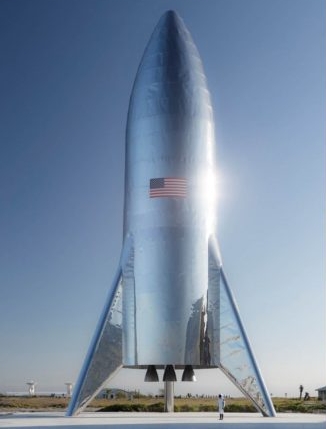
Capitalism in space: SpaceX has released pictures of the fully assembled suborbital Starship hopper, planned for its first test flights in the coming months. The image on the right is not a simulation, but the real thing.
In tweets by Elon Musk, he also revealed that they hope to have an orbital prototype of Starship built by June, with the Super Heavy booster beginning construction in the spring. More information here.
This is unquestionably an ambitious schedule, but the contrast with the development of SpaceX’s manned Dragon capsule, slowed absurdly by the government shutdown and NASA’s bureaucracy, highlights clearly the fundamental reason why SpaceX refused government money for the development of Super Heavy/Starship. By using private funds, SpaceX is free to proceed at its own pace, which is fast, rather than waiting for permission from the bean-counters sitting in NASA offices who have no real idea how to build anything.
It is likely they will not meet this schedule. It is also likely that they will also get this done in a time frame far faster than anyone expects.
The new colonial movement: India’s Chandrayaan-2 lander/rover mission to the south pole region of the Moon has now been re-scheduled for mid-April.
The launch date had to be pushed from the initially scheduled January-February window, as a few related tests could not be completed by the Indian Space Research Organisation (Isro). Isro chairman K Sivan told the media on Friday that the next available slot is during March-April, and the launch could take place by mid-April. However, if this window is passed, the prestigious mission will have to be pushed again to June.
The article also suggests that they have made some changes to the mission’s flight plan.
If you want a really good look at the Chang’e-4 landing site on the far side of the Moon — with Yutu-2 about thirty feet away — photographer Andrew Bodrov has produced a spectacular 360 degree panorama from images sent down by the lander.
This panorama reveals two things. First, the lander landed close to two small craters, which it thankfully missed. Second, there are some hills in the distance which I suspect are central peaks of Von Kármán crater. They are probably beyond Yutu-2’s range, but would make a worthwhile exploratory target.
Meanwhile, the rover and lander have come back to life after a brief hibernation to protect them from the heat of the lunar mid-day.
Finally, China has released a video showing Chang’e-4’s descent and landing, which I have embedded below the fold. In it, you can see the spacecraft computer maneuver to land between those two craters shown in the panorama.
» Read more