
Johnson Space Center shuttered due to flooding
NASA officials have shut the Johnson Space Center due to flooding from Tropical Storm Harvey, though all essential operations involving ISS and the Webb Telescope continue.
They hope to reopen quickly.
NASA officials have shut the Johnson Space Center due to flooding from Tropical Storm Harvey, though all essential operations involving ISS and the Webb Telescope continue.
They hope to reopen quickly.
Russia and China appear ready to sign a cooperative agreement involving the joint exploration of the Moon from 2018 to 2022.
The deal is expected to be signed this October and will bring significant benefits to both nations, particularly in manned and future missions to the moon….
The bilateral agreement will cover five areas including lunar and deep space exploration, developing special materials, collaboration in the area of satellite systems, Earth remote sensing, and space debris research.
No details yet. Moreover, the deal itself has not yet been signed, so this might all vanish into the ether. It does appear however that Russia’s financial problems are forcing it to partner with others, and China presently has a very sophisticated but inexperienced space program and lots of cash. Russia’s experience would be a great help to China, until they don’t need it anymore. Thus, the logic of the agreement.
Posted from the lobby of the Swiftcurrent hotel at the Many Glacier area of Glacier National Park. Diane completed a 10 mile hike today early, so we have the afternoon to relax. Tomorrow we make the long drive south to Capital Reef.
Capitalism in space: Orbital ATK today launched an Air Force satellite using its Minotaur rocket.
The launch also reactivated a Kennedy launchpad that hadn’t been used since 1999.
An evening pause: A beautiful performance on the piano of this “Explosions in the Sky” musical piece.
Hat tip Edward Thelen.
North Korea has launched another ballistic missile.
Not much information yet about its range or capability.
Update (now that I am off the mountain and back in the lobby, able to post): It appears North Korea successfully launched three short range ballistic missiles on Saturday.
Initial reports had suggested that all were failures. Now it appears that all were successful, flying about 150 miles.
An evening pause: Hat tip Carole Brabham.
Capitalism in space: Firefly Aerospace, the company that was forced into bankruptcy when it lost a Virgin Galactic lawsuit for stealing their proprietary engineering, has emerged from bankruptcy.
The full article is behind a paywall, but it appears that the company includes its same management staff under a new owner.
The uncertainty of science: Astronomers have produced the best image so far of the surface face of a star.
The star is Antares, and it provides some details of the star’s complex outer layers. If I was home and had good internet access, I’d post it here.
At the same time, it should be noted that this is not a real image. It is recreated from four telescopes, using interferometry to combine the images, and also includes it a great deal of assumptions and uncertainties in its creation.
Capitalism in space: Interstellar Technologies, the private Japanese rocket company attempting to enter the launch market with a low cost suborbital rocket, will attempt a second test flight before the end of the year.
Their first test flight failed to reach space when they had a communications problem and had to terminate the mission early.
Capitalism in space: SpaceX this week unveiled the flight suit that passengers will wear during their Dragon flights to and from ISS.
This is not strictly a spacesuit. It has limited capabilities, and can essentially only be used during the ferry flights. Nonetheless, I guarantee it as well as Boeing’s were developed for far less and much quicker than anything NASA could have come up with.
Capitalism in space: SpaceX today successfully launched Taiwan’s first homemade commercial satellite.
They also landed the first stage successfully on their barge.d
After a short hike this morning Diane and I decided to relax the rest of the day. Time to catch up on other stuff.
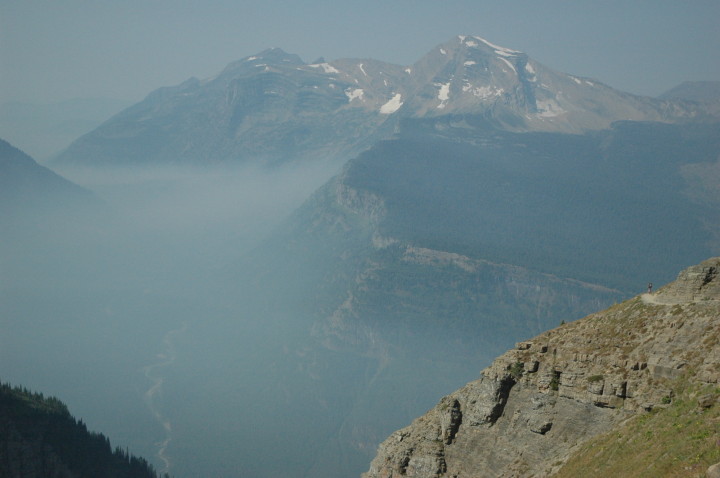
The picture below will help explain why I am not posting much this week. My wife Diane and I are in Glacier National Park, and today we did a 12 mile hike on the Highline Trail, considered by many to be one of the best trails in the U.S. I’ve done a lot of hiking in my life, and I have to agree.
I hope good internet access will return next week, and I will be able to post regularly again. Until then, make sure you look real close at the picture. On the right, at the end of the trail line, is a person. This will give you a sense of the scale here.
An evening pause: The only member of Steely Dan playing here appears to be Jeff “Skunk” Baxter, playing lead guitar. The others include Kipp Lennon on vocals, Nathan East on bass, and CJ Vanston on keys.
Hat tip Joseph Griffin.
A evening pause: Hat tip Diane Zimmerman.
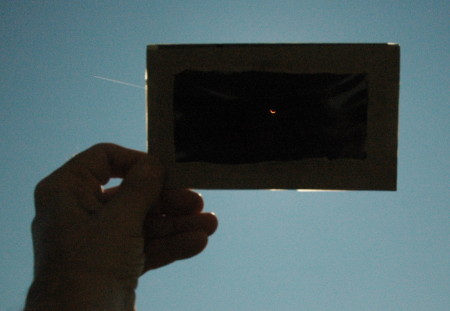
Just arrived at Glacier, where the internet access is bad, and there is no cell service. Thus, this might be my last post for the week. I will try to post in the evening, but this is a vacation, so it will not be my first priority. If I could do it in my room that would okay, but I have to go down to the lobby of the Lake McDonald Lodge.
Anyway the image to the right was taken by me by holding my hand filter out at arm’s length, blocking the sun, and snapping a picture with my camera. It came out far better than I expected, as you can actually see the sun in the filter, partly blocked.
Totality was amazing. I was amazed by two things. First, how quiet it became. There were about hundred people scattered about the hotel lawn, with dogs and kids playing around. The hotel manager’s husband set up speakers for music and to make announcements, but when totality arrived he played nothing. People stopped talking. A hush fell over everything. Moreover, I think we somehow imagine a subconscious roar from the full sun. Covered as it was, with its soft corona gleaming gently around it, it suddenly seemed still.
Secondly, the amazing unlikeliness of the Moon being at just the right distance and size to periodically cause this event seemed almost miraculous. Watching it happen drove this point home to me. And since eclipses themselves have been a critical event in the intellectual development of humanity, helping to drive learning and our understanding of the universe, it truly makes me wonder at the majesty of it. I do not believe in any particular religion or their rituals (though I consider the Bible, the Old Testament especially, to be a very good manual for creating a good life and society), but I do not deny the existence of a higher power. Something made this place, and set it up in this wonderous way. Today’s eclipse only served to demonstrate this fact to me again.
Posting will be light for the rest of the week. If I get a chance I will add some more pictures to this post tomorrow.
» Read more
An evening pause: Though this song has nothing to do with it, the lyrics to me somehow fit with today’s eclipse.
Hat tip Edward Thelen.
New evidence in the scandal surrounding the computer staff used by Democratic congressmen shows that the chief of staff for Yvette Clark (D-New York) apparently okayed the loss of $120,000 worth of missing computer equipment, thus hiding the loss from investigators.
Clarke’s chief of staff at the time effectively dismissed the loss and prevented it from coming up in future audits by signing a form removing the missing equipment from a House-wide tracking system after one of the Awan brothers alerted the office the equipment was gone. The Pakistani-born brothers are now at the center of an FBI investigation over their IT work with dozens of Congressional offices.
A senior House official with knowledge of the situation provided TheDCNF with new details about how exactly the brothers are suspected to have stolen the equipment and possibly data from Congress, raising questions about the members or staffers who were signing the checks on equipment purchases.
The $120,000 figure amounts to about a tenth of the office’s annual budget, or enough to hire four legislative assistants to handle the concerns of constituents in her New York district. Yet when one of the brothers alerted the office to the massive loss, the chief of staff signed a form that quietly reconciled the missing equipment in the office budget, the official told TheDCNF. Abid Awan remained employed by the office for months after the loss of the equipment was flagged.
It is not clear who actually did this, as there was a change in staffing at the time. Either way, it once again appears as if the Awan family had some dirt on the Democrats, and was using it to compel their cooperation in a variety of illegal acts.
The Trump administration has decided to not renew a pro-global warming climate panel set to expire this week.
The panel is part of the National Climate Assessment, a group aimed at helping officials and policy makers integrate the US Government’s climate change analysis into their long-term planning. A mandate for the 15-member Advisory Committee for the Sustained National Climate Assessment is set to expire on Sunday, and will not be renewed.
The press will paint this panel as an objective collection of climate scientists put together to provide the president with good advice on the climate. In truth, it is a part of the propaganda machine for the global warming part of the climate science community, designed to push their conclusions while excluding any skeptical input.
Once again it appears that while Trump might be wishy-washy on many issues, on climate he is serious about dismantling the corruption that has worked its way into that field while eliminating the over-regulation that this corruption has imposed on American society.
Can’t anyone here play this game? The Navy destroyer USS John S. McCain today collided with a merchant ship east of Singapore.
No word of any casualties as yet. The key quote from the article however is this:
This marked the fourth mishap for U.S. Navy ships in the Pacific since February. Aside from the USS McCain and USS Fitgerald incidents, the Navy crusier USS Antietam ran aground dumping over 1,000 gallons of oil in Tokyo Bay in Februray. In May, another cruiser, USS Lake Champlain, hit a South Korean fishing vessel.
Four incidents like this since February? Something in the Navy is seriously wrong.
Update: 5 injured and 10 missing.
Diane and I just arrived at our hotel in Idaho Falls, getting here about an hour earlier than expected because the roads were clear. Nor was I surprised. The typical Chicken-Little panic of government officials in this age is usually wrong, and almost always over-stated. Things look very normal here, with no big traffic jams or crowds. I do expect that tomorrow during the eclipse it will be like a party, as everyone in this hotel is here specifically for it. (I know this because this La Quinta charged premium rates for this event, something they were completely justified in doing. The result however is that it guaranteed that everyone here was here because they were willing to pay the rate.)
Anyway, this only proves again what I’ve written many times. Don’t let fear be your guide. Use your brains and be smart. When something exciting interests you, do it.
The hotel is offering a complementary potato bar dinner for its guests, so off we go to eat.