Has the tourist balloon company Space Perspective gone belly-up?

Space Perspective's Neptune Capsule
Space Perspective’s Neptune balloon capsule

According to the local paper Florida Today, the high altitude tourist balloon company Space Perspective owes more than $90K rent on its facility at Florida’s Space Coast Regional Airport, and has apparently ceased activity in mid-December.

Activity appears to have largely ceased at Space Perspective’s “Mission Control” office building at the Titusville airport, where the facility has appeared largely unoccupied the past two weeks. Nobody answered the doorbell during a trio of FLORIDA TODAY visits since Jan. 6, and no vehicles were in the parking lot just before 1 p.m. Wednesday.

FLORIDA TODAY has left messages unsuccessfully attempting to contact Space Perspective executives. One vehicle was parked in the Mission Control lot Tuesday afternoon, and an employee answered the doorbell. A FLORIDA TODAY reporter passed along a written message seeking comment from company officials.

Another source notes that numerous former employees in recent weeks have been looking for new jobs in the Florida region.

The Florida Today article also documents several other cases where the company had had problems paying its bills.

It is possible the company is dead. There is also the possibility that it remains alive, but has decided to skip town because it is now setting up operations in the Middle East. In one of its last major announcements in November 2024 it revealed it is in negotiations with a number of Middle Eastern nations for flying balloon flights there.

All in all this story is very puzzling. The company had already built its Florida factory for making its balloons, and had done one test flight of a prototype manned capsule for tourist flights. It seemed poised to begin commercial operations. To shut down so suddenly now suggests a lot of things, some of which could indicate some very dishonest motives indeed.

2 comments

FAA demands SpaceX do “mishap investigation” into the loss of Starship yesterday

The FAA today announced that it is going to require SpaceX “to perform a mishap investigation into the loss of the Starship vehicle during launch operations on Jan. 16.”

Will this demand involve the same delays seen during the Biden years? I strongly believe they will not, for several reasons.

First, the FAA’s announcement seemed to me to have a decidedly different tone than in the past. It didn’t say “The FAA needed to complete a mishap investigation,” it said SpaceX had to do it. During the Biden administration the FAA made believe it was qualified to investigate any issues on a Starship/Superheavy launch, when in reality it had no such qualifications at all. It simply waited for SpaceX to complete its investigation, then would spend one to three months as it retyped SpaceX’s report.

Before Biden, the FAA let the company do the investigation, and quickly accepted its conclusions. That appears to be what it is doing now.

Second, Musk’s own response in announcing the preliminary results of the SpaceX investigation yesterday suggests he already expects the FAA to change its approach in this manner. “Nothing so far suggests pushing next launch past next month.” Right away he is signaling us that when SpaceX completes its work it expects the FAA to quickly okay the next flight. No long waits for paper work.

Third, there is Trump. If any FAA bureaucrats still try to play power games against SpaceX they will quickly discover they have no allies in the chain of command. Musk will make these games public, and Trump will come down hard against them.

That’s my hopeful prediction. We shall shortly see if my optimism has merit.

Hat tip to BtB’s stringer Jay.

17 comments

Hubble’s biggest image yet, of Andromeda

Andromedia as seen by Hubble
Click for original image.

The image above, cropped and reduced to post here, was taken by the Hubble Space Telescope and shows the Andromeda galaxy, the Milky Way’s nearest spiral galaxy neighbor. The picture however is not one photo, but hundreds taken over the past decade.

This is largest photomosaic ever assembled from Hubble Space Telescope observations. It is a panoramic view of the neighboring Andromeda galaxy, located 2.5 million light-years away. It took over 10 years to make this vast and colorful portrait of the galaxy, requiring over 600 Hubble overlapping snapshots that were challenging to stitch together. The galaxy is so close to us, that in angular size it is six times the apparent diameter of the full Moon, and can be seen with the unaided eye.

Andromeda is not just visible to the naked eye, it is one of the largest objects seen in the sky. If you ever can get to a really dark sky location when it is above and have someone point it out to you (it remains faint), you will be astonished to find that it stretches across the sky the length of about six to eight full moons.

Thus, Hubble literally can’t take a picture of it. Its field of view is much too small. It must take many pictures to assemble a mosaic.

The picture above also hides the data contained in all those images. At the full resolution of each individual picture, Hubble has literally mapped the entire galaxy. Combined with other spectroscopic survey data taken by Hubble, astronomers over time will be able to decipher the galaxy’s makeup to better understand its formation history.

0 comments

U.S and Norway sign deal to allow U.S. companies to launch from Andøya

Proposed spaceports surrounding Norwegian Sea

The U.S. and Norway have now signed an agreement that will make it possible for American rocket and satellite companies to launch from Norway’s Andøya Spaceport, easing State Department rules that up until now made such launches difficult if not impossible.

[The Technology Safeguards Agreement (TSA)] will ensure the protection of U.S. technology, enabling the transfer of commercial launchers to Norway. Similar agreements have been established between the U.S. and other allied nations, including Australia, New Zealand, and the United Kingdom.

Right now Andoya has only two rocket customers, the German startup Isar Aerospace and a Polish suborbital startup, SpaceForest. Both hope to do launches sometime this year. Unlike the red tape that the United Kingdom has imposed on its new spaceports, Norway appears to be doing everything it can to grease the wheels so that launches can occur quickly and on schedule.

1 comment

January 16, 2025 Quick space links

Courtesy of BtB’s stringer Jay. This post is also an open thread. I welcome my readers to post any comments or additional links relating to any space issues, even if unrelated to the links below.

  • Hubble faces budget cuts
    To translate: Give us more money! I’d be more sympathetic if NASA was more willing to consider a rescue mission. If not, then there is every reason in the world to begin winding down operations.
5 comments

Starship lost near end of its orbital burn; Superheavy successfully captured by chopsticks

Superheavy captured for the second time

In today’s seventh test flight of SpaceX’s Starship/Superheavy large rocket, the results were decidedly mixed.

First the success: Superheavy once again performed perfectly, getting Starship up to speed and releasing it for its orbital flight. It then successfully returned to the tower at Boca Chica, where the chopsticks arms caught it. This was the second catch in three attempts. While we should all expect SpaceX to continue to refine Superheavy, right now it appears to be largely ready to go.

Next the failure: Shortly after stage separation Starship fired its own engines and proceeded upward towards orbit. At one point close to when it was suppose to shut off its engines to begin its orbital coast phase, something went wrong. Some engines cut off, but one did not, at least according to data projected on the screen. At that point all telemetry from the ship ended.

After another ten minutes of analysis flight controlers declared the ship lost. What happened remains unclear, but it is certain SpaceX engineers are digging hard to find out.

One unfortunate question remains that must be asked: Where is the ship, and is there a chance it will come down somewhere unexpected? Its orbit is such that it will naturally fall in the Indian Ocean, but the engine issues might have changed that orbit somewhat.

UPDATE: Locals in the Turks and Caicos Islands in the Caribbean post videos on X (here and here) of Starship breaking up overhead. It appears that if any debris reaches the ground it will land in the Atlantic.

31 comments

Live stream of the 7th test orbital flight of Starship/Superheavy

I have embedded below the live stream of today’s attempt by SpaceX to complete the 7th orbital flight of its giant rocket Starship/Superheavy. The stream goes live at around 3:15 pm (Central), 45 minutes before the start of the one hour launch window beginning at 4 pm (Central).

For embed purposes I am using the youtube version provided by Space Affairs. Once SpaceX’s feed goes live on X you can then switch to it, found here.

The flight’s goals:

Superheavy: Complete the second catch of the booster at the launch tower using the chopsticks. The booster will also be reusing an engine from the fifth test flight to confirm its viability for reuse.

Starship: Test new avionics, a new fuel feed system, and new heat shield tiles as well as the ablative material used underneath the tiles. Test a different placement and configuration of the flaps. The ship will also test engineering that will eventually lead to it being captured by the chopstick tower on return.

There will be an engine restart during Starship’s orbital cruise phase to further confirm the Raptor-2 engines can work reliably when needed during a full orbit de-orbit burn.

Finally, the ship will test its Starlink deployment system, releasing 10 dummy Starlink satellites.
» Read more

10 comments

One Martian ridge among many

One Martian ridge among many
Click for original image.

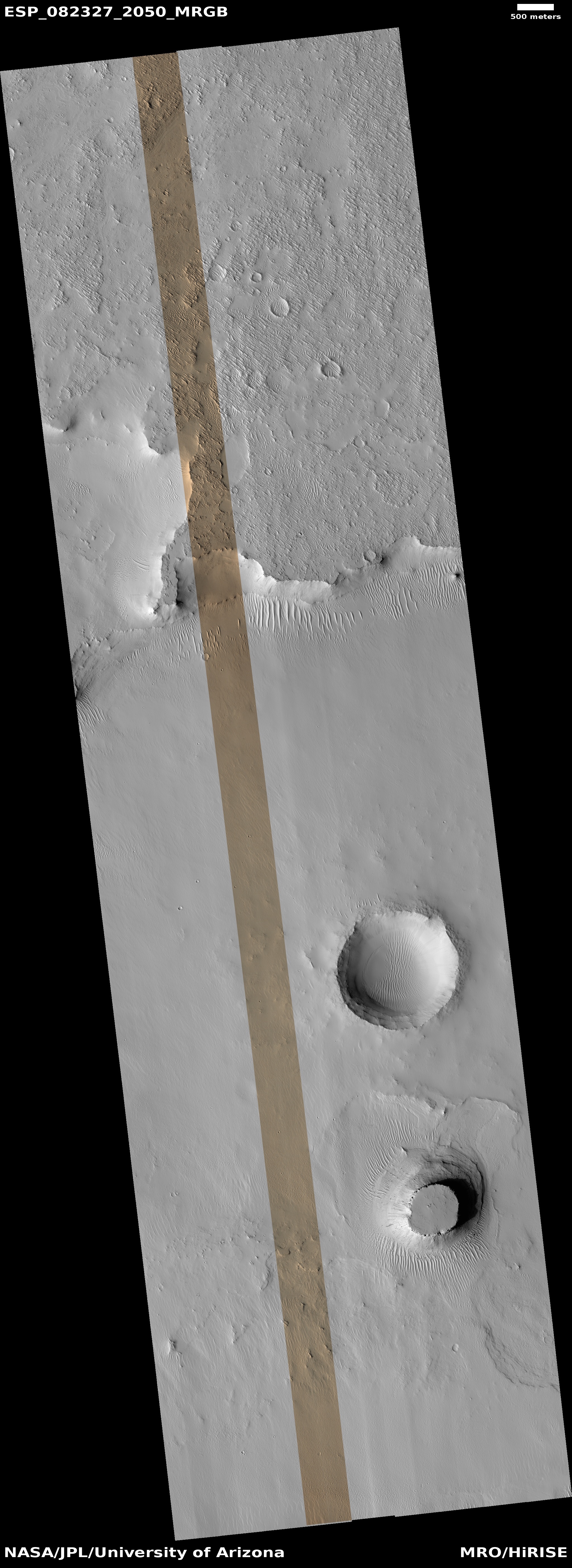
Cool image time! The picture to the right, cropped, reduced, and sharpened to post here, was taken on August 30, 2024 by the high resolution camera on Mars Reconnaissance Orbiter (MRO). It is labeled as a “terrain sample,” so it was likely taken not as part of any specific research project but to fill a gap in the camera’s schedule.

The subject this time was a series of parallel ridges. I have cropped the image to focus on the most distinct, which stands at its highest about 600 feet below the dune-filled hollows to the north and south. The streaks on its flanks are likely slope streaks, a phenomenon unique to Mars that is presently not entirely understood. Streaks appear like avalanches, but they do not change the topography at all, and in fact in some cases go up and over rises. It is believed they are related to dust events, but this is not yet confirmed.

Why focus on this ridge however? It isn’t as if this is the most stunning geology on Mars.
» Read more

0 comments

Rocket Factory Augsburg gets conditional licence for launching at Saxavord

Proposed spaceports surrounding Norwegian Sea

After years of delays and multiply approvals that in the end turned out to be meaningless, the United Kingdom’s Civil Aviation Authority (CAA) announced today that it has finally issued a launch license to the German rocket startup Rocket Factory Augsburg to do an orbital test launch from the Saxavord spaceport in the Shetland Islands.

The license however is not entirely without strings.

The licence is effective immediately, but a number of conditions need to be met before a launch can take place — including insurance arrangements and international agreements. The company is also required to give the CAA 60 days’ notice before launching.

Rocket Factory had hoped to launch last year, but it lost its RFA-1 rocket during a static fire test in August. It was planning a subsequent launch on the assumption the CAA would approve its licence in 2024. That assumption was wrong however. Even if the rocket had not been destroyed and was ready to go, the CAA was not, and continued to twiddle its thumbs until 2025. It is this twiddling that caused another German rocket startup, Hyimpulse, to abandon its plans to do launches from Saxavord, and switch to a new spaceport in Australia.

Rocket Factory now says it will attempt its first launch before the end of this year. Let’s see if the CAA lets that happen.

0 comments

Blue Ghost operating as expected on its way to the Moon

Blue Ghost selfie
Blue Ghost selfie. Click for original.

Firefly has announced that all is well with its Blue Ghost lunar lander, now in an ever expanding Earth orbit on its way to the Moon. Engineers have acquired signal and completed its on-orbit commissioning.

With a target landing date of March 2, 2025, Firefly’s 60-day mission is now underway, including approximately 45 days on-orbit and 14 days of lunar surface operations with 10 instruments as part of NASA’s Commercial Lunar Payload Services (CLPS) initiative.

…Firefly’s Blue Ghost will spend approximately 25 days in Earth orbit, four days in lunar transit, and 16 days in lunar orbit, enabling the team to conduct robust health checks on each subsystem, calibrate the propulsion system in preparation for critical maneuvers, and begin payload science operations.

NASA today released the first picture downloaded from the spacecraft, shown to the right. The view looks across the top deck of the lander, with two NASA science instruments on the horizon.

Once it lands it is designed to operate for about two weeks, during the lunar day. It will attempt to further gather some data during the long two-week long lunar night, but is not expected to survive to the next day.

0 comments

Stoke Space raises another $260 million, more than doubling its private capital

Stoke's Nova rocket
Stoke’s Nova rocket

The rocket startup Stoke Space, which is attempting to develop its own fully reusable two stage rocket, announced yesterday that it has successfully raised $260 million of private investment capital in its most recent funding round, more that doubling what it had raised previously and bringing the total raised by the company to $480 million.

The funding round involves new and existing investors including Breakthrough Energy Ventures, Glade Brook Capital Partners, Industrious Ventures, Leitmotif, Point72 Ventures, Seven Seven Six, the University of Michigan, Woven Capital, and Y Combinator, among others.

The company’s Nova rocket will use what has become the standard for first stage re-use, a vertical take-off and landing. Its second stage however will also be reusable, something no one has yet succeeded in doing, and Stoke intends to do it in a radical manner. Rather than use a single nozzle on its upper stage, it has instead gone with a new design whereby thrust is released through a string small nozzles placed in a ring on the bottom outside of the stage. The base of the stage can thus get a heat shield. The plan is to have the stage return much like many returnable capsules, with the small nozzles then used to provide control and thrust during landing.

This new influx of cash indicates renewed confidence in the company among the investor class. Its recent successful test of its Zenith first stage engines probably help fuel that confidence.

It had hoped to do its first test launch this year from Cape Canaveral, but has recently been burdened with new environmental red tape that might impact those plans.

1 comment
1 198 199 200 201 202 2,413