
July 28, 2021 Zimmerman/Batchelor podcast
Embedded below the fold in two parts.
» Read more
Very brief descriptions, with appropriate links, of current or recent news items.
Embedded below the fold in two parts.
» Read more

Click for full image.
Cool image time! The science team for the high resolution camera on Mars Reconnaissance Orbiter (MRO) today released a pair of images the camera took on June 28, 2021 of the nearest pitted cone to China’s Zhurong rover.
The stereo anaglyph to the right, cropped and reduced to post here, allows you, with blue-red 3D glasses, to see the cone in three dimensions. Quite impressive. As noted by Alfred McEwen of the Lunar & Planetary Laboratory in Arizona in his caption,
This image completed a stereo pair of a region just west of where the Zhurong rover landed in southern Utopia Planitia.
The cutout is from a portion of the stereo anaglyph, showing an enigmatic pitted cone. Is this cone composed of sediments or volcanic materials? The sharp bright features surrounding the cone are aeolian (wind-blown) landforms.
According to McEwan, the hill itself is about 200 to 220 feet high, with the pit at its top about 60-65 feet deep.
While McEwan has told me this cone would be his primary target if he was running Zhurong, it appears the Chinese are instead heading south toward the largest nearby crater, and on the way inspecting the parachute, fairing, and heat shield discarded just prior to landing.
The mosaic below from three MRO context camera images provides a wider overview.
» Read more
Twitter’s goal: Only Democrats can have freedom of speech.
Photo credit: William Zhang
The new dark age of silencing: In a single purge Twitter yesterday banned all the accounts of all election audits going on in Arizona, Georgia, Pennsylvania, Nevada, and Wisconsin.
Earlier today Twitter permanently suspended all nine of the official ‘Audit War Room’ accounts from it’s platform. The accounts were a main source for breaking updates and were banned as part of big tech’s continued attempt to shield the public from the stunning revelations being found regarding the fraudulent 2020 election.
Unsurprisingly, Twitter provided no reason for the suspensions. [emphasis mine]
Note the highlighted sentence. Twitter is no longer even pretending that it is banning these accounts because of some vague “community standard” that each violated. No, Twitter banned them simply because it is possible that the election audits going on in these states might actually uncover evidence of election fraud, and to allow honest and real news reporting can no longer be allowed, if that reporting might threaten the dominant leftist agenda and the Democratic Party politicians who are imposing it.
» Read more
The podcast of my two-hour appearance last night on The Space Show with David Livingston is now available here.
Thank you to David and tor everyone who called or emailed questions. Twas a very good show, to my mind. It also allowed me hone my verbal description of my new book, Conscious Choice. When I finish a book, I tend initially to get buried in the details in describing it in interviews. This appearance allowed me to get an idea on how to talk about the book quickly, in summary. I think it went well, and will certainly get better with future appearances.
Capitalism in space: According to this Ars Technica article by Eric Berger yesterday, Blue Origin has begun working on a project dubbed Jarvis, focused on making the upper stage of its orbital and as yet unlaunched New Glenn rocket reusable.
Bezos had been asking his senior staffers about reusable upper stages, but advisers told him such an approach was unlikely to work, sources said. Bezos also seems to have been told the SpaceX “fail forward” method of rapidly prototyping and testing Starships, with few processes and procedures, would be unlikely to succeed.
However, over the last year, Bezos took note as SpaceX launched and landed its Starship vehicle. This is one of the reasons he decided to initiate a project named “Jarvis” at Blue Origin within the reusable second-stage program. Sources said Bezos has walled off parts of the second-stage development program from the rest of Blue Origin and told its leaders to innovate in an environment unfettered by rigorous management and paperwork processes. [emphasis mine]
The highlighted sentences indicate evidence that the management that Bezos brought in to run Blue Origin for him in 2017 was definitely old school big space managers, with limited vision and timid about risk-taking, and that Bezos is beginning to recognize this and shift control of the company away from them.
This is excellent news, and suggests that we shall finally see some real progress at Blue Origin, something that has been lacking for the past four years. It also suggests that Bezos now recognizes he needs to make his rocket competitive with what SpaceX has, and is taking steps to make that happen
Isn’t competition and freedom wondeful? When allowed to flourish it makes things happen fast, and with amazing daring.
Capitalism in space: The German startup rocket company Isar Aerospace announced today that it has raised $75 million, bringing the total in private investment capital it has obtained to $180 million.
The initial funding had funded construction of their Spectrum smallsat rocket. This new funding the company says will be used to expand their manufacturing and to begin work on making their rocket reusable.
Spectrum, the rocket Isar is developing, is a two-stage vehicle designed to place up to 1,000 kilograms into low Earth orbit. The vehicle is powered by Aquila engines that the company is also building.
Guillen said the company is preparing to start tests of the full Aquila engine soon on a test stand in Kiruna, Sweden. Isar is also working on a launch site in Norway, having signed an agreement in April with Andøya Space for exclusive use of a pad at a new site under development by the state-owned launch site operator.
A first launch of Spectrum from Andøya is expected in the second half of 2022, she said. The company expects to conduct three to four launches in 2023, with a long-term goal of about 10 launches per year. While Andøya is well-suited for launches to sun-synchronous orbits, Isar is considering alternative launch sites, such as French Guiana, for missions to lower inclination orbits.
Isar is one of three German smallstat rocket company startups, and appears from all accounts to be ahead of the other two, Rocket Factory Augsburg and HyImpulse Technologies, in funding and development.
There is some long term historical context to these German rocket companies. Following World War II, Germany was forbidden to build such things, both legally and culturally, as rockets too closely resemble the V2 rocket used by Hitler to bomb Great Britain. Even when Germany joined the European Space Agency as a partner the rocket building was left mostly to the French and the Italians.
This has now changed, partly because the rockets are small, partly because Europe has been shifting to the capitalism model in its space industry, partly because the memories from World War II have faded, and partly because ESA’s subsized effort at Arianespace to build a new low-cost replacement for its Ariane 5 rocket has not been successful. The Ariane 6 costs too much, and is thus not garnering customers from within ESA.
I think it will be really great to start listing separate European private companies in my launch race updates. Doing so will only emphasize the global acceleration of the competition to get into space.
Click for full image.
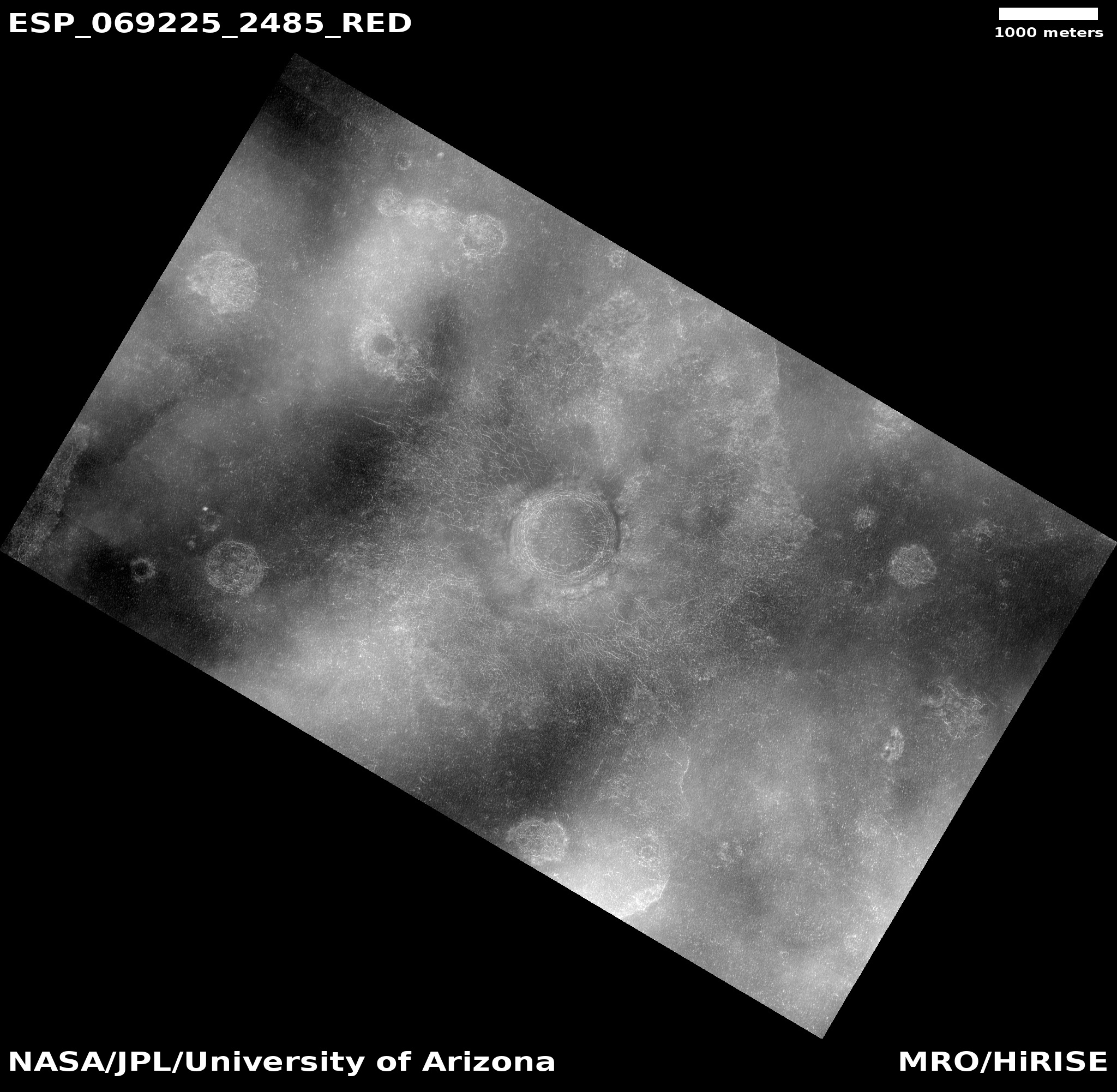
Cool image time! The photo to the right, cropped to post here, was taken on May 3, 2021 by the high resolution camera on Mars Reconnaissance Orbiter (MRO). It shows a remarkably fractured crater that lies only a few miles to the southeast of where the now-inactive Phoenix lander put down back in 2008, at the very high latitude of 69 degrees north.
Phoenix was purposely sent to this high latitude to find out what the ground and atmosphere was like there. It found the following:
Phoenix’s preliminary science accomplishments advance the goal of studying whether the Martian arctic environment has ever been favorable for microbes. Additional findings include documenting a mildly alkaline soil environment unlike any found by earlier Mars missions; finding small concentrations of salts that could be nutrients for life; discovering perchlorate salt, which has implications for ice and soil properties; and finding calcium carbonate, a marker of effects of liquid water.
Phoenix findings also support the goal of learning the history of water on Mars. These findings include excavating soil above the ice table, revealing at least two distinct types of ice deposits; observing snow descending from clouds; providing a mission-long weather record, with data on temperature, pressure, humidity and wind; observations of haze, clouds, frost and whirlwinds; and coordinating with NASA’s Mars Reconnaissance Orbiter to perform simultaneous ground and orbital observations of Martian weather.
Below is an overview map showing the location of both this crater and the Phoenix lander.
» Read more
Tonight I will be doing another long appearance from 7:00-9:00 pm (Pacific) with David Livingston on The Space Show. I hope my readers tune in and, more importantly, call in with questions.
I will most certainly talk about my new book, Conscious Choice, describing how the failures in British colonial America can inform us on building colonies on Mars and elsewhere.

No first amendment allowed at Berea College!
Persecution is now cool! The administration at Berea College, a Christian university in Kentucky, fired tenured professor Dave Porter because one student complained about a research survey he was conducting.
Porter’s offense was to have done a survey of attitudes on campus. One student claimed that the survey was a retaliation against her for having filed a Title IX complaint. Writes Porter, “The campus was quickly polarized, and the administration saw a crisis looming. Apparently, the dean had received information from a former student that current students were fearful of attending my classes. There was no investigation and suggestions of mediation or compromise were squelched by the dean’s claim that I was ‘unrepentant and unapologetic.’” [emphasis mine]
More details in this essay Porter himself wrote:
» Read more
The FCC under the Biden administration has informed the companies who obtained subsidies to encourage broadband access in rural areas that the money can only be spent in those areas, not on infrastructure improvements in facilities located in regions that already have good internet access.
The Federal Communications Commission told SpaceX and other companies on Monday that the billions in rural broadband subsidies it doled out last year can’t be used in already connected areas like “parking lots and well-served urban areas,” citing complaints. The commission, in an effort to “clean up” its subsidy auction program, offered the companies a chance to rescind their funding requests from areas that already have service.
The companies that got the subsidies must do the work to determine they qualify for the money, wrote Michael Janson, director of the FCC’s Rural Broadband Task Force, in a letter addressed to SpaceX’s finance director David Finlay. Similar letters, first reported by Bloomberg, were sent to other recipients of the commission’s Rural Digital Opportunity Fund, a $9.2 billion auction to expand broadband into rural areas that lack or have no service.
The news reports I’ve seen of this story have all been from the generally leftwing press, and have been written to hammer SpaceX. No matter. This program is rife with corruption and the misuse of taxpayer money. SpaceX doesn’t need the nearly billion dollar subsidy it got, or if it does need the billion, it should get it from private investment. As should all the other companies getting cash in this program.
Sadly, the Biden administration does not appear interested in ending the program. Instead, I get the sense what it really wants to do is send the cash to its own cronies, instead of the cronies favored by the Trump adminstration. Thus, do not be surprised if Blue Origin’s as-yet unbuilt Kuiper constellation starts to be a recipient of funds, even as the money is cut from SpaceX’s Starlink constellation.
Link here. The astrophysicist, Paul Sutter, does a very nice job of outlining the conundrum that has been causing astrophysicists to tear their hair out for the past decade-plus.
In the two decades since astronomers discovered dark energy, we’ve come upon a little hitch: Measurements of the expansion rate of the universe (and so its age) from both the CMB [cosmic microwave background] and supernovas have gotten ever more precise, but they’re starting to disagree. We’re not talking much; the two methods are separated by only 10 million or 20 million years in estimating the 13.77-billion-year history of the universe. But we’re operating at such a level of precision that it’s worth talking about.
If anything, this failure for two measurements of data spanning billions of light years — which is billions in both time and space — is a perfect illustration of the uncertainty of science. Astrophysicists are trying to come up with answers based on data that is quite thin, with many gaps in knowledge, and carries with it many assumptions. It therefore is actually surprising that these two numbers agree as well as they do.
Sutter, being in the CMB camp, puts most of the blame for this failure on the uncertainty of what we know about supernovae. He could very well be right. The assumptions about supernovae used to measure the expansion rate of the universe are many. There is also a lot of gaps in our knowledge, including a full understanding of the process that produces supernovae.
Sutter however I think puts too much faith in theoretical conclusions of the astrophysics community that have determined the age of the universe based on the CMB. The uncertainties here are as great. Good scientists should remain skeptical of this as well. Our knowledge of physics is still incomplete. Physicists really don’t know all the answers, yet.
In the end, Sutter however does pin down the biggest problem in cosmology:
The “crisis” is a good excuse to keep writing papers, because we’ve been stumped by dark energy for over two decades, with a lot of work and not much understanding. In a sense, many cosmologists want to keep the crisis going, because as long as it exists, they have something to talk about other than counting down the years to the next big mission.
In other words, the discussion now is sometimes less about science and theories and cosmology, but instead about funding and career promotion. What a shock!
In an open letter to NASA administrator Bill Nelson, Blue Origin founder Jeff Bezos offered to waive $2 billion in payments should NASA decide to switch its contract for building the manned lunar lander contract from SpaceX to the Blue Origin team, including Lockheed Martin, Northrop Grumman and Draper.
Blue Origin and its industry partners — including Lockheed Martin, Northrop Grumman and Draper — bid $6 billion to design and build a competing landing system. After SpaceX won the award, Blue Origin’s team and Dynetics, the third competitor for a NASA contract, filed protests with the Government Accountability Office. The GAO is due to rule on those protests by Aug. 4.
In his letter to Nelson, Bezos revisits the issues laid out in Blue Origin’s protest and complains that NASA “chose to confer a multi-year, multibillion-dollar head start to SpaceX” in the Human Landing System competition. He noted that NASA gave SpaceX a chance to revise its bid to fit NASA’s financial needs, and that Blue Origin wasn’t given a similar opportunity. “That was a mistake, it was unusual, and it was a missed opportunity,” Bezos wrote. “But it is not too late to remedy.”
Bezos then offered to waive all payments in the 2021-2023 fiscal years, up to $2 billion, “to get the program back on track right now.” He said that would be in addition to the $1 billion in corporate contributions that was previously pledged.
The article notes there may be some legal issues blocking such an offer. I also wonder what Blue Origins partners think about this. Has Bezos discussed it with them? Is he offering to cover their profits as well?
We must also be cognizant of one important detail: The Blue Origin team’s proposal lost the bid largely because was ranked below SpaceX’s for both financial and technical reaosns. Even more important, that team’s lander does yet not exist, even in prototype. No significant work has been done. And Blue Origin itself has so far failed to launch anything into orbit, with its orbital rocket New Glenn two years behind schedule. None of this inspires confidence.
SpaceX meanwhile has been test flying its Starship lander in repeated flight tests, demonstrating its capabilities.
Consider this bidding war from a custoner’s perspective. Blue Origin has yet to prove it can build what it promises. SpaceX is already doing so. And it bid less as well.
On August 4th the GAO will rule on the protests of both losers, Blue Origin and Dynetics. Anything can happen, but I strongly expect them to rule in favor of NASA and SpaceX.
And even if they do rule that the contract must be rebid, the bottom line remains: Blue Origin has got to stop trying to win its contracts in the courts, and finally start build the orbital spacecraft and rockets it has been promising for years. I have every faith it can be done. Bezos just has to get his company focused once again in doing so.

Stone her! She shook Trump’s hand!
Persecution is now cool! Addison Rae, an actress who IMDB calls TikTok’s second most popular and highest earning performer, was attacked by a mob on TikTok, YouTube, and Twitter for daring to shake hands with Donald Trump at a Las Vegas boxing event on July 11th.
As shown on a video at the link, “the two shook hands and she mentioned that she just “had to say hi” and that it was “so nice to meet you.”
How dare she?! The mob effort grew so loud that a Buzzfeed “news” reporter wrote a story expressly focused on determining if Rae was a Trump supporter, with the reporter stating:
[C]onsidering Rae has ignored questions about whether or not she is a Trump supporter, I decided to test her digital footprint and see for myself. So, I scrolled through all of her likes in 2016, when the Hillary Clinton v. Donald Trump election reached its peak, to see just how many of these accidental Twitter bugs I could find.
The reporter, Alexa Lisitza, discovered a variety of tweets in 2016 that suggested Rae actually might have had an open mind about Trump, and was not all-hate all-the-time, and might even have decided to vote for him. As the reporter concluded, “That’s it for 2016. Who knows what lies in the years spanning throughout the election, but do with this information what you will.” The implication of course is that Rae should be blacklisted for this blasphemy.
Nor was this Buzzfeed article unique. » Read more
Click for full image.
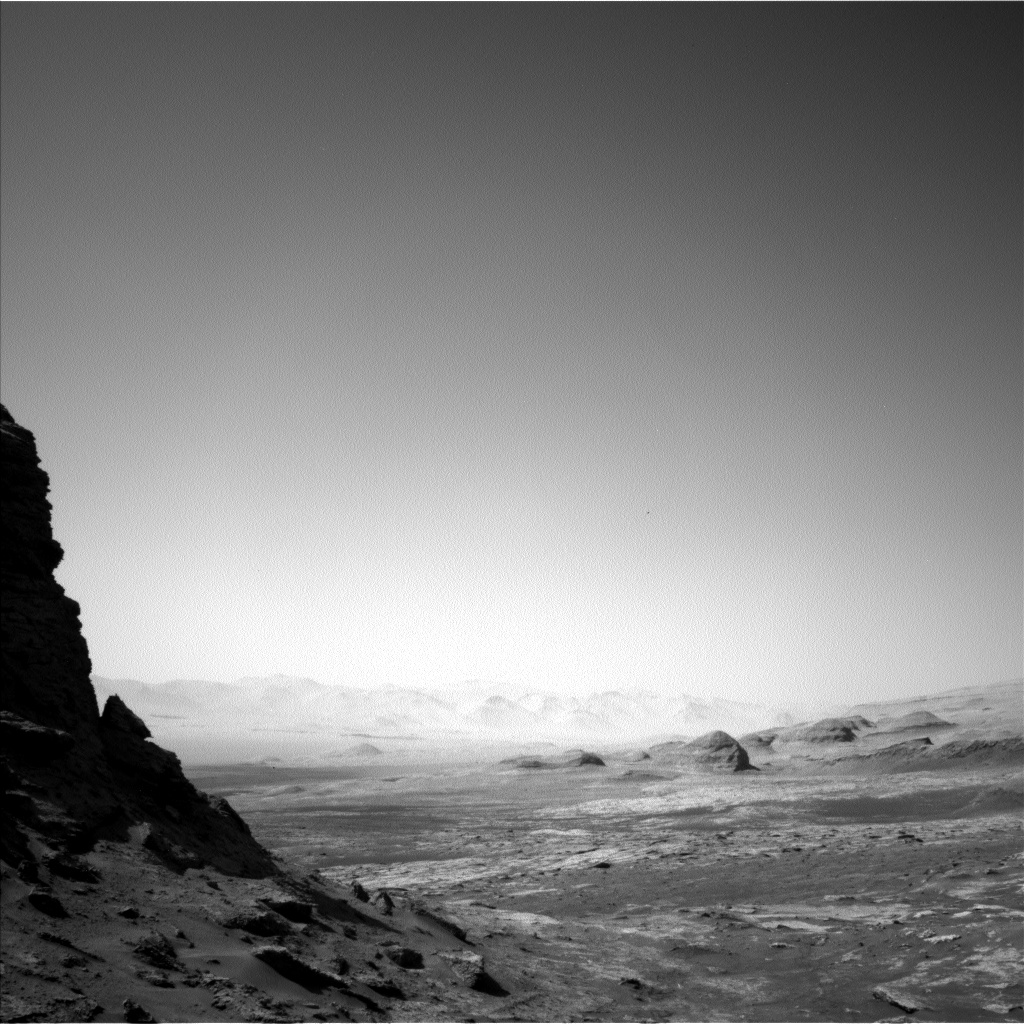
A quick cool image! The photo to the right, reduced to post here, was taken yesterday by Curiosity’s left navigation camera. It looks west across the floor of Gale Crater, at the base of a nearby butte.
The crater rim, as seen by the distant mountains, is about 25 miles away. The butte that towers above Curiosity is probably no more than 50 feet high.
Below is a panorama showing the full view to the west, with Navarro Mountain (the nearby 450-foot-high foothill at the base of Mount Sharp) on the left edge. Based on the rover’s planned route, it will travel to the right of the butte rather than climbing up onto the saddle on the left. This will take it to the western side of Navarro Mt, where it will eventually head south into the canyon Gediz Vallis.
» Read more
Using Hubble data, astronomers have detected the first evidence of water vapor in the atmosphere of Jupiter’s largest moon, Ganymede.
Though larger than the blistering planet Mercury, the Jovian moon Ganymede is no place to go sunbathing. Located ½-billion miles from the Sun, the water ice on its surface is frozen solid in frigid temperatures as low as minus 300 degrees Fahrenheit. This makes the ice as hard as rock. Still, a rain of charged particles from the Sun is enough to turn the ice into water vapor at high noon on Ganymede.
This is the first time such evidence has been found, courtesy of the Hubble Space Telescope’s spectroscopic observations of aurora on Ganymede spanning two decades. The auroras are used to trace the presence of oxygen, which then is linked to the presence of water molecules sputtering off the surface. Ganymede has a deep ocean located an estimated 100 miles below the surface. That’s too deep for water vapor to be leaking out.
This detection has a margin of uncertainty, but it provides a baseline for the up close observations planned for Europe’s JUICE orbiter, set to launch in ’22 and arrive in Jupiter orbit in ’29. JUICE’s study focus will be the three Galilean moons that appear to have lots of ice, Ganymede, Calisto, and Europa.
With the engine problems of Russia’s new ISS module Nauka apparently resolved sufficiently for its rendezvous and docking expected on on July 29th, Russian astronauts today undocked the 20-year-old Pirs module, which then used its engines so that it safely burned up over the Pacific Ocean.
The article provides a nice history of Pirs, which was originally intended for Russia’s Mir-2 station, never built after the fall of the Soviet Union.
Pirs, meaning “pier,” traces its origins back to the Mir-2 space station — which was itself a Soviet project that’s design began in 1976. Mir-2’s long and troubled history would eventually find it in the early 1990s where major design changes to launch its various modules via the Buran space shuttle were underway.
Following the collapse of the Soviet Union in December 1991, Mir-2 emerged the following year as a four-module station — including a Docking Module, which would become Pirs. In 1993, Mir-2 officially merged with the long-delayed NASA/European/Japanese/Canadian space station Freedom project to become the building blocks of the International Space Station.
The module, which provided the Russian half of ISS needed extra docking ports, was originally expected to be replaced after about five years with a larger module, but this was never built.
This post incorrectly reported a Chinese launch as occurring today when it had actually occurred (and was reported previously. I have therefore deleted it. Sorry about the error.
The leaders in the 2021 launch thus remain as follows:
23 China
20 SpaceX
12 Russia
3 Northrop Grumman
The U.S. still leads China 29 to 24 in the national rankings.
The news coming from the Perseverance and Ingeniuty science teams has been sparse this past weekend, even though Perseverance had begun drilling its first core sample that it will stored for pickup by a later unmanned robot, and Ingenuity had attempted its 10th and most challenging flight yet.
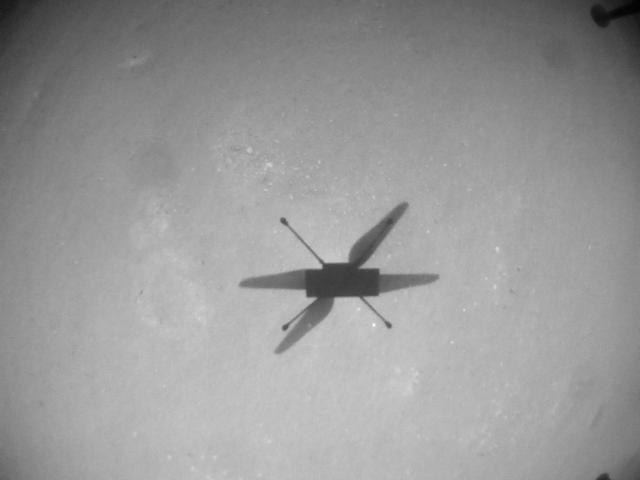
We do have images however, and the two to the right give us hints about what has happened.
First, the top picture on the right was taken by Ingenuity’s navigation camera just prior to landing. The camera looks straight down and is used by the helicopter to adjust its flight. The dark area is the helicopter’s shadow. Based on this picture and the four preceding images (taken over an eleven second period), it appears the helicopter was landing safely. No other images have yet been downloaded, nor has the Ingenuity team announced any results, so we do not yet know if the flight proceeded as planned.
UPDATE: The flight was a success, as per this JPL announcement:
With the #MarsHelicopter’s #flight success today, we crossed its 1-mile total distance flown to date. It targeted an area called “Raised Ridges,” named for its #geographic features. Flight 10 is #Ingenuity’s most complex flight profile yet, with 10 distinct waypoints and a new #record height of 40 feet (12 meters).

The second image, taken by Perseverance’s left navigation camera and cropped and reduced to post here, is more puzzling. It shows what appears to be the core sample still in the ground after drilling. While this could be entirely as planned, it seems very surprising. Most of what I can find online describing the operation for obtaining these samples implies that the robot arm would drill the hole, and then retract the sample immediately to place it in storage. Nothing suggests the arm would be retracted with the sample still in the ground.
I think however the odds of this picture revealing a problem are low. This JPL press release from February 2021 implies vaguely that the core sample will be released in this manner before retraction. After the core sample, with bit, is separated from the arm, the release suggests they will lift the arm away to inspect the drilling process, then return the arm to retract the core sample for storage. This does make some sense, though grabbing that sample again will be quite challenging.
If this was not supposed to happen as described, then there is a problem that must be resolved. I expect more details in the next day or so to clarify this situation.
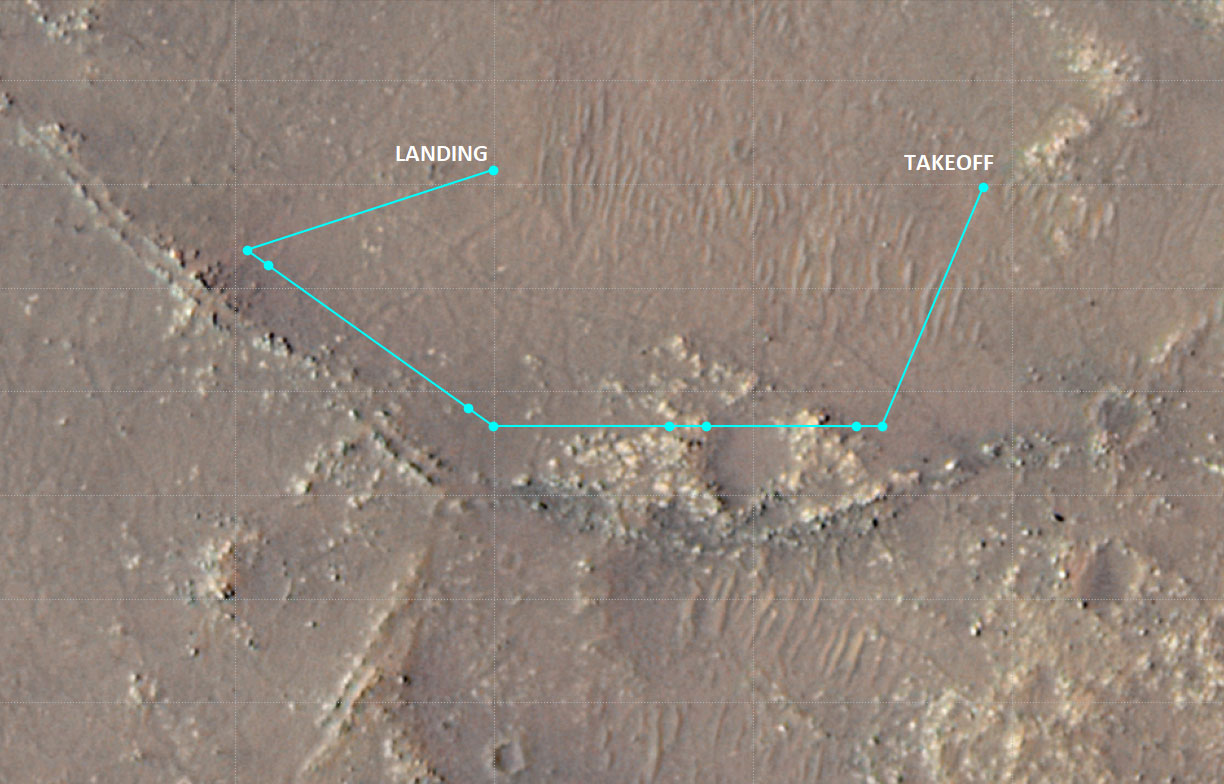
Click for full image.
Though circumstances can obviously change, the Ingenuity/Perseverance science teams have scheduled Ingenuity’s 10th Martian flight for sometime later today, with a flight plan, shown to the right, that is even more ambitious.
Flight 10 will allow us to reap the benefits of our previous flight. Scheduled for no earlier than this Saturday (July 24), Flight 10 will target an area called the “Raised Ridges” (RR), named for the geographic features that start approximately 164 feet (50 meters) south-by-southwest of our current location. We will be imaging Raised Ridges because it’s an area that Perseverance scientists find intriguing and are considering visiting sometime in the future.
From navigation and performance perspectives, Flight 10 will be our most complex flight to date, with 10 distinct waypoints and a nominal altitude of 40 feet (12 meters). It begins with Ingenuity taking off from its sixth airfield and climbing to the new record height. It will then head south-by-southwest about 165 feet (50 meters), where upon hitting our second waypoint, take our first Return to Earth (RTE) camera image of the Raised Ridges, looking south. Next, we’ll translate sideways to waypoint 3 and take our next RTE image – again looking south at Raised Ridges.
Imagery experts at JPL hope to combine the overlapping data from these two images to generate one stereo image. Flying farther to the west, we’ll try for another stereo pair of images (waypoints 4 and 5), then head northwest for two more sets of stereo pairs at waypoints 6 and 7 as well as 8 and 9. Then, Ingenuity will turn northeast, landing at its seventh airfield – about 310 feet (95 meters) west of airfield 6. Total time in the air is expected to be about 165 second.
Unlike the previous flights, this one will involve several turns while in the air. The engineers are definitely pushing the envelope with each flight, thus not only gathering scientific data about Jezero Crater but also advancing their engineering knowledge on the art of robotic flying on Mars.
Embedded below the fold in two parts.
» Read more