Rocket Lab’s Electron rocket lifts two more NASA hurricane monitoring satellites into orbit

Rocket Lab today successfully used its Electron rocket to place the last two of NASA’s four-satellite Tropics hurricane monitoring constellation into orbit.

The first launch occurred about two and a half weeks ago, on May 7, 2023. Both launches were originally contracted to Astra, but when that company discontinued operations of its Rocket-3 rocket, NASA turned to Rocket Lab.

The leaders in the 2023 launch race:

34 SpaceX
19 China
7 Russia
5 Rocket Lab

The U.S. now leads China 39 to 19 in the national rankings, and the entire world combined 39 to 33. SpaceX by itself now trails the entire world, including American companies, 34 to 38.

Note that at this moment SpaceX and Rocket Lab are the only American companies that have launched. The established rocket companies, ULA and Northrop Grumman, have launches planned but none as yet, while two American companies have ceased operations, Astra (supposedly temporarily) and Virgin Orbit (permanently).

American freedom resulted in the competition in rocketry which has lowered costs but taken business from the established companies. Freedom has also caused the death of two companies, because the success that freedom brings also carries risks. Failure can happen, but the sum total of achievement is always greater than when competition is squelched.

3 comments

The eroding north wall of glacial-filled Harmakhis Valles

The north wall of Harmakhis Valles
Click for original image.

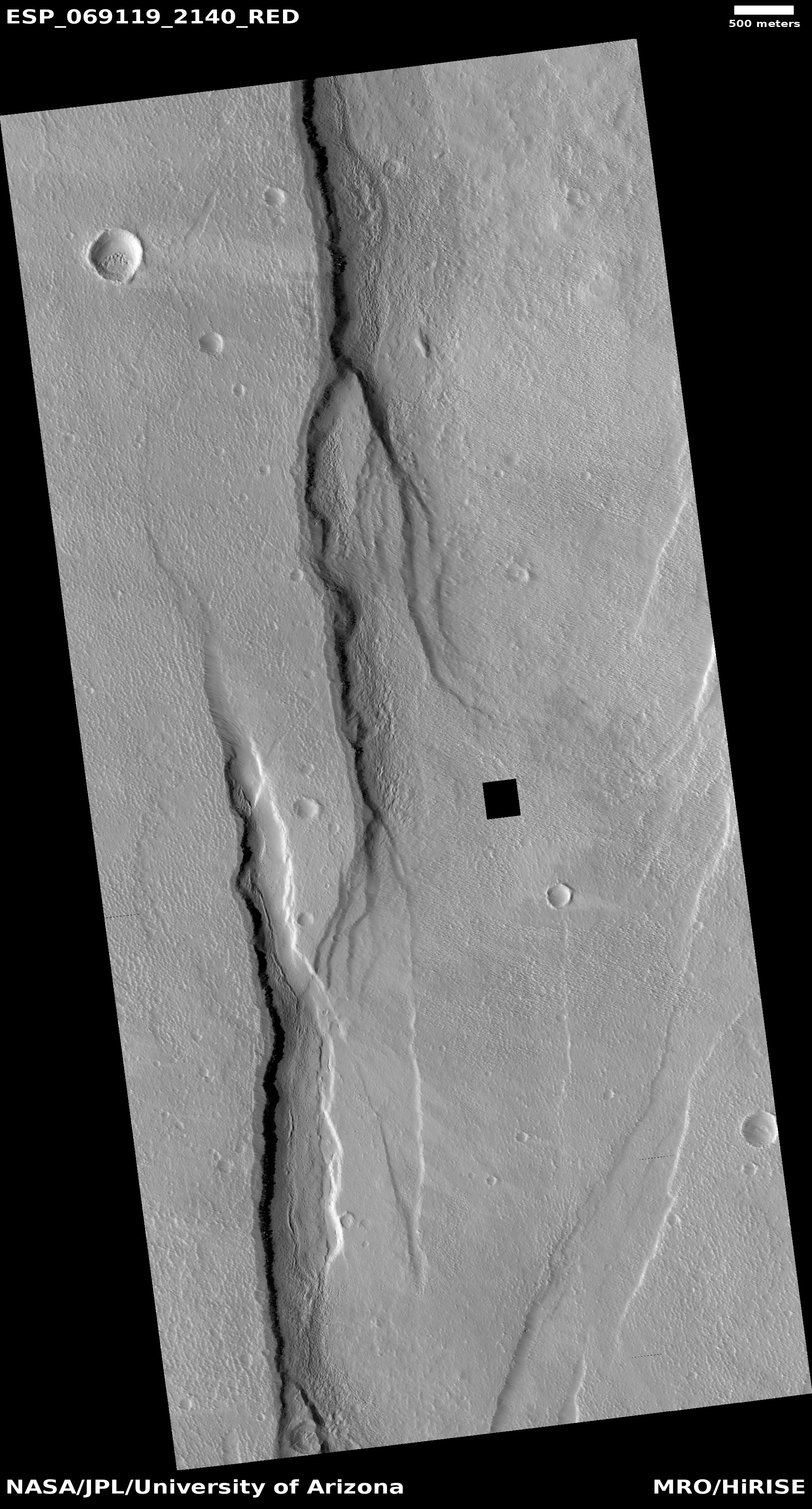
Cool image time! The picture to the right, cropped and reduced to post here, was taken on February 8, 2023 by the high resolution camera on Mars Reconnaissance Orbiter (MRO).

We are looking at the 2,400-foot-high cliff, its lower walls clearly cracking horizontally as they sag downward, with other large sections higher up appearing to have been eroded away in larger pieces.

Yet, the ground below this cliff wall appears to have no debris piles, the kind you would expect below a landslide. Instead, that ground appears to be very glacial in nature, with many linear parallel lines suggesting layers.

The overview map below provides us the context, and an explanation as to where that debris has gone.
» Read more

0 comments

South Korea successfully launches its Nuri rocket for the second time

The new colonial movement: South Korea today successfully launched its home-built Nuri rocket for the second time, lifting off from a coastal South Korean spaceport and carrying eight smallsats.

This was South Korea’s first launch this year. The leaders in the 2023 launch race remain the same:

34 SpaceX
19 China
7 Russia
4 Rocket Lab

The U.S. still leads China 38 to 19 in the national rankings, and the entire world combined 38 to 33. SpaceX by itself now trails the entire world, including American companies, 34 to 37.

Hat tip to BtB’s stringer Jay for reminding me of this launch.

0 comments

Watch a still brightening new supernova only 20 million light years away

A new still brightening supernova has been discovered in the Pinwheel Galaxy, also known as Messier 101, only 20 million light years away, one of the closest such supernovae in years.

The discovery was made on May 19, 2023. Because the supernova is so close, it was discovered very early in its explosion and is still brightening to maximum. It is also an object that ordinary amateur astronomers can spot using their own telescopes. The Pinwheel Galaxy is located in the Big Dipper, making it a good target for amateurs in the northern hemisphere.

A live stream of the supernovae, dubbed SN 2023ixf, is also being broadcast today by the Virtual Telescope Project, and will be available here starting at 3 pm (Pacific).

No supernovae have occurred within our own galaxy, the Milky Way, since the invention of the telescope, so any such event in a nearby galaxy is an important opportunity for astronomers to learn more about these explosions.

6 comments

Nova Scotia spaceport gets another launch contract

Maritime Launch Services, which is building a spaceport in Nova Scotia and hopes to offer its own rocket services to put satellites in orbit, has obtained what it claims could be a $1 billion contract with an unnamed European orbital tug company.

The only two European orbital tug companies that closely fit the description provided by Maritime officials are D-Orbit or Exolaunch. The latter had had a contract with Virgin Orbit to launch as many as 20 of its satellites. Coming less than one day after Virgin Orbit’s assets were sold off, this announcement suggests Exolaunch has replaced Virgin Orbit with this deal.

Unlike other spaceports, Maritime isn’t merely providing a launch site for rocket companies. Instead the company will also launch smallsats itself, using either Ukraine’s Cyclone-4M rocket or a British-made startup rocket dubbed Skyrora.

0 comments

Relativity and Impulse are now targeting ’26 launch window for 1st private mission to Mars

According to officials from the two companies, Relativity and Impulse have now delayed the launch date of their joint private unmanned lander to Mars from the ’24 launch window to the ’26 launch window.

The companies have also shared few technical details about the lander, but noted they plan to leverage designs and technologies developed for NASA’s InSight Mars lander, such as its heat shield. “We’re not trying to reinvent the wheel,” Brost said. “Doing a clean-sheet design of a lander is an insane, monumental engineering feat.”

Relativity is tasked with launching the probe, using its Terran-R rocket, which is under development and has its first launch scheduled in 2026. Impulse, which is building the lander, is at this point simply trying to develop its first small rocket engine. It appears therefore that this proposed Mars lander is designed mostly to make NASA willing to consider it when it starts hiring private companies to land probes on Mars. Its chances of launching in ’26 is quite small.

0 comments

SuperBIT high altitude astronomical balloon completes mission

SuperBIT image of Antennae Galaxy
The Antennae galaxy, one of four SuperBIT images released.
Click for original image.

After almost forty days circling Antarctica and taking high resolution images of galaxies and nebula, NASA SuperBIT high altitude astronomical balloon completed its mission today, landing in Argentina.

Having identified a safe landing area over southern Argentina, balloon operators from NASA’s Columbia Scientific Balloon Facility in Palestine, Texas, sent flight termination commands at 8:37 a.m. EDT, May 25. The 18.8-million-cubic-foot (532,000-cubic-meter) balloon then separated from the payload rapidly deflating, and the payload floated safely to the ground on a parachute touching down in an unpopulated area 66 nautical miles (122 kilometers) northeast of Gobernador Gregores, Argentina. NASA coordinated with Argentine officials prior to ending the balloon mission; recovery of the payload and balloon is in progress.

During its nearly 40-day journey, the balloon completed a record five full circuits about the Southern Hemisphere’s mid-latitudes, maintaining a float altitude around 108,000 feet. In the coming days, the predicted flight path would have taken the balloon more southerly with little exposure to sunlight, creating some risk in maintaining power to the balloon’s systems, which are charged via solar panels. The land-crossing created an opportunity to safely conclude the flight and recover the balloon and payload.

The picture above, cropped, reduced, and sharpened to post here, has incredible resolution, illustrating the advantage of flying a telescope on a high altitude balloon.

1 comment

May 24, 2023 Quick space links

Courtesy of BtB’s stringer Jay.


5 comments

Knobs on the floor of a Martian caldera

Knobs on the floor of a Martian caldera
Click for original image.

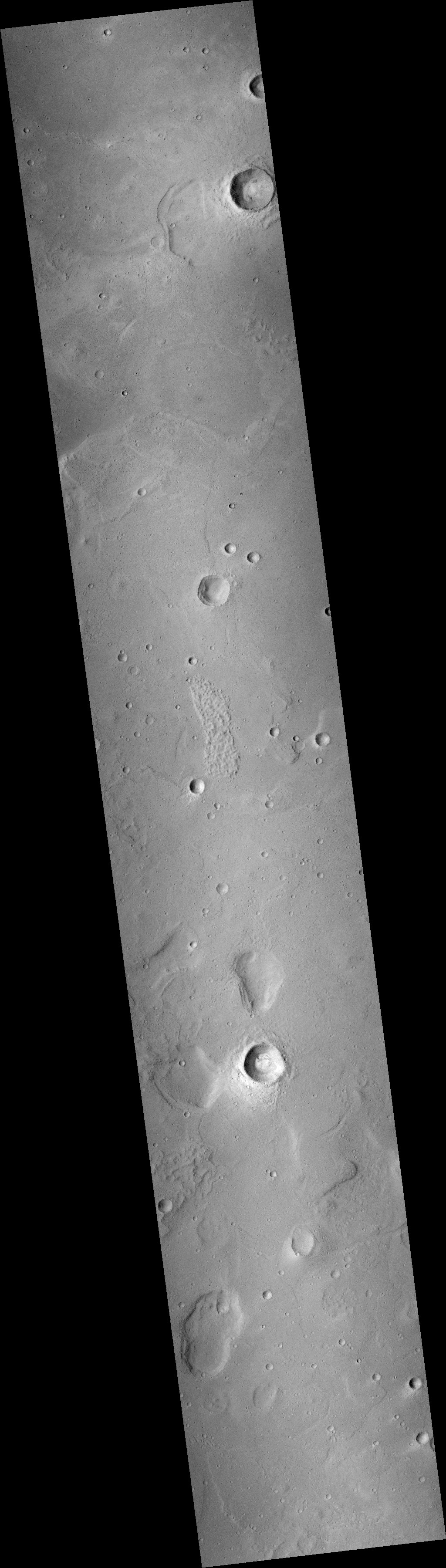
Cool image time! The picture to the right, rotated, cropped, reduced, and sharpened to post here, was taken on February 14, 2023 by the high resolution camera on Mars Reconnaissance Orbiter (MRO) and shows what the scientists have dubbed as “enigmatic knobs” located on the caldera floor of a Martian shield volcano.

The knobs themselves, while puzzling, aren’t that interesting on their own. They are no more than 100 to 200 feet high, and are relatively featureless. Since most lack a pit at their peaks, they are probably not some form of small volcanic vent, though this conclusion is uncertain. The location, at about 30 degrees south latitude, suggests the faint possibility of near surface ice, which could make these mud volcanoes, or a very specific Arctic-type permafrost mound dubbed pingos, but once again the lack of any central pit at their peaks makes these origins also doubtful.

What the knobs however revealed to me was a giant Martian shield volcano I had never noticed before, even though it was hiding in plain sight.
» Read more

0 comments

Spaceport startup launches small amateur rockets from ship

A company dubbed The Spaceport Company on May 22, 2023 launched two small amateur rockets from a ship in the Gulf of Mexico in order to demonstrate the logistics of such launches in advance of developing a floating launchpad.

The Spaceport Company, based in northern Virginia, launched on Monday 4-inch and 6-inch diameter rockets from a vessel about 30 miles south of Gulfport, Miss. The one-year-old company wanted to demonstrate its operations and logistics, which included getting approval from federal regulators, before developing larger floating platforms that would send satellites into orbit.

These offshore launches, as small as they were, were the first such ocean launches in U.S. history.

It appears that the company wants to offer an alternative launch option that might avoid the problems created by regulators in the UK that destroyed Virgin Orbit.

7 comments

Launch of Sierra Space’s Dream Chaser now scheduled for six month window opening in August

After years of delays, Sierra Space’s first Dream Chaser reusable mini-shuttle, dubbed Tenacity, is now scheduled for launch during the six month mission to ISS of a crew scheduled for launch in August.

Dream Chaser’s first flight on a United Launch Alliance Atlas V rocket is expected while Crew-7 is aboard and two of those crew members, NASA’s Jasmin Moghbeli and JAXA’s Satoshi Furukawa, recently trained on it. JAXA and NASA formally announced Furukawa’s assignment to Crew-7 today. Furukawa, Moghbeli, ESA’s Andreas Mogensen and a Russian cosmonaut whose assignment has not been officially announced yet, are expected to launch in mid-August for a 6-month stay on the ISS.

The exact launch date within that mission has not yet been determined. It will largely depend scheduling, fitting it in with other launches to the station, assuming Tenacity’s construction is finished in time. That construction began in 2015, and has taken three to four years longer than first announced.

1 comment
1 457 458 459 460 461 2,413