Glacial sinkhole in the Martian southern cratered highlands?

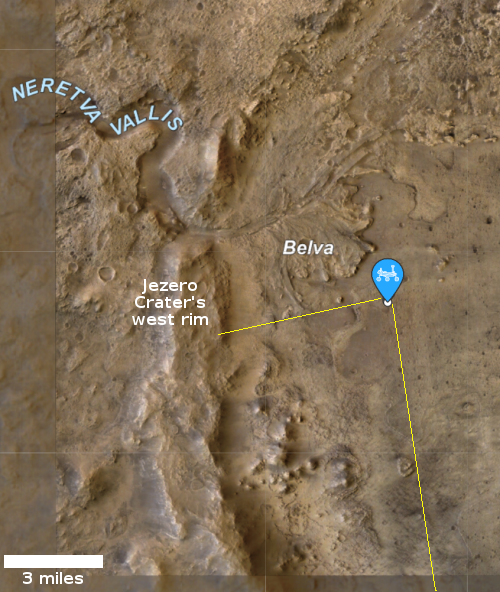
Overview map

Glacial sinkhole in the Martian southern cratered highlands?
Click for original image.

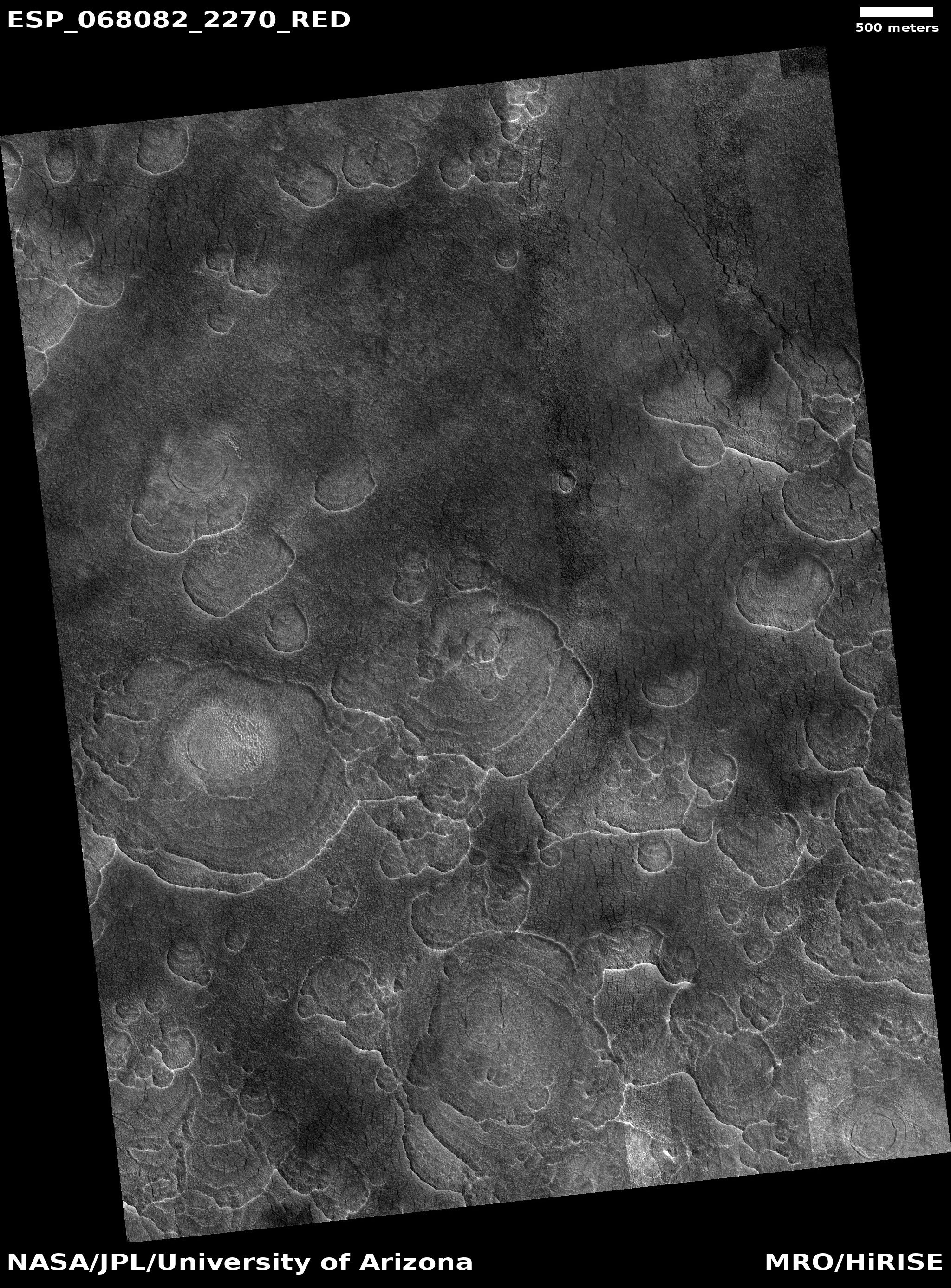
Cool image time! The picture to the right, cropped to post here, was taken on February 21, 2023 by the high resolution camera on Mars Reconnaissance Orbiter (MRO). This is a terrain sample image, which means it was snapped not as part of any specific research project but to fill a gap in the schedule in order to maintain the camera’s proper temperature. As usual, the camera team tried to pick something of interest, and I think they succeeded.

The two large depressions in the center of the picture do not resemble impact craters. They have no rim of ejected material and their shape is very distorted. Instead, both appear to be places where a top layer of ice/debris has sublimated away into gas, exposing a lower layer of glacial material that itself is sublimating away to form the bumpy mounds that fill the floor of the depressions.

The white dot inside the inset box on the overview map above marks this location, just south of the northern wall of a large 30-mile-wide canyon, with its northern floor even more depressed, as if the material in that raised middle a flat pile of glacial debris flowing to the southwest after leaving the gap in the crater to the northeast. An MRO context camera picture taken on January 6, 2016 gives a wider view, showing that there are a lot of these type depressions on the surface of this wide middle upraised floor, as well as some obvious impact craters.

This location is in the mid-latitude band where many glacial features are found. In this part of the southern cratered highlands there is also a lot of evidence of top layers sublimating away, as if the glacial material is a large buried ice sheet that is beginning to disappear at places where it has been exposed by impacts or shifting motion. The depression in the picture above appears to be an example.

0 comments

Today’s blacklisted American: Father gets fired immediately after speaking at school board against queer agenda

Afraid and cowed by the queer movement

They’re coming for you next: Immediately after Jason Brunt, a father of three boys in the public schools, gave a three minute speech at his local Sarasota School Board meeting, pleading for the school to provide his “straight” kids a safe space instead of harassing them for their preferred sexuality, queer activists began harassing his family and calling his employer with slanderous accusations, resulting in his immediate firing.

Mr. Brunt said that the attention he received turned into a living nightmare after radical progressive activists started harassing him and threatening his family, including homosexual acts toward his children. They even called his workplace with false accusations, which resulted in his immediate termination.

“However, the attention soon turned into a nightmare. Radical progressive activists began attacking me personally, sending me hate mail and threats. The situation only escalated when I began receiving phone calls at my job, making false allegations and defaming me to an obscene level. To my utter dismay, my employer decided to fire me effective immediately, citing the video as a reason for making people feel unsafe at work. It was devastating to lose a job I had worked so hard to obtain and succeed in,” Mr. Brunt said.

“As an HR professional, I am understanding and supportive of all people to express themselves as they see fit. However, it seems that today, if you disagree with the progressive ideology, you will be canceled and criminalized. It is not right that merely asking for equality and safe spaces for children like mine, I faced an all-out assault on my personal life,” he added.

So, what did this father say that was so egregious? Here is his speech:
» Read more

22 comments

NASA’s second super pressure balloon develops leak, forcing termination of mission

After only a day and a half after launch NASA’s second super pressure balloon, this time carrying a detector for studying cosmic rays, developed a leak that forced its controllers to terminate the mission.

The scientific balloon launched from Wānaka Airport, New Zealand, May 13, 12:02 p.m. NZST (May 12, 8:02 p.m EDT). The balloon was in flight for 1 day, 12 hours, and 53 minutes before termination over the Pacific Ocean May 14 at 12:54 UTC (8:54 a.m. EDT). The launch was the second and final for NASA’s 2023 New Zealand balloon launch campaign.

During flight, the SPB began experiencing a leak and teams attempted to troubleshot by dropping ballast to maintain the balloon’s altitude. The determination was made to safely terminate over the Pacific Ocean. NASA will investigate the cause of the anomaly.

Meanwhile, the first balloon, dubbed SuperBIT, continues to fly, presently on its fourth circumnavigation of Antarctic while its telescope takes high resolution images of celestial objects.

2 comments

Stratolaunch’s giant airplane Roc successfully completes first drop test of payload

On May 13, 2023 Stratolaunch’s giant airplane Roc took off with a Talon-0 engineering test vehicle attached to its fuselage and successfully released that test vehicle, completing the plane’s first drop test.

Saturday’s outing was the 11th flight test for Stratolaunch’s flying launch pad — a twin-fuselage, six-engine airplane with a record-setting 385-foot wingspan. The plane is nicknamed Roc in honor of a giant bird in Middle East mythology.

Roc carried the Talon-A separation test vehicle, known as TA-0, during three previous test flights. But this was the first time TA-0 was released from Roc’s center-wing pylon to fly free. The release took place during a four-hour, eight-minute flight that involved operations in Vandenberg Space Force Base’s Western Range, off California’s central coast.

With this success the company appears ready to fulfill its military contract to use its Talon-1 payloads to fly hypersonic flight tests.

3 comments

SpaceX launches another 56 Starlink satellites into orbit

Using its workhorse Falcon 9 rocket, SpaceX tonight successfully launched another 56 Starlink satellites into orbit from Cape Canaveral.

The first stage successfully completed its eleventh flight, landing on a drone ship in the Atlantic. The two fairings completed their 7th and 8th flights, respectively.

The leaders in the 2023 launch race:

31 SpaceX
17 China
6 Russia
4 Rocket Lab

American private enterprise now leads China 35 to 17 in the national rankings, and the entire world combined 35 to 29. SpaceX by itself trails the entire world, including other American companies, only 31 to 33 in launches this year.

3 comments

Another study suggests Saturn’s rings are young, much younger than the planet

Scientists using data from Cassini, which orbited Saturn from 2004 to 2017, have confirmed earlier research that said Saturn’s rings are much younger than the planet, only about 400 million years old.

From 2004 to 2017, the team used an instrument called the Cosmic Dust Analyzer aboard NASA’s late Cassini spacecraft to analyze specks of dust flying around Saturn. Over those 13 years, the researchers collected just 163 grains that had originated from beyond the planet’s close neighborhood. But it was enough. Based on their calculations, Saturn’s rings have likely been gathering dust for only a few hundred million years.

Though I cannot cite the earlier research, I distinctly remember a study from about a decade ago that posited the rings being young, only a few hundred million years old. This research confirms this conclusion, and likely firms up the theory considerably.

3 comments

Intuitive Machines’ first mission to land on Moon delayed

Intuitive Machines officials revealed during their quarterly report that the first mission of its Nova-C lunar lander has been delayed from June to late August or September.

The company announced in February plans for a June landing at Malapert A, a crater near the south pole of the moon. That date was a slip from a previously scheduled March launch, which the company said was linked to NASA’s decision to move the landing site to Malapert A.

Altemus said the company made “significant progress” in testing of the lander in recent months, such as structural tests to confirm the vehicle could handle the stresses of launch and cryogenic tanking demonstrations. “We have some functional testing” still to do on the lander, he said, but did not elaborate on the nature of those tests or their schedule ahead of shipping to Cape Canaveral for its Falcon 9 launch.

Two private companies have so far attempted and failed to land on the Moon, Israel’s SpaceIL and Japan’s Ispace. Two American companies, Intuitive Machines and Astrobotic, are both racing to achieve this goal in the coming months. This delay now puts Astrobotic in the lead, with its launch now targeting the summer.

0 comments

Engineers free stuck radar antenna on Juice probe to Jupiter’s big moons

Engineers have successfully freed the 52-foot wide radar antenna on the Juice probe to Jupiter, shaking it enough to release a pin that was blocking deployment.

The pin was freed by employing “back-to-back jolts”. Imagine when you roll your car back and forth to get it freed from mud or snow. It appears this is what they did with the pin.

Juice will arrive in Jupiter orbit in 2031, where it will make numerous fly-bys of Europa, Calisto, and Ganymede, and then settle into an orbit around Ganymede alone. The radar antenna was essential for probing the ice content of these worlds, below the surface.

Hat tip to reader Mike Nelson.

6 comments

May 12, 2023 Quick space links

Courtesy of BtB’s stringer Jay.


10 comments

Saturn now has 145 known moons

Using ground-based images analyzed in a new way, astronomers have discovered an additional 62 small moons orbiting Saturn, giving the ringed gas giant a total of 145 known moons.

The data used by the team was collected between 2019 and 2021 in three-hour spans by the Canada-France-Hawaii Telescope (CFHT) on top of Maunakea in Hawaii. It allowed the astronomers to detect moons around Saturn as small as 1.6 miles (2.5 kilometers) in diameter. That’s about two-thirds the length of Hollywood’s Walk of Fame.

Though some of the moons had been spotted as early as 2019, it takes more than sighting an object close to a planet to confirm it is a moon and not an asteroid making a brief close passage to that planet. To change these objects from “suspected moons” to “confirmed moons” of Saturn, the astronomers had to track them for several years to ensure each is actually orbiting the gas giant.

Performing a painstaking process of matching objects detected on different nights over the course of 24 months, the team tracked 63 objects that they ended up confirming as moons. One of these satellites was revealed back in 2021, with the remaining 62 moons gradually announced over the past few weeks.

To a certain extent, this declared number of moons around Saturn is utterly irrelevant. Think about it. Every single object in its rings should be defined as a moon, totaling hundreds of thousands. At some point the question of what defines a moon becomes the relevant question.

5 comments
1 462 463 464 465 466 2,413