
Angela Lansbury – Tale as Old as Time
An evening pause: From the animated film Beauty and the Beast (1991), a truly great movie made when Disney Studios was still sane.
An evening pause: From the animated film Beauty and the Beast (1991), a truly great movie made when Disney Studios was still sane.
Rearranging deck chairs on the Titantic: Boeing today announced that it is moving its headquarters from Chicago to Washington, DC, so as to place its corporate executives closer to key federal officials.
Boeing is a major defense contractor, and the move will put executives close to Pentagon leaders. Rival defense contractors including General Dynamics, Lockheed Martin and Northrop Grumman are already based in the D.C. area. Company executives would also be near the Federal Aviation Administration, which certifies Boeing passenger and cargo planes.
Gee, for more than a half century Boeing was based entirely in Seattle, and somehow got lots of federal contracts and built great airplanes and spacecraft. It moved to Chicago in 2001 to be more centrally located, but instead put its top managers distant from its actual manufacturing and design headquarters. The result has not been very cheerful.
Now Boeing is moving even farther from Seattle, just so its executives can hobnob with politicians, go to fancy cocktail parties, and figure out easier who to pay off with political donations. Who cares if the actual design and manufacturing work continues to be shoddy and poorly supervised? What really counts is getting contracts to build bad stuff that either doesn’t work or is delivered late and overbudget for our corrupt federal government.
As proof, see this other story today: Starliner’s protective window cover falls off during capsule move to VAB.
From CBS space reporter Bill Harwood:
During the rollover to pad 41, as the Starliner neared the Vehicle Assembly Building, a protective window cover somehow fell off the capsule and tumbled to the road.
You can see video of this absurdity at the link. As this was not actually part of the capsule but a protective cover, it appears no damage to Starliner occurred. That it occurred at all however once again tells us of the serious quality control problems at the company.

On Christmas Eve 1968 three Americans became the first humans to visit another world. What they did to celebrate was unexpected and profound, and will be remembered throughout all human history. Genesis: the Story of Apollo 8, Robert Zimmerman's classic history of humanity's first journey to another world, tells that story, and it is now available as both an ebook and an audiobook, both with a foreword by Valerie Anders and a new introduction by Robert Zimmerman.
The print edition can be purchased at Amazon or any other book seller. If you want an autographed copy the price is $60 for the hardback and $45 for the paperback, plus $8 shipping for each. Go here for purchasing details. The ebook is available everywhere for $5.99 (before discount) at amazon, or direct from my ebook publisher, ebookit. If you buy it from ebookit you don't support the big tech companies and the author gets a bigger cut much sooner.
"Not simply about one mission, [Genesis] is also the history of America's quest for the moon... Zimmerman has done a masterful job of tying disparate events together into a solid account of one of America's greatest human triumphs."--San Antonio Express-News

A witch hunt: What Antifa considers reasonable political discourse.
Fight back twice as hard: Because Robin Patch attended a protest where she reported accurately the violence of Antifa, Antifa member Chad Loder responded by falsely slandering Patch on Twitter, falsely claiming she had a criminal record for “burglary + vandalism.”
Patch is now suing Loder in small claims court for $5,000.
In Patch’s lawsuit, she explicitly denies Loder’s claims that she is a criminal convict and has been on probation. “This is 100% false,” Patch wrote in the small claims complaint. “I have never had any criminal convictions, nor have I ever been on probation.” Patch wrote in the complaint that Loder blocked her on Twitter so that she could not directly respond to his posts.
“Mr. Loder made two consecutive tweets about me on July 8, 2021, which included personal information such as my (former) place of employment, home city, Instagram posts, LinkedIn profile and results from an outdated background check.”
According to her complaint, Loder’s slanders on Twitter caused her to lose a job.
The evidence clearly shows who is the real criminal here.
» Read more
Capitalism in space: For the first time, a private space station company, Axiom, has purchased 32 space station robot arm grapple points, or interfaces, from the Canadian company MDA that builds the robot arms on ISS for NASA.
The MDA interfaces aboard Axiom’s space station will also include those that allow the existing Canadarm2 on the International Space Station (ISS) to build and assemble the new Axiom Station. Once that stage is complete, MDA’s Canadarm3 interfaces will act as permanent robotic system fixture points on the outside of Axiom Station, forming the foundation for future robotic arm integration and utilization once it separates from the ISS and operates independently.
This deal means that eventually Axiom is going to purchase its own MDA-built robot arm.

Now available in hardback and paperback as well as ebook!
From the press release: In this ground-breaking new history of early America, historian Robert Zimmerman not only exposes the lie behind The New York Times 1619 Project that falsely claims slavery is central to the history of the United States, he also provides profound lessons about the nature of human societies, lessons important for Americans today as well as for all future settlers on Mars and elsewhere in space.
“Zimmerman’s ground-breaking history provides every future generation the basic framework for establishing new societies on other worlds. We would be wise to heed what he says.” —Robert Zubrin, founder of the Mars Society.
All editions are available at Amazon, Barnes & Noble, and all book vendors, with the ebook priced at $5.99 before discount. All editions can also be purchased direct from the ebook publisher, ebookit, in which case you don't support the big tech companies and the author gets a bigger cut much sooner.
Autographed printed copies are also available at discount directly from the author (hardback $29.95; paperback $14.95; Shipping cost for either: $6.00). Just send an email to zimmerman @ nasw dot org.
Capitalism in space: Stratolaunch yesterday successfully completed the fifth test flight of its giant Roc airplane, now being designed for testing hypersonic vehicles in flight.
You can read the press release here [pdf], which stated the following:
The fifth flight debuted a new pylon on the aircraft’s center wing that will be used to carry and release Talon-A hypersonic vehicles. The hardware is comprised of a mini-wing and adapter that is constructed with aluminum and carbon fiber skins. It weighs approximately 8,000 pounds and occupies 14 feet of Roc’s 95-foot center wingspan, allowing for adequate space between the aircraft’s dual fuselages for safe vehicle release and launch. The state-of-the-art structure also features a winch system that will load Talon onto the platform from the ground, expediting launch preparation and reducing the need for ground support.
The company has been building two Talon hypersonic vehicles, and now has a third under construction. This third Talon is intended to be reuseable. All will be used as part of the company’s contract with the Air Force to test hypersonic technology, with the first flights now scheduled for ’23.
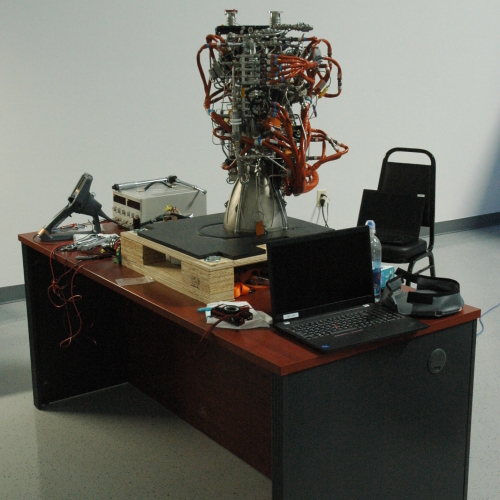
Capitalism in space: The smallsat startup rocket company Phantom Space today announced it has ordered more than 200 rocket engines from the rocket engine company Ursa Major.
The order includes Ursa Major’s 5,000-Pound Thrust Hadley engines and the new 50,000-pound thrust Ripley engines. By using Ursa Major’s Hadley engines, Phantom’s Daytona rocket is slated for orbital launch in 2023, just three years after Phantom Space was formed. Under the terms of the agreement, Ursa Major will supply hundreds of its Hadley engines in different configurations including ground test and upper-stage vacuum variants, as well as numerous Ripley engines for planned upgrades to the Daytona vehicle.
The CEO of Phantom Space, Jim Cantrell, gave me a tour of its facility here in Tucson only three weeks ago, during which I took the picture above of a Hadley engine being tested and prepared for further static fire tests.
Cantrell had been the founder of Vector, his earlier failed attempt to create a smallsat rocket company. He clearly has not let that failure stop him.

Leaving Earth: Space Stations, Rival Superpowers, and the Quest for Interplanetary Travel, can be purchased as an ebook everywhere for only $3.99 (before discount) at amazon, Barnes & Noble, all ebook vendors, or direct from my ebook publisher, ebookit.
If you buy it from ebookit you don't support the big oppressive tech companies and I get a bigger cut much sooner.
"Leaving Earth is one of the best and certainly the most comprehensive summary of our drive into space that I have ever read. It will be invaluable to future scholars because it will tell them how the next chapter of human history opened." -- Arthur C. Clarke
In announcing a press conference later today about the status of NASA’s SLS rocket, the agency revealed it now plans to conduct a second SLS launch dress rehearsal in June.
NASA’s SLS rocket and Orion spacecraft arrived back at Kennedy’s Vehicle Assembly Building April 26 after a 10-hour journey from launch pad 39B. Since their arrival, teams have worked to replace a faulty upper stage check valve and repair a small leak within the tail service mast umbilical ground plate housing. The teams also have been performing additional checkouts while the spaceport’s supplier of gaseous nitrogen makes upgrades to their pipeline configuration to support Artemis I activities.
We will likely find out NASA’s new launch schedule for the rocket today.
China today used its Long March 2D rocket to place eight Earth observation satellites into orbit as part of a larger constellation.
The Jilin-1 constellation, now consisting of 50 Earth observation satellites since its first launch in 2015, is China’s first-ever commercial remote-sensing satellite system. The system is operated by Chang Guang Satellite Technology Corporation, also known as Charming Globe, a commercial spinoff of the Changchun Institute of Optics, Fine Mechanics, and Physics in the northeast Chinese city of Changchun.
The constellation is planned to consist of 138 satellites by 2025, and the satellites will be orbiting at 535 km altitude above Earth. The constellation, featuring types of satellites with different capabilities, will ultimately be capable of revisiting any point on Earth every ten minutes, with an interim thirty-minute capability being achieved with sixty satellites in orbit.
China claims the data from this constellation will be for commercial use. Don’t be surprised however if its primary customer turns out to be China’s military.
As the rocket launched from one of China’s interior spaceports, its first stage crash landed in China. No word on whether it used parachutes or grid fins to control that landing.
The leaders in the 2022 launch race:
17 SpaceX
14 China
6 Russia
3 Rocket Lab
2 ULA
The U.S. still leads China 25 to 14 in the national rankings, with the U.S. leading all other nations combined 25 to 23.
SpaceX’s Endurance manned capsule today undocked from ISS carrying four astronauts with a planned splashdown off the coast of Florida at shortly after midnight (Eastern) tonight.
I have embedded the live stream for the splashdown below. It will go live about 11:00 pm (Eastern) in order to cover all the splashdown events:
11:48 p.m. Trunk jettison
11:53 p.m. Deorbit burn
12:04 a.m. Nosecone closed
12:43 a.m. Dragon splashdown
» Read more
Embedded below the fold in two parts.
To listen to all of John Batchelor’s podcasts, well worth your time, go here.
» Read more
An evening pause: Hat tip Cotour, who adds “classic Benny Hill.”

Click for full image.
Cool image time! The photo to the right, rotated, cropped, and reduced to post here, was taken on February 23, 2022 by the high resolution camera on Mars Reconnaissance Orbiter (MRO). Though it shows the largely featureless northern lowland plains of Mars, it is particularly interesting for two reasons.
First, according to the photo’s label this scarp/ridge is apparently near a quake detected by the seismometer placed on Mars by the lander InSight, located about a thousand miles to the southwest. Though no information of the strength of this quake is available, it is likely to have been a small and weak one, interesting mostly because it indicates some small underground instability or a recent small impact on the surface. The image favors the former, as it shows no obvious recent features of change. What it does show is one very intriguing flow feature draping the scarp. As the location is at 34 north latitude in a region where scientists have found a lot of evidence of water ice very close to the surface, the flow could very well be glacial in nature, though dismissing a lava origin would be a mistake.
The second reason this location is of interest is what lies relatively nearby, as shown in the overview map below.
» Read more

Any media that blindly repeats anything out of this guy’s mouth
risks getting sued for slander
Fight back twice as hard: The owner of the computer repair shop, who legally uncovered the laptop that belonged to President Joe Biden’s son Hunter Biden and exposed significant evidence of corruption by both, has now filed a multi-million dollar defamation lawsuit against CNN, Politico, the Daily Beast, and Congressman Adam Schiff (D-California).
John Paul Mac Isaac was highlighted in a blacklist column in March, noting how his entirely legal effort to expose extensive corruption by Joe Biden and his son prior to the election caused him to be harassed, threatened, and driven to bankruptcy. While he lived in hiding because of the physical threats against him, Isaac also found it impossible to get unemployment insurance because of stone-walling by the Delaware unemployment department, stone-walling that only ended when Isaac wrote of letter of complaint to the state’s junior senator.
Isaac’s nightmare began when Democrats like Schiff began spreading lies against him, suggesting without any evidence that he was a treasonous Russian agent and had even obtained the laptop illegally. Mainstream media outlets acting as Democratic Party operatives immediately republished those lies as if they were true, despite the reality that only a tiny amount of due diligence would have revealed them to be lies.
An earlier lawsuit by Isaac against Twitter was thrown out by the courts, leaving him with about $175K in legal bills. This new lawsuit however is now possible because of new sponsorship.
» Read more
We’re here to help you! Documents obtained by CNBC under a Freedom of Information request have revealed the specific objections of Fish & Wildlife that has helped delay the approval of the FAA’s environment reassessment of SpaceX’s Boca Chica facility for Starship launches.
SpaceX must take steps to track and mitigate its impact on endangered species and their habitat in order to gain approvals for testing and commercial launches of its Starship Super Heavy lift-launch vehicle in Boca Chica, Texas, according to documents from the U.S. Fish and Wildlife Service obtained by CNBC.
The documents, released by the federal agency in response to a Freedom of Information Act request, show that recent declines in an endangered bird species, the piping plover, have already been correlated with SpaceX activity at the South Texas facility.
The documents also reveal that SpaceX is, for now at least, reducing the amount of energy it plans to generate at a utility-sized natural gas power plant on the 47.4-acre launch site there.
According to a lawyer from the radical environmentalist organization the Center for Biological Diversity who was interviewed for the article, Fish & Wildlife’s demands are not tremendously restrictive, and might actually allow the project to go forward, since they appear to only require SpaceX to “monitor affected animal populations carefully, limit construction and launch activity to specific seasons or times of day and night, and use shuttles to reduce vehicle traffic of workers on location.”
I see it differently. I think Fish & Wildlife bureaucrats are struggling to come up with reasons to block SpaceX. They know that decades of data in Florida prove that rocket launches have no negative impact on wildlife. To claim such a thing in Texas is thus not justified. They are trying to do it anyway.
Capitalism in space: A new South Korean smallsat rocket startup company, Innospace, is now planning its first suborbital test launch in December, launching a Brazilian military payload from that country’s Alcântara Space Center.
The 16.3-meter, single-stage test rocket is a precursor to the company’s planned commercial satellite launcher Hanbit-Nano, a two-stage small satellite launcher designed to carry up to a 50-kilogram payload to a 500-kilometer sun-synchronous orbit. The first stages of the two rockets are powered by a 15-ton-thrust hybrid rocket engine that uses liquid oxygen and paraffin-based propellants. Hanbit-Nano’s upper stage is equipped with a 3-ton hybrid engine, according to the Sejong-based company’s website.
“If the upcoming test launch is successful, we will start preparing for a test launch of Hanbit-Nano,” Innospace spokesperson Kim Jung-hee told SpaceNews.
The company has so far raised almost $28 million in private investment capital. It also has an agreement with Norway to launch its rockets from there.
Since South Korea’s government has its own rocket program, it will be interesting to see which succeeds first in getting into orbit.
According to tracking data from the Space Force, an old Russian Proton upper stage engine, originally launched in 2007, broke up on April 15, 2022, creating a small cloud of new space junk in a highly elliptical orbit.
These Proton upper-stage ullage motors are known as SOZ motors, and there are currently 64 of them in Earth orbit, McDowell tweeted. The acronym is short for “Sistema Obespecheniya Zapuska,” which translates roughly as “Launch Assurance System,” he said.
“The SOZ motors don’t use up all their propellant when they fire. And they have an unfortunate tendency to go bang years or decades later, leaving a bunch of debris in highly elliptical orbit. At least 54 SOZ motors have now exploded,” McDowell tweeted.
The SOZ motor that just blew up had been racing around Earth in a highly elliptical path, getting as close as 241 miles (388 kilometers) and as far away as 11,852 miles (19,074 km), McDowell said in another tweet, noting that “the debris will take quite a while to reenter.”
“So — this debris event was predictable and is well understood; still very unfortunate,” he wrote. [emphasis mine]
The highlighted words suggest a certain irresponsibility on the Russian’s part. If these upper stage engines are abandoned with fuel still on board, why doesn’t Russia use that fuel to fire the engines to de-orbit them safely, especially as the engines have a tendency to eventually blow up and cause space junk? There might be complex technical reasons, but I suspect the real reason is pure laziness on Roscosmos’ part. No one ever bothered to think about it.
An official of the European Space Agency (ESA) at a May 3rd science meeting announced that the launch of its ExoMars rover will likely be delayed until 2028 at the earliest because of the partnership breakup with Russia due to its invasion of the Ukraine.
Russia had been providing both the launch rocket as well as the lander on Mars.
Speaking at a May 3 meeting of NASA’s Mars Exploration Program Analysis Group (MEPAG), Jorge Vago, ExoMars project scientist at ESA, said he doubted a new lander could be ready by 2026. “It is theoretically possible, but in practice we think it would be very difficult to reconfigure ourselves and produce our own lander for 2026,” he said. “Realistically, we would be looking at a launch in 2028.”
Launching in 2028 could pose technical challenges for ExoMars. One trajectory would get the rover to Mars relatively quickly, but have it arrive just a month before dust storm seasons starts at the preferred landing site. An alternative trajectory would require traveling for more than two years to each Mars, but get the rover there six months before dust storms start.
“We have been trying very hard to convince the engineering team that the dust storm season is not death,” Vago said. “We should concentrate on making the rover more robust and able to weather a dust storm.”
There are other issues. The rover will need new radioisotope heating units, or RHUs, to provide power, since Russia will no longer providing them. If the U.S. provides, the launch for security reasons will have to take place in the U.S., which means the launch provider will have to be American.
The delay to ’28 also could cause the ExoMars rover mission to be completely changed, repurposed to become part of the sample return mission that the ESA and NASA are partnering to bring back the cached samples that Perseverance is gathering. If so, this repurposing might delay its launch to Mars even further.
An evening pause: The medley covers 25 songs from every James Bond film from Dr No (1962) to No Time To Die (2021).
Hat tip Dan Morris.

No free speech allowed at St. Olaf College.
The new dark age of silencing: David Anderson, the president of St. Olaf College in Minnesota, has removed the director of the school’s Institute for Freedom & Community, Edmund Santurri, because Santurri apparently encouraged too much free speech by inviting a wide range of speakers to lecture at the institute.
The lecture that appeared to draw the most objections was by Peter Singer, who has expressed controversial views about disabled people. An appearance by John McWhorter — who has argued some anti-racism initiatives go too far in stifling debate — was also reportedly controversial.
Singer has for decades often advocated in favor of abortion and even infanticide. McWorter meanwhile opposes the racist principles of critical race theory. To put it mildly, these speakers indicated the sincerity of Santurri’s effort to bring a wide range of political thought to St. Olaf.
When Anderson removed Santurri, he explained his reasons were because the lectures arranged by Santurri had “created a new enemies of the Institute.” Anderson also justified the action because he had received complaints from the college’s board of regents as well as others at the college.
» Read more
Bill Nelson, Biden’s NASA administrator and a former Democratic Party senator from Florida, made it clear during his testimony before a subcommittee of the Senate Appropriations committee today that he condemns cost-plus contracts and no longer wants to use them for any NASA project, even though he demanded NASA use such contracts when he was a senator.
Nelson was asked what, in his opinion, was the biggest threat to NASA’s goal of landing humans on the Moon by 2025. Nelson responded that the agency needed competition in its program to develop a Human Landing System. In other words, he wanted Congress to support NASA’s request for funding to develop a second lander alongside SpaceX’s Starship vehicle.
But Nelson didn’t stop there. He said Congress needs to fund this lander contract with a fixed-price award, which only pays companies when they reach milestones. This contracting mechanism is relatively new for the space agency, which traditionally has used “cost-plus” contracts for large development programs. Such awards pay contractors their expenses, plus a fee. “I believe that that is the plan that can bring us all the value of competition,” Nelson said of fixed-price contracts. “You get it done with that competitive spirit. You get it done cheaper, and that allows us to move away from what has been a plague on us in the past, which is a cost-plus contract, and move to an existing contractual price.”
The significance of Nelson’s remarks is that it bluntly signals that the Biden administration has now wholly bought into the ideas I put forth in Capitalism in Space. Nelson wants NASA to be a customer that buys what it needs from the private sector, and to do it as inexpensively as possible. He also wants to encourage competition by allowing that private sector to own and control what it builds.
In the past, a new administration would have abandoned the policies of the past administration. Instead, the Biden administration is accelerating the Trump administration’s policy of encouraging private enterprise and eliminating cost-plus contracts.
The future of the American space industry appears bright indeed.
This statement by Nelson also indicates that the future of SLS is now very precarious, especially because it is being built almost entirely on cost-plus contracts. Any serious failure could kill it. And even if its next launch succeeds, further launches hang now by a very thin political thread. And the more success private space has, the thinner that thread will become.