Russian space junk hit Chinese satellite in March

It now appears that the partial breakup of a Chinese military satellite in March 2021 was caused when it collided with a piece of rocket space junk leftover from a 1996 Russian launch.

It appears that the object that hit the satellite was one of eight pieces left over in orbit from that Russian launch that have been tracked over the years, and was somewhere between 4 and 20 inches in size. The result of the collision?

Thirty-seven debris objects spawned by the smashup have been detected to date, and there are likely others that remain untracked, he added.

Despite the damage, Yunhai 1-02 apparently survived the violent encounter, which occurred at an altitude of 485 miles (780 kilometers). Amateur radio trackers have continued to detect signals from the satellite, McDowell said, though it’s unclear if Yunhai 1-02 can still do the job it was built to perform (whatever that may be).

According to the article, this was the first major orbital collision since 2009, though similar collisions are suspected in 2013 and 2015.

2 comments

Zhurong completes its planned 90-day mission on Mars

China’s state-run press announced today that its Mars rover Zhurong has successfully completed its planned 90-day mission, is operating without issues, and will continue its exploration of the Red Planet.

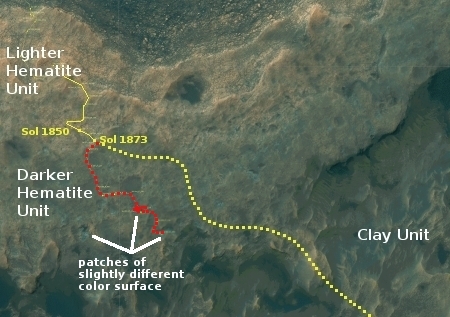
The rover has traveled 889 meters as of Aug. 15, and its scientific payloads have collected about 10 Gb of raw data. Now the rover runs stably and operates in good condition with sufficient energy. The CNSA added that the rover will continue to move to the boundary zone between the ancient sea and the ancient land in the southern part of Utopia Planitia and will carry out additional tasks.

According to the administration, Zhurong operated with a cycle of seven days during its exploration and detection. Its navigation terrain camera obtained topographic data along the way to support the rover’s path planning and detection target selection.

Zhurong’s subsurface detection radar acquired the data of the layered structure below the Martian surface, which analyzes the shallow surface structure and explores the possible underground water and ice. [emphasis mine]

This announcement reveals two tantalizing details. First, they are extending the mission, and plan to continue traveling to the south, with a very long term fantasy goal of reaching the transition zone between the northern lowland plains that Zhurong landed in and the southern cratered highlands. That fantasy goal is about 250 miles away. At the pace Zhurong is traveling, about 1,000 feet per month, it will take about a 100 years to cover that ground. Even so, as they move south they are slowly going up hill, and have the chance of seeing some change in the geology along the way.

The second tantalizing detail is indicated by the highlighted last sentence, and is probably the most important data obtained by Zhurong. It suggests they obtained good data from the rover’s ground penetrating radar, and it indicated the existence of underground layers. Whether those layers contain ice however is not clear. From the story it appears the data has not yet been analyzed enough to say.

0 comments

Genesis cover

On Christmas Eve 1968 three Americans became the first humans to visit another world. What they did to celebrate was unexpected and profound, and will be remembered throughout all human history. Genesis: the Story of Apollo 8, Robert Zimmerman's classic history of humanity's first journey to another world, tells that story, and it is now available as both an ebook and an audiobook, both with a foreword by Valerie Anders and a new introduction by Robert Zimmerman.

The print edition can be purchased at Amazon or any other book seller. If you want an autographed copy the price is $60 for the hardback and $45 for the paperback, plus $8 shipping for each. Go here for purchasing details. The ebook is available everywhere for $5.99 (before discount) at amazon, or direct from my ebook publisher, ebookit. If you buy it from ebookit you don't support the big tech companies and the author gets a bigger cut much sooner.


The audiobook is also available at all these vendors, and is also free with a 30-day trial membership to Audible.
 

"Not simply about one mission, [Genesis] is also the history of America's quest for the moon... Zimmerman has done a masterful job of tying disparate events together into a solid account of one of America's greatest human triumphs."--San Antonio Express-News

Lacy patterns in the high north of Mars

lacy patterns in the high north of Mars

Cool image time! The photo to the right, cropped, reduced, and rotated so that north is up, was taken on May 12, 2021 by the high resolution camera on Mars Reconnaissance Orbiter (MRO). It shows the strange lacy patterns seen routinely in the very high northern latitudes surrounding the Martian north pole.

Located in a region of the vast northern lowland plains dubbed Scandia Tholi, such features are apparently common here. From a 2011 geology paper of the region’s geological history:

We find that Scandia Tholi display concentric ridges, rugged peaks, irregular depressions, and moats that suggest uplift and tilting of layered plains material by diapirs and extrusion, erosion, and deflation of viscous, sedimentary slurries as previously suggested. These appear to be long-lived features that both pre-date and post-date impact craters.

The small circular feature near the bottom of the picture appears to be a mesa, and might be a pedestal crater, so old that the surrounding terrain has worn away and left the hardened-by-impact crater as a butte. To its right is a larger circular mesa with its scarp well eroded into hollows. This might also be a pedestal crater, or not.

The white lacy patterns could be frost, either water ice or dry ice. That the white lace tends to favor the north-facing slopes lends support to this guess. The photo was taken in the early spring, so the thin mantle of carbon dioxide that falls to cover the polar region south to sixty degrees latitude is only beginning to sublimate away.

0 comments

Conscious Choice cover

Now available in hardback and paperback as well as ebook!

From the press release: In this ground-breaking new history of early America, historian Robert Zimmerman not only exposes the lie behind The New York Times 1619 Project that falsely claims slavery is central to the history of the United States, he also provides profound lessons about the nature of human societies, lessons important for Americans today as well as for all future settlers on Mars and elsewhere in space.

 
Conscious Choice: The origins of slavery in America and why it matters today and for our future in outer space, is a riveting page-turning story that documents how slavery slowly became pervasive in the southern British colonies of North America, colonies founded by a people and culture that not only did not allow slavery but in every way were hostile to the practice.  
Conscious Choice does more however. In telling the tragic history of the Virginia colony and the rise of slavery there, Zimmerman lays out the proper path for creating healthy societies in places like the Moon and Mars.


“Zimmerman’s ground-breaking history provides every future generation the basic framework for establishing new societies on other worlds. We would be wise to heed what he says.” —Robert Zubrin, founder of the Mars Society.


All editions are available at Amazon, Barnes & Noble, and all book vendors, with the ebook priced at $5.99 before discount. All editions can also be purchased direct from the ebook publisher, ebookit, in which case you don't support the big tech companies and the author gets a bigger cut much sooner.


Autographed printed copies are also available at discount directly from the author (hardback $29.95; paperback $14.95; Shipping cost for either: $6.00). Just send an email to zimmerman @ nasw dot org.

Today’s blacklisted American: Big time comic book artist and screenwriter Frank Miller banned from British comic convention

Banned: Artist and screenwriter Frank Miller
Banned: Comic book artist and movie screenwriter Frank Miller

Genocide is coming: Frank Miller, well known comic book artist and the screenwriter of several major Hollywood movies, was banned from a British comic convention recently because fifteen years earlier — only a few years after the destruction of the World Trade Center and during the American effort to defeat the Islamic terrorist organization al-Qaeda — Miller had penned a comic book whose main character fought those terrorists.

And what prompted Miller’s banning by the convention, dubbed the Thought Bubble festival? Apparently, it received a single complaint from one very unknown Islamic cartoonist.

Miller was dropped after Zainab Akhtar, whom The Mix describes as an “award-winning cartoonist and small press publisher ShortBox founder,” said that she would “no longer be attending Thought Bubble festival this November” because Miller was set to be there. Akhtar explained: “As a proud Muslim woman, I cannot in good conscience attend a festival that deems it appropriate to invite and platform Frank Miller, a person who is responsible for the propagation of abhorrent anti-Muslim hate, particularly via his work.”

Akhtar in her complaint never actually cites any specific examples of Miller’s anti-Muslim hate, thus forcing everyone to guess what Miller’s specific crime might be. The only possible example is that earlier work, which very specifically attacked a terrorist group, not all of Islam.

But then, for the oppressive left, which includes radical Islamists like Akhtar, any criticism of their allies or agenda must always be labeled as “racist.”

As usual, what makes this story most appalling is the obsequiousness of the convention management, which immediately bowed to Akhtar’s slanderous complaint, begging forgiveness in the most cowardly way.
» Read more

6 comments

Saturn’s core is a slushy mix of rocks and liquid

Saturn's rings
Click for more information.

Using archival data from the Cassini orbiter that mapped ripples in the rings of Saturn, scientists have produced a model of Saturn’s core that suggests it is a slushy soup that as it sloshes about shifts the gas giant’s gravitational field.

By using the famous rings like a seismograph, scientists studied processes in the planet’s interior and determined that its core must be “fuzzy.” Instead of a solid sphere like Earth’s, the core of Saturn appears to consist of a ‘soup’ of rocks, ice and metallic fluids that slosh around and affect the planet’s gravity.

…Not only does the planet’s core seem sludgy, it also appears to extend across 60% of the planet’s diameter, making it much larger than previously estimated. The analysis showed that Saturn’s core might be about 55 times as massive as the entire planet Earth. Of the total mass of the core, 17 Earth masses are made of ice and rock, with the rest consisting of a hydrogen and helium-based fluid, the study suggests.

The image above was taken in 2017, and shows both a density wave in the rings (the parallel lines in the center) caused by a Saturn moon, and numerous “propellers”, small distortions in the rings caused by slightly larger objects.

4 comments

Leaving Earth cover

Leaving Earth: Space Stations, Rival Superpowers, and the Quest for Interplanetary Travel, can be purchased as an ebook everywhere for only $3.99 (before discount) at amazon, Barnes & Noble, all ebook vendors, or direct from my ebook publisher, ebookit.

If you buy it from ebookit you don't support the big oppressive tech companies and I get a bigger cut much sooner.


Winner of the 2003 Eugene M. Emme Award of the American Astronautical Society.

 
"Leaving Earth is one of the best and certainly the most comprehensive summary of our drive into space that I have ever read. It will be invaluable to future scholars because it will tell them how the next chapter of human history opened." -- Arthur C. Clarke

Ingenuity’s 12th flight successful

Ingenuity's shadow just before landing.

According to the Perseverance science team, the Mars helicopter Ingenuity successfully completed its twelfth flight on Mars early yesterday, making a short scouting round trip over an area called South Seitah to provide images that the team can use to plan the rover’s future route.

All told, Ingenuity flew just under 1,500 feet flying about 30 feet above the ground for just under three minutes. The picture to the right was taken just before landing, and shows the helicopter’s shadow on the ground. It is one of six so far downloaded. The remaining images will follow later.

The announcement was made on Twitter, and included some embarrassingly over-the-top prose:

The #MarsHelicopter’s latest flight took us to the geological wonder that is the “South Séítah” region.

South Seitah is hardly a “geological wonder”. It is a sandy area with some rocks and interesting geology.

I’m not sure why, but the Perseverance rover team seems prone to do this with their press releases and announcements. The claim they make over and over that Perseverance’s prime mission is to look for ancient life is junk Now they call a relatively undistinguished and small area on a crater floor a “wonder.”

Makes one think they somehow feel a need to justify what they are doing, something that is patently absurd. They are controlling a robotic rover and helicopter tens of millions of miles away as both explore a place on another planet no one had ever visited before. That certainly is spectacular enough, and does not need purple prose to justify.

3 comments

Blue Origin files lawsuit against Starship lunar contract award

What a joke: Jeff Bezos’s company Blue Origin on August 13th filed a lawsuit in federal court, attempting to overthrow the contract award NASA gave SpaceX’s Starship in its manned lunar lander Artemis project

In a court filing on Friday, Blue Origin said it continued to believe that two providers were needed to build the landing system, which will carry astronauts down to the Moon’s surface as early as 2024. It also accused Nasa of “unlawful and improper evaluation” of its proposals during the tender process. “We firmly believe that the issues identified in this procurement and its outcomes must be addressed to restore fairness, create competition and ensure a safe return to the Moon for America,” Blue Origin said.

The article then goes on to list the basic facts that make this lawsuit absurd. First, NASA had not been appropriated enough money by Congress to award two contracts, and had it done so, it would have violated the law. Second SpaceX’s bid was the lowest bid, far less than Blue Origin’s expensive price. Third, SpaceX was already test flying early prototypes of its Starship lander, while Blue Origin had built nothing. Fourth, many other technical issues made SpaceX’s bid superior.

Finally, the GAO, as an independent arbitrator, has already ruled against a Blue Origin protest, stating unequivocally that NASA had done nothing wrong in its contract process.

This lawsuit makes Blue Origin appear to be a very unserious company. Rather than putting its energies towards building rockets and spacecraft to demonstrate its capabilities, it focuses its effort on playing legal games in the courts. Such behavior will only make it seem less appealling when next it bids on a NASA or Space Force contract.

15 comments

Arianespace’s Vega rocket successfully launches five satellites

Capitalism in space: Arianespace’s Vega rocket today successfully launched five satellites into orbit, completing the company’s third launch in 2021 and the second Vega launch this year.

With only three launches so far in 2021, Arianespace does not make the leader board, which is presently as follows:

26 China
20 SpaceX
12 Russia
4 Northrop Grumman

The U.S.’s lead over China in the national rankings remains 31 to 26.

0 comments

Regional Martian dust storms help suck water from Mars

Orbital data now shows that both global and regional dust storms on Mars help remove the planet’s water, allowing it to reach higher atmospheric elevations where solar radiation breaks it up and it escapes into space.

Scientists have long suspected that Mars, once warm and wet like Earth, has lost most of its water largely through this process, but they didn’t realize the significant impact of regional dust storms, which happen nearly every summer in the planet’s southern hemisphere. Globe-enveloping dust storms that strike typically every three to four Martian years were thought to be the main culprits, along with the hot summer months in the southern hemisphere when Mars is closer to the Sun.

But the Martian atmosphere also gets heated during smaller, regional dust storms, according to a new paper published August 16 in the journal Nature Astronomy. The researchers, an international team led by Chaffin, found that Mars loses double the amount of water during a regional storm as it does during a southern summer season without regional storms.

This conclusion is based on data gathers from three different orbiters during a regional dust storm in early 2019.

1 comment

A Martian river of ice

Glacial flow on Mars?
Click for full image.

Cool image time! The photo to the right, rotated, cropped and reduced to post here, was taken on May 13, 2021 by the high resolution camea on Mars Reconnaissance Orbiter (MRO). It spans the entire 4.7 mile width of the southern hemisphere canyon dubbed Reull Vallis. The white arrow indicates the direction of the downhill grade

The scientists title this image “Lineated Valley Fill.” The vagueness of this title is because they have not yet confirmed that this lineated valley fill is a glacier flowing downhill to the west.

Nonetheless, the material filling this valley has all the features one expects glaciers to exhibit. Not only is the the lineation aligned with the flow, it varies across the width of the canyon as glaciers normally do. At the edge the parallel grooves are depressed, probably because they are torn apart by the canyon walls as the glacier flows past. In turn, at the center of the flow the grooves are thinner and more tightly packed, and appear less disturbed. Here, the flow is smooth, less bothered by surrounding features.

This pattern also suggests the merging of two flows somewhere upstream.

A glance at the spectacular Concordia glacier in the Himalayas near the world’s second highest mountain, K2, illustrates the similarity of this Martian feature to Earth glaciers.

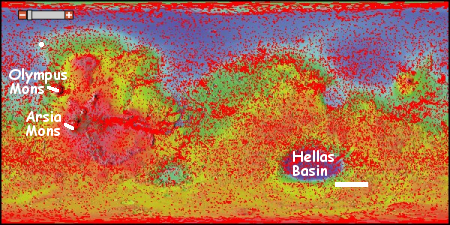
Reull Vallis itself flows down to Hellas Basin, the deepest basin on Mars. As it meanders downhill along its 650 mile length it steadily gets wider and less distinct as it drops into Hellas. Along its entire length MRO has photographed numerous similar examples of this lineated fill, all suggesting that under a thin layer of debris is a thick glacier, slowerly carving this canyon out.

The overview map below illustrates these facts nicely, while further reinforcing these glacial conclusions.
» Read more

8 comments
1 894 895 896 897 898 2,929