Fish & Wildlife has expanded its regulatory rule to every tree in much of the U.S.

Areas now subject to regulation if you intend to cut down any trees
The blue and green areas are now subject to
Fish & Wildlife regulation if you intend to cut
down any trees

Apparently in a bid to give itself more power over every proposed building project in the United States, the Fish & Wildlife Service in October 2024 (just before the election) wildly expanded its regulatory rules for protecting endangered bats.

According to the new rules, Fish & Wildlife now considers the removal of any trees at such projects to be a risk to the endangered species, because those trees “may” have been used as roosts and would therefore threaten the species ability to survive if removed.

No matter that there may be thousands of other trees nearby, including many acres of forest. If you are building anything that involves cutting down any trees, you will be subjected to Fish & Wildlife supervision that could block construction. And the area this new rule covers includes almost the entire eastern and northern parts of the United States, as shown on the maps to the right, taken from the new regulation guidelines [pdf].

Long time reader Jack O’Leary informed me of this new power grab. He also sent me information about one particular project in Massachusetts involving the installation of a well and pump station in a forested area southeast of Boston, far from any bat hibernacula. The only impact this project might have on any bats is the removal of some trees, though the project is located in a forested area with hundreds of acres of trees all around (as shown clearly on the satellite view on Google maps).

Yet Fish & Wildlife makes it clear in its letter [pdf] to the project that its “Endangered Species Act requirements are not complete.” Fish & Wildlife admits that the project will pose no direct threat to the endangered bats, but the very act of cutting down a few trees “may affect” the bats, so therefore government regulatory supervision is required.
» Read more

9 comments

South Africa courts Starlink; Musk says no

The South African government appears to be offering Starlink some concessions in order to get it approved in that country, but it also appears that Elon Musk is not interested in the deal, because it would still require the company to impose racial quotas on hiring and ownership that he not only considers immoral, but are illegal by U.S. law.

In an interview at the Qatar Economic Forum in Doha, Musk did not confirm whether a deal had been made with South Africa, as suggested in the reports. However, he maintains that Starlink’s failure to secure a license is attributed to his not being black.

“First of all, you should be questioning why there are racist laws in South Africa; that’s the problem. That’s the issue you should be attacking. The whole idea with Nelson Mandela, he was a great man, was that all races should be on equal footing in South Africa, that’s the right thing to do, not to replace one set of racist laws with another set of racist laws.”

“I was born in South Africa but can’t get a licence to operate in Starlink because I’m not black,” Musk said.

The first link notes that South Africa requires a 30% ownership by “historically disadvantaged groups, primarily Black South Africans,” a racist quota that Musk is likely to reject whole-heartedly.

10 comments

In telling us why they are fleeing Trump America, three Yale professors prove they are unqualified for their jobs

What many now label the
The “Poison Ivy League” may have finally
gotten better!

Good riddance! In a New York Times op-ed on May 14, 2025, three former Yale professors attempted to explain why they have quit their jobs at Yale and moved to teach in Canada at the University of Toronto.

Unbeknownst to them, their idiotic and ignorant reasons for leaving demonstrated that they are actually completely unqualified to be college professors, and that Yale (and the United States) will be better off without them.

Professor Stanley is leaving the United States as an act of protest against the Trump administration’s attacks on civil liberties. “I want Americans to realize that this is a democratic emergency,” he said.

Professor Shore, who has spent two decades writing about the history of authoritarianism in Central and Eastern Europe, is leaving because of what she sees as the sharp regression of American democracy. “We’re like people on the Titanic saying our ship can’t sink,” she said. “And what you know as a historian is that there is no such thing as a ship that can’t sink.”

Professor Snyder’s reasons are more complicated. Primarily, he’s leaving to support his wife, Professor Shore, and their children, and to teach at a large public university in Toronto, a place he says can host conversations about freedom. At the same time, he shares the concerns expressed by his colleagues and worries that those kinds of conversations will become ever harder to have in the United States.

As noted in this analysis of their actions, all three say they are doing this because they have studied fascism and thus “equate ‘Make America Great Again’ with Adolf Hitler’s ‘Ein Volk, ein Reich, ein Führer.'”

The analogy is so weak and incoherent as to be laughable. As the essayist in this second link notes, it cheapens the meaning of fascism and in fact suggests these three “professors” don’t have the slightest idea what the word means, despite their claim they have studied it.

More important however are the three quirks of personality illustrated by their position and actions that signify why their are unqualified to be professors to begin with.
» Read more

26 comments

FAA issues revised launch window and flight restrictions for future Starship test flights

Flight path for Starship's ninth test flight

Due to the breakup of Starship over the Atlantic during its last two test flights, the FAA today issued [pdf] revised launch window and flight plan restrictions for future flights, in an attempt to placate somewhat the concerns of the United Kingdom.

The map to the right, taken from the FAA assessment, shows in red the area where air traffic is impacted by the next Starship/Superheavy launch, now tentatively planned for next week. Note how the path threads a line avoiding almost all land masses, thus limiting the worst impact to just the Bahamas, the Turks & Caicos Islands. Though the launch will effect 175 flights and require one airport on these islands to close during the launch window, to minimize the impact the FAA has required that the launch window be scheduled outside peak travel periods.

At the same time, the FAA after discussions with the governments on these islands has approved this flight plan, noting that “no significant impacts would occur” due to the ninth flight.

The agency has not yet actually issued the launch license, but it will almost certainly do so in time for SpaceX’s planned launch date. Since the advent of the Trump administration the FAA has no longer been slow walking these approvals in order to retype the results of SpaceX’s investigation. Instead, as soon as SpaceX states it has satisfactorily completed its investigation, the FAA has accepted that declaration and issued a launch license. Expect the same this time as well.

2 comments

NASA: Perseverance observed the first visible-light aurora in March 2024

According to a NASA/JPL press release today, Perseverance successfully observed the first visible-light aurora on another world when in March 2024 it photographed a faint aurora overhead, caused by a strong solar flare.

The images at the link are quite unexciting, so much so that I don’t see a reason to include it here. The aurora observed is barely noticeable. Moreover, this is not really a new discovery. Previous observations in the ultraviolet had determined that Mars does have a weak aurora. That in rare circumstances a strong solar event can have it also appear in visible wavelengths is hardly news.

Normally I would have considered this story unimportant enough to list merely as a quick link at the end of the day, but I post it now because of how the mainstream propaganda press has latched onto it as if it is a big deal. The New York Times, the Washington Post, and the Associated Press all posted stories, giving it far more play than it deserves.

My impression from all these articles is that their reporters know almost nothing about Mars and the research that is going on there, and were easily bamboozled by the press people at NASA and JPL to report this relatively minor story loudly. They no longer have anyone who covers science and space on a regular basis and thus understand the larger context, so therefore their coverage is often shaped entirely by the public relations departments at NASA.

More proof that in today’s internet world, if you want good information the last place you should go is the old dinosaur press.

5 comments

Academics in space community scheme to continue their racist DEI policies

USRA logo

A letter sent out yesterday by the Universities Space Research Association (USRA) clearly illustrated the bigoted desire of our modern Marxist academic community to continue its racist Diversity, Equity, and Inclusion (DEI) policies in hiring by hiding or renaming them so that the Trump administration might not notice.

USRA is one of several university consortiums that manage a variety of space, science, and astronomical operations for the government. In USRA’s case, it manages the Lunar Planetary Institute (LPI) for NASA.

The letter purported to announce how the organization was complying with Trump’s executive orders banning such race-based programs, but instead revealed its desire to continue them, but to do so under the table where no one could monitor them.
» Read more

5 comments

NASA cancels VIPER solicitation

NASA today announced that it has canceled its solicitation from the private sector, asking for proposals for launching its overbudget and as yet unfinished lunar rover VIPER to the Moon.

NASA announced Wednesday it is canceling its Lunar Volatiles Science Partnership Announcement for Partnership Proposals solicitation, which sought opportunities to send VIPER to the Moon at no cost to the government.

The announcement, which was very short and lacking in any details, stated also that the agency “will announce a new strategy for VIPER in the future.”

Some background: VIPER was originally budgeted at $250 million. When cancelled in 2024 its budget had ballooned to over $600 million, and that wasn’t enough to complete the rover for launch.

This decision suggests the agency did not get any worthwhile proposals. Apparently, no one was interested in paying the cost to get VIPER finished (about $100 million) and launched. It is also likely that the planned Trump budget cuts had an impact on this decision. NASA management probably recognized that there was no way they could con the administration into forking over any money to finance any private proposal.

It is also possible that this cancellation now is part of the typical game NASA managers always play to get Congress to fund bloated programs like this. Cancel it, get the propaganda press to cry about how the cancellation is so terrible, which in turn gets Congress outraged and willing to approve the extra funds.

0 comments

FAA approves SpaceX request to increase Starship launch rate at Boca Chica

The FAA today by email announced that it has released the final environmental reassessment that approves SpaceX’s request to increase the number of yearly Starship/Superheavy launches at Boca Chica to as many as 25.

The assessment is now available for public comment, and could still be revised. However, the FAA’s conclusions are clear, as indicated by the highlighted phrase:

The FAA is announcing the availability of the Final Tiered Environmental Assessment and Mitigated Finding of No Significant Impact/Record of Decision (FONSI/ROD) for the SpaceX Starship/Super Heavy Vehicle Increased Cadence at the SpaceX Boca Chica Launch Site in Cameron County, Texas (Final Tiered EA and Mitigated FONSI/ROD).

Under the Proposed Action addressed in the Final Tiered EA, the FAA would modify SpaceX’s existing vehicle operator license to authorize:  Up to 25 annual Starship/Super Heavy orbital launches, including: Up to 25 annual landings of Starship (Second stage); Up to 25 annual landinqgs of Super Heavy (First stage). The Final Tiered EA also addressed vehicle upgrades.

You can read the executive summary of this announcement here [pdf]. The full reassessment can be read here [pdf]. Its conclusion is quite blunt:

The 2022 PEA [Preliminary Environmental Assessment] examined the potential for significant environmental impacts from Starship/Super Heavy launch operations at the Boca Chica Launch Site and defined the regulatory setting for impacts associated with Starship/Super Heavy. The areas evaluated for environmental impacts in this EA [environmental assesssment] included air quality; climate; noise and noise‐compatible land use; visual resources; cultural resources; Department of Transportation Section 4(f); water resources; biological resources (terrestrial and marine wildlife); land use; hazardous materials; natural resources and energy supply; and socioeconomics, and children’s health. In each of these areas, this EA concludes that no significant impacts would occur as a result of SpaceX’s proposed action. [emphasis mine]

As I’ve noted repeatedly, this has all been self-evident for years, as proved by the environmental circumstances at the American spaceports at Cape Canaveral and Kennedy in Florida and Vandenberg in California. Spaceports help the environment by creating large wildlife refuges where no development can occur. We have known this for decades. That the FAA and the federal bureaucracy has in the past five years suddenly begun demanded these long reassessments time after time that simply restate these obvious facts can only be because that bureaucracy wants to justify its useless existence with make-work.

4 comments

Australia’s first rocket company continues to be blocked by red tape

Australian commercial spaceports
Australia’s commercial spaceports. Click for original map.

The first rocket launch by Gilmour Space, Australia’s first rocket company, from its Bowen spaceport on the east coast of Australia has apparently been blocked by continuing bureaucratic regulatory red tape.

In February the company had announced a planned launch date in March, based on what appeared to be the issuance (after more than a year’s delay) of its launch licence. That launch however never happened, with no public explanation, until now. From the link above:

In an update on Sunday, the Queensland-based firm said it had received approval from CASA and is now waiting for final clearance from the Australian Space Agency.

…It had planned for an inaugural blast-off in April 2024 but faced a lengthy delay in obtaining its final permit from the Australian Space Agency.

In other words, the launch license had only been promised, but then was not issued, leaving the company stranded for several more months, with that license still buried in the government’s byzantine operations.

The article at the link says the Australian government is now moving to streamline its space regulatory system, but don’t believe it. The elections this week saw a resounding victory for the leftist coalition with the conservative party defeated handily. With the left now in firm control, expect the regulation to increase, not decrease. Leftwing governments almost never reduce regulation. It goes against their power-hungry genetics.

4 comments

ESA’s issues a non-reaction to Trump’s proposed NASA cuts

The European Space Agency (ESA) yesterday issued its first reaction to Trump’s proposed cuts to NASA’s Artemis program, including cancellation of the Orion capsule and Lunar Gateway station that ESA is building major components, and essentially said nothing.

NASA has briefed ESA about the Budget Request, and while some questions still remain about the full repercussions, follow-up meetings are already taking place with NASA. ESA remains open to cooperation with NASA on the programmes earmarked for a reduction or termination but is nevertheless assessing the impact with our Member States in preparation for ESA’s June Council.

ESA and NASA have a long history of successful partnership, particularly in exploration – a highly visible example of international cooperation – where we have many joint activities forging decades of strong bonds between American and European colleagues. Space exploration is an endeavour in which the collective can reach much farther than the individual. Thus, ESA has strong partnerships with space agencies from around the globe and is committed to not only being a reliable partner, but a strong and desirable partner.

Basically ESA is holding off any major response until they get more information from NASA and the Trump administration. It also notes that any more detailed response must wait until it holds its own meetings scheduled for June and later.

ESA’s problem is that it tied its manned space effort to NASA’s Orion capsule and Gateway station. On Orion it is building the service module, and has a number under construction that now might be unneeded if only two more Orions fly. As for Gateway, Europe is building major components of the station’s central habitation module. It is also building, in partnership with Japan, a second habitation module for their use. The cancellation of Gateway leaves these modules hanging with nowhere to go.

Though we should expect some pushback from Europe in an attempt to save Lunar Gateway, I expect these events will end up doing more for Europe’s nascent commercial launch industry. What the continent really needs is a private competitive aerospace industry making money in space. If it gets that, it will no longer have to rely on NASA, or ESA for that matter.

And based on the recent policy actions by ESA’s major partners (Germany, France, Italy, Spain, and the UK) to shift from a government-run centralized space program run by ESA’s Arianespace to encouraging the development of an independent competing private launch industry, I predict Europe will shift even more focus in this direction when they finally respond to the Trump cuts.

Expect European to call for more autonomy and European-built rockets and spacecrafts that do not rely on NASA or American proposals. This will not necessarily end its space partnership with the U.S., but it will be less beholden to it.

0 comments

It only took $22 billion and 19 years: Lockheed Martin proudly announces the completion of the first Orion capsule capable of manned flight

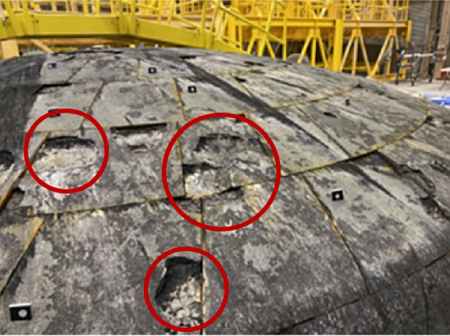
Orion's damage heat shield
Damage to Orion’s heat shield caused during re-entry in 2022,
including “cavities resulting from the loss of large chunks”.
Nor has this issue been fixed.

My heart be still. On May 1, 2025 Lockheed Martin proudly announced that it had finally completed assembly and testing of the first Orion capsule capable of taking human beings into space.

Lockheed Martin [NYSE: LMT] has completed assembly and testing of NASA’s Orion Artemis II spacecraft, transferring possession to NASA’s Exploration Ground Systems (EGS) team today. This milestone is a significant step for NASA and the Artemis industry team, as they prepare to launch a crew of four astronauts to further the agency’s mission in establishing a human presence on the Moon for exploration and scientific discovery. It will also help build the foundation for the first crewed missions to Mars.

Orion is the most advanced, human-rated, deep space spacecraft ever developed. Lockheed Martin is the prime contractor to NASA for Orion and built the crew module, crew module adaptor and launch abort system. “This achievement is a testament to our employees and suppliers who have worked tirelessly to get us to this important milestone,” said Kirk Shireman, vice president of Human Space Exploration and Orion program manager at Lockheed Martin. “The Orion spacecraft completion for Artemis II is a major step forward in our nation’s efforts to develop a long-term lunar presence. It’s exciting to think that soon, humans will see the Earth rise over the lunar horizon from our vehicle, while also traveling farther from Earth than ever before.”

What disgusting hogwash. First of all, Lockheed Martin was issued the contract to build two capsules, one for testing and one for manned flight, in 2006. It only took the company 19 years to build both. Second, that 2006 contract was supposed to only cost $3.9 billion. Instead, NASA has forked out more than $22 billion.

And what have we gotten? Two capsules, plus a handful of prototype test versions. Worse, this first capsule will be the first to ever carry the life support systems that keep humans alive, as Lockheed Martin admits in its press release:
» Read more

22 comments

Trump bypasses Boeing to get an newly refurbished 747 Air Force One

Apparently disgusted with Boeing’s inability to get two Boeing 747s refurbished on budget and before he leaves office in 2028, the Trump administration has now enlisted another aerospace company, L3Harris, to refurbish a 747 formerly used by the Qatar government.

The president hopes to use the refurbished plane by the fall, sources told the outlet, and is regularly checking on its progress . This aircraft will be an interim solution until the Boeing jets are delivered.

The current presidential jets — which have been in service since the George H.W. Bush administration — are nearing their end of life.

Boeing’s conduct here has been truly disgraceful. It got the $3.9 billion fixed-price contract to refurbish two of its own 747s in 2018. Yet, despite having two working 747s — a plane it designed and built — it can’t refurbish them in less than a decade, while going over budget by about $2.4 billion, money it has to lay out because of the fixed-price nature of the contract.

Hat tip to reader James Street.

10 comments
1 18 19 20 21 22 239