Bankrupt Virgin Orbit is dead, its assets purchased by a variety of different companies

After failing to find a single buyer for the whole company, Virgin Orbit is now officially dead as a company, its assets broken up during bankruptcy proceedings and purchased by several different companies.

Rocket Lab paid $16.1 million for Virgin Orbit’s main manufacturing facility in California, which it intends to use for developing its larger Neutron rocket. Stratolaunch paid $17 million for the company’s 747 airplane and related equipment. Launcher, a former rocket startup that is now owned by the space station startup Vast, paid $2.7 for the company’s test site in Mojave, California, which it plans to use for static fire engine tests of a rocket engine it is developing for sale to others. A liquidation company purchased other assets, while the various LauncherOne rockets under construction remain unsold.

It is essential the reasons for this failure are made very clear. The destruction of this company occurred because regulators in the United Kingdom prevented it from launching from within the UK for almost half a year, during which it could not perform other launches elsewhere and therefore earn revenue. It then ran very low on cash, and when the UK launch failed in January, the company no longer had the resources to weather to time necessary to complete the investigation, fix the problem that caused the failure, and resume launches.

For other rocket startups, it is very important to consider this story before committing to launching in the UK. where you will face major bureaucratic obstacles from its government. Until there is evidence that something has changed, it might be better to consider other launch sites.

21 comments

Lunar Reconnaissance Orbiter spots Hakuto-R1 impact debris on Moon

Hakuto-R1 impact site, before and after
Click for original blink image.

NASA’s Lunar Reconnaissance Orbiter (LRO), scientists have spotted what they think is the impact debris produced when Ispace’s private lunar lander Hakuto-R1 crashed on the Moon on April 25, 2023.

To the right are two LRO images, the first at the top taken prior to Hakuto-R1’s landing attempt. The second at the bottom was acquired by LRO on April 26, 2023, the day after that attempt. The lettered arrows indicate four spots where the scientists identified changes between the two pictures. From the caption:

Arrow A points to a prominent surface change with higher reflectance in the upper left and lower reflectance in the lower right (opposite of nearby surface rocks along the right side of the frame). Arrows B-D point to other changes around the impact site.

According to the LRO science team, these changes suggest different pieces of debris, though it will take more analysis and more images under different lighting conditions to determine more precisely what they have found.

The presence however of four pieces strongly suggests that Hakuto-R1 hit the ground hard enough to break apart. Based on the initial data received during landing, it was thought the spacecraft had touched down softly but then was damaged by some unforeseen obstacle on the ground, such as a large boulder. The LRO image suggests instead that it did not touch down softly at all.

3 comments

Air Force awards Ursa Major rocket engine development contact

The Air Force Research Laboratory (AFRL) has awarded the rocket engine startup Ursa Major a contract to develop two different rocket engines.

Under the contract, the Colorado-based firm will build and test a prototype of its new Draper engine for hypersonics, and further develop its 200,000-pound thrust Arroway engine for space launch.

…Under the AFRL contract, for which neither the lab or company provided a value, Ursa Major will also build a dedicated test stand for Draper and plans to hotfire the engine within 12 months.

Arroway, on the other hand, is a reusable liquid oxygen and methane staged combustion engine for medium and heavy launch vehicles. Ursa Major first announced development the 200,000-pound thrust engine last August, explaining that when clustered together, Arroway engines could replace the Russian-made RD-180 and RD-181, which are no longer available to US launch firms.

According to Ursa Major’s press release, the AFRL contract will allow further development of Arroway with a hotfire expected in 2025.

Ursa Major already has several contracts for its smaller Hadley engine, from the rocket startups Phantom, Vector, Astra, and the Air Force, and has built more than a hundred so far. The Arroway meanwhile is being developed as an American replacement for the Russian engines used by Northrop Grumman in its Antares rocket.

All in all, it appears Ursa Major is becoming a major challenger to Aerojet Rocketdyne, which in recent years had a lock on most government contracts for rocket engines. That lock resulted in very expensive engines that took years to build. The government (and others) are now finding someone else to provide this service at a better cost and far more quickly. We shall see whether Aerojet Rocketdyne responds to this competition properly, or goes the way of the horse carriage.

0 comments

SpaceX files to join FAA as defendant in lawsuit trying to shut down Boca Chica

SpaceX on May 19, 2023 submitted a motion to become a defendant in the lawsuit filed by the Center for Biological Diversity (CBD) and others that demands its Starship/Superheavy launchsite at Boca Chica be shut down.

“SpaceX’s Starship/Super Heavy launch program hinges on the FAA’s review and licensing decision challenged here. If the Court were to rule in Plaintiffs’ favor, the FAA’s decision could be set aside, and further licensing of the Starship/Super Heavy Program could be significantly delayed, causing severe injury to SpaceX’s business,” the company said in the motion, which was filed on May 19.

The full motion can be read here [pdf].

SpaceX’s motion notes that it has followed all government regulations in the decade since it established its Boca Chica launch site, and invested more than $3 billion in doing so. The motion points out that “the FAA does not adequately represent SpaceX’s interests” and that the company must participate because the lawsuit will have direct financial impact on its business.

In other words, the big guns are now being hauled out against this lawsuit, which on its face is somewhat weak. We shall see if it can withstand the much more aggressive fight that SpaceX is certain to put up.

11 comments

Indian company joins the high altitude balloon tourist race

A new company from India, Space Aura, is proposing to fly tourists on a high altitude balloon by 2025, joining the global competition that already includes two American balloon companies as well as one Spanish company.

Space Aura’s capsule, christened prototype SKAP1, will be tethered to a high performance ‘space balloon system’, complete with an enormous parachute. The capsule will accommodate six tourists and one pilot with ample leg room and comfortable walking space. It will be pressurised during flight and will have environmental control and life support systems that maintain oxygen, pressure, and temperature levels.

Even though passengers will not experience microgravity, they would still need to prepare before flying. Prior to the launch, which will be from Karnataka, Maharashtra, or Madhya Pradesh, the group of space tourists will undergo a week of basic physical training. The duration of the entire flight is expected to be about 5.5 to 6 hours. Tourists will ascend for about 90 minutes, spend an hour gazing out at the earth below, and begin their 90-minute descent with the balloon and parachute.

The two American companies, Space Perspective and World View, claim they will be flying tourists by 2024, while the Spanish company, Halo Space, is targeting 2025.

1 comment

SpaceX launches Axiom’s second commercial manned mission to ISS

SpaceX today successfully used its Falcon 9 rocket to launch its Freedom manned capsule on its second flight, carrying four passengers on Axiom’s second commercial manned mission to ISS.

The Axiom crew included three paying passengers, one from the U.S. and two from Saudi Arabia, with the fourth crew member former NASA astronaut Peggy Whitson, now acting as Axiom’s commander. They plan to spend eight days docked to ISS. Making this commercial flight even more interesting is that the station already has a Middle Eastern commercial astronaut, from the United Arab Emirates. The Arab space race is clearing heating up.

The first stage was making its first flight, and successfully landed back at Cape Canaveral.

Were you aware this was happening? With my readers I expect so, but I am willing to bet that we are a very small minority. SpaceX has now made American manned spaceflight so routine almost no one pays attention.

The leaders in the 2023 launch race:

34 SpaceX
18 China
6 Russia
4 Rocket Lab

American private enterprise now leads China 38 to 18 in the national rankings, and the entire world combined 38 to 30. SpaceX by itself is now tied in total launches with the rest of the world, including American companies.

14 comments

SpaceX launches 5 Iridium and 16 OneWeb satellites

SpaceX early today successfully used its Falcon 9 rocket to put five Iridium and sixteen OneWeb satellites into orbit, lifting off from Vandenberg Space Force Base.

The first stage successfully completed its eleventh flight, landing on a drone ship in the Pacific. The two fairings completed their third and sixth flights respectively.

The leaders in the 2023 launch race:

33 SpaceX (with a launch scheduled for tomorrow)
18 China
6 Russia
4 Rocket Lab (with a launch scheduled for tomorrow)

American private enterprise now leads China 37 to 18 in the national rankings, and the entire world combined 37 to 30. SpaceX now trails the entire world combined, including American companies, by only 33 to 34.

8 comments

Starship prototype #25 is rolled to launchpad for static fire engine tests

Starship prototype #25 on the way to launchpad
Click for original image.

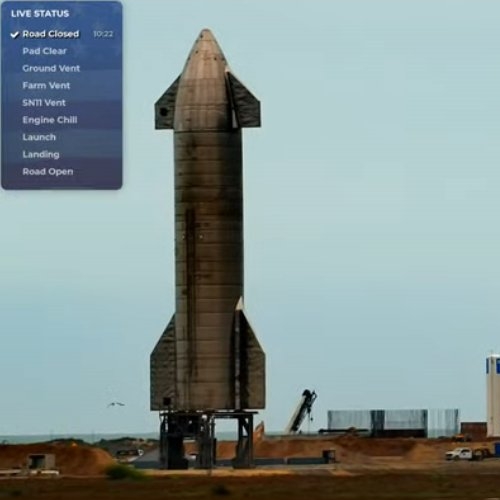
SpaceX yesterday evening rolled its 25th prototype of its Starship spacecraft to its suborbital launchpad at Boca Chica, as shown on the image to the right, for a planned static fire engine test of its six Raptor engines.

If all goes well, the company hopes to stack this prototype on top of the ninth prototype of Superheavy and complete the second test orbital flight of the entire rocket as early as June 15, 2023, with a launch window as long as six months according to the company’s FCC communications license application.

The actual launch date however remains very uncertain, for several reasons. The FAA must issue a launch license, and it won’t do that until it is satisfied the investigation into the first launch failure is complete. That launch approval will also likely be delayed because of the lawsuit against that agency for issuing the previous launch license.

8 comments

Capstone does lunar fly-by, takes first lunar pictures, completes main mission

The Moon as seen by Capstone
Click for original image.

The smallsat engineering test lunar orbiter Capstone has now successfully ended its primary mission, completing six months of operation in the near-rectilinear halo orbit that NASA’s Lunar Gateway manned space station intends to fly.

To put a final touch on that main mission, in May mission managers at the private company Advanced Space also completed two additional experiments. On May 3, 2023 they performed a close-fly of the Moon, using the spacecraft’s camera for the first time to take the picture of the Moon to the right.

Then, on May 9 Capstone successfully tested navigation technology in conjunction with NASA’s Lunar Reconnaissance Orbiter (LRO), also in orbit around the Moon.

During the May 9 experiment, CAPSTONE sent a signal to LRO designed to measure the distance and relative velocity between the two spacecraft. LRO then returned the signal to CAPSTONE, where it was converted into a measurement. The test proved the ability to collect measurements that will be utilized by CAPS software to determine the positioning of both spacecraft. This capability could provide autonomous onboard navigation information for future lunar missions.

The mission now enters its extended mission, planned to last at least a year.

3 comments

NASA picks Blue Origin’s partnership for building second manned lunar lander

Artist's concept of Blue Moon
An artist’s concept of Blue Moon

NASA today announced that it has chosen the partnership led by Blue Origin to build a second manned lunar lander for its Artemis program.

Blue Origin will design, develop, test, and verify its Blue Moon lander to meet NASA’s human landing system requirements for recurring astronaut expeditions to the lunar surface, including docking with Gateway, a space station where crew transfer in lunar orbit. In addition to design and development work, the contract includes one uncrewed demonstration mission to the lunar surface before a crewed demo on the Artemis V mission in 2029. The total award value of the firm-fixed price contract is $3.4 billion.

The other partners in the contract are Draper, Astrobotic, and Honeybee Robotics.

This is NASA’s second contract for a lunar lander, with SpaceX’s Starship the first. The idea is to have two landers available from competing companies for both competition and redundancy, similar to the approach the agency has used for its manned ferry service to ISS, using SpaceX and Boeing. I wonder if NASA’s experience on the Moon will be similar to that ferry service, whereby only SpaceX so far has been able to deliver. The track record of Blue Origin suggests it will do about as poorly as Boeing has with Starliner.

28 comments

SpaceX launches another 22 upgraded Starlink satellites into orbit

Using its Falcon 9 rocket SpaceX early today successfully launched another 22 upgraded Starlink satellites into orbit, lifting off from Cape Canaveral.

The first stage completed its fifth flight, landing successfully on a drone ship in the Atlantic. The fairings completed their eighth flight.

The leaders in the 2023 launch race:

32 SpaceX
18 China
6 Russia
4 Rocket Lab

American private enterprise now leads China 36 to 18 in the national rankings, and the entire world combined 36 to 30. SpaceX by itself only trails the entire world combined, including American companies, 32 to 34.

2 comments

Student model rocket doubles altitude record

On April 16, 2023 students from the Embry-Riddle Aeronautical University launched a model rocket that more than doubled the altitude record for liquid-fueled model rockets.

The rocket reached an altitude of 47,732 feet, setting multiple records, including the highest undergraduate and collegiate amateur liquid rocket launch in the United States. It more than doubled the previous record of 22,000 feet.

Named Deneb after one of the brightest stars in the northern hemisphere, the rocket had a total burn time of 26.1 seconds, reaching a velocity of 1,150 mph (Mach 1.5).

I have embedded the live stream below, set to begin just before launch.
» Read more

2 comments
1 186 187 188 189 190 676