ESA announces new round of funding for new rocket companies

Capitalism in space: The European Space Agency (ESA) yesterday announced a new round in its Boost! program to provide new startup rocket companies funding.

The new round will accept new submissions through 2028. The program is designed to encourage the development of private and independent rocket companies, competing for market share, with the added ability to provide ESA its needed launch services. What makes this ESA program different than all its previous rocket programs is that ESA does not own or control the rockets. It is helping to get these companies started, and will simply then be a customer buying the product from them once operation. Ownership will belong to the companies, not ESA.

To emphasize the ownership point, to get funding under this program “requires private co-funding. For every euro invested by ESA in commercial space businesses, often more than five euros are leveraged from private investors.”

So far ESA has provided funding to eleven different European startups, including Isar Aerospace, Rocket Factory Augsburg, and PLD, all three of which hope to make their first orbital launch this year. This new round is being offered to these companies and any new ones that might come forward. Of the 110 million euros so far allocated 20 million euros remains available for distribution.

3 comments

AST SpaceMobile reaffirms its goal to launch 45 Bluebird satellites by the end of ’26

Despite the launch failure last month by Blue Origin’s New Glenn rocket, causing the loss of its satellite, AST SpaceMobile in its most recent quarterly report this week reaffirmed its goal to get 45 Bluebird satellites into orbit by the end of 2026.

In AST SpaceMobile’s 10-Q filed with the SEC on Monday, the company said the loss is expected to be in line with the carrying value of the satellite, in the range of $155 million to $160 million. The company plans for an asset write-off in the second quarter of 2026. The company also said in the 10-Q it had launch insurance coverage that covered a portion of the satellite and launch costs and has filed claims.

“At the end of the day, remember, we have 33 satellites in advanced stages of production at the factory. So it was a loss, we’re on to the next,” Wisniewski told investors. He added that the company is working closely with Blue Origin and is “optimistic” about New Glenn returning to the launch pad soon.

The company’s next launch is with SpaceX on a Falcon 9 rocket that will launch three satellites — BlueBirds 8, 9 and 10. Wisniewski confirmed the company has contracted launch capacity to meet its target of deploying 45 satellites by the end of this year. He also mentioned that five BlueBirds would fit in a United Launch Alliance Vulcan configuration, mentioning the company has been developing other heavy launch providers outside of SpaceX and Blue Origin.[emphasis mine]

The highlighted sentence suggests the company is also negotiating new contracts with both Arianespace’s Ariane-6 rocket and India’s LVM3 rocket. It has already used the latter on one launch successfully.

Nonetheless, the only company with the capability of ramping up enough launches quickly this year to meet this goal will be SpaceX. Expect that company to get more Bluebird launches in 2026.

3 comments

The 12th Starship/Superheavy test orbital flight now scheduled for May 19, 2026

Starship/Superheavy (version 3) on launchpad

SpaceX yesterday announced that the 12th orbital test flight of its Starship/Superheavy rocket is now scheduled for May 19, 2026, with a launch window opening at 5:30 pm (Central).

The mission will be also be the first flight of what SpaceX calls Version 3 of both the booster and the spaceship, will include the first use of the Raptor-3 engine, and the first use of a completely redesigned launchpad.

The flight test’s primary goal will be to demonstrate each of these new pieces in the flight environment for the first time, with each element of the Starship architecture featuring significant redesigns to enable full and rapid reuse that incorporate learnings from years of development and test.

The booster’s primary test objective will be executing a successful launch, ascent, stage separation, boostback burn, and landing burn at an offshore landing point in the Gulf of America. As this is the first flight test of a significantly redesigned vehicle, the booster will not attempt a return to the launch site for catch.

The Starship upper stage will target multiple in-space and reentry objectives, including the deployment of 22 Starlink simulators, similar in size to next-generation Starlink satellites. The last two satellites deployed will scan Starship’s heat shield and transmit imagery down to operators to test methods of analyzing Starship’s heat shield readiness for return to launch site on future missions. Several tiles on Starship have been painted white to simulate missing tiles and serve as imaging targets in the test. The Starlink simulators will be on the same suborbital trajectory as Starship. A relight of a single Raptor engine while in space is also planned.

As an added potential test-to-failure, the company has also removed a single heat shield tile to test how Starship performs under this failure scenerio. The flight plan will be the same as the previous flights, designed to come down in the Indian Ocean.

A detailed description about the upgrades to Starship, Superheavy, and the ground systems can be found here.

The company will broadcast the launch live, which I will embed on Behind the Black once available.

16 comments

SpaceX kind of confirms rumor it is considering purchasing 136,000 acres in Louisiana

Pecan Island SpaceX facility?

In a tweet yesterday SpaceX sort of confirmed the rumor reported here last week that it is considering purchasing a giant 200-plus square mile plot (about 136,000 acres) on the south coast of Louisiana near the unincorporated town of Pecan Island.

It’s no secret that we intend to launch Starship a lot, targeting thousands of flights per year. That cadence will require the ability to launch from many different locations, so we are constantly exploring to find viable sites to expand Starship operations in the future, both domestically and internationally

This comment was in response to a tweet touting this rumor. Note that SpaceX’s comment is somewhat vague. It says the company is searching for additional launch locations for Starship, but does not say specifically if this Louisiana plot is one of them.

I suspect it is, based on all the known facts. The company is just being coy, likely because negotiations are still on-going. If so, the tweet tells us that if purchased SpaceX intends to use the site as a future spaceport. And because of its size, it will likely also install Raptor-3 engine test stands as well as its planned data-center satellite manufacturing, consolidating some operations in one location.

Hat tip BtB’s stringer Jay.

6 comments

SpaceX and Google negotiating deal to launch data centers into space

Though few details have been confirmed, according to the Wall Street Journal SpaceX and Google are in advanced negotiations to launch data centers into space.

We don’t know if these data centers will be part of a SpaceX/Google partnership, or whether Google is merely negotiating a SpaceX launch deal to place its own data centers in orbit. Nor do we know if this deal will use SpaceX’s Falcon rockets, or is aimed at using Starship when operational. Neither would surprise me. Nor would it be surprising if both occur.

The story is in linked to SpaceX’s impending initial public stock offering (IPO), expected to the biggest in history.

10 comments

OHB joins Dassault’s project to build a reusable mini-shuttle

Vortex
Vortex-S with service module attached. Click for original image.

The German aerospace company OHB has now joined with France’s Dassault Aviation in its project to build Vortex, a reusable mini-shuttle that could be used to supply cargo to the future commercial space stations presently under development.

An initial subscale demonstrator of the spaceplane, called the VORTEX-D, is being developed by the company with support from the French Ministry of the Armed Forces. During a 25 June 2025 hearing of the French National Assembly’s Committee on National Defence and the Armed Forces, it was revealed that the demonstrator is expected to be launched in 2028 and has a total project cost of €70 million, with Dassault providing more than half of the funding and the remainder coming from the French government.

The VORTEX-S is expected to follow the VORTEX-D demonstrator. This larger, more complex variant will be developed in partnership with OHB following the finalisation of the 11 May agreement, as the companies seek to secure ESA backing for the project. According to the release announcing the partnership, discussions are also underway with other major European space companies to “expand the team.”

Dassault will remain the lead contractor, building the mini-shuttle. OHB will build the service module. The hope is that later versions of Vortex could also ferry crews to and from space.

This project started in 2023, and initially hoped to do the first test mission to ISS in 2026. That test flight is now targeting 2029, with later missions slipping beyond 2031 and now targeting missions to one of the new stations replacing ISS.

4 comments

Two overnight launches from SpaceX and China

Both SpaceX and China successfully completed launches since yesterday. First, SpaceX launched a new group of satellites for the National Reconnaissance Office, its Falcon 9 lifting off from Vandenberg Space Force Base in California. For security reasons, the number of satellites launched was not revealed.

The first stage completed its 9th flight, landing on a drone ship in the Pacific.

Next China launched another set of Qianfan (SpaceSail) internet satellites into orbit, its Long March 6A rocket lifting off from its Taiyuan spaceport in northeast China. Though China’s state run press did not reveal the number of satellites launched, past Long March 6A launches of this constellation have placed 18 satellites into orbit. If so, there are now 155 Quinfan satellites in space, out of a planned constellation of as many as 10,000. The first phase of the constellation however only requires 648, which China hopes to reach before the end of the year.

The state-run press also did not reveal where the rocket’s lower stages (using very toxic hypergolic fuels) crashed inside China.

The leaders in the 2026 launch race:

56 SpaceX
25 China
8 Russia
6 Rocket Lab

For the third straight year SpaceX leads the entire world combined in total launches, 56 to 46.

SpaceX hopes to complete another launch later today, carrying a Dragon cargo capsule to ISS (on its sixth flight), but weather might force a scrub. UPDATE: Scrubbed due to weather, rescheduled for May 13, 2026.

0 comments

Vast signs deal with Lithuania

Haven-1 with docked Dragon capsule
Artist rendering of Haven-1 with docked
Dragon capsule

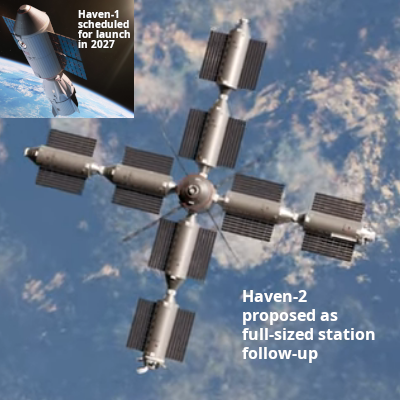
The space station startup Vast earlier this week signed an agreement with Lithuania to work together on future space missions, either to ISS or its Haven-1 single-module station scheduled for launch next year.

Under the agreement, Vast and Innovation Agency Lithuania will explore opportunities for joint scientific research activities either in the International Space Station National Lab or Haven-1, scheduled to be the world’s first commercial space station, launching in 2027. The partnership also includes plans to further develop educational programs in Lithuania and deepen engagement with local industry.

This deal is similar to Vast’s earlier deals with the European Space Agency, the Czech Republic, Colombia, Uzbekistan, Japan, and the Maldives. All are structured so that should Haven-1 reach orbit and be proven operational and safe for occupancy, these countries could consider sending their own astronauts on missions there. All thus show there is an international market for a private space station, a market that Vast is working hard to capture.

In other space station news, Voyager Technologies, the lead company building the Starlab station, released its 2026 first quarter fiscal report, indicating a solid financial position resulting from its diversification into military-based space applications. Though the report notes that “Starlab does not generate revenue today, nor is expected to generate revenue in the near term,” the company’s overall strength lays a strong foundation for that station’s eventual construction.

In my rankings below of the five stations under development, these two stations remain essentially tied for first place, with Axiom a close third.
» Read more

3 comments

Katalyst completes final ground testing of its Swift rescue spacecraft

Katalyst's proposed Swift rescue mission
Katalyst’s proposed Swift rescue mission.
Click for original image.

The orbital servicing startup Katalyst has now successfully completed the final ground testing of its Swift rescue spacecraft, dubbed LINK, that it hopes will be able to catch the Gehrels-Swift Telescope and raise its orbit, thus saving the telescope.

During vibration testing at NASA Goddard, engineers mimicked the shaking the spacecraft will experience during its launch from a Northrop Grumman Pegasus rocket. In the footsteps of Swift itself and NASA’s upcoming Nancy Grace Roman Space Telescope, the Katalyst team also used NASA Goddard’s Space Environment Simulator for thermal vacuum testing.

Once the air was pumped out of this 27-foot-wide chamber, LINK experienced space-like hot and cold temperature extremes. The team also practiced firing the satellite’s three xenon-powered ion thrusters and deployed one of the arms.

After some more testing in Arizona, the spacecraft will be integrated in June onto Northrop Grumman’s Pegasus rocket — the last one in its inventory — and launched later that month.

Katalyst has never done this before. It was preparing LINK as a demo mission when NASA requested bids for saving Swift. It proposed reconfiguring LINK for that purpose, and won the contract in September 2025, only eight months ago.

If this mission succeeds it will be a big feather in Katalyst’s cap.

9 comments

Rover startup Lunar Outpost raises $30 million in investment capital

The lunar rover startup Lunar Outpost revealed yesterday that it has raised $30 million in private investment capital in its latest funding round.

Lunar Outpost, the leader in off-planet mobility and in-space infrastructure, today announced a $30M Series B led by Industrious Ventures, with participation from Type One Ventures, Eniac Ventures, Promus Ventures, Reliable Equity, and others. The capital injection accelerates production and deployment of the company’s advanced robotics and mobility platforms as it scales the critical industrial layer required for a permanent human presence in space.

The company started out competing for NASA’s initial planned contract to build a manned lunar rover, proposing its “Eagle” rover and even signing a contract with SpaceX to deliver it to the Moon on Starship. Since then it has developed and successfully tested an autonomous excavator, dubbed Owl, while expanding its product line beyond rovers.

1 comment

Rocket Lab gets big launch contract for both its Electron and new Neutron rocket

Artist's rendering of the Neutron first stage deploying its second stage
Artist’s rendering of Neutron’s first stage fairings opening
to deploy the payload with the second stage engine.

Rocket Lab announced yesterday that it has won a big new launch contract with an undisclosed customer for three launches of its Electron rocket and five launches of its new Neutron rocket.

The multi-launch agreement includes five dedicated Neutron launches and three dedicated Electron launches baselined to launch between 2026 and 2029. The missions will lift-off from both Rocket Lab Launch Complex 1 in New Zealand and Rocket Lab Launch Complex 3 in Virginia. Pricing for these launches aligns with Rocket Lab’s average selling price for Neutron and Electron. The remaining terms of the deal are undisclosed.

Based on the known average launch prices for these rockets, this deal is likely worth somewhere between $250 million to $300 million. That a customer was willing to purchase five launches of Neutron before the rocket has even launched is also a strong statement of confidence in Rocket Lab itself. The company hopes to do the first test launch of Neutron before the end of this year.

Rocket Lab also made a slew of other announcements yesterday. The company will be partnering with Anduril as part of its 20-launch contract with the War department to use its suborbital HASTE version of its Electron first stage for hypersonic testing. The deal involves three of those twenty launches.

The company also announced a partnership with Raytheon to “demonstrate advanced capabilities for the United States Space Force’s Space Based Interceptor program.” Rocket Lab also revealed it is acquiring the California robotic company Motiv Space Systems that has built equipment used on the Mars rover Perseverance.

Rocket Lab might not be as big as SpaceX, but it has unquestionably been as successful in its own way.

17 comments

Louisiana state senator: Two unnamed aerospace companies are bidding for major land purchase

Pecan Island SpaceX facility?

In response to the story earlier this week that SpaceX might be acquiring a 200-plus square mile patch of land near Pecan Island on the southern coast of Louisiana, a state senator has now confirmed that two unnamed aerospace companies have been talking with landowners about a possible purchase.

State Sen. Bob Hensgens, R-Abbeville, said he knows of two companies — he did not reveal if it is Elon Musk-owned SpaceX or Jeff Bezos’ Blue Origin — that have reached out to landowners in coastal Vermilion and Cameron parishes about a possible acquisition. “I know both companies are trying to find property in southwest Louisiana,” Hensgens said. “I know from people in the parishes that the companies have made outreach in the area.”

If so, we might actually have a bidding war for this property. Note however that nothing has yet been confirmed, including the names of the companies involved. The article at the link however provides some background into the 136K acre plot owned by Exxon, and how it might now be for sale. It also reports that a number of legislators (not Hensgens) have signed non-disclosure agreements about the negotiations.

14 comments
1 3 4 5 6 7 676