China tests lunar orbital maneuvers using last in-space component of Chang’e-5 sample return mission

China appears to be using the last in-space component of its Chang’e-5 sample return mission, left in lunar orbit after the samples came back to Earth and the sample ascent capsule was sent crashing to the lunar surface, to test a variety of lunar orbital maneuvers that could be used in future missions.

Chinese engineers have apparently moved it from a near-Moon orbit to what is called a distant retrograde orbit (DRO), shifting back and forth from the Lagrange points on each side of the Moon with respect to the Earth. Though some spacecraft in the Artemis program are planned to use this orbit, this is the first time anyone has done so.

[S]pacecraft activity tracker Jonathan McDowell, also an astrophysicist at the Harvard-Smithsonian Center, told SpaceNews that he believes China is probably using the Chang’e-5 spacecraft gaining experience with astrodynamics. “They are using it as a toy to play around with. It is clearly useful as a stable lunar orbit for future missions, I just don’t think it’s a specific precursor.”

This activity is also par for the course for China. They have previously used other leftover lunar spacecraft to test different orbital maneuvers. The activity also confirms China’s determination to continue its exploration and settlement of the Moon.

0 comments

China wants a formal hot line with U.S. and its companies to avoid space collisions

China last week proposed that a formal method of communications be established between it and the U.S. and its companies in order to avoid space collisions.

The proposal was made after Chinese officials once again claimed that several Starlink satellites had threatened its space station, something U.S. officials dispute.

At a Feb. 10 press conference, Zhao Lijian, spokesman for China’s Ministry of Foreign Affairs, reiterated claims the country made to the United Nations in December that it had to maneuver its space station twice in 2021 to avoid close approaches by SpaceX Starlink satellites. “China was fulfilling the international obligation stipulated by Article V of the Outer Space Treaty by informing the U.N. of the Starlink satellites’ dangerous approach to the Chinese space station that threatened the safety of in-orbit Chinese astronauts,” he said according to a government transcript, adding that the “in-orbit Chinese astronauts were facing real and urgent safety threats.”

China filed its notice with the U.N., he said, after failing to hear U.S. officials. “After the incidents, China’s competent authorities tried multiple times to reach the U.S. side via e-mail, but received no reply,” he said.

The U.S. government, though, tells a different story. In its own note verbale filed with the U.N., dated Jan. 28 and published by the U.N.’s Office for Outer Space Affairs Feb. 3, the U.S. says it never heard from the Chinese government about the close approaches by satellites designated Starlink-1095 and Starlink-2305.

This cat-and-mouse game is not simply about avoiding collisions in space. China this year will launch two more modules to its space station, using its Long March 5B rocket. Unless it has completely redesigned the rocket (very unlikely), the core stage for both launches will come crashing uncontrolled to the ground, causing endless bad press for China. These claims by China appear to be a propaganda effort to improve its image prior to those launches.

Nonetheless, establishing a better lines of communications with China to avoid future collisions makes sense. Right now U.S. companies are forbidden by law from communicating directly with China, which makes resolving collision threats difficult if not impossible.

5 comments

Rocket stage to hit Moon is from Chinese rocket, not Falcon 9 upper stage

Astronomers have now concluded that the rocket stage that will impact the Moon on March 4th is not an abandoned the Falcon 9 upper stage that launched the DISCOVR satellite in 2015, but an upper stage from a Chinese rocket.

It was an engineer at NASA’s Jet Propulsion Laboratory, Jon Giorgini, who realized this object was not in fact the upper stage of a Falcon 9 rocket. He wrote to Gray on Saturday morning explaining that the DSCOVR spacecraft’s trajectory did not go particularly close to the Moon, and that it would therefore be a little strange if the second stage strayed close enough to strike it. This prompted Gray to dig back into his data, and identify other potential candidates.

He soon found one—the Chinese Chang’e 5-T1 mission launched in October 2014 on a Long March 3C rocket. This lunar mission sent a small spacecraft to the Moon as a precursor test for an eventual lunar sample return mission. The launch time and lunar trajectory are almost an exact match for the orbit of the object that will hit the Moon in March.

Regardless, it will be very useful to pindown the exact impact time and place so that astronomers can observe it.

4 comments

China plans more than 50 launches in 2022

China today released what it calls a blue paper outlining its space plans for 2022, predicting it will launch more than fifty times while completing assembly of its Tiangong space station.

The Shenzhou-14 astronauts will be aboard Tianhe core module for the arrival of the 20-metric-ton-plus Wentian and Mengtian modules, both now expected to launch in the second half of the year, later than earlier tentative times of June and August respectively. The module launches will complete the T-shaped orbital outpost. Tianzhou-5 will launch ahead of Shenzhou-15, both scheduled for late in the year.

Work on the Long March 2F, Long March 5B and Long March 7 rockets for launching Shenzhou, space station module and cargo missions respectively continued during the recent Lunar New Year holiday, according to CASC [China’s space agency]. The module launches will be followed closely, partly due to the significance of the missions, but also because of the use of the Long March 5B, the two previous launches of which saw the large first stages make high-profile uncontrolled reentries which sparked acrimony.

The rocket maker, the China Academy of Launch Vehicle Technology (CALT), says it has further optimized the two new Long March 5B rockets to ensure mission success without providing details. [emphasis mine]

The highlighted words, as well as the delay in launch of these two modules, suggests China might have done some work on its Long March 5B to control the de-orbit of its core stage.

China also says the year will also include the first six month long mission on Tiangong, as well as the first arrival of two crews to the station.

My present count of all proposed launches for 2022 is just under 200, more than double the average number of launches (89) completed annually since the launch of Sputnik. U.S. companies alone right now are predicting 100 launches. While all of these numbers are uncertain, it looks like ’22 will be a banner year for space exploration.

0 comments

China’s plans to dominate space revealed in a new Chinese government white paper

China's 2022 white paper on space

The new colonial movement: The Chinese government today released a white paper summarizing in broad terms what it has accomplished in space over the past five years and what it intends to do in the next five years.

If this white paper is ignored by western governments, the ramifications to human freedom and civilization in space will be profound, and quite likely tragic.

You can read the English text of the white paper here.

The paper makes clear China’s considerable successes and advancements in the aerospace sector since 2016. It ramped up its manned program with the launch of two prototype space modules followed by the on-going assembly of its fullsize station. It has successfully landed probes on the Moon and Mars, and brought back samples from the former. It is presently upgrading or replacing its older rockets. It has launched a full constellation of Landsat-type Earth-resource satellites. It has expanded its satellite communications and broadcasting capabilities. It has completed its 30-satellite GPS-type constellation.

And that’s only a short summary.

The white paper then outlines China’s ambitious plans for the next five years. Three areas are of greatest importance.
» Read more

14 comments

China tests space junk removal robot in geosynchronous orbit

China has apparently used a space junk removal robot to tug a defunct Chinese satellite out of geosynchronous orbit, thus opening that slot for future satellites.

Ground tracking by ExoAnalytic Solutions found that the robot, dubbed SJ-21, apparently docked with the defunct satellite on January 22nd. Since then:

In an email to Breaking Defense this afternoon, Flewelling [of ExoAnalytic] said the latest tracking data gathered earlier today from ExoAnalytic’s telescopes show the SJ-21 separating from the Compass G2, leaving the latter in the eccentric “super-graveyard drift orbit.” SJ-21 now has moved back to a near-GEO orbit.

The orbit places the defunct satellite in an orbit above the geosynchronous orbit satellites use, but in an orbit that is not typical.

This work is comparable to what the Japanese/American company Astroscale is presently testing in low Earth orbit, though it appears far more sophisticated. In fact, based on what SJ-21 has done so far, it appears China is far ahead of everyone else in developing in-orbit robotic servicing capabilities.

2 comments

Pseudo-private rocket company in China raises $200 million from Chinese investors

The Chinese pseudo-private rocket company Galactic Energy has successfully raised $200 million from a number of Chinese investors, money that the company will use to develop a mid-size rocket with a reusable first stage.

Though the company is not directly funded by the Chinese government, it is not an independent private company, which is why I label it “pseudo.” Everything it does is closely supervised and approved by the communist government. Also, some of this investment money apparently came from “state-backed investment vehicles,” which in plain language are fronts used by the government to funnel funding to these companies while maintaining the false appearance the companies are entirely private.

The fake nature of this charade has apparently influenced the decisions of real investors:

Incomplete information on funding in China’s emerging commercial space sector suggested that overall investment was lagging just over halfway through 2021, concentrating in fewer players.

It appears that no one outside China is willing to put money behind these companies, and even within China there is hesitancy.

Nonetheless, by letting many such competing operations that can also make profits for investors, China is successfully encouraging some innovation. That Galactic Energy — as well as several others — are planning on building reusable rockets is evidence of that.

4 comments

Debris from Russian anti-sat test just misses Chinese satellite

A Chinese satellite was almost destroyed on January 18th when a piece of debris from Russia’s November 15th anti-satellite test zipped past at a distance of less than a few hundred yards.

Expect more such events in the coming years.

This quote from the article I found somewhat ironic:

In an article from Beijing tabloid Global Times Jan. 20, cited experts stated that further close encounters cannot be ruled out. “Currently, they keep a safe distance but the chance for these two getting close in the future cannot be excluded,” said space debris expert Liu Jing.

Aerospace commentator Huang Zhicheng, told the publication that the growing issue of space debris should be addressed, including through international legal mechanisms. “It is not only necessary to conduct research on experimental devices or spacecraft to remove space debris, but also to formulate corresponding international laws and regulations on the generation of space debris under the framework of the UN,” Huang said. [emphasis mine]

Since anything published in the Chinese press must be approved by the Chinese government, this statement is essentially what the Chinese government wants said. For China however to demand other nations obey international law and not create more space junk that threatens others is hilarious, considering that China this year will likely launch two rockets whose core stages will crash to Earth uncontrolled, in direct violation of the Outer Space Treaty that China is a signatory to.

Since China doesn’t obey the treaties it signs, why should it expect others to do the same?

5 comments

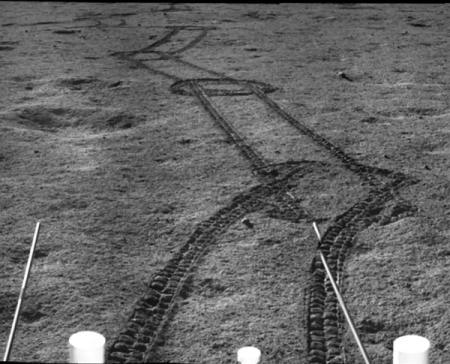
Yutu-2 scientists find soil “cloddy” during its journey

Chinese scientists today published a paper describing results from Yutu-2’s two year journey on the far side of the Moon, with the most interesting discovery being that the soil is “cloddy” there.

They found that the bearing property of the regolith is similar to that of dry sand and sandy loam on Earth, stronger than the typical lunar soil of Apollo missions.

But they estimated, based on the cloddy soil observed in Yutu-2’s wheels, that the soil there is stickier than the landing site of its predecessor Chang’e-3 which soft-landed on the moon’s Bay of Rainbows in Dec. 2013, according to the study.

The researchers attributed the increased soil cohesion to the higher percentage of agglutinates in the regolith, which make the soil particles more likely to hold together when ground by the wheels.

Since the blocky soil has adhered onto the rover’s wheel lugs instead of its meshed surface, they suggested that the lug’s surface could be coated with a special anti-adhesion material in future missions to improve the machine’s ability of traction.

The rover also traveled by the number of small and relatively fresh secondary craters.

Yutu-2 continues to operate. It is at present in hibernation during the lunar night, and will resume operations when the Sun comes up in about a week or so.

0 comments

Chinese pseudo-company preparing first launch of methane-fueled rocket

The Chinese pseudo-private company, Landspace, is apparently prepping its new launchpad and Zhuque-2 rocket for launch in one of China’s interior spaceports.

Satellite imagery and deleted social media postings indicate that work is progressing on a new complex for facilitating methane-liquid oxygen launch vehicles at Jiuquan Satellite Launch Center in northwest China. Timelapse and high resolution satellite imagery show the development near the national Jiuquan center in the Gobi Desert and suggest the presence of a Zhuque-2 test article. A recent, now-deleted article indicates a new flame trench has been completed at Jiuquan.

The article at the link also cites statements by the company’s CEO in November, where he claimed they would launch in the first quarter of ’22. If successful, it would be the first orbital launch of a methane-fueled rocket, beating out both SpaceX’s Starship and Blue Origin’s New Glenn.

The article also says that the company is working on making the first stage reusable, which makes sense in that it will launch from inside China and that first stage if expendable will crash uncontrolled on Chinese territory. A second Chinese pseudo-company, iSpace, also claims it will begin hop tests of its own reusable rocket later this year.

For new readers: I call these companies pseudo because they really are not independent entities, as private companies are in the west. China’s government since 2014 has allowed private investors to create these companies and for the companies to compete against each other for government business, but none of them do anything without the full supervision of the Chinese government. Most have completed their first launches using solid rockets, technology almost always reserved for military use. None could have done so without that government permission and control.

The strategy here of China’s government is nonetheless smart, as the policy is creating competition and thus some innovation within its aerospace industry. The top-down control however will likely prevent these companies from doing anything truly different. Instead, they are apparently latching onto the new ideas, such as methane-fueled rockets and vertically landing first stages, that they have seen demonstrated by the truly independent private companies in the west.

2 comments

China launches military test satellite

The new colonial movement: China yesterday completed its first launch in 2022, using its Long March 2D rocket to launch a military test satellite into orbit.

No word on where the first stage crashed in the interior of China, or whether it used parachutes or grid fins to control its landing.

The 2022 launch race:

2 SpaceX
1 Virgin Orbit
1 China

These numbers should change later today, as SpaceX has a Falcon 9 Starlink launch scheduled. UPDATE: The SpaceX Starlink launch has been delayed one day to tomorrow.

4 comments
1 45 46 47 48 49 118