Yutu-2 approaches boulder, has now traveled more than 1,000 meters

Yutu-2's square boulder
Click for original image.

The Chinese state-run press has released some more images from its rover Yutu-2, including a new image of the square-shaped lunar rock that was first identified a month ago. This new image is to the right, cropped and reduced to post here.

In the original image, the rock appeared very square as it was on the horizon and silhouetted by the black sky. As is usual in our emotion- and movie-run society, many began to push wild theories about the rock, proposing it was anything from an alien spacecraft to the monolith from the 1968 movie 2001: A Space Odyssey.

The picture confirms what any thoughtful person would have concluded, that it was simply a rock. The available image does not provide a scale, so I cannot tell you whether this is a large boulder, or a small piece of gravel. However, a wider image taken by Yutu-2 shows that the rock is on the edge of a small crater, which suggests the boulder is probably somewhere between three to ten feet across. The rover has completed only about half of its 260-foot journey to it, and won’t reach it until its next lunar day of operations in February.

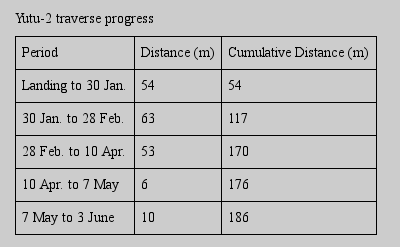
The same report also revealed that the rover has now traveled just over 1,000 meters on the far side of the Moon, or about 3,280 feet, since it began operations in early 2019.

2 comments

China tests space station robot arm

The new colonial movement: The Chinese state-run press yesterday reported that it has successfully used the robot arm on its Tiangong space station to move a Tianzhou freighter from one point to another.

After being unlocked and separated from the space station core module Tianhe, Tianzhou-2 was moved into a predetermined position by the robotic arm. The arm then reversed the maneuvers to bring the spacecraft back to its original position. Tianzhou-2 re-docked with the core module and completed locking.

The test preliminarily verified the feasibility of using the mechanical arm to conduct a space station module transfer, confirmed the effectiveness of relevant technologies, and laid a foundation for the subsequent in-orbit assembly and construction of the country’s space station, said the CMSA [Chinese Manned Space Agency].

The news report did not indicate whether this operation was run from ground control, or by the astronauts on board Tiangong. Either way, it apparently clears the way for the arrival of two more large modules, planned for launch later this year, suggesting that the arm will be used in some manner to position those modules prior to docking.

1 comment

China takes the global lead in fusion research

In setting new records of temperature and running time in its own tokamak fusion experiment, China now leads the U.S. in the field of developing the technology for generating practical fusion energy.

[The U.S.] ITER’s target temperature is 150 million ยฐC (270 million ยฐF). China’s EAST facility, which is a key contributor to the ITER project, has hit this mark already, reaching 160 million ยฐC (288 million ยฐF) for 20 seconds, and holding 120 million ยฐC (216 million ยฐF) for 101 seconds in separate experiments announced last May.

The latest experiment tested the Chinese tokamak’s capability to endure extreme temperatures over longer periods, sustaining a temperature 2.6 times hotter than the Sun’s core for some 1,056 seconds, or 17 minutes and 36 seconds. Nobody’s ever sustained a high-temperature plasma for 1,000 seconds before, so this is an important milestone.

The development of this capability continues China’s effort to lead the world in all areas of research, led I think by the many high government officials in positions of great power after cutting their teeth as managers for China’s space effort. These individuals understand how to build big technology projects at the cutting edge of science, and are likely pushing for more such research in all fields, such as the experiments in fusion energy above.

As big government projects, however, the long term future of such work is very risky. Government projects like this might start out great, which describes China’s status today, but they always end up corrupt and hidebound, as seen in the Soviet Union and at NASA in the U.S.

Nonetheless, this success highlights China’s aggressive effort to lead the world in all things. We would be foolish to ignore this.

5 comments

A review of China’s space program

Link here. The article covers China’s achievements in ’21, then reviews the status of its rocket development program. The key quote to me however was this, describing the upcoming plans for the assembly of China’s space station:

In 2022, China is expected to launch two more crew rotations to the Tiangong station using its Shenzhou spacecraft. The first, Shenzhou 14, is expected in May, while the second one will launch in November. Both missions will launch aboard Chang Zheng [Long March] 2F/G rockets. Two more modules for the space station are also planned to launch in the course of the year.

These new modules are the laboratory cabin modules (LCMs). The first is named Wentian, meaning Quest for the Heavens, while the second is Mengtian, or Dreaming of the Heavens. Both will launch on Chang Zheng 5B rockets, with Wentian currently scheduled to lift off in May or June, with Mengtian planned to launch in August or September.

This means that — assuming China has not reworked the design of its Long March 5B rocket — a large out-of-control core stage will be crashing to Earth in the the spring and late summer.

6 comments

China completes two launches to make 2021 the most active year in rocketry ever

China yesterday completed two different launches from two different spaceports using two different rockets.

First it used its Long March 2D rocket to launch an Earth observation satellite from the Jiuquan Satellite Launch Center in northern China.

Then, a few hours later, a Long March 3B rocket launched a classified military satellite from the Xichang Satellite Launch Center in southwest China.

Both launches dropped first stage boosters in the interior of China. No word on whether either used parachutes or grid fins to better control the stages so that they avoid habitable areas.

These two launches bring China’s total number of successful launches in 2021 to 52, a record for that country and the most any single country has achieved since Russia successfully launched 54 times in 1992 as its high launch rate slowly shut down following the fall of the Soviet Union.

The two launches also bring the total number of successful launches in 2021 to 134, the most in any single year in the entire history of space exploration. The last time global launches reached such numbers was in the 1970s and 1980s, numbers that were produced mostly by the launch of a lot of short term low orbit surveillance satellites by the Soviets, using technology that the U.S. had abandoned in the 1960s as inefficient. It took the collapse of the communist state for Russia to finally cease such launches itself.

Now the high number of launches is increasingly being fueled by commercial competition and profits, though China’s record this year is partly due to the same top down communist set-up similar to the Soviet Union. Even so, the number of competing private rocket companies worldwide is on the rise, and in most places (even China in a few cases), it is those companies that are providing the launch services to the government. Profit and private ownership are the watchwords, and so there is aggressive competition that is lowering the launch cost.

I will have more to say about this in my annual report, which I will publish on Monday, January 3rd.

The leaders in the 2021 launch race:

52 China
31 SpaceX
23 Russia
7 Europe (Arianespace)

0 comments

China attacks SpaceX, claiming Starlink satellites threaten its space station

China earlier this month submitted a complaint against SpaceX to the UN, claiming that the company’s Starlink satellites have twice forced it to adjust the orbit of its space station to avoid a collusion.

The note said the incidents “constituted dangers to the life or health of astronauts aboard the China Space Station”.

“The U.S. … ignores its obligations under international treaties, posing a serious threat to the lives and safety of astronauts,” Chinese foreign ministry spokesman Zhao Lijian said at a routine briefing on Tuesday.

The story became news today because there was suddenly a flurry of outrage against SpaceX on Chinese social media, responding to Lijian’s statement, with much of it very likely astroturf posts prompted by the Chinese government itself.

This announcement likely signals that China is getting ready to launch the next module to that station. During that launch the large core stage of the Long March 5B rocket will reach orbit, but only for a few days. It will then crash uncontrolled somewhere on Earth. The Chinese government knows it is going to get a lot of bad press because of this fact, and is likely making this complaint to try to excuse its own bad actions.

The two issues however are not the same. Satellite orbits are very predictable, and any maneuvers required by China to avoid Starlink satellites were very routine. Moreover, if necessary SpaceX can adjust its own satellite orbits to avoid a collusion.

The crash of the Long March 5B core stage however is due entirely to a bad design that does not allow for any controlled maneuvers. Once the stage’s engines shut down after delivering the station module into orbit, they cannot be restarted, as designed. The stage must fall to Earth in an unpredictable manner, threatening every spot it flies over during that orbital decay.

At this time the actual launch date for that Long March 5B launch, carrying the next station module, has not been announced. The astronauts on the station just completed their second spacewalk, doing work to prepare for the arrival of the next module. Its arrival can’t be too far in the future, and this complaint by China today suggests it will be sooner rather than later. When it happens China will face a flurry of justified criticism, and the Xi government likely plans to use this UN complaint then to deflect that criticism.

8 comments

China’s Long March 4C rocket launches Earth observation satellite

China today completed its 50th launch in 2021, successfully launching an Earth observation satellite into orbit using its Long March 4C rocket.

It also launched a cubesat built by students.

Not only does 50 launches smash its previous yearly launch record, set last year at 35, but it exceeds by 20% the 40 launches China had predicted at the start of the year it would complete in 2021.

The leaders in the 2021 launch race:

50 China
31 SpaceX
22 Russia
7 Europe (Arianespace)

China leads the U.S. 50 to 48 in the national rankings. This was the 131st launch in 2021, the second highest total in a single year since the launch of Sputnik in 1957.

7 comments

China launches two military satellites with its Long March 7A

China today successfully launched two military satellites from its coastal Wenchang spaceport, using its new Long March 7A rocket.

The Long March 7 family of rockets will eventually replace the Long March 2 and 3 families. It can launch from the coast, thus eliminating the need to drop boosters in China’s interior. It has greater capacity. It also uses kerosene and oxygen, not hypergolic fuels that ignite on contact and are very toxic.

The leaders in the 2021 launch race:

49 China
31 SpaceX
22 Russia
6 Europe (Arianespace)
5 ULA
5 Rocket Lab

As there no more American launches planned this year, with this launch China wins the 2021 launch race, moving ahead of the U.S. 49 to 48.

This was the 129th launch in 2021. As there are three launches still scheduled — a Russian Angara test launch, a Ariane 5 launch placing Webb in orbit, and a Russian OneWeb launch — the year is likely end up tying or beating 1975 as the most active year in rocketry ever. The Chinese could also launch, as it has in the past done a lot of launches in December.

0 comments

China’s Kuaizhou-1A rocket fails during launch

China’s Kuaizhou-1A rocket experienced its second launch failure on December 14th, though few details about what went wrong have been released.

The Kuaizhou-1A rocket is built by one of China’s pseudo-private companies, Expace.

Expace had been encouraged by three successful Kuaizhou-1A launches across September, October and November, which followed the Kuaizhou-1A being grounded for one year as a result of a failure in September 2020.

Since the rocket’s first three stages use solid rocket motors, it must have been derived from military missile technology. Thus, the company is not private, even if it has obtained Chinese private investment capital, but closely supervised by the Chinese government and its military.

11 comments

China launches second communications satellite for its manned space station missions

The new colonial movement: China today launched the second Tianlian communications satellite for its manned space station missions, using its Long March 3B rocket.

No word on whether the rocket’s first stage used parachutes or grid fins to control its crash landing in the interior of China.

The leaders in the 2021 launch race:

48 China
28 SpaceX
22 Russia
6 Europe (Arianespace)
5 ULA
5 Rocket Lab

China now leads the U.S. 48 to 45 in the national rankings. This launch was the 124th in 2021, making the sixth most active year in rocketry since Sputnik in 1957.

0 comments

China launches two satellites with Long March 4B

China today launched two satellites thought to be for military reconnaissance, using its Long March 4B rocket.

The leaders in the 2021 launch race:

47 China
27 SpaceX
21 Russia
6 Europe (Arianespace)
5 ULA
5 Rocket Lab

China now leads the U.S. 47 to 45 in the national rankings. There have now been 122 successful launches in 2021, making it the seventh most active year in the history of space exploratoin.

0 comments

ULA and China complete launches

Two launches were successfully completed in the past twelve hours.

First ULA’s Atlas-5 rocket successfully launched two Space Force military satellites and a NASA ultraviolet telescope into orbit on a launch that had been repeatedly delayed since February.

Next, one of China’s pseudo-private companies, Galactic Energy, completed its second launch of its Ceres-1 rocket, putting five smallsats into orbit. As the Ceres-1 rocket uses solid rocket motors, its initial development was for the military, and thus everything Galactic Energy does is carefully supervised by that Chinese military.

The leaders in the 2021 launch race:

46 China
27 SpaceX
20 Russia
6 Europe (Arianespace)
5 ULA

China now leads the U.S. 46 to 43 in the national rankings. The 118 total launches this year is now the most since 1985. And this number is only temporary, with two more launches scheduled in the next 24 hours.

0 comments
1 46 47 48 49 50 118