Comet ISON is not brightening as much as expected, suggesting it will not be as spectacular as some had hoped.
Comet ISON is not brightening as much as expected, suggesting it will not be as spectacular as some had hoped.
Comet ISON is not brightening as much as expected, suggesting it will not be as spectacular as some had hoped.
Boom! A newly discovered comet has an orbit that might have it collide with Mars in October 2014.
I reported on the discovery of Comet ISON back in September, noting then the possibilities that this could become one of the brightest comets in years, while giving its show in primetime for the northern hemisphere. As this article also notes, this show could also be a dud, as has happened before. Stay tuned.
Astronomers have identified the same kind of minerals found in comets in our solar system in the dusty disk surrounding the nearby star Beta Pictoris.
Amateurs astronomers have once again captured images of a major impact of something on Jupiter.
Catching the death of a comet.
The view of Comet Lovejoy from ISS. With video.
Comet Lovejoy lost its tail in skimming through the Sun’s atmosphere Thursday.
Chicken Little wrong again! Comet Elenin is no more.
New results using the Herschel Space Telescope suggest that Earth’s water was brought here by comets.
Get out those binoculars! Two comets, Elenin and Garradd, are now showing in the night sky.
The Pan-STARRS Telescope has found a comet that might provide us all a show in 2013.
Pop! Analysis of the images that Stardust took of Comet Tempel 1 strongly suggest that when Deep Impact hit the comet’s surface it broke open several underground cavities that then burst like balloons.
In a paper published tonight on the Los Alamos astro-ph preprint website, astronomers described new observations of Comet Hale-Bopp at a distance of 30 astronomical units, or 2.8 billion miles, from the sun. Their conclusions:
To quote the paper, “Observing Hale-Bopp in a completely frozen state would be extremely important because a thick coma was constantly present during the entire appariation [Ed. the fly-by of the Sun]. The coma obscured the nucleus which was not observed directly. Lack photometric data of the bared nucleus, its size — one of the most important input parameter in activity models — remains uncertain.”
Scientists have found strong evidence that liquid water once existed in the interior of a comet.
The ripples in the rings of Saturn and Jupiter were caused by comet impacts decades ago.
Stardust has ended its mission after twelve years and two comet flybys.
Ground controllers will command the spacecraft to fire up its four rocket thrusters one last time at 7 p.m. EDT (2300 GMT) today to use up its remaining fuel. Engineers plan to watch closely while the probe’s propellant tank ran dry to help future missions gauge their fuel reserves more precisely.
More news from Stardust: scientists have now identified what they think is the crater produced by Deep Impact’s impact in 2005. Key quote:
The images revealed a 150-metre-wide crater at the Deep Impact collision point that was not present in 2005. The crater is a subtle feature in the images, but it appears consistently in multiple views from the spacecraft. “So I feel very confident that we did find the [impact] site,” said mission member Peter Schultz of Brown University in Providence, Rhode Island, at a press briefing on Tuesday. The crater’s features are “subdued” rather than sharply defined, like those of craters made in hard materials like rock. “The message is: This surface of the comet where we hit is very weak,” said Schultz. The crater also has a small mound in its middle, indicating that some of the material thrown up by the impact was drawn by the comet’s gravity back down into the crater, he said: “In a way, it partly buried itself.”
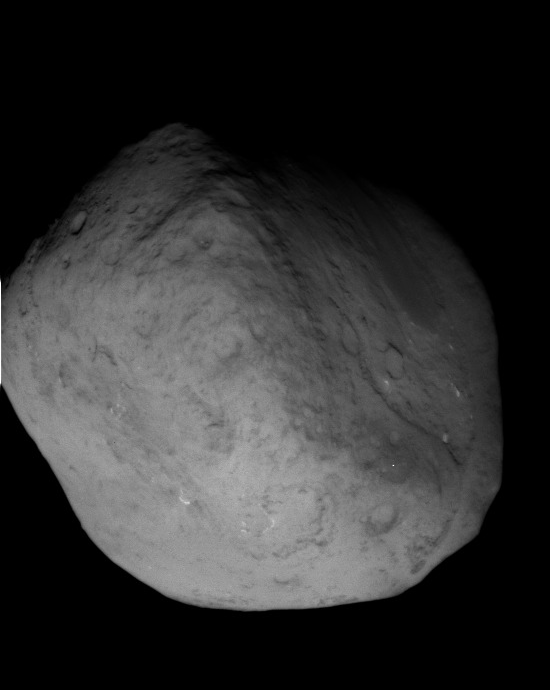
The images from Stardust’s flyby of Comet Tempel 1 are now available. I think the image below is the best, as it shows many details of the presently inactive comet surface. Scientists will need a bit of time now to compare these features with those imaged during the flyby of Deep Impact back in 2005.