New NASA development contracts include refueling work by SpaceX

Capitalism in space: Yesterday NASA announced a bunch of partnership agreements with thirteen companies, where those companies will get NASA assistance at no cost to help them develop new engineering that would aid future solar system exploration.

The partnerships covered everything from helping small companies develop new space electronics, heat shields, and new types of thrusters to helping Blue Origin develop the technology for for landing on the Moon.

An article at Ars Technica today about this NASA announcement focused specifically on the SpaceX deal, mainly for its important political implications.

The partnership will have two different NASA agencies helping SpaceX develop the refueling technology it needs for Starship to reach Mars. The key is that this deal has NASA openly supporting technologies that are in direct competition with its own SLS rocket. When such research work was proposed back in 2010, it was opposed quite strongly by past agency officials as well as powerful politicians in Congress, for exactly that reason.

It was a contentious time in space policy, as the White House was pushing for more funding for new space companies—and new space ideas such as fuel-storage depots—while Congress wanted to keep NASA in the rocket-building business.

Eventually, Congress got the upper hand, putting NASA on track to build the large SLS rocket at a development cost of more than $2 billion a year. The rocket program mostly benefited the Alabama space center and was championed by Alabama State Senator Richard Shelby. The potential of in-space fuel storage and transfer threatened the SLS rocket because it would allow NASA to do some exploration missions with smaller and cheaper rockets. As one source explained at the time, “Senator Shelby called NASA and said if he hears one more word about propellant depots he’s going to cancel the Space Technology program.”

The line from other NASA officials was that as a technology, propellant depots were not ready for prime time. In 2011, former NASA Administrator Mike Griffin and current Executive Secretary of the National Space Council Scott Pace—both SLS advocates—wrote a withering criticism of the technology for Space News.

Now however the Trump administration is helping SpaceX develop refueling for Starship, which if successful will help make SLS irrelevant. This is more evidence that the Trump administration is laying the political groundwork that will allow it to shut SLS down, actions that were impossible in the political culture of Washington only two years ago.

This quote in the article is probably the most startling of all:

“Administrator Bridenstine is clearly executing on President’s Trump’s guidance to increase commercial public-private-partnerships at NASA,” Miller, now chief executive of UbiquitiLink, told Ars. “The game-changing technology that NASA has discovered is capitalism. This program proves NASA leadership has figured out the future is reusability mixed with commercial public-private-partnerships.” [emphasis mine]

Imagine that. An American government agency has learned that capitalism is the way to go. Will wonders never cease?

Update: See this related Ars Technica article: The SLS rocket may have curbed development of on-orbit refueling for a decade (Hat tip reader Calvin Dodge.)

8 comments

Suborbital rocket company has launch failure

Capitalism in space: Gilmour Space Technologies, one of the numerous new rocket companies aimed at capturing the emerging smallsat market, experienced a launch failure on July 29 just prior to lift-off of its suborbital rocket.

At T-7 seconds to launch, the test rocket suffered an anomaly that resulted in the premature end of the mission. Initial investigations show that a pressure regulator in the oxidiser tank had failed to maintain the required pressure, and this caused the upper half of the rocket to be ejected as helium escaped.

On the positive side, there were no explosions due to the safe nature of hybrid rocket engines, and no observable damage to the engine. (The white plume seen here is steam.) Moreover, despite failure to launch, the team did successfully test Gilmour Space’s mobile launch platform and mission control centre, which had journeyed over 1,800 km to the test site.

It appears the failure was from a piece of equipment provided by an outside contractor.

0 comments

LightSail-2 successfully raises its orbit using sunlight

Capitalism in space: By raising its orbit by the use of sunlight only, LightSail-2 has confirmed what an earlier Japanese solar sail Ikaros had demonstrated, that it is possible to use solar sails to travel in space.

Since unfurling the spacecraft’s silver solar sail last week, mission managers have been optimizing the way the spacecraft orients itself during solar sailing. After a few tweaks, LightSail 2 began raising its orbit around the Earth. In the past 4 days, the spacecraft has raised its orbital high point, or apogee, by about 2 kilometers. The perigee, or low point of its orbit, has dropped by a similar amount, which is consistent with pre-flight expectations for the effects of atmospheric drag on the spacecraft. The mission team has confirmed the apogee increase can only be attributed to solar sailing, meaning LightSail 2 has successfully completed its primary goal of demonstrating flight by light for CubeSats. [emphasis mine]

The highlighted text notes a secondary but possibly more important engineering achievement here. LightSail-2 was launched as a cubesat. It has now proven that such a cubesat can include a solar sail and use it for purposes of transportation.

Moreover, that this engineering test was funded entirely by private funds proves again that the government is not necessary for great things to be achieved.

They will continue to raise the spacecraft’s apogee for the next month, until the lowering of the perigee causes the spacecraft to get pulled out of orbit by the drag from the atmosphere. That second process will still take about a year.

2 comments

iSpace plans eight launches in 2020

After its first successful orbital mission last week, China’s semi-private rocket company iSpace announced today that it hopes to complete eight launches in 2020.

Clients from Singapore, Italy, Spain, Hong Kong and Sri Lanka, as well as mainland customers, have already either signed up for a spot on iSpace’s rockets or expressed interest.

iSpace is open to both private and government clients. “It’s the same for us whether it’s a private or a state-owned company,” Vice President for Marketing and Communications Yao Bowen said.

The price tag to launch a rocket is 4.5 million euros ($5 million), Yao added.

This launch price is just under what Rocket Lab has been charging, $6 million, and is clearly designed to take business from them. It is however higher than what Vector says it will charge, $4 million, should that company ever get its rocket off the ground.

The article also notes the investment capital raised by iSpace, totaling just over $100 million. This does make this company appear a private company, but don’t believe it. Its existence is very much tied to and supervised by the Chinese government.

1 comment

Russia launches and docks new Progress freighter to ISS

Russia today launched and quickly docked a new Progress freighter, to ISS, with the trip taking slightly over three hours.

I think this might have been the fastest flight to ISS, though if not it is certainly among the fastest.

The leaders in the 2019 launch race:

11 China
11 Russia
9 SpaceX
5 Europe (Arianespace)
4 India

The U.S. continues to lead in the national rankings, 15-11.

0 comments

Want to get off gmail? A possible Behind the Black option

On July 3rd I put out a feeler to see if there was sufficient interest among my readers for providing a private email service through Behind the Black. As I wrote then:

I am exploring the possibility of offering email services through my server for those who want to get off of gmail and google. However, before such a service can be offered, we need to know the amount of interest there might be. The demand will effect the cost, which means I can’t even give you an idea of what we might charge.

Regardless, if you are interested in having “your.name@behindtheblack.com” as your email address, please say so in the comments. There will be no obligations, by you or me or my server, but the response however will help us decide if we can do it.

And if we can do it, and many people sign on, we will then be taking the proper free enterprise approach for combating the corrupt business practices of giants like Google. Our federal government might still act to break Google up, but I think it would be far better if the free market did the job instead.

About a dozen people expressed interest at that time. In discussing this with my server, we both agreed that this is too small a number for us to begin this service. However, we are also both quite willing to do this, if the initial number of subscribers was higher.

I am therefore posting this feeler out again. If you expressed a desire to sign up as a comment in the previous post, then there is no need to comment again. However, if you did not comment previously, and think this service will be what you want, then post a comment here saying so.

It would also help me to get an idea what you would be willing to pay per month for this service. For this information I request everyone comment, including those who commented earlier.

13 comments

Europe completes 1st rollout of Ariane 6 mobile launch gantry

The mobile launch gantry that Europe will use for its new Ariane 6 rocket successfully completed its first rollout tests last week.

This gantry is the equivalent of NASA’s VAB building. Within this gantry they will assemble Ariane 6 vertically, then roll the gantry back for launch.

Assembling a rocket vertically I think is more costly, but it also makes it possible for the rocket to launch payloads that must be installed in this manner. Thus, Ariane 6 will have this selling point over rockets like the Falcon 9 and Falcon Heavy, which are assembled horizontally.

1 comment

Private lunar landing company backs out of NASA contract

Capitalism in space: The commercial lunar landing company, OrbitBeyond, has told NASA that it cannot fulfill its $97 million contract, only two months after that contract was announced.

NASA announced July 29 that OrbitBeyond informed the agency that “internal corporate challenges” will prevent it from carrying out a task order that NASA awarded the company May 31 as part of its Commercial Lunar Payload Services (CLPS) program. The company asked to be released from that contract, and NASA agreed.

NASA didn’t elaborate on what specific issues caused OrbitBeyond to scrap its contract with NASA, and the company didn’t immediately respond to a request for comment. At the May 31 event where NASA announced the contracts, Siba Padhi, chief executive of OrbitBeyond, said the company was still in the process of closing a round of funding. The company has not subsequently announced a funding round.

Considering its receipt of a $97 million NASA contract, it would be very puzzlingly for the company to be unable to obtain further investment capital. If anything, that contract should have encouraged funding. If the lack of funding is the cause of this termination then it also suggests the company had other problems.

This leaves NASA with two private lunar lander companies. I expect NASA will look to award the contract to a third company. The company Firefly and its team of Israeli Beresheet engineers comes immediately to mind.

1 comment

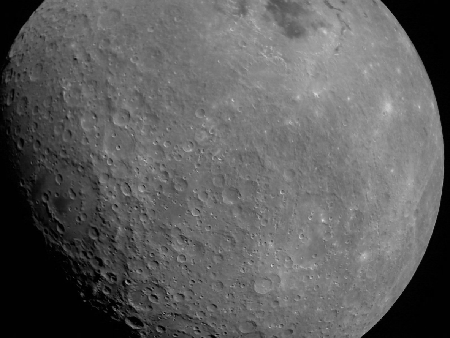
Chandrayaan-2 completes third orbit maneuver

Chandrayaan-2 has completed its third engine burn to raise the apogee of its orbit to 71K.

The next burn is set for August 2, when the spacecraft returns to its orbital low point, the perigee. As it raises its orbit each time the time between burns gets extended because the orbit gets longer. By September however the apogee will put the spacecraft in the Moon’s gravitational field of influence, and when Chandrayaan-2 reaches that apogee engineers will then fire its engines again to slow it down and enter lunar orbit.

0 comments

Japanese private smallsat rocket company launch failure

Capitlism in space: Interstellar Technologies, a Japanese private smallsat rocket company, experienced on July 27 its third suborbital launch failure in four attempts.

The vehicle only reached an altitude of 13 kilometers following the launch at 4:20 p.m., falling into the sea some 9 kilometers (about 5.5. miles) offshore from Taiki, Hokkaido, its test site, Interstellar Technologies said. The rocket is the same model as Momo-3, measuring about 10 meters long, 50 centimeters in diameter and weighing 1 ton.

After failed attempts in 2017 and 2018, the startup finally found success with its third launch in May, with the rocket reaching an altitude of around 113 km before falling into the Pacific Ocean.

The failure occurred when an onboard computer detected something wrong and shut the engine down.

0 comments

China tests controlled flight for returning first stage

Chinese news sources today confirmed that during its last launch on July 26, they tested the use of grid fins (essentially copied from SpaceX’s Falcon 9) to control the return flight of the first stage of their Long March 2C rocket.

The success of the test is of great significance for improving China’s inland rocket landing safety, minimizing the inconvenience to the local people, as well as promoting the follow-up development of carrier rockets’ controllable recovery, soft landing and reuse, according to He Wei, an official with the CASC.

“The swinging grid fins were used to control the rocket debris’ direction and attitude, much like the wings of the debris,” said Cui Zhaoyun, the deputy chief designer of Long March-2C rocket. The landing site control of large and medium rockets is much more difficult than that of small rockets, he added.

For almost forty years China has allowed these first stages to crash, sometimes very close to villages and habitable areas. Now, inspired by what freedom and U.S. innovation has accomplished, they have finally begun the process of figuring out how to land these stages vertically. Since their propellants are very toxic, it is not clear however whether they will be able to reuse them should they succeed in landing them undamaged.

8 comments

NASA to do full engine test of SLS first stage

NASA confirmed yesterday that it will do a full engine test of its SLS first stage, what it calls the Green Run test.

This decision makes sense. SpaceX for example routinely does a static fire test of its first stages before every flight. NASA however had hesitated doing this test because it will likely force a delay in the first launch of SLS. Unlike a commercial company like SpaceX, NASA is incapable of doing this test and then proceeding to flight quickly, mostly because the size of SLS (it is very large) and its design (very cumbersome) makes such quick action difficult.

This decision however means that it is almost certain that SLS’s first unmanned test launch cannot happen in 2020. For NASA to make Trump’s commitment to fly a lunar landing by 2024 means that NASA must compress SLS’s schedule to one flight per year. First the unmanned test flight would occur, probably in 2021. Then the first manned test flight around the Moon would follow, in 2022 or 2023. Finally the landing mission would take place in 2024.

Can NASA do this? I have many doubts. The agency’s biggest obstacle would be getting their lunar lander built in time, which by the way is not yet even designed. This isn’t the only problem. NASA for years has said that they will need from one to three years between SLS flights. This schedule demands more from them.

Meanwhile, there is a good possibility that SpaceX will beat them to the Moon. If that happens, then expect SLS to die, either before or after its first or second flight.

9 comments

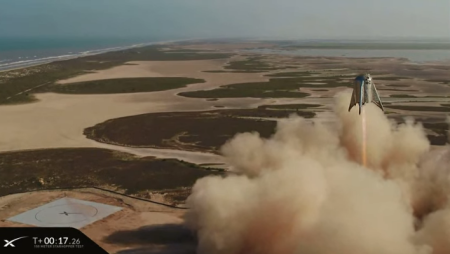
Starhopper has hopped

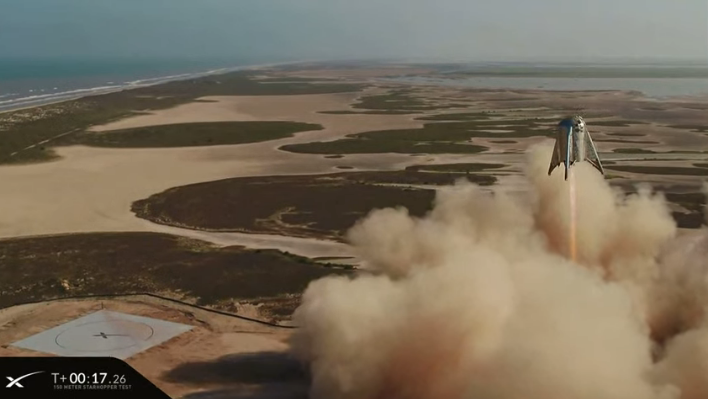
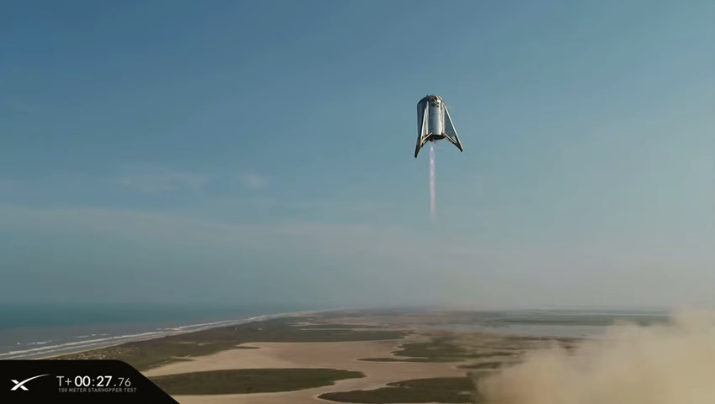
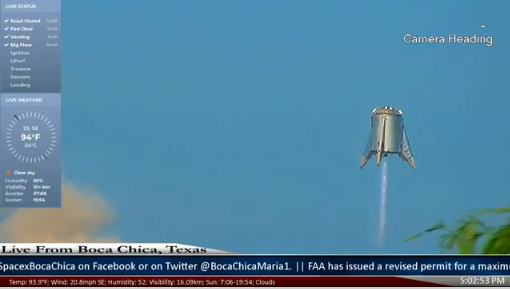
Capitalism in space: SpaceX last night successfully completed the first untethered flight of its Starship/Super Heavy prototype dubbed Starhopper.

This hop attempted and flew about 65 feet. They hope to do next flight, planned to be about ten times higher, in a week or two, according to a Musk tweet.

Below the fold is video of the hop. You can’t see much as the viewing angle is ground level, it is night, and the engine flames obscure things. Expect better footage from future hops.
» Read more

11 comments

SpaceX launches used Dragon to ISS with used Falcon 9

Capitalism in space: SpaceX today successfully used a Falcon 9 rocket to launch a Dragon freighter to ISS.

The Dragon is making its third flight to ISS. The first stage, which landed successfully, was making its second flight, and will likely be used on the next Dragon cargo mission.

Video of the launch and 1st stage landing is below the fold. The launch is at about 15 minutes. The first stage landing is one of the most spectacular yet.

The leaders in the 2019 launch race:

10 China
9 Russia
9 SpaceX
5 Europe (Arianespace)
4 India

The U.S. now leads China 15-10 in the national rankings.
» Read more

3 comments

Chandayaan-2 completes first orbit burn

India’s lunar orbiter/lander/rover Chandrayaan-2 yesterday completed its first orbital engine burn, raising its apogee, the high point in its orbit, 6,000 kilometers to about 51,000.

This boost meant that Isro scientists have to perform one less manoeuvre in the Earth orbit than what was planned earlier. According to the path chalked out for Chandrayaan-2 before the launch, the on-board propulsion systems were to be fired six times in Earth orbit – five times to raise the apogee and once to raise the perigee. Now, only four more “burns”, or firing of the propulsion system, will be needed on July 26 and 29, and August 2 and 6, to reach the final orbit of 233.2 x 143,953km.

…With a final boost on On August 14, Chandrayaan-2 will escape Earth’s orbit and begin its seven-day journey towards the moon. The spacecraft is scheduled to reach the moon orbit on August 20.

Once in lunar orbit they plan four more burns to lower the spacecraft to a 100 kilometer circular orbit, where the lander/rover will release and begin their own lowering process aimed for a September 7 landing.

0 comments

China smallsat company succeeds in orbital launch

A Chinese semi-private company, iSpace, successfully launched two smallsats into orbit today.

iSpace’s Hyperbola-1 rocket blasted off from the Jiuquan Satellite Launch Centre at 1 p.m. (0500 GMT) Thursday, sending two satellites and payloads into a predetermined orbit, the company said in a statement on its official Wechat account.

The successful orbital launch was preceded by two failures since late last year by other startups.

More here.

I am very reluctant to call this company, along with the other Chinese smallsat companies OneSpace and LandSpace, a private commercial firm. While it might get investment capital within China, it is very clearly supervised closely by the government. Moreover, its use of solid rocket motors, as noted in the second link, strongly suggests it is taking advantage of Chinese military technology, something that could only happen under government control. From the second link:

It’s unclear how much it cost for iSpace to build the rocket. Chinese state-owned automaker Changan’s passenger car brand Oushang said it would sponsor the launch, but didn’t specify the amount. In OneSpace’s case, the firm’s nine-meter-tall, solid-propellent rocket cost the company $78 million to design, build, and launch. iSpace’s main private backers (link in Chinese) include domestic private-equity firms CDH Investments and Matrix Partners.

iSpace didn’t immediately respond to requests for comment.

But private space companies are also getting state support in China. All of the private launches so far, for example, have taken place at Jiuquan—Elon Musk’s SpaceX recently launched a rocket at NASA’s Kennedy Space Center, while its main customer is the US Air Force. What’s different in China is the constraints that come with having state backing. In June, China rolled out a set of rules that restrict what private companies can develop and manufacture. It’s unclear if that may restrict private companies’ capabilities in building larger rockets that could rival state rocket builders. [emphasis mine]

The money for this comes from state-owned companies. The technology comes from military hardware. The goals are almost all military in nature. I would also bet, because of the lack of information released, that the satellites launched today were military payloads. This is hardly an independent private company competing on the open market.

Nonetheless, this success gives China a new capability and raises its status as a world space power.

The leaders in the 2019 launch race:

10 China
9 Russia
8 SpaceX
5 Europe (Arianespace)
4 India

The U.S. still leads China 14 to 10 in the national rankings.

0 comments

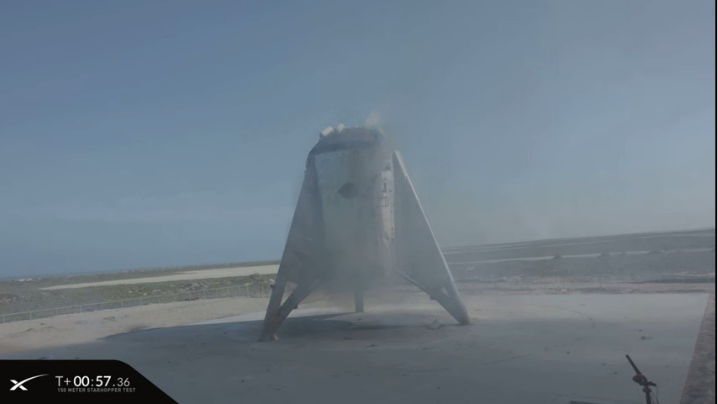
Starhopper’s 1st test hop aborts

Capitalism in space: SpaceX’s first attempt to fly Starhopper untethered in a short vertical flight was aborted only a few seconds after engine ignition.

Video of the test is below the fold. The vehicle never leaves the ground, and there are flames visible near its top, something one should not see. Obviously this is a development program, so failures like this are to be expected. More significant is the speed in which the company is moving. It is only a week since their last StarHopper test, which also had issues. Rather than take years to move forward (like NASA), they are pushing forward aggressively.
» Read more

8 comments
1 272 273 274 275 276 473