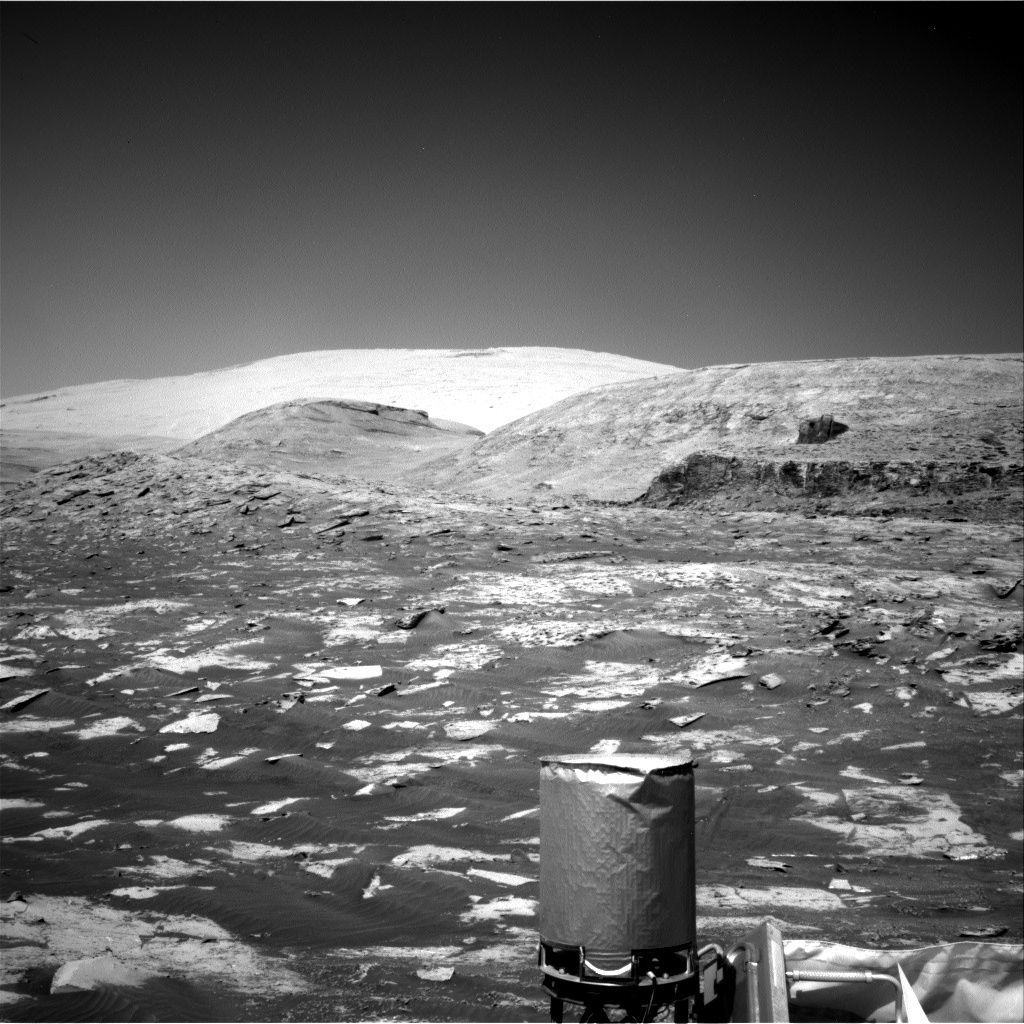
Perseverance data suggests a strong river rushed down the delta in Jezero Crater

Skrinkle Haven on Mars
Click for original image.

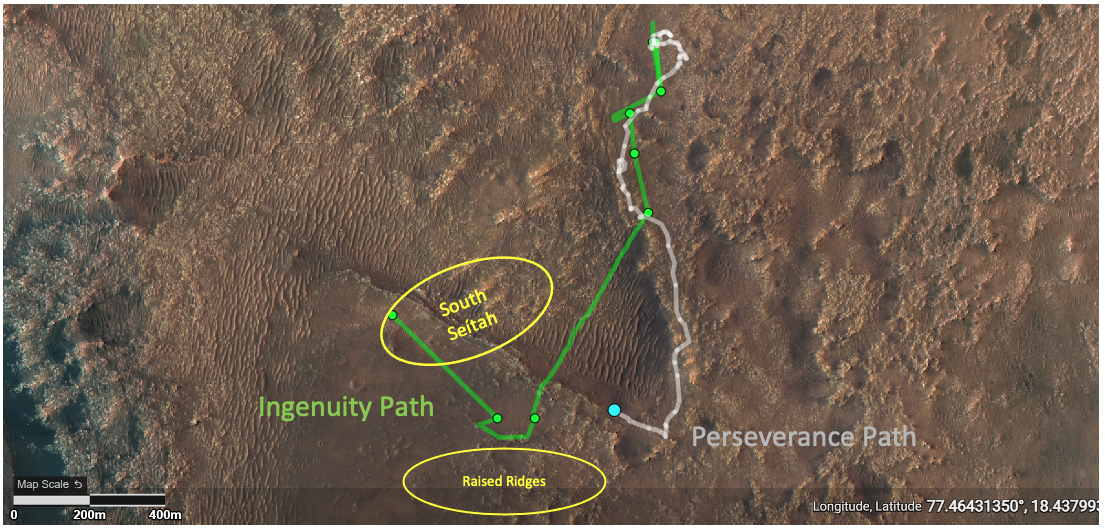
Based on the images and geology so far gathered by the Mars rover Perseverance as it has climbed up onto the delta that flowed into Jezero Crater sometime in the far past, scientists now think a roaring river once flowed down that delta.

Years ago, scientists noticed a series of curving bands of layered rock within Jezero Crater that they dubbed “the curvilinear unit.” They could see these layers from space but are finally able to see them up close, thanks to Perseverance.

One location within the curvilinear unit, nicknamed “Skrinkle Haven,” is captured in one of the new Mastcam-Z mosaics [a section of which is posted to the right]. Scientists are sure the curved layers here were formed by powerfully flowing water, but Mastcam-Z’s detailed shots have left them debating what kind: a river such as the Mississippi, which winds snakelike across the landscape, or a braided river like Nebraska’s Platte, which forms small islands of sediment called sandbars.

When viewed from the ground, the curved layers appear arranged in rows that ripple out across the landscape. They could be the remnants of a river’s banks that shifted over time – or the remnants of sandbars that formed in the river. The layers were likely much taller in the past. Scientists suspect that after these piles of sediment turned to rock, they were sandblasted by wind over the eons and carved down to their present size.

The press release say nothing about glacial activity here, but I am willing to bet the scientists have considered this. As it requires a greater leap into the unknown, involving geological processes not yet understood on an alien planet, it is makes sense that they have put it aside at this point. I also am willing to bet that it will pop up again, with time and additional data.

0 comments

Ariane-6’s first launch now likely delayed again, until 2024

According to officials from the German company OHB, which makes parts of Europe’s new Ariane-6 rocket, its first launch will not take place before the end of this year, as presently scheduled by Arianespace, the commercial arm of the European Space Agency (ESA).

In a May 10 earnings call, executives with German aerospace company OHB predicted that the rocket will make its long-delayed debut within the first several months of 2024, the strongest indication yet by those involved with the rocket’s development that it will not be ready for launch before the end of this year.

“It’s not yet launched, but we hope that it will launch in the early part of next year,” said Marco Fuchs, chief executive of OHB, of Ariane 6 during a presentation about the company’s first quarter financial results. A subsidiary of OHB, MT Aerospace, produces tanks and structures for the rocket. Later in the call, he estimated the rocket was no more than a year away from that inaugural flight. “I am getting more and more confident we will see the first launch of Ariane 6 early next year,” he said. “I think we are within a year of the first launch and that is psychologically very important.”

These delays seriously impact many projects of ESA and other European companies. Ariane-6 was originally supposed to launch by 2020, overlapping the retirement of its Ariane-5 rocket by several years. Ariane-5 now has only one launch left, presently scheduled for June. Once that flies, Europe will have no large rocket available until Ariane-6 begins operations. This situation is worsened for Europe in that its other smaller rocket, the Vega-C, failed on its last launch and has not yet resumed operations.

It is not surprising therefore that many European projects have been shifting their launch contracts away from Ariane-6 to SpaceX and others. It is also not surprising that there is now an increasing move in Europe to develop new competing private rocket companies, rather than relying on a government-owned entity like Arianespace.

6 comments

Space Perspective buys ship to use for launching and recovering its passenger balloons

The high altitude balloon company Space Perspective has now purchased a 292-foot long ship to use as both a launch and recovery vessel for its planned flights of its Neptune capsule carrying tourists to 20-plus miles above the Earth.

Named in honor of the Voyager 1 space probe, the vessel was acquired to allow the company to launch and recover its spacecraft capsule Neptune from anywhere in the world, starting with pre-approved locations near Florida. The company completed its first test flight in June 2021, launching from land near Kennedy Space Center. The capsule splashed down in the Gulf of Mexico roughly seven hours later. On that occasion, the capsule was recovered from the water using a chartered commercial vessel, GO America.

Building on that first recovery, Voyager will have the capability to both launch and recover the spacecraft in an integrated, flexible solution that can also relocate to avoid bad weather — a problem that often plagues traditional rocket launches and marine capsule recovery operations. Space Perspective has previously stated it expects Voyager to be the first in a fleet of marine spaceports globally.

It is now expected that Voyager will begin operations late this year, when Space Perspective begins test flights of Neptune.

The article also notes near the end the growing congestion at Port Canaveral due to the numbers of space-related ships, either already operating or anticipated. It appears a marina for these ships will soon become necessary, as the port does not want them taking up docking space when not in use.

0 comments

Astronomers find largest explosion yet discovered

Using a large variety of telescopes, astronomers have confirmed the discovery of the largest and longest explosion ever discovered, dubbed AT2021lwx and more than eight billion light years away yet ten times brighter than any supernovae previously recorded while lasting years rather than months.

The researchers believe that the explosion is a result of a vast cloud of gas, possibly thousands of times larger than our sun, that has been violently disrupted by a supermassive black hole. Fragments of the cloud would have been swallowed up, sending shockwaves through its remnants, as well as into a large dusty doughnut-shaped formation surrounding the black hole. Such events are very rare and nothing on this scale has been witnessed before.

Last year, astronomers witnessed the brightest explosion on record – a gamma-ray burst known as GRB 221009A. While this was brighter than AT2021lwx, it lasted for just a fraction of the time, meaning the overall energy released by the AT2021lwx explosion is far greater. The physical size of the explosion is about 100 times larger than the entire solar system, and at its brightest, it was about 2 trillion times brighter than the Sun.

The only things in the universe that are as bright as AT2021lwx are quasars – supermassive black holes with a constant flow of gas falling onto them at high velocity.

Any theories at this moment about the cause of this explosion are very tentative, pending acquisition of more data. What is certain is that the tools of astronomers are far more sophisticated today, allowing for such discoveries that were once impossible. And it also appears that the existence of thousands of Starlink satellites in orbit did nothing to hinder this research.

2 comments

China’s X-37B copy appears to have tested docking and rendezvous while in orbit

Tracking data during the 276-day flight of China’s copy of Boeing’S X-37B reusable mini-shuttle suggests that it tested docking and rendezvous operations with an object it released while in orbit.

U.S. Space Force’s 18th Space Defense Squadron tracking data revealed an object in a closely-matching orbit to the spaceplane Oct. 31, 2022 (NORAD ID 54218 (2022-093J COSPAR ID)).

This companion subsatellite was then used in a series of rendezvous and proximity operations (RPO) with the spacecraft, according to Leolabs. “Analyzing data from our global radar network, we’ve determined that the Test Spacecraft2 has propulsive capability and engaged in proximity operations with Object J, including what appeared to be at least two and possibly three capture/docking operations,” a Leolabs statement said.

None of this is a surprise. Such reusable shuttles allow for a great deal of testing and experimentation in orbit, that can then be returned to Earth for analysis.

Hat tip Jay, BtB’s stringer.

1 comment

Is this ice or lava in the death valley of Mars?

Ice or lava on Mars?
Click for original image.

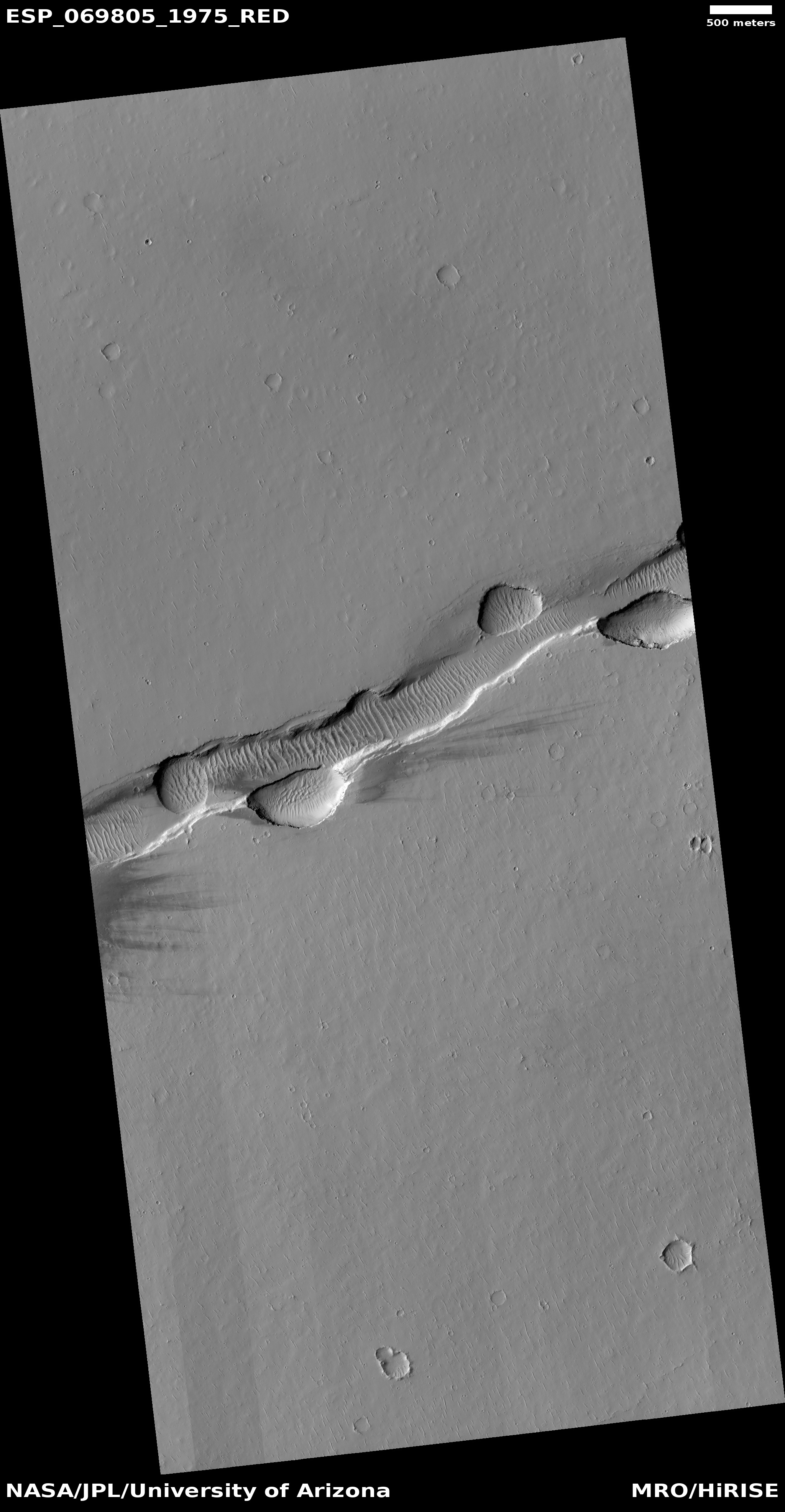
Cool image time! The picture to the right, rotated, cropped, reduced, and sharpened to post here, was taken on February 28, 2023 by the high resolution camera on Mars Reconnaissance Orbiter (MRO).

To put it mildly this is strange terrain. The curving east-west feature resembles a glacial flow, but it also has features that say otherwise. For example, what could cause that gap in the middle of the picture? Such things are not usually seen in an ice flow. Then there is that filled crater on the center left edge of the picture, inside the flow. Though filled with material, the flow itself does not flow around the crater, suggesting the impact occurred after the flow. Moreover the crater is a pedestal crater, whereby the surrounding terrain has eroded away so that the crater ends up standing above it.

These facts suggest that this flow is very old, and has not flowed for a very very very long time. This in turn suggests it isn’t ice but solidified lava, though for a lava flow it also has features that are anomalous when compared to typical flood lava on Mars.
» Read more

1 comment

Scientists: Stars orbiting close to Milky Way’s supermassive black hole do it alone

The stars orbiting Sag A*
The stars orbiting Sag A*. Click for original image.

Based on a ten year study of the motions of nine stars orbiting close to Sagittarius A* (pronounced A-star), the supermassive black hole at the center of the Milky Way, scientists have concluded that they are single stars, not binaries as would be expected.

Using W. M. Keck Observatory on Maunakea, Hawaiʻi Island, Devin Chu of Hilo, an astronomer with the UCLA Galactic Center Orbits Initiative, led a 10-year survey that found these ‘S-stars,’ where ‘S’ stands for Sagittarius A*, the name of the monster black hole at our galaxy’s core, are all single.

The result is surprising given the S-stars Chu’s team observed included young, massive main-sequence stars that are only about six million years old. Normally, stars at this age that are 10 times more massive than our Sun spend their childhood years paired with a twin in a binary system, or sometimes even as triplets.

This finding suggests that the black hole’s massive gravitational field causes the binaries to be pulled apart, or somehow to merge during their formation.

This data point and the questions it raises pales before the more fundamental question that astronomers have been asking since these stars were first discovered in the 1990s: How is it possible for any stars to form so close to such a disruptive gravitational field?

1 comment

A rash on Mars

A Martian rash
Click for original image.

Cool image time! The picture to the right, rotated, cropped, reduced, and sharpened to post here, was taken on January 30, 2023 by the high resolution camera on Mars Reconnaissance Orbiter (MRO). The science team labeled this a “Circular Outcrop of Bright Rock.

What I see is a Martian skin rash. Based on the ripple pattern below the ridge one might think we are looking at sand dunes, except that the rash above the cliff has no such pattern. Instead, the ground in this one particular area looks very roughened in a random sort of way.

The location at 27 degrees south latitude suggests there is little near surface ice at this location to cause this feature. The overview map below provides another but not very helpful possibility.
» Read more

2 comments

SpaceX successfully launches another 51 Starlink satellites

SpaceX today successfully launched another 51 Starlink satellites, using its Falcon 9 rocket lifting off from Vandenberg Space Force Base in California.

The first stage successfully completed its third flight, landing on a drone ship in the Pacific. Both fairings completed their second flight in space.

The leaders in the 2023 launch race:

30 SpaceX
17 China
6 Russia
4 Rocket Lab

American private enterprise now leads China 34 to 17 in the national rankings, and the entire world combined 34 to 29. SpaceX by itself trails the entire world, including other American companies, only 30 to 33 in launches this year.

0 comments

SpaceX to launch Vast’s first space station module as well as two manned missions to it

Vast Haven-1 station inside Falcon-9 fairing

SpaceX and the private space station company Vast today revealed a deal whereby SpaceX will use its Falcon 9 rocket to launch VAST’s first space station module, dubbed Vast Haven-1, followed soon thereafter by two manned missions using SpaceX’s Dragon capsule and lasting up to 30 days.

The announcements claim that first launch will occur by August 2025, which will make it the first privately-owned manned space station to reach orbit, well ahead of the plans by the three space station companies that NASA has issued contracts (by teams led by Northrop Grumman, Sierra Space, and Nanoracks). The only other private station hoping to beat this date, Axiom, won’t be flying independent, but will be attaching its first module to ISS in 2024.

In addition, Vast says that this module will be the incorporated into its proposed larger spinning-wheel station.

Vast is owned and financed by billionaire Jed McCaleb, who doesn’t need NASA seed money for development. In fact, it appears he and SpaceX want to remain as independent of the government as possible, considering the high fees NASA is charging to dock and stay at ISS as well as the stringent research rules it is demanding from private astronauts. This approach also appears to be the same one that Jared Isaacman is taking with his series of private missions on Dragon and Starship.

4 comments

UAE asteroid mission will rendezvous with seven asteroids and will include lander

Though the mission was first announced in 2021, the UAE only recently revealed at a science conference the mission’s specific targets and plan.

From the conference poster [pdf]:

The mission will launch in 2028 and visit 7 main belt asteroids, including 6 high-speed flyby encounters en route to a rendezvous with the asteroid 269 Justitia. The mission is enabled by solar electric propulsion and gravity assist flybys of Venus, Earth, and Mars, bringing the total number of mission encounters to 10. The trajectory design presented will include the overall timeline of the mission, launch targets, launch period, overall duration of the encounters, design of the encounters, and trajectory modeling. Mission design analyses include designing the Deep space maneuvers (DSMs) prior to the rendezvous with Justitia and design Justitia’s orbits and maneuvers to accomplish the lander deployment.

As with the UAE’s Al-Amal Mars Orbiter, the country is relying on an American university, the University of Colorado, as well as the commercial company, Advanced Space, to design, build, and operate the spacecraft. In this sense the UAE is paying these American entities to fly the mission while requiring them to train its own engineers and scientists.

0 comments

China launches cargo freighter to its Tiangong-3 space station

Using its Long March 7 rocket launching from its coastal Wenchang spaceport, China today successfully placed into orbit a Tianzhou cargo freighter to resupply the Tiangong-3 space station.

The leaders in the 2023 launch race:

29 SpaceX (with a launch scheduled for later today)
17 China
6 Russia
4 Rocket Lab

American private enterprise still leads China 33 to 17 in the national rankings, and the entire world combined 33 to 29.

0 comments
1 326 327 328 329 330 1,352