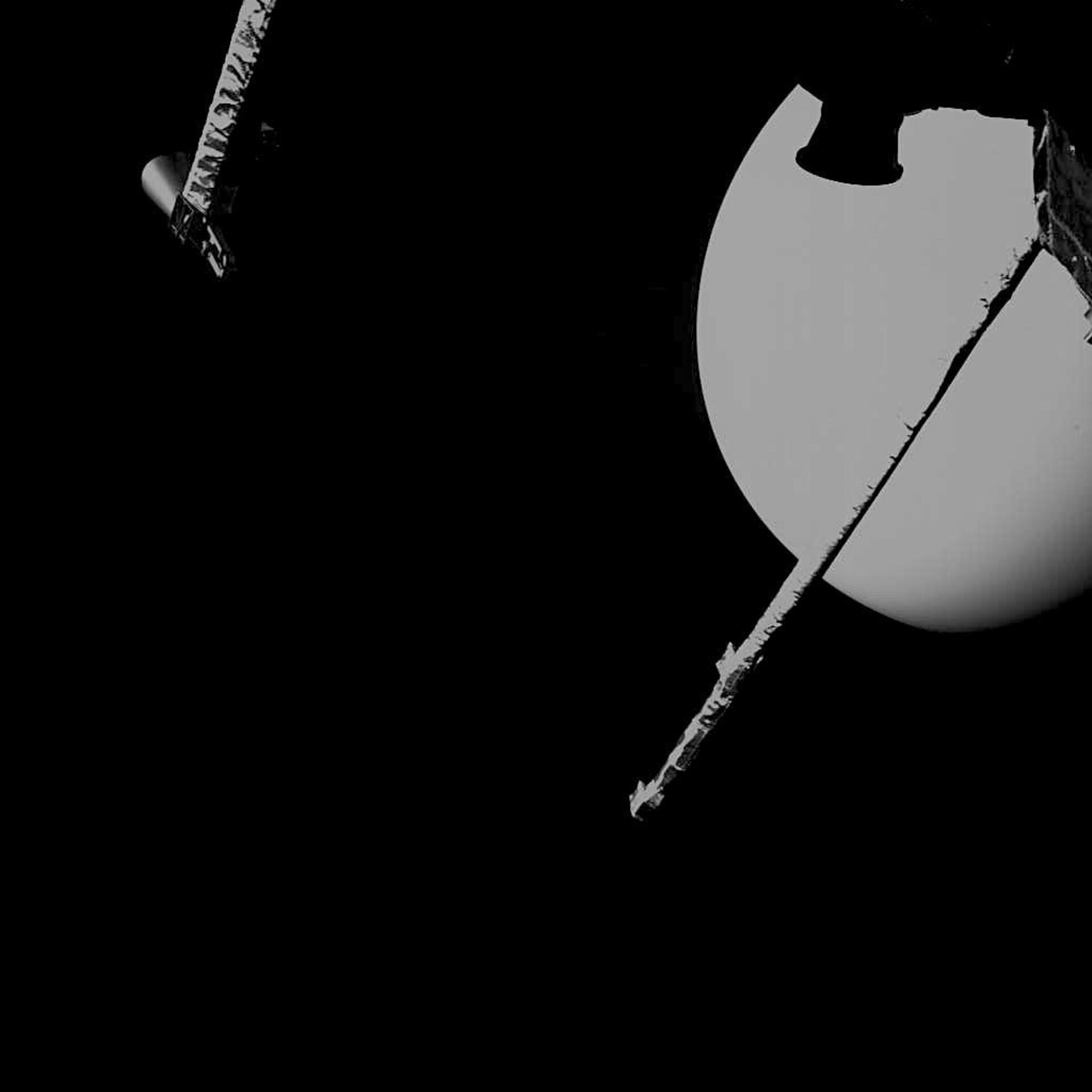
Pieces of a defunct ESA Earth-observation satellite will hit the Earth

The orbit of a defunct European Space Agency (ESA) Earth-observation satellite, ERS-2, is expected to decay later this month, with most of the satellite burning up in the atmosphere but some pieces surviving to hit the ground.

The satellite will break apart when it hits an altitude of about 50 miles (80 km), according to the FAQ [from ESA]. Most of the resulting fragments will then burn up in the atmosphere. Don’t worry too much about the ones the make it down to the surface, for they’ll contain no toxic or radioactive substances, according to ESA.

The article and the FAQ both go out of their way to minimize the risks. Both are correct. However, the risk of this debris hitting anyone, though very very very VERY small, still exists.

0 comments

Spain awards rocket startup PLD $43.8 million grant

Capitalism in space: The Spanish rocket startup PLD has won a $43.8 million grant from the Spanish government to develop its Miura-5 orbital launch rocket.

The company won the funding after completing the preliminary design review (PDR) its Miura 5 small launch vehicle, a review that was then examined by an independent committee. The award is technically a loan, which will be paid off over 10 years once Miura 5 begins commercial operations, currently scheduled for 2026.

The rocket will compete directly with Rocket Lab’s Electron rocket, with a bigger payload capacity. PLD also plans to recover and reuse its first stages after splashdown in the ocean, as Rocket Lab is now attempting to do with Electron.

The significance of this deal is multifold. It shows us that Spain is now a player in space, with its own rocket company, though still only a startup. It also provides further evidence that the nations of Europe are beginning to go their own way in space, rather than rely on their partnership in the European Space Agency and its rocket division, Arianespace. Arianespace has failed to do the job, so Spain like Germany is now looking to the private sector to get its satellite payloads in orbit.

Finally and most important, this deal illustrates the shift in Europe from being the designer and owner of rockets to being a mere customer. Rather than depend on a governnment-built and owned Arianespace rocket, Spain is buying the service from a private company, PLD. That company owns it entirely and can sell its services to others as well.

This trend away from government-owned rockets bodes well for the future of space exploration in Europe. It will produce a vibrant competitive industry with many different companies coming up with different ideas that will increase innovation while reducing cost.

It also signals the coming death of Arianespace, ESA’s commercial division which despite dominating the commercial launch market for almost two decades, was never able to make a profit ever. Instead, it produced rockets that were too expensive and required subsidies on a yearly basis. The nations of Europe are no longer willing to tolerate that bad performance, and have basically told Arianespace it either must compete with these new private companies, or die. I expect it to die. If it does survive, it will only do so if it changes radically.

1 comment

Europe signs up four rocket startups to provide it launch services

Capitalism in space: The European Space Agency (ESA) and the European Commission have jointly signed four rocket startups to contracts for eventually providing these government agencies a competitive commercial rocket industry capable of launching its payloads into space.

Each of the companies will receive a “frame” contract as part of the initiative, allowing them to compete for task orders for launching specific missions. Officials did not disclose the anticipated value of those contracts, or how many launch companies competed to participate in the program.

Four of the companies selected for the Flight Ticket Initiative are startups working on small launch vehicles: Isar Aerospace, Orbex, PLD Space and Rocket Factory Augsburg. None of them have yet conducted an orbital launch but expect to do so within the next two years.

Arianespace, ESA’s launch company that previously had a monopoly on launches, also received a frame contract, but it apparently must now compete for future contracts with these startups.

Europe had attempted to compete with SpaceX by once again using Arianespace and its big space contractors to build the Ariane-6 rocket. That project however is years behind schedule, and has resulted in an expendable rocket that is too expensive. Europe has thus been forced to buy launches from SpaceX.

This new arrangement essentialy means that Europe has adopted the recommendations I made in my 2017 policy paper, Capitalism in Space, available here [pdf]. Rather than design, build, and own its rockets, Europe will instead become a customer like anyone else, buying products developed and owned by private and competing European rocket companies.

Of the startup companies listed above, two (Isar and Rocket Factory) are German, one (Orbex) is British, and one is Spanish (PLD). Thus, this arrangement also spreads the wealth throughout Europe.

Unless outside events change things (such as war or economic collapse), this decision is likely to result in a renaissance in Europe’s launch industry comparable to what is happening now in the U.S. and India. If so, the future for the exploration and settlement of the solar system looks bright indeed.

1 comment

SpaceX successfully launches four astronauts to ISS on Axiom private mission

They’re coming for you next: SpaceX today successfully launched three European astronauts (plus the company capsule commander) to ISS on an Axiom private mission, its Falcon 9 rocket lifting off from Cape Canaveral at 4:49 pm (Eastern).

The capsule, Freedom, is flying humans into space for its third time. The first stage successfully completed its fourth flight, landing back at Cape Canaveral.

The mission itself is private, but the customer is the European Space Agency, which has paid the company Axiom to bring its astronauts to ISS for a fourteen day mission. Axiom in turn hired SpaceX to provide the rocket and capsule. This flight is confirmation that Europe has accepted the concept of capitalism in space, whereby it no longer depends on governments to accomplish what it wants, but instead is a customer buying those products from the private sector.

The astronauts are expected to dock with ISS early tomorrow morning.

The 2024 launch race:

6 SpaceX
5 China
1 India
1 ULA
1 Japan

2 comments

Next manned mission to ISS to launch tomorrow

The next manned mission to ISS, a private mission by the company Axiom carrying three European astronauts and commanded by an Axiom astronaut, is presently scheduled to launch tomorrow, January 18, 2024, at 4:49 pm (Eastern).

This is a private mission by Axiom, launched on SpaceX’s Falcon 9 and flying the astronauts in its Freedom Dragon manned capsule. This will be Freedom’s third flight to ISS. The launch was originally scheduled for today, but SpaceX scrubbed the mission today in order to give it “additional time allows teams to complete pre-launch checkouts and data analysis on the vehicle.” It appears during normal prelaunch checkouts engineers found the joints between the upper stage and the capsule were not tightened the proper amount. The company decided to replace the joints, which caused this one day delay.

The crew will spend up to fourteen days at ISS.

I have embedded a live stream of the launch below.
» Read more

0 comments

Italian subcontractor for Arianespace misplaces two rocket tanks

This story is hard to believe but true: The Italian company Avio, one of the subcontractors for Arianespace that builds its smaller rockets Vega and Vega-C, apparently misplaced two rocket tanks that were to be used on the Vega rocket’s last launch, thus preventing that launch entirely.

The two propellant tanks that went missing were housed in an Avio production department in Colleferro that had undergone renovation work. At some point following the completion of the renovations, the two tanks were found to be missing.

According to the initial source, the tanks had not been entered into a company-wide asset management system that tracked the location of all vital Avio components. This ensured that the teams tasked with investigating the disappearance had very little to go on when beginning their search for the missing tanks.

Despite the futility of the search, the tanks were eventually found. This was, however, not the good news Avio had hoped for. The tanks are, unfortunately, not in a usable state. They had been crushed and were found alongside metal scraps in a landfill.

The tanks power Vega’s fourth stage that deploys satellites in orbit. They were to be used on the final flight of Vega, which has been delayed repeatedly for unexplained reasons. We now know the reason.

Because this was the final flight, however, the tanks cannot be replaced because the Vega production line has been shut down. The company is considering using two of the four qualification tanks first built more than a decade ago when Vega was first being tested, but those were test tanks and have been sitting unused for as long. It will be difficult to determine their reliability.

Europe’s government-run rocket program thus at present has no rocket capable of launching. Its Ariane-5 is retired. Its Vega cannot launch. Its Vega-C, which replaces the Vega, remains grounded due to a launch failure in December 2022, with the next launch expected no earlier than late in 2024. And its new Ariane-6 rocket won’t do its first launch until the summer of 2024, at the earliest.

6 comments

ESA admits Ariane-6 will not fly until the summer of 2024

The European Space Agency today announced that the first launch of its new Ariane-6 rocket will not take place in the first quarter of 2024 and is now targeting a summer launch instead.

At a Nov. 30 briefing, ESA Director General Josef Aschbacher announced a launch period for the inaugural Ariane 6 flight of June 15 through July 31. A more precise launch date will be provided after qualification reviews in the spring of 2024. The announcement comes after a Nov. 23 long-duration test firing of a model of the core stage of the Ariane 6. That test, conducted on the launch pad at Kourou, French Guiana, was intended to simulate a full burn by the core stage.

The delay is not significant by itself, but in the large scheme of things it continues for another few months Europe’s lack of any large rockets to launch any payloads. The original plan when the Ariane-6 project was announced in the mid-2010s was for it to begin flights in 2020 with a several year overlap as the Ariane-5 was retired around 2023. As planned, the last launch of Ariane-5 occurred this summer, but Ariane-6 is now four years behind schedule.

At the moment the rocket has one more major test required, an upper stage static fire test scheduled for December. That test must go well for this new schedule to go forward, which will include a second Ariane-6 launch in 2024 followed by “as many flights as possible” in 2025. ESA hopes to do 9 to 10 Ariane-6 launches per year, most to fulfill the contract of 18 launches with Amazon to put some of its Kuiper satellite constellation into orbit.

0 comments

Ariane-6’s core stage completes full 7 minute engine test

Engineers yesterday successfully completed a two-hour dress rehearsal countdown and fueling of an Ariane-6 first stage followed by a full seven minute engine burn, simulating what that stage would do during a launch.

The test took place on Ariane-6’s launchpad in French Guiana.

The November 23 test sequence was run the same way as the previous ones, with a launch sequence and final countdown representative of a launch, including removal of the mobile gantry and filling the launcher’s upper and core stage tanks with liquid hydrogen (-253° Celsius) and liquid oxygen (-183° Celsius). The test ended with the ignition of the core stage Vulcain 2.1 engine, followed by more than 7 minutes of stabilized operation covering the entire core stage flight phase. All functional aspects of Ariane 6’s core stage during the flight phase were tested.

According to the European Space Agency, only one more engine test of the Ariane-6’s upper stage remains before the spring launch can be attempted, and that engine test is planned for next month in Germany.

With the retirement of the Ariane-5 rocket in July, Europe has had no large rocket to launch payloads. Originally Ariane-6’s first launches were supposed to be in parallel with Ariane-5’s last launches, but its development is four years behind schedule.

1 comment

ESA firms up space station partnership with Voyager Space

The European Space Agency (ESA) and the American company Voyager Space last week signed an agreement making Voyager’s Starlab space station Europe’s main space station destination, replacing ISS.

Starlab will fulfill that role, at least partially, in the future for the space agencies of individual ESA member states. It’s expected to launch as soon as 2028, with operations set to start in 2029. This will include access for astronaut missions and to conduct research as well as providing opportunities for commercial business development. Starlab is also set to provide a complete “end-to-end” system in low-Earth orbit to which European crews and cargo will journey.

This European deal became more likely when Airbus joined the partnership of Voyager and Lockheed Martin in January 2023. It is also probably why Northrop Grumman in October 2023 abandoned its own space station project and joined this one instead. ESA is a big customer, most likely to guarantee the most profits.

What makes this deal different than ISS is that the station will not be owned by this large government customer. The companies building Starlab — led by Voyager — will be free to sell its services to anyone who wishes to use it. This deal also means that NASA and ESA will be going separate ways after ISS, no longer partnering on a station.

0 comments

ESA commits to a zero space junk policy

The European Space Agency (ESA) announced yesterday that it is now commited to a zero space junk policy, and has established its own standards for the end-of-life disposal of all orbiting spacecraft, to be included during the design and construction.

The policy also requires collision avoidance systems as well as engineering designed to reduce light pollution that harms ground-based astronomy.

2 comments

SpaceX gets ESA contract to launch up to four of its Galileo GPS-type satellites

The European Space Agency (ESA) this week announced that it has awarded SpaceX a launch contract to put up to four of its Galileo GPS-type satellites into orbit. Though the deal is signed, approval must still be obtained by ESA’s members and executive commission.

This will be the first time SpaceX will launch any ESA satellites, and the first time in fifteen years that a Galileo satellite will launch outside of Arianespace operations. Previously the Russians had done a number of Galileo launches, using its Soyuz-2 rocket launching out of Arianespace’s French Guiana spaceport, but that partnership ended with Russia’s invasion of the Ukraine.

For the ESA the situation is even worse. It needs SpaceX to launch its satellites because at present it doesn’t have any of its own rockets to do it. The Ariane-5 is retired, and the new Ariane-6 (meant to replace it) is long delayed, and will not have its first test launch until next year, at the earliest. The Vega-C (too small for Galileo anyway) is also grounded due to design defects in the nozzle of its upper stage, while the Vega rocket it replaces has only one more launch before its own retirement.

Much like the Axiom-UK deal posted below, the American commercial space industry is once again making money from others, solely due to the capabilities developed in the past decade due to competition and freedom.

1 comment

ESA completes investigation of Vega-C rocket failure

The European Space Agency (ESA) today released its completed investigation of December 2022 launch failure of its Vega-C rocket’s second stage.

One of the recommendations was to implement a (delta-)qualification of the nozzle with a new Carbon-Carbon throat insert material different from that previously used on the Zefiro40, the solid rocket booster of the Vega-C second stage. On 28 June 2023, a static firing test of the modified Zefiro40 engine took place at the test bench in Salto di Quirra in Italy. During the test the engine nozzle suffered significant damages.

ESA Director General Josef Aschbacher has set up an Independent Enquiry Commission chaired by the ESA Inspector General, Giovanni Colangelo, and composed of experts from CNES, ASI, ESA, Arianespace and academia to understand the cause of the test anomaly and propose recommendations.

The Independent Enquiry Commission concluded that in the current design of the nozzle, the combination of the geometry of the Carbon-Carbon throat insert and the different thermo-mechanical properties of the new material caused progressive damage of other adjacent nozzle parts and a progressive degradation eventually leading to the nozzle’s failure.

In other words, the changes implemented based on the initial investigation that was completed in March did not work. The nozzle needs to redesigned, and will also require at least two more static fire engine tests to be certified.

At the moment ESA officials are predicting that Vega-C will resume launches in the fourth quarter of next year, but do not put any money on that prediction.

1 comment
1 10 11 12 13 14 22