Europe targets 2031 for the first mission of its own lunar lander

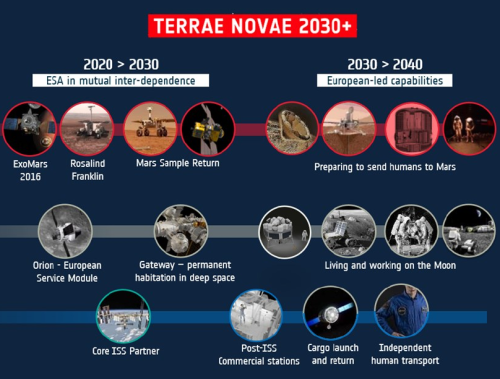
The European Space Agency (ESA) has approved a target date of 2031 for the first mission of its own unmanned lunar lander, dubbed Argonaut, and launched on the most powerful version of the Ariane-6.

On 16 July, the agency published a call for Argonaut Mission 1 Phase A/B1 development aimed at demonstrating the technical and programmatic feasibility of the Argonaut mission concept. The call included a proposed launch date of 2031 for the first Argonaut mission to the Moon.

The Argonaut lunar lander will be launched aboard an Ariane 64 rocket. Once operational, ESA envisions it being used for a wide variety of applications, from cargo logistics to acting as an in-situ resource utilization plant. The agency has already completed pre-phase A studies for what it calls the European Charging Station for the Moon. This system would be launched aboard an Argonaut lunar lander and would essentially act as a gas station on the Moon that would be used to support crewed missions on the surface of the Moon.

As I’ve noted previously, ESA routinely sets a glacial pace on all its government-run projects. Do not expect this government lander to fly on this schedule. More likely by 2031 there will be many cheaper and available options from the private sector, and European companies wanting to put payloads down on the Moon will turn to those, especially because Argonaut is apparently being forced to use the expensive expendable Ariane-6 rocket. The cost for going on Argonaut is simply going to be too high.

0 comments

ESA announces asteroid mission to Apophis

Apophis' path past the Earth in 2029
A cartoon showing Apophis’s path in 2029

The European Space Agency (ESA) today announced that is beginning work on an asteroid mission, dubbed Ramses, to the potentially dangerous asteroid Apophis when it makes its next close-fly of the Earth in 2029.

Ramses needs to launch in April 2028 to allow for an arrival at Apophis in February 2029, two months before the close approach. In order to meet this deadline, ESA requested permission to begin preparatory work on the mission as soon as possible using existing resources. This permission has been granted by the Space Safety programme board. The decision whether to commit to the mission in full will take place at ESA’s Ministerial Council Meeting in November 2025.

Using a suite of scientific instruments, the spacecraft will conduct a thorough before-and-after survey of the asteroid’s shape, surface, orbit, rotation and orientation. By analysing how Apophis changes during the flyby, scientists will learn a lot about the response of an asteroid to external forces as well as asteroid composition, interior structure, cohesion, mass, density, and porosity.

Based on the track record of European space projects, which appear to always proceed at a glacial pace with late problems that cause the missions to miss their launch window (with the launch of the Franklin Mars rover as the poster child), the project is getting started far too late to meet its launch date of April 2028. We shall see if Europe surprises us this time and gets the project off the ground as planned.

Right now the only confirmed mission to Apophis is OSIRIS-APEX, which was redirected to the asteroid after it delivered its samples from Bennu to Earth. Many others have been proposed, including a commercial mission, but none appear to be confirmed or under construction.

2 comments

Watch the first launch of Europe’s Ariane-6 rocket

Europe’s Ariane-6 rocket, first proposed in 2014 and about four years behind schedule, will finally make its first launch at 2 pm (Eastern) today.

I have embedded the live stream below.

The rocket was conceived by the European Space Agency (ESA) as an attempt to compete with SpaceX’s Falcon 9 rocket. It failed to do this from day one, since the rocket was from day one designed to be expendable. By the 2020s it became clear to European satellite companies and government agencies that its launch cost would be far higher that the Falcon 9, and these companies and agencies have therefore resisted signing launch contracts with ArianeGroup. In fact, if Amazon had not decided in ’22 to give the Ariane-6 a contract for 18 launches to put up its Kuiper satellites, the rocket would have almost no launches in its manifest.

This situation was made even more starkly evident at the end of June, when the European governent weather company Eumetsat cancelled its Ariane-6 contract and switched to the Falcon 9.

Though the unelected bureaucrats and apparatchiks in the European Union are trying to require the use of Ariane-6, ESA and Europe’s rocket future resides in the independent rocket startups (Rocket Factory Augsburg, Isar Aerospace, Hyimpulse, PLD). Because they are in competition with each other as well as SpaceX, and are not saddled with heavy government interference, they can focus on innovating to lower cost. Expect them to quickly begin launching in the next three years, with reusability soon to follow.

» Read more

1 comment

ESA approves taking the Vega-C rocket away from Arianespace

The council that runs the European Space Agency (ESA) today approved a resolution that shifted ownership of the Vega-C rocket away from government-run Arianespace and giving it back to its builder, the Italian aerospace company Avio.

Arianespace and Avio have agreed that Arianespace will remain the launch service provider and operator for Vega and Vega-C launch services until Vega flight 29 (VV29), scheduled for the fourth quarter of 2025. For Vega-C launches following VV29, the customers who have already contracted with Arianespace will be offered the possibility to transfer their contracts to Avio as the new launch service provider and sole operator of Vega.

Arianespace will primarily focus with ArianeGroup on the Ariane 6 exploitation to best meet the customer needs.

The council also agreed with France’s plan to allow independent commercial rocket startups to launch from French Guiana. Control of that spaceport has also been taken from Arianespace and returned to its owner, the French space agency CNES.

Essentially, this decision ties Arianespace’s future to Ariane-6, which is likely to disappear once its present manifest of launches, mostly for Amazon’s Kuiper constellation, gets launched.

4 comments

Arianespace calls for Europe to require all European space payloads use European rockets

Arianespace, whose many-decade-long European launch monopoly is presently threatened by a wave of new rocket startups and an effort by European governments to created a competitive launch industry of many companies, has now urged Europe to require that all European space payloads use European rockets.

Arianespace head of public affairs Charlotte Lang has advocated for legislation that would require European missions to be launched aboard European rockets. Lang made the comments during the “Ensuring Long Term Autonomous Access to Space for Europe” panel on the first day of The European Space Forum conference. “The EU should enforce the principle of European launcher preference,” said Lang.

In a follow-up statement, Arianespace reiterated “the need for the EU to legislate that European missions are launched from European territory using launchers and technology manufactured in Europe by European providers.” The company identified the European Union’s planned IRIS² constellation as the “perfect opportunity to advance this initiative.”

Arianespace is like Blue Origin. It can’t get its rockets built and flying at a competitive price, so instead it advocates lawfare to limit competition in order to give it a favored position when it bids on future launch contracts.

In the case of Europe, I think this Arianespace effort will generally fall on deaf ears. The trend among numerous European governments (Germany, France, Italy) is to encourage new rocket companies to compete with Arianespace, in order to create options. These governments will of course wish to favor these new European rocket companies with any contract awards, but they will also not want to tie their hands with the kind of legislation Arianespace proposes. They all discovered in the past two years what could happen if they do that, when Arianespace failed to get Ariane-6 launched on time, and Europe ended up with no launch capabilities. During that time period they still had the option to use other non-European options (such as SpaceX). Having that flexibility in the future makes great sense.

6 comments

Slovenia becomes 23rd member nation of the European Space Agency

Formerly part of Yugoslavia and largely aligned with the communist bloc during the Cold War, Slovenia has now signed on to become the 23rd member nation of the European Space Agency (ESA).

Slovenia has been working with ESA since 2008, when it signed a first Cooperation Agreement, followed by a European Cooperation Agreement. This cooperation was strengthened with its accession to associate membership in 2016, which it upgraded in 2020 with a new Agreement for an enhanced Association. This included a provision that after its expiration in 2025, Slovenia can apply for ESA membership.

Slovenia’s membership still needs to be ratified, but that is expected.

Increasingly Putin’s invasion of the Ukraine has proven to be incredibly stupid. It has not only trapped Russia in a quagmire that it can’t easily escape, with victory nowhere in sight, it has caused all of its other neighbors to look west, away from Russia, out of fear of getting invaded themselves. Slovenia is just the most recent example.

4 comments

ESA signs deal with Vast to use its Haven-1 space station

Vast Haven-1 station inside Falcon-9 fairing

The European Space Agency (ESA) and the commercial space station startup Vast today signed an agreement that sets the initial terms for ESA to use Vast’s first space station, Haven-1, as well as any space stations to follow.

The agreement outlines the parties’ intention to foster human spaceflight, science, technology and commercialisation development and explore collaboration in low Earth orbit destinations other than the International Space Station. The collaboration will initially focus on exploring opportunities for access to space for Europe through the Vast Space Stations. These could include:

  • Access to the Vast Space Stations for ESA and its Member States, for astronaut missions and research activities as well as commercial business development.
  • Supporting European industry to supply subsystems and equipment for future Vast Space Stations.
  • Vast making use of future qualified European LEO cargo and/or crew transportation services, at market rates and commercially viable terms and conditions, also as a means for offsetting future ESA Astronaut Missions.
  • Vast and ESA jointly supporting European industry in getting certified for docking to future Vast Space Stations.

This deal is actually a very big deal, as Vast’s Haven-1 space station is the only one under construction that does not have a deal with NASA. It is being financed privately and will at first simply be a one module habitat set to launch as early as August 2025 on a Falcon 9 rocket, with the first 30-day 4-person manned mission to follow almost immediately on a Dragon capsule. Vast’s work is closely linked with SpaceX, as its station also has a deal to use Starlink for communications.

The plan is to add more modules in the coming years to build up to a full station.

This deal not only indicates that this independent station is going to give the NASA-supported stations some real competition, it indicates that Europe is committed to doing the same. Now that Europe has abandoned the government-owned and international cooperation model it has used for decades with decidedly mixed results and switched to the capitalism model, where it is merely a customer buying things from a competing private sector, it is doing so full speed ahead, without any hesitation.

The independence of this station also frees it and its customers from the heavy rules that NASA routinely imposes on anyone who deals with it. This aspect gives Vast a competitive advantage that many will clearly wish to take advantage of.

This deal is therefore a challenge that better be recognized by NASA and the other commercial stations. If they don’t react properly they could find themselves left in the dust completely.

8 comments

ESA requests information from European rocket startups

The European Space Agency (ESA) has released a request for information from European rocket startups to outline their capabilities and plans so that ESA can assess whether they qualify for future launch contracts.

Currently, ESA is working towards publishing a competitive tender in early 2025 for the award of contracts to allow European launch providers to demonstrate their ability to provide the capacity to serve institutional mission needs. To better define this competitive tender and align the challenge in the best possible way to incentivize providers, ESA has published a Request for Information call. “This Campaign will let economic operators express their views and expectations on the future of European access to space and actively participate in the definition of the European Launcher Challenge,” explains the call.

The call is limited to companies in Europe. The information the companies provide will then be used by ESA to shape the actual contract offers in 2025. The long term goal is for independent and competing European rocket companies to replace the Ariane-6, and provide a fleet of rockets of all types capable of launching European payloads faster and for much less money.

0 comments

French startup captures Russian satellite maneuvering close to another geosynchronous satellite

The French startup Aldoria has released a short movie taken by its ground telescopes showing a Russian “inspector” satellite maneuvering close to another geosynchronous satellite.

In a recent operation, Aldoria detected a sudden close approach by the Russian Luch Olymp K-2 (Luch-2) to a satellite positioned in geostationary orbit (GEO). This manoeuvre occurred on April 12, around 35,780 km in altitude, highlighting the increasing complexity of space activities. Luch Olymp 2, known for its unusual manoeuvres was predicted, by Aldoria, to closely approach the satellite prior to the observed manoeuvre. The original Luch-1, launched in 2014, was known for similar abnormal behaviour, creating a heightened sense of vigilance within the space community. Luch-2, like its predecessor, has a history of unusual manoeuvring near other satellites in geostationary orbit, which has also generated suspicions regarding its mission.

You can see the video here.

In the past year it appears the entire aerospace industry in Europe has come alive, no longer captured by the European Space Agency’s government-owned commercial arm, Arianespace. Instead, there are companies popping up everywhere, doing the kinds of entrepreneurial work American companies have been known to do since the founding of the country.

The competition for business and the amount of innovation in space should get very brisk in the next few years.

2 comments

Avio completes static fire test of the upper stage of its grounded Vega-C rocket

The Italian company Avio yesterday completed a full static fire test of the solid-fueled upper stage of its grounded Vega-C rocket, proving that the second redesign of its nozzle now works.

The initial post-test review indicates that the new nozzle assembly performed as expected throughout the scheduled 94 seconds burning time of the test, simulating a nominal in-flight performance.

The Zefiro-40 is a 7.6 m tall rocket motor, loaded with over 36 tonnes of solid propellant. For this test the motor was installed on its horizontal test bench. Zefiro-40 is developed and manufactured by Avio in their Colleferro factory near Rome, Italy.

A second firing-test will be conducted after the summer to confirm the data collected today. Avio engineers will review the data from the first test to prepare for a second test in October that will then qualify the second stage Zefiro-40 solid rocket motor for a return-to-flight by end 2024 from Europe’s Spaceport in French Guiana.

The nozzle — originally built in the Ukraine — had failed during a launch in December 2022. Then Avio’s first redesign failed in a ground test in July 2023.

With this launch, the Vega-C is poised to resume operations by the end of the year. Those operations will be different however in one major respect. While previously the rocket was built by Avio but owned and controlled by the European Space Agency’s commercial arm, Arianespace, its ownership has been transferred back to Avio. Arianespace is now merely a “launch service provider” according to the press release. I suspect this means that Arianespace handles the launch in French Guiana, something that will also soon be taken from it because control of that spaceport is also being returned to the French space agency CNES.

0 comments

ESA awards contracts to two companies to build unmanned orbital freighters

The European Space Agency (ESA) today awarded contracts worth 25 million euros each to two European companies — the French startup The Exploration Company and the established Italian contractor Thales-Alenia — to begin development of their own unmanned freighters capable of bringing cargo to and from orbit.

During phase 1 development, the selected companies will mature the design of their respective vehicles, focusing on mission requirements, architectures, technology maturation, and de-risking activities. This phase of development is expected to run from June 2024 to June 2026.

Phase 2 of the initiative will see the companies develop and execute a demonstration mission that must be launched by the end of 2028. However, the commencement of Phase 2 will be subject to decisions and appropriations made at ESA’s next ministerial-level council meeting, which will take place in late 2025.

These contracts only cover phase 1. If successful, these capsules will compete with the cargo capsules that SpaceX, Northrop Grumman, and Sierra Space fly in providing supplies to the four commercial space stations presently being built.

2 comments

ESA narrows Ariane-6 launch date to first two weeks in July

In an announcement today, the European Space Agency (ESA) narrowed the launch window for the first launch of its new Ariane-6 rocket to the first two weeks in July.

It also stated that the final launch date will be revealed in the first week of June, during presentations at an air show in Berlin, Germany.

In the next month the rocket will undergo a full dress rehearsal countdown on the launchpad. It will then be “drained of fuel in preparation” for the actual launch.

This rocket is built and mostly owned by the private consortium ArianeGroup, made up of a partnership of Airbus and Safran, and working in conjunction with ESA. Though Arianespace, ESA’s long time commercial arm, is mentioned as ESA’s “launch service provider” for this launch, it is very clear that it is being pushed aside and will soon become irrelevant. The rocket is four years behind schedule and being entirely expendable it is too expensive to compete in the modern launch market. The member nations of ESA have rejected it, and so they are shifting to a capitalism in space model, whereby they no longer have a government commercial “launch service provider” like Arianespace, but instead buy launch services from competing private European rocket companies.

Europe’s problem is that it will take time to develop these private companies. In the interim it will be forced to use Ariane-6, but likely only for a few years. There are at least five new rocket companies in Europe, with three (Rocket Factory Augsburg, PLD, and Hyimpulse) having already completed their first launch tests.

0 comments
1 8 9 10 11 12 22