Third launch attempt by Japanese rocket startup Space One fails

Kairos rocket just after failure

In another attempt to do the maiden launch its orbital Kairos rocket today, the Japanese rocket startup Space One experienced its third launch failure, with the rocket breaking up about a minute after launch.

The screen capture to the right shows the rocket just after failure. The cloud arc in the upper left is the moment some burst occurred. Within seconds it was clear that the rocket was now in several pieces.

The launch attempt, which took place from the company’s own spaceport, Spaceport Kii, on the southern coast of the main island of Japan, was the third failure in a row, all involving failures of the first stage. The first launch in March 2024 blew up mere seconds after launch. The second attempt in December 2024 failed about 90 seconds after launch when the rocket began to spiral out of control.

This third launch appeared more controlled, but it also occurred only a minute after launch.

Whether the company can survive a third straight failure, none of which got even close to main engine cutoff and stage separation, is unknown. The company has some major investors, including Canon, several major Japanese banks, and the government-owned Development Bank of Japan. While they might stick with the company, it would not be surprising if there was a major shake-up in management.

Japan at the moment has no operational launch capability. Space One is its only private rocket startup, while the two rockets belonging to its space agency JAXA, H3 and Epsilon, are both grounded due to launch failures.

4 comments

South Korean rocket startup Innospace signs another spaceport launch deal

Proposed Canadian spaceports

The South Korean rocket startup Innospace, which has attempted one launch of its Hanbit-Nano rocket (a failure), has now signed a launch deal with the proposed Spaceport Nova Scotia, run by Maritime Launch Services.

Maritime Launch Services announced a strategic partnership with South Korean rocket developer Innospace. Under a new Letter of Intent (LOI), the two companies will evaluate hosting the HANBIT launch system at Spaceport Nova Scotia, potentially transforming the Atlantic coast into a primary North American hub for the South Korean firm.

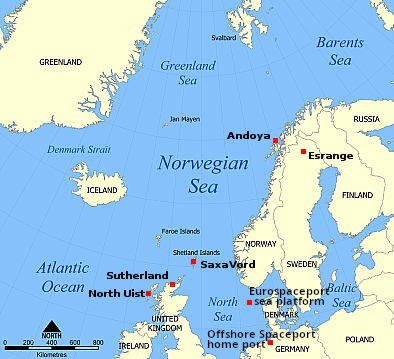
Innospace’s first launch was from Brazil’s long unused Alcantera spaceport on its northeast coast. The company has also signed deals with Portugal’s proposed Santa Maria spaceport, two spaceports in Australia (Southern Launch and Equatorial Launch), and Norway’s Andoya spaceport.

This new deal in Nova Scotia is still preliminary, with the two companies having until the end of the year to finalize the specifics. For Innospace, it appears the company its trying to give itself as many spaceport options as possible. It can also launch from the government spaceport in South Korea, but that provides much more limited orbital flight paths, and presents scheduling difficulties.

For Maritime, this deal might finally get this spaceport off the ground. It was first proposed in 2016, offering satellite companies both a launch site and a Ukrainian-built rocket. That plan fell through when Russia invaded the Ukraine and the rocket became unavailable. Since then Maritime has struggled to convince rocket companies to use the spaceport, all to no avail. It signed some deals, but none has gone anywhere. This deal is its first with a rocket startup that has actually attempted a launch, though that launch was a failure.

1 comment

The first orbiting private space telescope releases “first light” image

Mauve's first light image and data
Click for original image.

The first orbiting private space telescope, owned by Blue Skies Space and dubbed Mauve, has successfully taken its first image and data, a 5 second long exposure of a single star.

That image is to the right, with the spectroscopic data shown by the magenta line. The Hubble Space Telescope’s spectroscopic data is shown in blue and while for comparison.

As part of early commissioning, Mauve was pointed at its first calibration target, eta Ursae Majoris (eta UMa), a bright star in the constellation Ursa Major, approximately 104 light-years from Earth, for a 5-second observation. Eta UMa is a hot, blue-white star, much hotter than our Sun. Eta UMa shines brightly in ultraviolet light, making it an ideal calibration target for a UV observatory like Mauve.

The telescope has a 5-inch mirror, so its resolution is far lower than Hubble’s 94-inch mirror, but because it is above the atmosphere its view is far better than larger ground-based telescopes. Mauve is intended as a three-year-long demonstration project, during which it will study flares from nearby stars that are thought to have exoplanets, as well as binary star systems and variable stars. It is also making this data available to scientists, for a subscription fee. It already has almost a dozen universities signed up.

Blue Skies hopes Mauve’s success will help it raise the capital to build Twinkle, a space telescope with an 18-inch primary mirror. If that succeeds, the company plans to scale up to even bigger orbiting telescopes.

This private sector astronomy model is how the U.S. did things routinely prior to World War II. Then, for many reasons, the government took over for the next three-quarters of a century. It now appears the pendulum is shifting back to the private sector.

1 comment

ESA asks for proposals on building its own space station

ESA logo

The European Space Agency (ESA) last week issued an open call for proposals outlining the construction of its own space station, independent of the five American stations presently in development to replace ISS.

On 27 February, ESA published an intended call for tenders for two Pre-Phase A studies under Scenario 3. According to the call, the studies will consolidate the “feasibility, architecture, utilisation, and technology requirements of a European-led LEO outpost” and propose cooperation with the Canadian Space Agency, Japan’s national space agency JAXA, and “additional partners.” The results of the two parallel studies will be used to enable ESA decision-making for its post-ISS transition by the end of 2026.

Do not expect these “studies” to produce a European-led space station any time soon. It is the ESA way to do lots of studies, and then after reading these to do more detailed follow-up studies outlining what they will do. Then, after years of review, it might finally get started on construction, which always proceeds somewhat slowly.

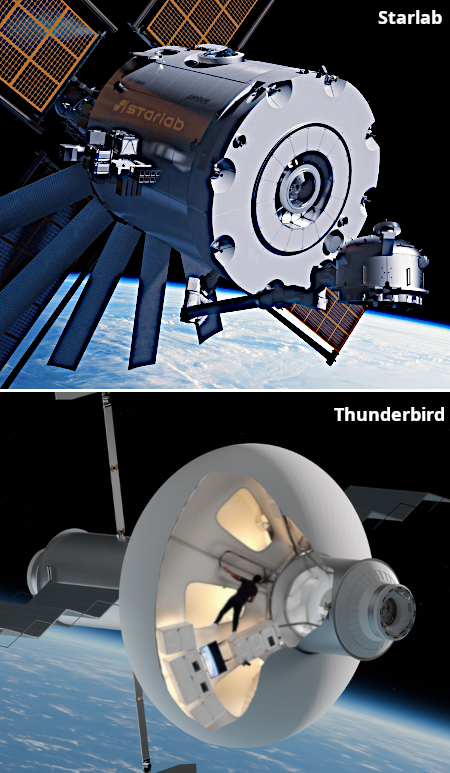
In the meantime, ESA has signed agreements with three of the five American space station projects (Axiom, Starlab, Vast), with its deal with the Starlab station the most extensive. All three deals leave open the possibility that Europe will rent time at each station to fly experiments and astronauts there.

0 comments

Spanish rocket startup PLD raises $209 million in new investment capital

The Spanish rocket startup PLD, which hopes to launch its orbital Miura-5 rocket this year, has now raised an additional $209 million in new investment capital, bringing the total capital it has raised to more than $400 million.

PLD Space, an international space transportation company, has closed a €180 million Series C equity funding round led by the renowned Japanese manufacturer Mitsubishi Electric Corporation, alongside with other investors.

The Spanish Ministry of Science, Innovation and Universities, through the Centre for the Development of Technology and Innovation (CDTI) and its INNVIERTE fund, and the Spanish public funds management company COFIDES, through its FOCO investment fund, have co-invested in this round. Ultimately, the European renowned Spanish fund Nazca Capital, via Nazca Aeroespacial y Defensa INNIVERTE I FCR Fund, close the round.

The company hopes to ramp up its launch pace to as many as 30 launches per year by 2030, though these numbers are clearly aspirational. It has already won two launch contracts, and it is building its own launchpad in French Guiana, where that first launch will take place, and has also signed a deal with Oman to launch from its proposed spaceport in Duqm. PLD has also said it is in negotiations for a third launch site, not yet named.

0 comments

Varda rents new 200K-square-foot facility in California

Varda's W-5 capsule after landing today
Varda’s fifth capsule after landing on January 29, 2026

The startup Varda, which launches returnable capsules for manufacturing products in space, has now rented a large building in California to build those capsules.

In an expansion of its business of processing pharmaceuticals in Earth’s orbit, Varda Space Industries is renting a large El Segundo plant where toy manufacturer Mattel used to design Hot Wheels and Barbie dolls. The plant in El Segundo’s aerospace corridor will be an extension of Varda Space Industries’ headquarters in a much smaller building on nearby Aviation Boulevard.

Varda will occupy a 205,443-square-foot industrial and office campus at 2031 E. Mariposa Ave., which will give it additional capacity to manufacture spacecraft at scale, the company said

The company will take control of the building in December, and will then need another four to eight months to install its production facilities.

Varda has launched and recovered five capsules so far. Some produced pharmaceuticals for sale on Earth, others other products, while two did hypersonic tests for the Pentagon during re-entry. It has a deal in Australia to land as many as 20 more capsules, and presently has ten more missions scheduled on SpaceX’s Falcon 9 rocket.

1 comment

SpaceX launches 29 more Starlink satellites

SpaceX early this morning successfully placed another 29 Starlink satellites in orbit, its Falcon 9 rocket lifting off from Cape Canaveral Space Force Station in Florida.

The first stage completed its 25th flight, landing on a drone ship in the Atlantic.

The 2026 launch race:

28 SpaceX
8 China
2 Rocket Lab
2 Russia
1 ULA
1 Europe (Arianespace)

Not only is SpaceX this year leading the entire world combined in total launches — as it did in both ’24 and ’25 — at the moment it has launched twice as much as the rest of the globe.

0 comments

While Democrats rage against the American/Israel war on Iran, the PEOPLE celebrate

Without doubt there remain great risks and real constitutional issues involved the present military campaign by both the United States and Israel to destroy the Islamic leadership in Iran. First, it is almost impossible to force a change in power solely by air power. This has been tried numerous times, with little success. Killing the leaders of this terrorist Iranian government is a positive step, but it remains entirely unclear whether this war can produce a better government there.

Second, as much as there might be legal precedents that allow President Trump to initiate this action without direct congressional approval, it continues a dangerous trend ceding power away from Congress and to the presidency, in direct opposition to the intentions of the Founding Fathers in their writing of the Constitution. They very much were opposed to giving any president the power to start a war unilaterally.

Pro-U.S. and Israeli demonstrations by Iranians
Click here and here for original videos.

Having stated the reasonable objections to this military action, however, we must now take a look at the two images to the right to see its immediate and very positive consequences. Both pictures are from videos of very spontaneous demonstrations on February 28, 2026 by Iranian refugees celebrating the American/Israeli attacks against Iran.

The top picture is a screen capture from a demonstration in Georgetown, DC. The bottom picture is a screen capture from a demonstration in Austin, Texas.

Note the flags in both pictures. There are numerous flags of Iran (the version during the Shah’s rule, not the version from the Islamic Revolution). There are many American flags, of course, since these demonstrations are in America.

What is most revealing however are the Israeli flags, being enthusiastically waved by Iranians. Clearly the decades of hate against Israel and Jews by the mullahs in Iran has not had any impact on these Iranian refugees. In fact, in the video of the bottom picture they are chanting “Thank you, Bibi!”, referring to Israel’s leader Benjamin Netanyahu as the camera pans across the crowd.

Moreover, these demonstrations took place in two Democratic Party strongholds, cities where pro-Hamas demonstrations have been routine, including rioting and violence against Jews and anyone who dared suggest Israel’s actions in Gaza might be justified.

Nor are these two demonstrations an exception. They have been the rule across the United States and Europe, as well as in Iran itself. The public — the ordinary people for whom governments are meant to serve — seem very much in favor of what President Trump and Netanyahu are doing in Iran. And they are expressing that support of both America and Israel quite unequivocally. If this doesn’t indicate to the world that Israel and the rest of the Middle East can live together in peace and mutual cooperation, nothing can.

This conclusion is further supported by the response by almost every Arab nation in the Middle East, most of whom started off quite willing to let the U.S. and Israel do this deed, with no opposition or with covert support. Now, because of Iran’s indiscriminate attacks on Arab nations, they have all publicly joined the war, allying themselves not with the Islamic nation of Iran but with the U.S. and Israel.

I would not be surprised if Saudi Arabia soon signs the Abraham Accords. Nor would I be surprised if most of the last remaining Arab nations that have not yet done so join Saudi Arabia.

We could very well be seeing a major realignment of alliances in the Middle East that could really really harbinger the beginnings of real peace in that region. Imagine: Israel at peace with all its neighbors, because the Arabs have finally recognized that it is to their own best interest to do so as well.

37 comments

Japan to do vertical tests of its own Grasshopper-type demo stage this month

Japan’s space agency is about to attempt two test vertical take-off-and-landing test flights of of its own Grasshopper-type demo stage, dubbed RV-X later this month.

First flight of a small experimental version of a reusable launch vehicle has been scheduled for March 6 by the Japan Aerospace Exploration Agency (JAXA). The 24-ft.-tall vertical-takeoff-and-vertical-landing (VTVL) RV-X is planned to make a short hop at the agency’s Noshiro Rocket Testing Center on the Sea of Japan coast.

RV-X is the first of two flight experiments planned by JAXA on the path to development of a reusable first stage for a next-generation launch vehicle. A second vehicle is planned to fly in 2027 under the multinational Callisto program.

Callisto is being developed jointly with the European Space Agency. Both it and RV-X have been in development for about a decade. Both were initiated in response to SpaceX’s successful reuse of its Falcon 9 first stage. Both projects however appeared stalled until the last two years or so, with little happening.

The JAXA engine on RV-X is apparently the engine it is providing for Callisto. If the flight tests are successful this March, it will be the be transferred to French Guiana for Callisto tests planned no sooner than ’27.

0 comments

Indian rocket startup Agnikul completes static fire test of three-engine cluster

The Indian rocket startup Agnikul has now released a video of a 40-second static fire test of three-engine cluster it hopes to use on its Agnibaan orbital rocket.

The engines, powered by electric motor-driven pumps, were designed and manufactured in-house at Agnikul’s Rocket Factory-1. All three were fully 3D-printed as single-piece hardware units, reflecting the startup’s focus on advanced manufacturing and indigenous engineering.

Co-founder and chief executive Srinath Ravichandran said that increasing the number of engines improves rocket performance and that a three-engine system is required for commercial missions. The clustered test involved calibrating six pumps and six motors and fine-tuning six independent speed control algorithms to function in synchronisation. The goal was to achieve uniform startup, steady-state operation and shutdown performance across all three engines, a technically complex process given the precision required in semi-cryogenic propulsion systems.

The company has completed one suborbital test launch in May 2024, and in September 2025 said its orbital rocket’s first stage will land vertically and be reused.

Agnikul however has not released any schedule for launch, and based on this static fire test appears years from a first launch. It is making progress, but slowly. At the same time, it says it has raised $500 million in private investment capital, giving it the resources to build the rocket.

Based on testing and published progress, Agnikul appears to be trailing India’s other rocket startup Skyroot, though this could change in the coming year.

0 comments

Rocket Lab completes in-space commissioning of two Escapade Mars orbiters

Built by Rocket Lab for NASA and launched in November 2025, the company has now completed the in-space commissioning of two Escapade Mars orbiters and is about to hand operations over to the University of California Berkeley Space Sciences Laboratory (UC-Berkeley).

With both spacecraft now fully commissioned and successfully operating at the Earth–Sun Lagrange Point 2 (L2), Rocket Lab is preparing to hand over operational control to [UC-Berkeley], who will lead science operations at L2 and prepare the mission for its cruise to Mars.

Under contract from [UC-Berkeley], Rocket Lab was selected to design, build, and provide commissioning operations of the two high delta-V Explorer-class interplanetary spacecraft for ESCAPADE. Rocket Lab moved from concept to launch readiness in just over three years, proving commercial collaboration can deliver important science key to supporting future human and robotic exploration of Mars on ambitious schedules and for significantly smaller budgets than typical interplanetary missions. This speed was made possible through Rocket Lab’s vertically integrated spacecraft production, with key components including solar arrays, reaction wheels, propellant tanks, star trackers, radios, avionics, and flight software designed and built in-house.

Launched from Cape Canaveral Space Force Station in November 2025, the twin ESCAPADE spacecraft, known as Blue and Gold, completed spacecraft commissioning and executed two precise trajectory correction maneuvers, placing both spacecraft into their loiter trajectory near L2, approximately 1.5 million kilometers from Earth.

Both spacecraft will be sent on their way to Mars in December 2026 when orbital mechanics between the Red Planet and Earth are right for the journey. Once in Mars orbit the two orbiters will allow for a three-dimensional study of the interaction between the solar wind and Mars’ atmosphere.

Though this is a NASA-funded mission, note that it was built a commercial company and operated not by NASA but by a university. For this reason, it was not only built fast and at a low cost, it uses an innovative flight path that allowed it to be launched anytime and wait in orbit for the right moment to go to Mars. This last innovation provides for a lot more flexibility.

1 comment

SpaceX completes its second Starlink launch today; Firefly scrubs launch

SpaceX successfully placed another 29 Starlink satellites in orbit this evening during its second launch today, its Falcon 9 rocket lifting off from Cape Canaveral Space Force Station in Florida.

The first stage completed its 26th launch, landing on a drone ship in the Atlantic.

Firefly meanwhile scrubbed its launch of its Alpha rocket due to high winds. No new launch date as yet been scheduled. This would be Firefly’s first launch since it had a launch failure in April 2025, followed by a static fire test explosion in September 2025. According to the company, this Alpha launch will be the last of this version before it begins flying an upgraded rocket.

The 2026 launch race:

27 SpaceX
8 China
2 Rocket Lab
2 Russia
1 ULA
1 Europe (Arianespace)

As it did in both ’24 and ’25, SpaceX in ’26 so far has more launches than the entire rest of the world combined.

0 comments
1 16 17 18 19 20 684