Peregrine only has hours left, its fuel leaking away

According to a number of recent updates by Astrobotic, its Peregrine lunar lander only only a few more hours of life left, its fuel leaking away due to the failure of a valve to close inside its oxygen tank.

Astrobotic’s current hypothesis about the Peregrine spacecraft’s propulsion anomaly is that a valve between the helium pressurant and the oxidizer failed to reseal after actuation during initialization. This led to a rush of high pressure helium that spiked the pressure in the oxidizer tank beyond its operating limit and subsequently ruptured the tank.

The company also noted that the Vulcan rocket did no harm to the spacecraft during launch, placing it in the correct orbit. The tank rupture however means it will not land on the Moon, and in fact is likely not going to escape Earth orbit. Sometime in the next day or so the spacecraft will run out of fuel, and at that point it will be fly out of control, its batteries draining because the solar panels will no longer point to the Sun.

How this failure will impact Astrobotic’s next and larger lander, Griffin, remains unknown. It is presently scheduled to land on the Moon in November 2024.

14 comments

SpaceX: Ready to launch Starship/Superheavy by end of January but it won’t

Surprise! During the NASA press update yesterday making official the new delays in its entire Artemis lunar program, a SpaceX official revealed that the company will be ready to launch the third orbital test flight of its Starship/Superheavy rocket by end of January, but it also does not expect to get a launch approval from the FAA for at least another month.

Speaking during the press conference, SpaceX Vice President of Customer Operations & Integration Jensen said Starship hopes to be ready to test Starship once more by the end of January and to receive the necessary license from federal authorities to do so by the end of February.

During the conference Jensen made it repeatedly clear that it will require numerous further launch tests to get ready ready for its lunar landing mission for NASA — about ten — and that the company hopes to have this task completed by 2025 so that the agency’s new delayed schedule can go forward as now planned.

Yet how will SpaceX do this if the FAA is going to delay each launch because of red-tape by at least one month? SpaceX might be confident the FAA will give the okay for a launch in late February, but no one should be sanguine about this belief. Bureaucrats when required to dot every “i” and cross every “t”, as it appears the Biden administration is demanding, can be infuriatingly slow in doing so, even if they wish to hurry.

This news confirms my prediction from November that the launch will happen in the February to April time frame. It also leaves me entirely confident that my refined December prediction of a launch no earlier than March will be right.

SpaceX wants to do about six test launches per year. I don’t know how it can do so with the FAA holding it back.

4 comments

NASA makes it official: The entire Artemis schedule is delayed

Surprise! NASA yesterday officially confirmed the rumors reported earlier about delays in its Artemis Moon program, outlining a new schedule that pushes all the launches back from months to more than a year.

NASA will now target September 2025 for Artemis II, the first crewed Artemis mission around the Moon, and September 2026 for Artemis III, which is planned to land the first astronauts near the lunar South Pole. Artemis IV, the first mission to the Gateway lunar space station, remains on track for 2028.

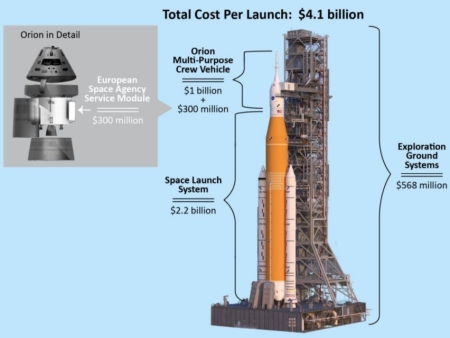
The agency cited issues with its Orion capsule that need fixing, including unexpected damage to its heat shield during the first test flight in 2022, battery problems found during ground testing, and new issues discovered with the as-yet unflown environmental systems designed to keep the astronauts alive.

One rumor that did not turn out to be true was the suggestion that first manned lunar landing would be shifted from Artemis 3 to Artemis 4, to give NASA more time to test things.

More details about the press briefing can be found here.

No one should take any of these dates seriously. NASA technique for announcing delays in this moon program have consistently been wrong. It announces small delays incrementally, to hide the fact that it knows the actual launch will be delayed far more that politics allows. The program was first proposed in 2004 with a planned landing in 2015. Since then NASA has announced numerous delays numerous times, always in small amounts. Yet by 2015 it was clear the first landing wouldn’t happen for at least a decade (after a decade of work), because of Obama’s unilateral cancellation of the initial program and Congress’s demand that it be re-established in a different form. By 2022 it was clear that the first manned landing mission was at least five years away.

Thus these new dates will certainly slip. You can bet on it. As I noted yesterday, NASA will be lucky to make that first manned lunar landing by 2030.

6 comments

Proposed removal of William Penn statue proves the Democrats really are anti-American

The William Penn statue in Welcome Park
The William Penn statue in the center of
Welcome Park. Note the panels on the wall
behind, describing the achievements of his life.
The park service was also planning to “rehabilitate”
this as well.

Though the Biden administration and the National Park Service immediately backed down from its proposal to remove the statue of William Penn from the Pennsylvania park dedicated in 1982 to honor his memory, the very proposal proved without doubt how much the Democrats who dominate our government truly hate America, its founding, and everything it stands for.

First, let’s review the proposal that has now been dumped. According to the National Park Service press release issued on January 5th,

The proposed rehabilitation of Welcome Park includes expanded interpretation of the Native American history of Philadelphia and was developed in consultation with representatives of the indigenous nations of the Haudenosaunee, the Delaware Nation, Delaware Tribe of Indians, the Shawnee Tribe, and the Eastern Shawnee Tribe of Oklahoma. The reimagined Welcome Park maintains certain aspects of the original design such as the street grid, the rivers and the east wall while adding a new planted buffer on three sides, and a ceremonial gathering space with circular benches. The Penn statue and Slate Roof house model will be removed and not reinstalled. [emphasis mine]

In other words, a park built at the site of William Penn’s pioneer home and designed expressly to honor his achievements as the founder of Pennsylvania as a religious haven for all people was to be redesigned instead as a memorial to the primitive stone-age Indian tribes that once lived there, focusing instead on how Penn and the Quakers oppressed them by coming to America. And to rub salt in the wound, this change was to be done in connection with the 250th anniversary of the signing of the Declaration of Independence in 2026.

As I said, the Democrats who dominate our federal bureaucracy as well as academia are our enemies. They truly intend to wipe any positive mention of America from every history book or place, and replace it with Marxist icons and false anti-American propaganda.

Very quickly there was an uproar against this plan. » Read more

11 comments

UK spaceports to UK government: There’s too much red-tape!

Proposed spaceports surrounding Norwegian Sea
Proposed spaceports surrounding Norwegian Sea.

At a hearing this week before the Scottish Affairs Committee of the United Kingdom’s parliement, the heads of the two spaceports being built in Scotland demanded that a single senior minister be assigned to handle all regulation for space launches, because the present system involves too many different agencies from too many different UK governments.

The result has been endless delays, and no launches.

“For me, there’s almost too many cooks involved,” [according to Scott Hammond, deputy CEO of SaxaVord Spaceport.] “I think what we need to look at is having a senior politician directly responsible for space and space launch and I would suggest that at cabinet level.” Despite the UK Government space portfolio, he said it is still “difficult to know who’s actually running launch in the UK”.

He gave the example of seeking permissions from Scottish Government’s marine directorate, something he said was taking six months rather than 14 weeks as promised.

The CEO of the company Orbex, which has a fifty-year lease to launch from the other spaceport in Sutherland, admitted that the spaceport “had appeared to be in a ‘better place’ in 2018 but acknowledged circumstances had changed since then.” In other words, regulation was now threatening the company’s operations at Sutherland, and it is beginning to look elsewhere for future launches.

Saxavord had hoped to do its first launch this year, but now is looking to the summer, all because of the long delays experienced in getting government approvals.

The map shows other space ports being developed in Europe. These, as well as new spaceports elsewhere, might end up getting all of this UK business because of the continuing red tape issues in Great Britain.

4 comments

JPL lays off 100 contractors due to expected budget cuts

JPL last week laid off 100 contractors due to expected budget cuts in its troubled Mars Sample Return (MSR) mission.

A JPL spokesperson confirmed Jan. 7 that the center laid off the contractors and took other measures, such as across-the-board spending cuts and pausing work on one aspect of MSR, because of the “uncertain federal budget” in fiscal year 2024. The Los Angeles Times first reported the layoffs.

NASA announced in November that it would slow down work on MSR because of sharp differences in proposed funding for the effort in separate House and Senate bills. A House appropriations bill would provide the agency’s full request of $949.3 million while the Senate version allocated only $300 million.

Since the final budget has not been determined, nor has NASA made any decisions on what will happen to the sample return mission, these cuts (as well as NASA’s slowdown in November) are as much a political act as anything. JPL and NASA are trying to pressure Congress to fully fund everything, and by imposing cuts now the agencies generate news that elected officials don’t like. Routinely the legislators then back off of any budget cuts.

We shall see. Congress remains bankrupt, treating its budget as a blank check with money that grows on trees. Yet the sample return mission as presently designed is a mess. It needs a major reshaping in every way.

2 comments

Rocket Lab gets contract to build 18-satellite constellation for U.S. military

Rocket Lab was yesterday awarded a half billion dollar contract to build the next set of eighteen satellites of the U.S. military’s Tranche communications satellite constellation.

Rocket Lab will act as prime contractor for the $515 million USD firm-fixed price agreement, leading the design, development, production, test, and operations of the satellites, including procurement and integration of the payload subsystems. The contract establishes Rocket Lab’s position as a leading satellite prime contractor, providing supply chain diversity to the Department of Defense (DoD) through vertical integration. The contract comprises $489 million base plus $26 million of incentives and options and will be carried out by Rocket Lab National Security (RLNS), the Company’s wholly owned subsidiary created to serve the unique needs of the U.S. defense and intelligence community and its allies.

The plan is for these satellites to launch in 2027. It does not appear that the contract includes the launches itself. Rocket Lab can do some, but it is likely the military will award some to SpaceX and others.

This deal continues the military’s shift from designing and building its own satellites that usually cost too much and are years behind schedule to buying the product from the private sector. It also continues the shift from large unwieldly and very exposed single satellites to constellations of many small satellites that are difficult to destroy..

1 comment

China launches X-ray space telescope

China early today successfully used its Long March 2C rocket to launch its new Einstein X-ray space telescope, built in partnership with the European Space Agency (ESA). The rocket lifted off from the Xichang spaceport in the southwest of China.

Astronomers will use the telescope to study the high energy released by during supernovae. It will also be used to study black holes and other high energy deep space phenomenon.

Meanwhile, the lower stages of the rocket, which use toxic hypergolic fuels, fell somewhere in China. No word if they landed anywhere near habitable areas.

The 2023 launch race:

3 SpaceX
2 China
1 India
1 ULA

2 comments

Astrobotic’s Peregrine lunar lander suffers major failure

According to updates by the engineering team running Astrobotic’s Peregrine lunar lander, launched early today by ULA’s Vulcan rocket, the lander’s propulsion system suffered a major failure shortly after activation.

After successfully separating from United Launch Alliance’s Vulcan rocket, Astrobotic’s Peregrine lunar lander began receiving telemetry via the NASA Deep Space Network. Astrobotic-built avionics systems, including the primary command and data handling unit, as well as the thermal, propulsion, and power controllers, all powered on and performed as expected. After successful propulsion systems activation, Peregrine entered a safe operational state. Unfortunately, an anomaly then occurred, which prevented Astrobotic from achieving a stable sun-pointing orientation.

The company later released an update, stating that the failure caused “a critical loss of propellant” that will make the mission impossible as planned. They are reassessing to see if they can come up with an alternate plan, but without sufficient fuel no lunar landing will be possible under any mission profile.

Peregrine is a smaller test version of Astrobotic’s larger Griffin lunar lander, which has contracts with NASA and ESA for later missions. This failure will likely impact those missions, forcing either delays or redesigns.

This mission was always an engineering test mission designed to prove out Astrobotic’s landing design, so experiencing a failure was not a surprise. The problem is that this failure occurred so soon after launch that it prevents the company from testing that landing design, at all.

8 comments

Americans push back against government overreach with some real defiance

Are Americans finally waking up and emulating their country's founders?

Bring a gun to a knife fight: For the first time since 2020, when state and federal governments nationwide decided the Constitution and Bill of Rights no longer applied to them and began imposing a whole range of abusive illegal regulations and lockdowns and mandates and blacklisting on Americans everywhere, we are now finally beginning to see some real push back from ordinary people, in ways that leave these tinpot dictators no choice but to back down.

Two examples in the past week. First in St. Louis the city government (controlled by radical leftist Democrats) decided it was time to institute a new panic over COVID, likely to give them the ability to once again easily manipulate voting in 2024, by instituting a new city mask mandate. Though it only recommended strongly that everyone wear masks everywhere, its director of health Matifadza Hlatshwayo Davis said that masks were required of government employees if they were indoors or in a car with another person.

Davis’s problem was that, unlike 2020, almost no one obeyed her demands.
» Read more

20 comments

ULA’s Vulcan rocket successfully places payload in orbit on first launch

Vulcan at liftoff.
Vulcan at liftoff.

After four years of delay, mostly caused by delays at Blue Origin in delivering the two BE-4 engines used in the first stage, ULA’s Vulcan rocket finally completed its first launch early on January 8, 2024, lifting off from Cape Canaveral and successfully placing Astrobotic’s Peregrine lunar lander into orbit.

As of posting the upper stage had just deployed Peregrine, which will leave Earth orbit in about four days using its own engines. The upper stage has one more burn to send it into solar orbit, carrying the ashes of numerous people for the company Celestis.

The 2024 launch race:

3 SpaceX
1 India
1 China
1 ULA

For ULA, this launch is a very big deal. It is the first of two required in order for the Space Force to certify the rocket for future military launches. It also positions the company to begin the many launches that Amazon has awarded it to place into orbit a large percentage of that company’s Kuiper internet satellite constellation, assuming of course Blue Origin can deliver on schedule the many BE-4 engines that ULA will require.

This launch will also likely lead to the sale of ULA. » Read more

10 comments

NASA: UAE to build airlock module for lunar station plus have astronaut fly there

According to a press release from NASA today, the United Arab Emirates (UAE) will build the airlock module for the Lunar Gateway space station plus have one astronaut fly a mission to the station after it is built.

Under a new implementing arrangement expanding their human spaceflight collaboration with NASA through Gateway, MBRSC will provide Gateway’s Crew and Science Airlock module, as well as a UAE astronaut to fly to the lunar space station on a future Artemis mission.

I strongly suspect that the UAE will mostly pay for this module to be built, hiring outside contractors from either the U.S. or Europe to do the work.

4 comments
1 154 155 156 157 158 982