GAO rejects protests by Blue Origin and Dynectics over lunar lander award

The Government Accountability Office (GAO) today rejected the protests by Blue Origin and Dynectics against the award by NASA of its manned lunar lander contract to SpaceX’s Starship spacecraft.

In denying the protests, GAO first concluded that NASA did not violate procurement law or regulation when it decided to make only one award. NASA’s announcement provided that the number of awards the agency would make was subject to the amount of funding available for the program. In addition, the announcement reserved the right to make multiple awards, a single award, or no award at all. In reaching its award decision, NASA concluded that it only had sufficient funding for one contract award. GAO further concluded there was no requirement for NASA to engage in discussions, amend, or cancel the announcement as a result of the amount of funding available for the program. As a result, GAO denied the protest arguments that NASA acted improperly in making a single award to SpaceX.

GAO next concluded that the evaluation of all three proposals was reasonable, and consistent with applicable procurement law, regulation, and the announcement’s terms.

Finally, GAO agreed with the protesters that in one limited instance NASA waived a requirement of the announcement for SpaceX. Despite this finding, the decision also concludes that the protesters could not establish any reasonable possibility of competitive prejudice arising from this limited discrepancy in the evaluation.

This decision will likely allow NASA to proceed with the contract, and for SpaceX to begin work on the revisions it will need to make to Starship to make it a lunar lander.

The decision also puts companies like Blue Origin and Dynectics on notice: You need to prove you have the goods, or you won’t win customers. Commit some of your own funds to research and development, start building actual prototypes you can test, and the world will begin to beat a path to your door.


20 comments

Arianespace successfully completes first Ariane 5 launch in almost a year

Arianespace today successfully completed its first Ariane 5 launch since August 2020, placing in orbit two commercial communications satellites.

The long gap in launches occurred because of a vibration issue discovered during that August 2020 launch durng the release of the rocket’s two fairing halves.

Engineers introduced modifications to the Ariane 5’s payload fairing, or nose cone, to reduce vibrations imparted on the satellites during separation of the shroud, which protects payloads during the first few minutes of flight through the atmosphere. Ground teams will analyze data from the rocket to make sure the changes reduced the vibrations.

Another launch is scheduled for September, followed next by the launch of the James Webb Space Telescope in either November or December. The results from today’s launch as well as the one in September will determine if the Webb launch will go forward on time.

These issues with Ariane 5, delays imposed by the company in fear of the Wuhan flu, and other launch problems with Arianespace’s Vega rocket, has meant that this is only its second launch in 2021, a pace that is below its pace for most of the last decade. Whether the company can recover and pick up the pace before the end of the year will depend on what they learn during today’s launch.

With only two launches total, Europe’s Arianespace remains off the leader board in the 2021 launch race:

24 China
20 SpaceX
12 Russia
3 Northrop Grumman
3 Rocket Lab

The U.S. lead over China in the national rankings remains 30 to 24.

3 comments

Today’s blacklisted American: Town tries to silence Trump supporter; he sues

Banned for being conservative
No first amendment rights in Long Beach, New York!

The modern dark age: Because the town of Long Beach, New York has forced a Trump supporter to hide his car, festooned with pro-Trump and conservative messages, he is suing that town for $25 million for denying him is first amendment rights.

“I believe the city is trying to silence me because I’m pro-Trump,” [Michael Wasserman] told The Post. The 62-year-old entrepreneur has become known in the area for plastering his home — along with his Porsche and Jeep — with a rotating variety of political flags and stickers.

Now he has filed a $25 million federal suit — against the City of Long Beach, the chief of police, the city manager and specific police officers — after officials forced him to remove the flags on his cars.

The town claims they are a violation of an ordinance stating that “[No] sign shall be erected, affixed or maintained within the perimeter of any … public street or public property.” Wasserman parks his car on a public street outside his home.

“They’re bending and massaging the ordinance to fit the crime,” Wasserman told The Post. “This is a blatant attempt to silence me.”

The picture above shows Wasserman leaning on his car, with his home behind him, also covered with flags and political banners.

The city claims they are simply enforcing a law that forbids signage without permission on public streets. Yet, how are the signs on Wasserman’s car any different then every bumper sticker you see? They are not, and this is where Wasserman’s claim that it is pure political oppression seems confirmed.

Wasserman’s case is further reinforced by the treatment he gets generally in this blue-state New York town:
» Read more

21 comments

Apollo: When Americans last did some real exploring

The journey of Apollo 15 on the Moon
Click for full image.

Today is the fiftieth anniversary of the landing of Apollo 15 on the Moon. To commemorate that event the science team for Lunar Reconnaissance Orbiter (LRO) today published some orbital images that capture the astronauts’ travels while on the Moon. The picture to the right, reduced to post here, outlines in oblique view their various excusions to the edge of Hadley Rille and the foot of a mountain dubbed Hadley Delta. As they note,

While Apollo 15 was the fourth mission to land a crew successfully on the lunar surface, it still pioneered many new technologies and had many firsts.

Some of the technologies developed for Apollo 15 included new suits, which were more flexible and had longer life support capabilities, as well as the Lunar Roving Vehicle (LRV), a rover capable of speeds up to 15 km / hour. With these advancements, astronauts Commander David (Dave) Scott and Lunar Module Pilot James (Jim) Irwin were able to travel more than eight times the distance traveled during the previous mission, for a total of over 25 km.

All told, astronauts Dave Scott and Jim Irwin spent more than 18 hours exploring the lunar surface on three scouting trips, covering 15.5 miles. During all those excursions their only protection from the harsh lunar environment was that thin spacesuit. In addition, if their rover broke down a walk back to the lunar module would become a race against suffocation.

And even then, they still had to get that lunar module off the ground, rendezvous and dock with the Apollo 15 command module, and then get that module back to Earth safely.
» Read more

46 comments

United Kingdom passes comprehensive spaceflight regulations

Capitalism in space: As required by the Outer Space Treaty as well as to lay a framework for commercial and private space launches from within the United Kingsom, the UK this week passed new comprehensive spaceflight regulations that appear modeled closely after already existing regulations in the United States.

From the government’s press release:

The legislation provides the framework to regulate the UK space industry and enable launches to take place from British soil for the very first time. It will unlock a potential £4 billion of market opportunities over the next decade, creating thousands of jobs and benefiting communities right across the UK.

This also puts the UK in a unique position as the first country in Europe able to launch spacecraft and satellites from home soil. This could lead to better monitoring of climate change, as well as improved data for satellite navigation systems, improving journeys right here on the ground, too.

The full law can be read here. It is long, so I have not reviewed it entirely, but it does seem to be closely modeled after several U.S. laws, including the 2004 Space Amendments Act that presently guides FAA regulation and licensing of commercial space launches. The UK even gave its own Civil Aviation Authority (CAA) the same job the FAA has in the U.S.

6 comments

Atomic oxygen in Mars’ atmosphere, as seen by Al-Amal

Oxygen distribution on Mars

The UAE’s Al-Amal Mars orbiter on July 19, 2021 released a new spectroscopic image, showing the global distribution of atomic oxygen in the Martian upper atmosphere.

The Emirates Ultraviolet Spectrometer (EMUS) mapped the distribution of atomic oxygen in the planet’s upper atmosphere, showing a dense patch emerging from the nightside into the new day.

The photo to the right, cropped and reduced to post here, shows this.

Over the next two years, covering one single Martian year, Al-Amal will monitor the distribution of this oxygen to see how it fluctuations from season to season, as well as from day to day. Gather this information will help the theorists untangle the past atmospheric history of Mars.

3 comments

Today’s blacklisted American: Democrat endorses racial discrimination and press censorship aimed at whites

Discriminated against by Chicago Democrats
Eagerly discriminated against by Democrats

Blacklists and segregation are back and the Democrats have got ’em: Lori Lightfoot, the Democratic Party mayor of Chicago, recently and enthusiastically defended her past racial disciminatory policy of refusing to give any one-on-one interviews to white reporters, saying she intends to do it again.

Chicago Mayor Lori Lightfoot said she would “absolutely” grant interviews only to journalists of color again after she drew waves of backlash earlier in the year when she announced the policy.

“I would absolutely do it again. I’m unapologetic about it because it spurred a very important conversation, a conversation that needed to happen, that should have happened a long time ago,” the Democrat said on a segment of the New York Times’s podcast Sway, released on Monday.

“Here is the bottom line for me: To state the obvious, I’m a black woman mayor,” she said. “I’m the mayor of the third-largest city in the country. Obviously, I have a platform, and it’s important to me to advocate on things that I believe are important. Going back to why I ran — to disrupt the status quo. The media is critically important to our democracy. … The media is in a time of incredible upheaval and disruption, but our City Hall press corps looks like it’s 1950 or 1970.”

» Read more

7 comments

India officially delays launch of its next lunar rover to ’22

The new colonial movement: India has now officially delayed the launch of its next lunar rover, Chandrayaan-3, to the third quarter of 2022.

Chandrayaan-3 was planned to demonstrate India’s capability of soft landing on a celestial body, with the rover then communicating with Earth via the existing orbiter from Chandrayaan-2. The orbiter has an estimated lifespan of seven years. The third mission was announced months after the Vikram lander aboard Chandrayaan-2 crash-landed on the lunar surface just 2.1 km from its destination in September 2019. Chandrayaan- 3 was initially scheduled for late 2020 or early 2021, but the disruption caused by the pandemic affected the schedule.

The Wuhan flu panic has essentially shut down India’s entire space program for more than a year. Not only has the country only done one launch so far in 2021, far less than expected, it has also had to delay its manned space program by a year, as well as the launch of its own new smallsat rocket.

The delay in launches, including that smallsat rocket, is likely losing India customers in the commercial market, especially because the private rocket companies in the U.S. have continued to launch with almost no delays. If India doesn’t get off the ground soon its rocket industry will be seriously damaged in a way that might take years to recover.

0 comments

China’s Long March 2D rocket launches earth observation satellite

China today successfully used its Long March 2D rocket to launch an earth observation satellite into orbit.

The launch was from one of China’s interior spaceports, so the expendable first stage and fairings landed within China. No word on whether they landed uncontrolled or used the parachutes or grid fins to control the landing.

The leaders in the 2021 launch race:

24 China
20 SpaceX
12 Russia
3 Northrop Grumman
3 Rocket Lab

The U.S. still leads China 30 to 24 in the national rankings.

0 comments

Nauka finally docks with ISS

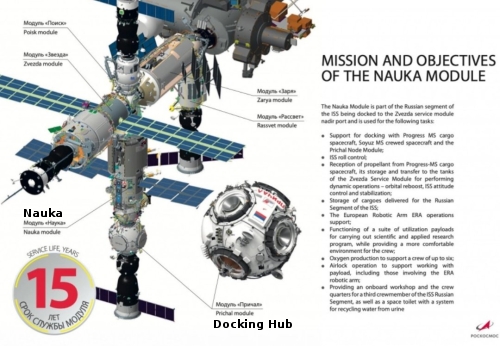
ISS configuration with Nauka added
The configuration of the Russian portion of ISS with
Nauka and the as-yet launched docking hub.

This morning the new fullsize module to ISS, Nauka, finally docked with the station, ending a week of tension because of issues with its engines.

The docking was not without issue, with Russian cosmonauts noting that Nauka wasn’t on the correct course less than an hour before docking; however, a retro burn quickly corrected the issue. After also troubleshooting an issue with the TORU manual docking system, Nauka successfully docked in automated fashion to the Zvezda service module’s nadir port at 09:29 EDT / 13:29 UTC, marking the first major expansion to the Russian segment for over 20 years.

They will now begin a series of eleven spacewalks to outfit the module. This includes installing a new European-built robot arm and transferring an airlock and radiator on a different module that were originally built to be attached to Nauka and have been waiting eleven years for its much delayed arrival.

In November Russia will then launch a small docking hub module that will dock with Nauka and provide the docking ports that were lost when the Piers module was detached earlier this week (thus allowing Nauka to dock). This new docking hub is also critical, because it will allow Russia to limit dockings to the aft port on Zvezda, which has serious structural stress issues and must be treated gently to prevent further hull cracks and air leaks.

5 comments

Today’s blacklisted American: Twitter bans all election audit accounts in Arizona, Georgia, Pennsylvania, Nevada, and Wisconsin

Liberty and freedom banned
Twitter’s goal: Only Democrats can have freedom of speech.
Photo credit: William Zhang

The new dark age of silencing: In a single purge Twitter yesterday banned all the accounts of all election audits going on in Arizona, Georgia, Pennsylvania, Nevada, and Wisconsin.

Earlier today Twitter permanently suspended all nine of the official ‘Audit War Room’ accounts from it’s platform. The accounts were a main source for breaking updates and were banned as part of big tech’s continued attempt to shield the public from the stunning revelations being found regarding the fraudulent 2020 election.

Unsurprisingly, Twitter provided no reason for the suspensions. [emphasis mine]

Note the highlighted sentence. Twitter is no longer even pretending that it is banning these accounts because of some vague “community standard” that each violated. No, Twitter banned them simply because it is possible that the election audits going on in these states might actually uncover evidence of election fraud, and to allow honest and real news reporting can no longer be allowed, if that reporting might threaten the dominant leftist agenda and the Democratic Party politicians who are imposing it.
» Read more

11 comments

July 27, 2021 Zimmerman Space Show podcast

The podcast of my two-hour appearance last night on The Space Show with David Livingston is now available here.

Thank you to David and tor everyone who called or emailed questions. Twas a very good show, to my mind. It also allowed me hone my verbal description of my new book, Conscious Choice. When I finish a book, I tend initially to get buried in the details in describing it in interviews. This appearance allowed me to get an idea on how to talk about the book quickly, in summary. I think it went well, and will certainly get better with future appearances.

2 comments

FCC tightens rules for giving grants to broadband companies

The FCC under the Biden administration has informed the companies who obtained subsidies to encourage broadband access in rural areas that the money can only be spent in those areas, not on infrastructure improvements in facilities located in regions that already have good internet access.

The Federal Communications Commission told SpaceX and other companies on Monday that the billions in rural broadband subsidies it doled out last year can’t be used in already connected areas like “parking lots and well-served urban areas,” citing complaints. The commission, in an effort to “clean up” its subsidy auction program, offered the companies a chance to rescind their funding requests from areas that already have service.

The companies that got the subsidies must do the work to determine they qualify for the money, wrote Michael Janson, director of the FCC’s Rural Broadband Task Force, in a letter addressed to SpaceX’s finance director David Finlay. Similar letters, first reported by Bloomberg, were sent to other recipients of the commission’s Rural Digital Opportunity Fund, a $9.2 billion auction to expand broadband into rural areas that lack or have no service.

The news reports I’ve seen of this story have all been from the generally leftwing press, and have been written to hammer SpaceX. No matter. This program is rife with corruption and the misuse of taxpayer money. SpaceX doesn’t need the nearly billion dollar subsidy it got, or if it does need the billion, it should get it from private investment. As should all the other companies getting cash in this program.

Sadly, the Biden administration does not appear interested in ending the program. Instead, I get the sense what it really wants to do is send the cash to its own cronies, instead of the cronies favored by the Trump adminstration. Thus, do not be surprised if Blue Origin’s as-yet unbuilt Kuiper constellation starts to be a recipient of funds, even as the money is cut from SpaceX’s Starlink constellation.

3 comments

Bezos offers to waive $2 billion in payments to get lunar lander contract

In an open letter to NASA administrator Bill Nelson, Blue Origin founder Jeff Bezos offered to waive $2 billion in payments should NASA decide to switch its contract for building the manned lunar lander contract from SpaceX to the Blue Origin team, including Lockheed Martin, Northrop Grumman and Draper.

Blue Origin and its industry partners ⁠— including Lockheed Martin, Northrop Grumman and Draper ⁠— bid $6 billion to design and build a competing landing system. After SpaceX won the award, Blue Origin’s team and Dynetics, the third competitor for a NASA contract, filed protests with the Government Accountability Office. The GAO is due to rule on those protests by Aug. 4.

In his letter to Nelson, Bezos revisits the issues laid out in Blue Origin’s protest and complains that NASA “chose to confer a multi-year, multibillion-dollar head start to SpaceX” in the Human Landing System competition. He noted that NASA gave SpaceX a chance to revise its bid to fit NASA’s financial needs, and that Blue Origin wasn’t given a similar opportunity. “That was a mistake, it was unusual, and it was a missed opportunity,” Bezos wrote. “But it is not too late to remedy.”

Bezos then offered to waive all payments in the 2021-2023 fiscal years, up to $2 billion, “to get the program back on track right now.” He said that would be in addition to the $1 billion in corporate contributions that was previously pledged.

The article notes there may be some legal issues blocking such an offer. I also wonder what Blue Origins partners think about this. Has Bezos discussed it with them? Is he offering to cover their profits as well?

We must also be cognizant of one important detail: The Blue Origin team’s proposal lost the bid largely because was ranked below SpaceX’s for both financial and technical reaosns. Even more important, that team’s lander does yet not exist, even in prototype. No significant work has been done. And Blue Origin itself has so far failed to launch anything into orbit, with its orbital rocket New Glenn two years behind schedule. None of this inspires confidence.

SpaceX meanwhile has been test flying its Starship lander in repeated flight tests, demonstrating its capabilities.

Consider this bidding war from a custoner’s perspective. Blue Origin has yet to prove it can build what it promises. SpaceX is already doing so. And it bid less as well.

On August 4th the GAO will rule on the protests of both losers, Blue Origin and Dynetics. Anything can happen, but I strongly expect them to rule in favor of NASA and SpaceX.

And even if they do rule that the contract must be rebid, the bottom line remains: Blue Origin has got to stop trying to win its contracts in the courts, and finally start build the orbital spacecraft and rockets it has been promising for years. I have every faith it can be done. Bezos just has to get his company focused once again in doing so.

16 comments

Russians detach Pirs module in anticipation of Nauka arrival to ISS

With the engine problems of Russia’s new ISS module Nauka apparently resolved sufficiently for its rendezvous and docking expected on on July 29th, Russian astronauts today undocked the 20-year-old Pirs module, which then used its engines so that it safely burned up over the Pacific Ocean.

The article provides a nice history of Pirs, which was originally intended for Russia’s Mir-2 station, never built after the fall of the Soviet Union.

Pirs, meaning “pier,” traces its origins back to the Mir-2 space station — which was itself a Soviet project that’s design began in 1976. Mir-2’s long and troubled history would eventually find it in the early 1990s where major design changes to launch its various modules via the Buran space shuttle were underway.

Following the collapse of the Soviet Union in December 1991, Mir-2 emerged the following year as a four-module station — including a Docking Module, which would become Pirs. In 1993, Mir-2 officially merged with the long-delayed NASA/European/Japanese/Canadian space station Freedom project to become the building blocks of the International Space Station.

The module, which provided the Russian half of ISS needed extra docking ports, was originally expected to be replaced after about five years with a larger module, but this was never built.

15 comments

Deleted

This post incorrectly reported a Chinese launch as occurring today when it had actually occurred (and was reported previously. I have therefore deleted it. Sorry about the error.

The leaders in the 2021 launch thus remain as follows:

23 China
20 SpaceX
12 Russia
3 Northrop Grumman

The U.S. still leads China 29 to 24 in the national rankings.

3 comments

SpaceX wins contract to launch Europa Clipper to Jupiter

Capitalism in space: NASA today awarded SpaceX a $178 million contract to use its Falcon Heavy rocket to launch Europa Clipper to Jupiter.

If all goes according to plan, Clipper will lift off in October 2024 from NASA’s Kennedy Space Center in Florida and arrive in orbit around Jupiter in April 2030. The probe will then study Europa in depth during nearly 50 close flybys of the moon over the course of about four Earth years, mission team members have said.

The award is not really a surprise. Falcon Heavy is really the only operational rocket with the power capable of launching this mission. Because for years Congress had mandated Europa Clipper be launched on SLS, it was designed with more mass than normal for such planetary missions. Delays in the SLS program however finally forced Congress to relax that mandate, but that left NASA with a payload too heavy for all operational rockets except Falcon Heavy, and even that requires this six year flight, with flybys of the Earth and Mars to get it to Jupiter.

The price for the launch is significantly greater than SpaceX normally charges for its Falcon Heavy, but since it was the only game in town, I suspect SpaceX drove a hard bargain.

10 comments

Today’s blacklisted American: Democrats introduce Senate bill demanding companies censor social media

Democrats: No soapbox free speech allowed
Democrats: No soapbox allowed! Photo: GeorgeLouis

Blacklists are back and the Democrats got ’em! Two Democrats, Senator Amy Klobuchar (D-Minnesota) and Ben Ray Lujan (D-New Mexico), yesterday proposed a new law that would force social media companies like Google, Facebook, and Twitter to immediately remove any posts on their platforms that includes medical information those Democrats disagree with.

If the companies do not do so, they will be held liable for those posts.

As has become typical of Democrats, they label any information they disagree with as “misinformation.” To make sure their definition is sustained, their bill would have the federal government determine what is correct and not correct. That definition would then be used to justify silencing any other opinions.

Such a law would essentially repeal the First Amendment of the Constitution. Free speech will be banned. Only government-approved speech in connection with health will be allowed. If such a law was upheld by the courts (a very distinct possibility in today’s legal culture), it could quickly be expanded to cover all speech on any subject.

There is some irony in this Democratic Party proposal. » Read more

12 comments

Nauka issues apparently resolved?

According to a press release for Roscosmos, engineers have successfully fired the engines on Russia’s new large module for ISS, dubbed Nauka, and the module is now on course for rendezvous with the space station.

On Thursday, July 22, 2021 the Nauka Multipurpose Module Flight Control Group specialists at Moscow Mission Control Center conducted two correction maneuvers of the module that had launched to the International Space Station the previous day.

The first maneuver took place at 15:07 UTC with the module engines burn for 17.23 seconds giving an impulse of 1 m/sec. The second burn for 250.04 seconds took place at 17:19 UTC with an impulse of 14.59 m/sec.

No details were released explaining why the first course correction engine burn did not happen as scheduled.

UPDATE: I have added a question mark to the headline because there indications from a variety of sources, all unconfirmed, that the problems might still persist. We shall find out in the next two days.

6 comments

Court rejects Viasat’s effort to stop SpaceX Starlink launches

Capitalism in space? A three-judge panel on July 20, 2021 rejected Viasat’s request for a temporary injunction that would have stopped all SpaceX Starlink launches until Viasat’s lawsuit against that constellation is settled.

While this decision does not settle the lawsuit, it allows SpaceX launches to continue, and likely cause the case to be expedited in the courts. The decision also suggests that the court does not favor Viasat’s claims, which are somewhat dubious on their face, and appear designed merely to shut down a successful competitor through the use of the courts.

Viasat alleged that the FCC did not comply with the National Environmental Policy Act (NEPA) when it approved SpaceX satellite launches because the commission “refused to conduct any environmental assessment.” Viasat told the DC Circuit court that SpaceX launches should be halted because of potential environmental harms when satellites are taken out of orbit; light pollution that alters the night sky; orbital debris; collision risks that may affect Viasat; and because “Viasat will suffer unwarranted competitive injury.”

The FCC by the way disputes Viasat’s claims, and filed its own brief defending SpaceX.

Viasat’s real concern is that its satellite internet service will be considered inferior to SpaceX’s and will thus lose customers to it. Too bad. Competition means you step up your game and do better, not go to court to try to shut down your opposition.

9 comments
1 204 205 206 207 208 594