
Barnes Wallis: the man behind World War II’s Dambusters.
Barnes Wallis: the man behind World War II’s Dam Busters.
Barnes Wallis: the man behind World War II’s Dam Busters.
An evening pause:
How much does it cost, I’ll buy it.
The time is all we’ve lost, I’ll try it.
But he can’t even run his own life
I’ll be damned if he’ll run mine.
The irony of this song is that it was written during the Vietnam War as a protest against the war and the draft. Today, most of the same anti-war protesters that sung it then, now want that same government to run our lives, even though it can’t run its own.
The story of the youngest survivor of the Buchenwald concentration camp to be liberated by the Americans.
At age seven, he was separated from his mother when she thrust him over to the men’s side during deportation. “Tulek, take Lulek,” she said, entrusting him to Naftali in the hope that the men were more likely to survive. Naftali smuggled him into the Buchenwald labor camp since a child his age would have been exterminated on the spot if discovered. Rabbi Lau thus became the youngest and smallest inmate in the camp. His survival over the next year was largely due to Naftali’s constant self sacrifice and protection.
You don’t have to be Jewish or even believe in God to agree with this man that miracles do happen every day.
A close study of human bones recently uncovered from Jamestown’s early “Starving Time” have revealed evidence of cannibalism.
This really isn’t news, since we have always had firsthand accounts suggesting cannibalism during that terrible winter of 1609. It is, however, the first empirical proof of that cannibalism.
Smithsonian researchers have recovered a short recording of Alexander Graham Bell’s voice, made in 1885.
A new report from Russia suggests that the undeployed antenna on the Progess freighter will interfere with ISS’s docking port and prevent a docking.
It appears that the antenna would allow a soft docking but prevent the hard docking necessary to allow for the opening of the hatch. Something similar to this had happened on the Russian Mir station in the 1987. Two astronauts did a space walk to clear the hatch of a piece of debris. Now the Russians are suggesting again that if a hard dock becomes impossible a spacewalk be performed to get the antenna out of the way.
R.I.P. Margaret Thatcher (1925-2013).
One of the giants of the 20th century. As she said in her final speech as Prime Minister in 1990,
» Read more
British scientists have located the underwater remains of one of the man-made Mulberry harbours built by the British to support the D-Day Normandy invasion.
An expedition financed by Jeff Bezos has recovered two Apollo-era Saturn 5 F-1 engines from the ocean bottom.
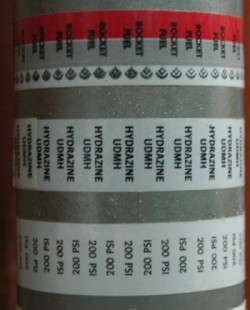
A fuel line for the Titan missile.
Last week my oldest friend Lloyd and his wife Denise came to visit Diane and I here in Tucson. One of Lloyd’s requests was to visit the Tucson Missile Museum. This museum is built at the site of one of the now disabled missile silos built in the 1960s as a means for launching nuclear weapons against the Soviet Union. Fifty-four silos total had been built and operated, with eighteen of those silos scattered around the Tucson, Arizona area. When the U.S. signed a nuclear arms treaty with the Soviet Union in the 1980s these silos were then shut down and sold. Some became private residences. Others remain buried and abandoned.
One silo, however, was kept as intact as allowed by treaty and made into a museum in order to preserve this artifact of history. Because Diane and I happen to know Chuck Penson, the archivist at the museum, we were able to arrange an augmented tour of the facility. Below are some of my pictures as Chuck took us down into the deepest bowels of the silo.
» Read more
Seven sound recordings made before Thomas Edison.
An evening pause: In honor of Rand Paul’s filibuster today, let’s watch Jimmy Stewart perform a movie filibuster from the (1939) movie, Mr. Smith goes to Washington.
As Mr. Smith says, “Somebody will listen to me.”
A sunstone, used by mariners to judge the position of the Sun when it is cloudy, has been found at a 16th century shipwreck.
A previous study showed that calcite crystals reveal the patterns of polarized light around the sun and, therefore, could have been used to determine its position in the sky even on cloudy days. That led researchers to believe these crystals, which are commonly found in Iceland and other parts of Scandinavia, might have been the powerful “sunstones” referred to in Norse legends, but they had no archaeological evidence to support their hypothesis—until now.
New research concludes that it was a static electric spark that set fire to the Hindenberg in 1937.
Funny: Proof that cats have been walking on important stuff for basically forever.
Don’t they have better things to do ? The House yesterday voted to rename the Dryden Flight Research Center after Neil Armstrong.
As I noted previously, I disagree strongly with this action. To honor Armstrong properly we should name something really important after him. But it is shameless and wrong to steal the honor from Hugh Dryden in doing so. Armstrong, a modest and honorable man, would have surely protested this action himself.
The man who taught the air forces of the world how to fly.
“I shall never surrender or retreat.” William Travis’ letter of defiance returns to the Alamo.
An evening pause: In honor of George Washington’s birthday, here is his farewell speech, in which he outlined his advice for the citizens of this country to sustain a free America into a long and prosperous future.
The wisdom of these words is astonishing. More so is their predictive quality. Washington knew, possibly better than anyone, the greatest risks that threatened liberty. Woe to us all if we choose to ignore his warnings.
The microfilmed miniature bibles that flew to the moon during Apollo have become the center of a custody dispute between the state of Texas and the author who wrote their history.