Striped dunes in crater on Mars

Striped dunes in crater on Mars
Click for full image.

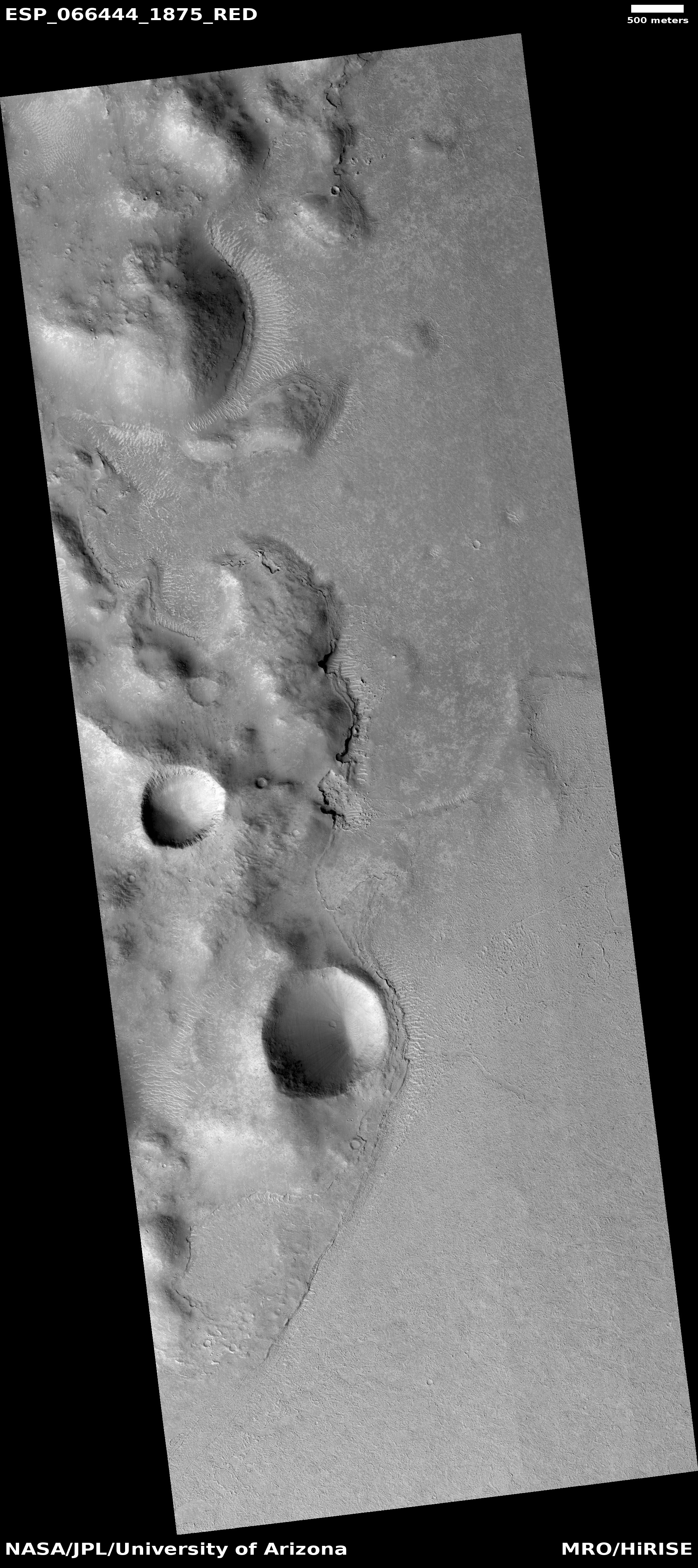
Cool image time! The photo on the right, rotated, cropped, and color-enhanced to post here, was taken by the high resolution camera on Mars Reconnaissance Orbiter (MRO) on October 1, 2020. It shows some large dunes with what appear to be black or dark features across their surface, reminiscent of tiger stripes.

The dunes are located on the floor of 42-mile-wide Kunowsky Crater, located in the northern lowland plains of Mars at the high mid-latitude of 57 degrees north.

What are the tiger stripes? The second image below, provided at the image link, zooms in at full resolution at the area in the white box, and shows that the stripes appear to actually be made up of spots strung together.
» Read more

3 comments

A Martian polliwog

Three-mile-wide crater with exit breach
Click for full image.

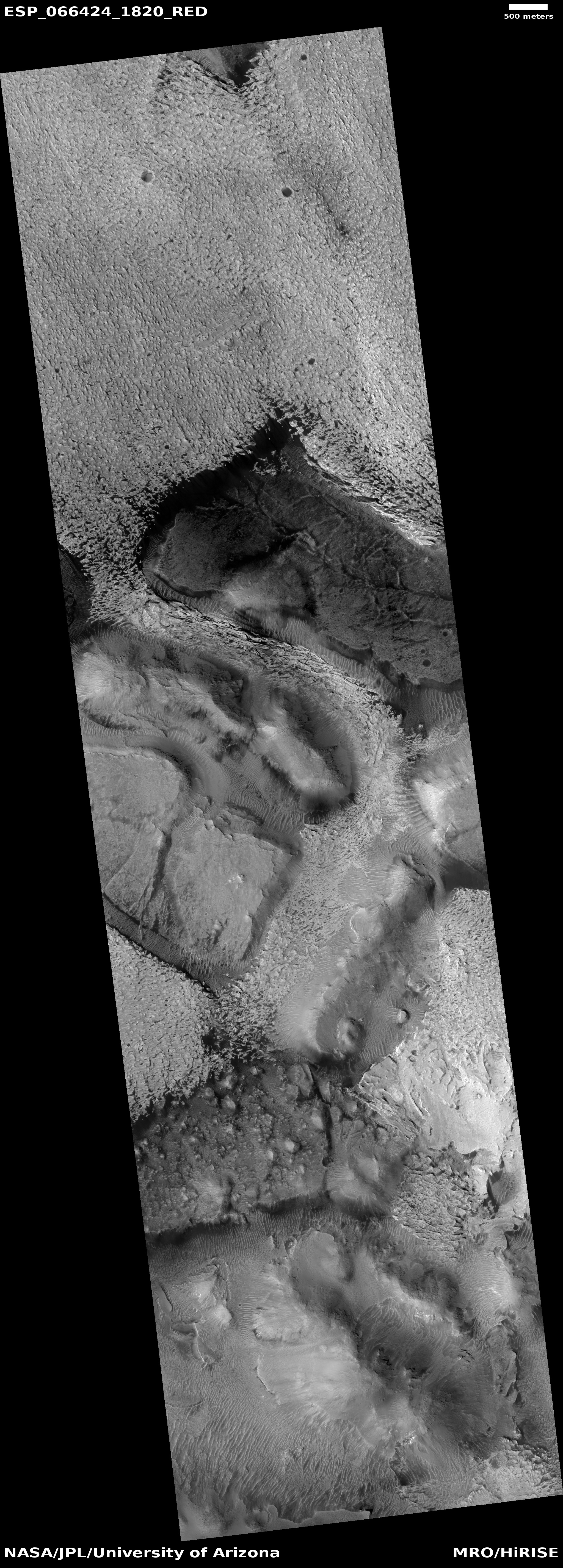
Cool image time! The photo to the right, rotated, cropped, and reduced to post here, was taken on September 30, 2020 by the high resolution camera on Mars Reconnaissance Orbiter (MRO).

It shows one half of what scientists have dubbed a pollywog crater, in which there is a single breach in the crater wall, aligned with the low point in the crater’s floor. Such craters suggest that they were once water- or ice-filled, and that they drained out through the breach either quickly in a single event or slowly over multiple events.

The second image below was taken by the wide angle context camera on MRO, and not only shows this entire crater, but several other adjacent craters, all of which show evidence of glacial fill in their interiors. The latitude here is 34 degrees south, placing these craters within the mid-latitude bands where such glacial features have been found by scientists in great numbers.
» Read more

4 comments

Terraced mesas in Martian crater

Terraced mesa in Martian crater
Click for full resolution image.

The cool image to the right, reduced and annotated to post here, was a captioned photo released by the Mars Reconnaissance Orbiter (MRO) science team earlier this week. Taken by MRO’s high resolution camera, it shows in color a beautifully stair-stepped mesa located in an unnamed 22-mile-wide equatorial crater in Arabia Terra, the large transitional zone between the lowland northern plains and the southern cratered highlands. As the caption notes,

Several craters in Arabia Terra are filled with layered rock, often exposed in rounded mounds. The bright layers are roughly the same thickness, giving a stair-step appearance. The process that formed these sedimentary rocks is not yet well understood. They could have formed from sand or volcanic ash that was blown into the crater, or in water if the crater hosted a lake.

If volcanic ash, the layers are signalling a series of equal eruptions of equal duration, which seems unlikely. Water is also puzzling because of the equatorial location. Like yesterday’s mystery cool image, water is only likely here at a time when the red planet’s rotational tilt, its obliquity, was much higher, placing this at a higher latitude than it is today.

Regardless, make sure you look at the full image here. This crater floor is chock-full of more such terraced mesas, some of which are even more striking than the sample above.

I have also posted below the MRO context camera photo of the entire crater.
» Read more

5 comments

A splat on Mars

A splat on Mars
Click for full image.

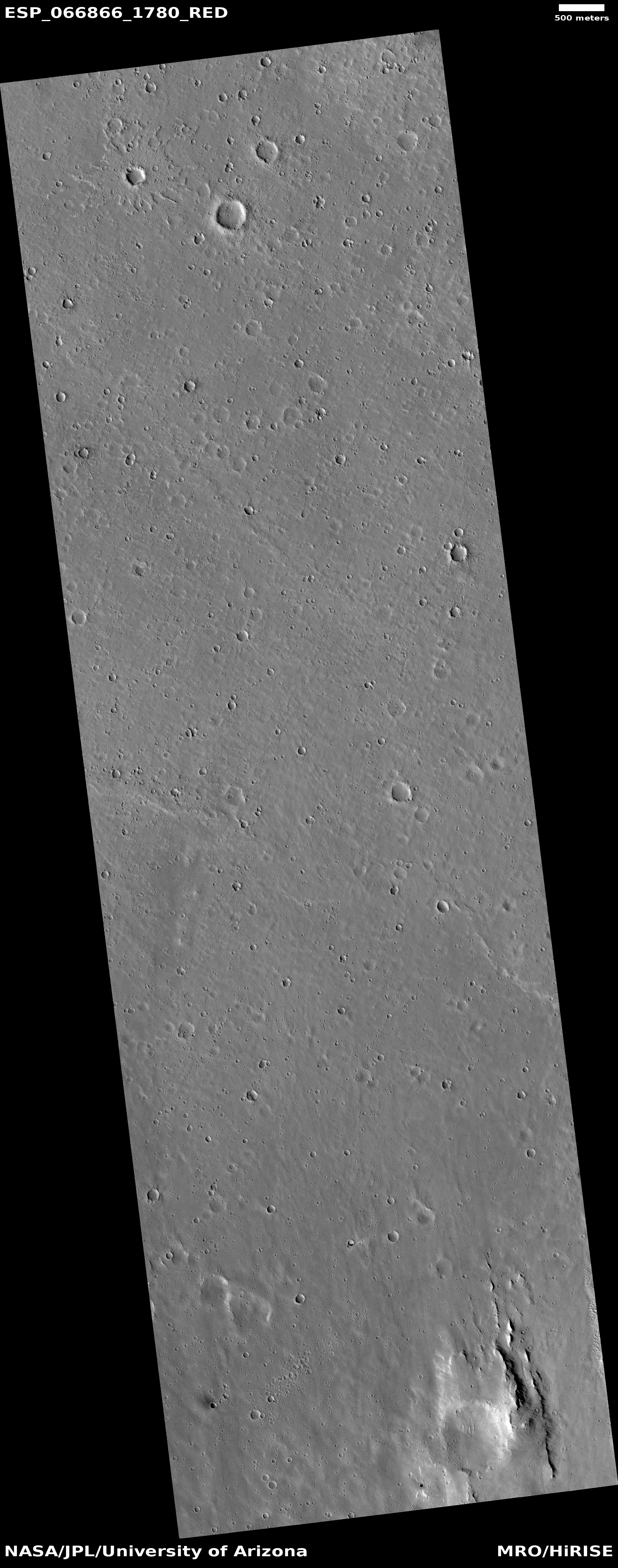
Cool image time! The photo to the right, cropped to post here, was taken on October 31, 2020 by the high resolution camera on Mars Reconnaissance Orbiter (MRO). Labelled simply as a “Terrain Sample”, it was not taken as part of any specific science research but because the MRO science team need to regularly take pictures to maintain the camera’s temperature. When such engineering images are required they try to pick spots of some interest, but sometimes the resulting picture is somewhat bland.

If you look at the full image, you will see that blandness generally describes it. However, in the upper left corner was a most intriguing-looking crater, which I have focused on above. From all appearances, when this impact happened the ground was quite soft, almost like mud, and thus the ejecta splattered away not as individual rocks and debris but as a flow.

The map below gives a little context, but really doesn’t explain this crater fully.
» Read more

5 comments

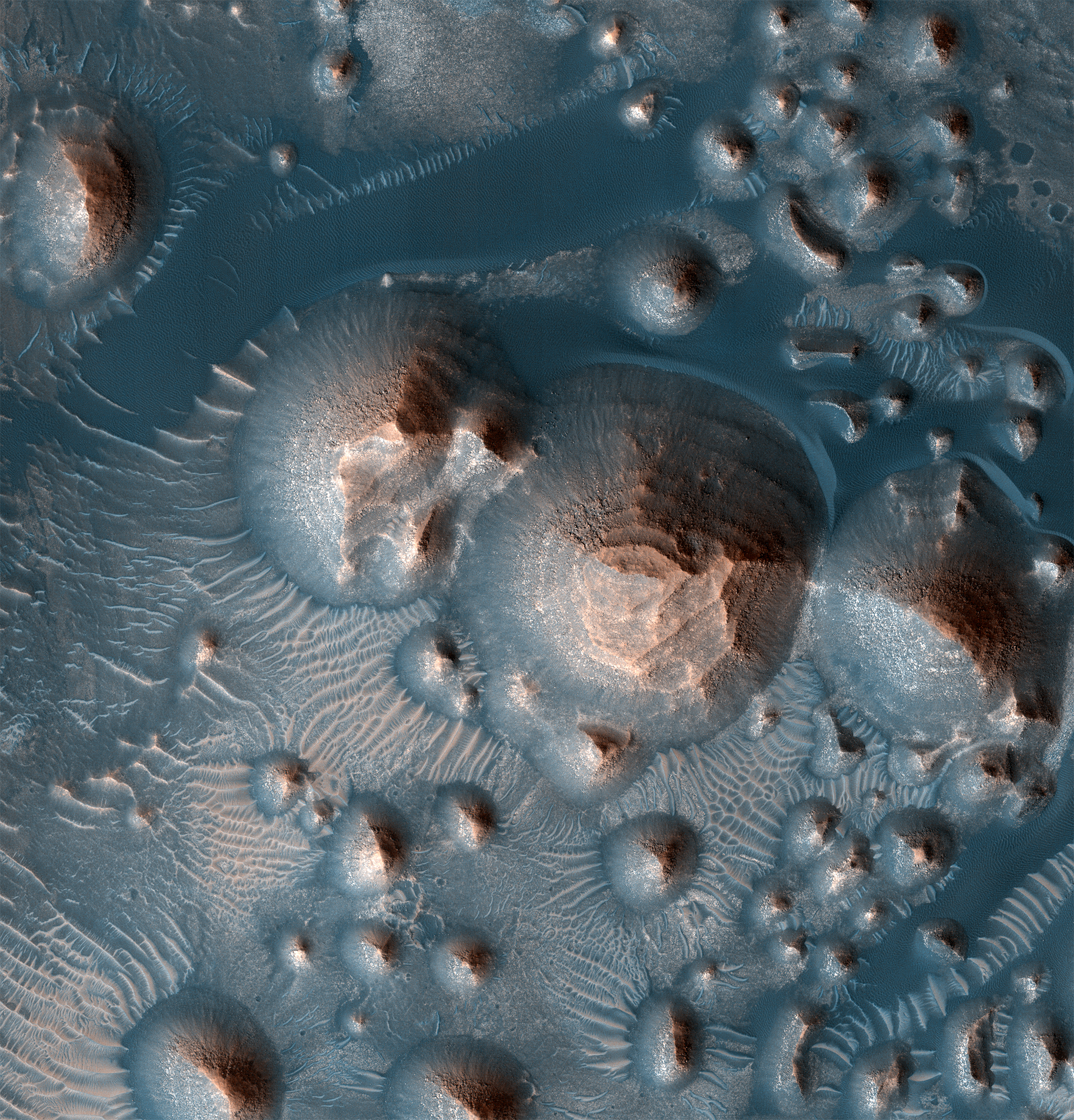
Cones on Mars!

Today’s cool image is actually a bunch, all found recently in the monthly image download from the high resolution camera on Mars Reconnaissance Orbiter (MRO).

All the photos I post below show pimple-like cones, all of which appear to be a type of small volcano. The cones are found in a wide range of locations, from the northern lowland plains to the cratered highlands to the mid-latitude transition zone between the two. They are also found at the bottom of deep canyons, in the floors of craters, and amidst mountains.

Let us begin.
» Read more

2 comments

Ancient and recent volcanoes on Mars

Volcanic vent on eastern flank of Olympus Mons
Click for full image.

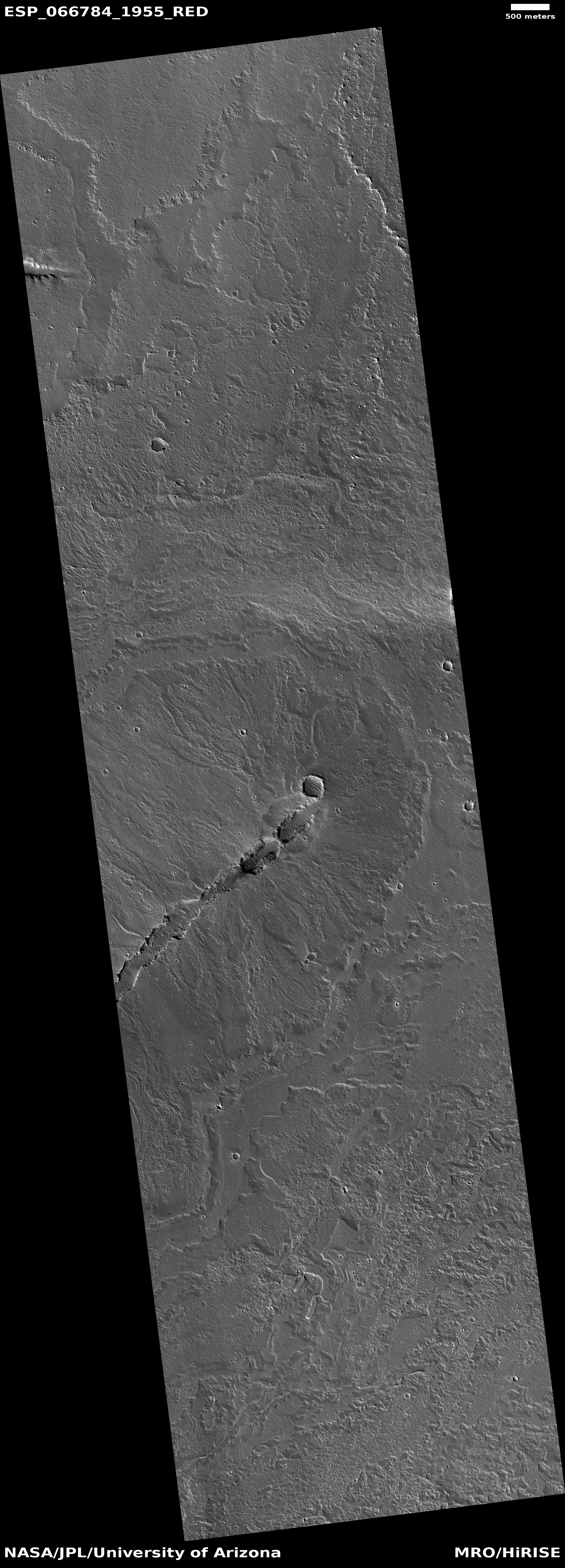
Cool image time! The photo to the right, rotated, cropped, and reduced to post here, was taken by the high resolution camera on Mars Reconnaissance Orbiter (MRO) on October 25, 2020. It shows what it calls a “possible volcanic vent east of Olympus Mons”.

Is this active? If not, how old is it. Also, the elongated shape of the vent suggests the possibility of a lava tube, or at least some underground complexity to the release of its magma.

In order to get some clarity, I emailed Sarah Sutton of the Lunar and Planetary Laboratory of the University of Arizona, who requested this photograph. Her response:

The image is of a small shield volcano with an elongated vent at the summit. We don’t have complete stereo here yet, so we can’t tell exactly what the height is. This vent might have sourced tube-fed flows, but in this case, we can’t resolve such features in the image data. This and other small shield volcanoes in the vicinity are partially buried by plains-forming lava flows. The lava flows around the base overlap the flows that emanate radially from the summit vent. Therefore we infer that the shield is older than the surrounding lava flows.

The vent, which runs from the southwest to the northeast, sits on top of a sloping wide hill, which is that small shield volcano described by Sutton. The flat plains surrounding this hill are from later eruptions from other and possibly larger volcanoes. The wider overview map below might give us a clue as to the source.
» Read more

1 comment

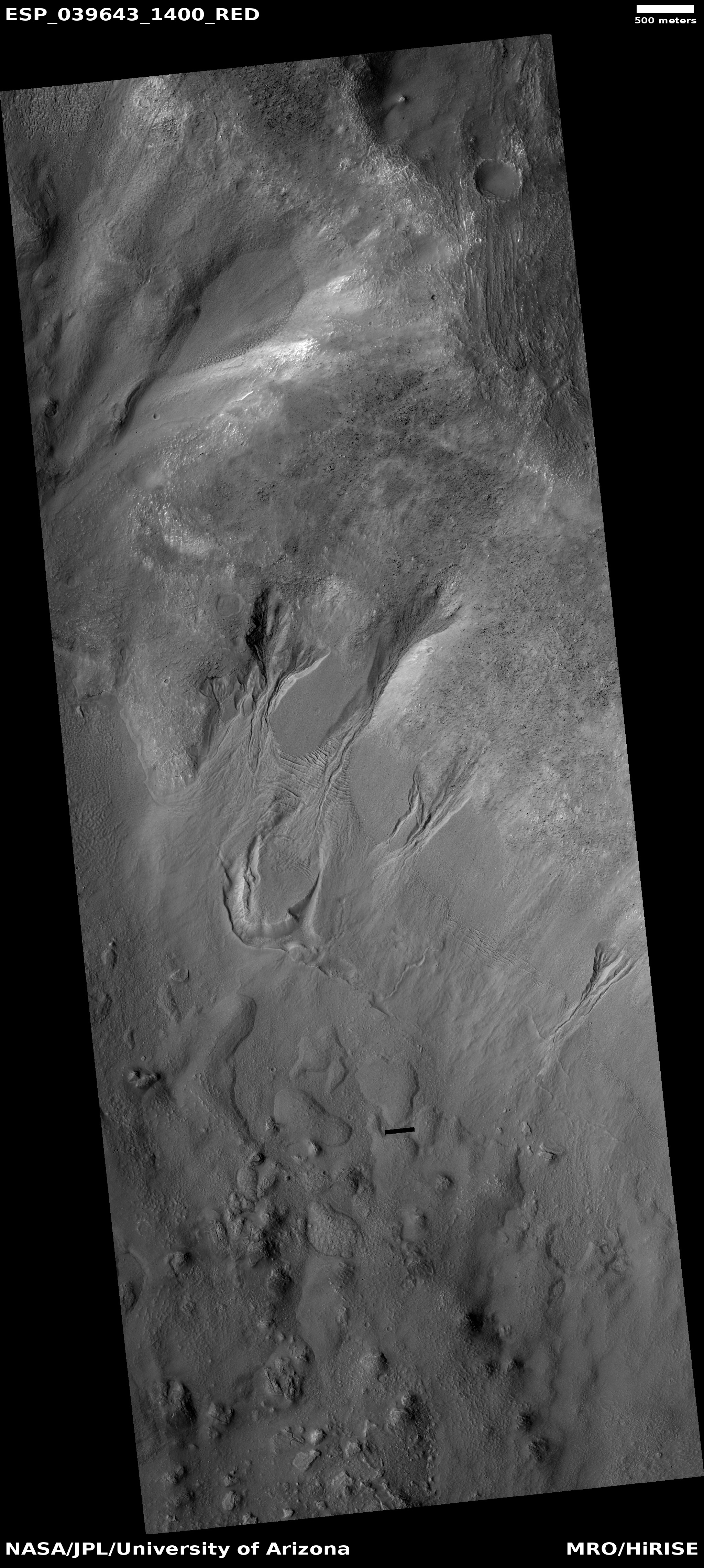
Confirmed: Martian glacial features are ice

Lobate glacial flows on Mars
Click for full image.

Scientists using the radar instrument on Mars Reconnaissance Orbiter (MRO) have now confirmed that the Martian glacial features that most resemble the glaciers seen on Earth are made of substantial amounts of ice, and were possibly active and growing only a few million years ago.

“Our radar analysis shows that at least one of these features is about 500 meters thick and nearly 100 percent ice, with a debris covering at most ten meters thick,” said Berman, lead author of “Ice-rich landforms of the southern mid-latitudes of Mars: A case study in Nereidum Montes” published online in Icarus at https://doi.org/10.1016/j.icarus.2020.114170. PSI scientists Frank C. Chuang, Isaac B. Smith and David A. Crown are co-authors on the paper.

Global mapping of Viscous Flow Features (VFFs), a general grouping of ice-rich flow features in the southern hemisphere of Mars shows a dense concentration in Nereidum Montes, along the northern rim of Argyre basin. Located within a northwestern subregion of Nereidum Montes is a large number of well-preserved VFFs and ice-rich mantling deposits, the paper says, potentially the largest concentrations of any non-polar region in the southern hemisphere.

…Processed data from the Shallow Radar (SHARAD) instrument aboard NASA’s Mars Reconnaissance Orbiter spacecraft were used to search for basal reflections across VFFs within the region. For one in particular, these observations and analysis indicate that it is composed of nearly pure water ice. Model ages obtained from crater counts and their associated size-frequency distributions (SFDs) on both ice-rich mantling deposits and small lobate VFFs suggest that the deposits stabilized several to tens of millions of years ago in the Late Amazonian Epoch, and that small lobate VFFs likely formed due to the mobilization of mantling deposits.

This data here reinforces the impressions from many other places within the 30-60 degree latitude bands on Mars where many such features are found.

Mars might be a desert, but it is a desert like Antarctica, not the Sahara. Any settlement there must use the Earth’s south pole as its guide for construction and design.

6 comments

Strange crater in the basement of Mars

Strange crater in Hellas Basin
Click for full image.

Today’s cool image to the right, cropped and reduced to post here, is intriguing for a number of reasons. Taken on September 11, 2020 by the high resolution camera on Mars Reconnaissance Orbiter (MRO), it shows a partially buried crater found in the middle of Hellas Basin, the lowest point on Mars and what I like to call the red planet’s basement.

What makes this crater intriguing is the layered pile of material filling its interior. If I didn’t know any better, I would think some construction crew has used a bulldozer to push debris from the crater’s right half in order to smooth the ground in preparation for building a strip mall, office building, or housing development.

This of course is not what happened. Then what did create those layered piles in the crater’s left half?
» Read more

1 comment

Cryptic Terrain on Mars

Cryptic terrain near Mars' south polar ice cap
Click for full image.

Cool image time! The photo to the right, rotated and cropped to post here, was taken on September 27, 2020 by the high resolution camera on Mars Reconnaissance Orbiter (MRO). It shows what is likely a crater that is partly buried by ice and dust and sand near or on the edge of Mars’s south polar ice cap.

It also shows an example of what planetary scientists have dubbed “cryptic terrain,” found generally on the margins of that ice cap. In this case, the location is on a plateau adjacent to the ice cap dubbed Promethei Planum. Despite a lot of searching, I could not locate any research papers describing Promethei Planum, though data outlined in one Mars Express press release from 2008 suggested it was part of the polar ice cap more than two miles thick that is covered by a thin mantle of dry ice each winter.

The strange curlicue cliffs and plateaus seen here are thought to form as part of the arrival and then sublimation away of that seasonal dry ice mantle, but how that process exactly works to create these particular geological features remains I think a mystery. North is to the top. The general grade is also downhill away from the icecap to the north.

Moreover, the overview map below, with the location of this image indicated by the blue cross, illustrates more mysteries.
» Read more

1 comment

Landslides on the edge of Mars’ youngest lava field

Landslides on the edge of Mars' youngest lava field
Click for full image.

Cool image time! The photo to the right, cropped to post here, was taken by the high resolution camera on Mars Reconnaissance Orbiter (MRO) on September 28, 2020. It shows several indentations in a north-south cliff face, with debris apparently falling down into a flat plain to the east.

The scientific history of this picture is very interesting. The first photo of these landslides was taken in 2006 and was titled, “Landslides on Flat Topography in Elysium Planitia”. The second, taken a few months later in 2007 to produce a stereoscopic view, was labeled “Landslides Along Shoreline in Elysium Planitia.” This most recent 2020 image is merely labeled “Landslides in Elysium Planitia.”

Is the flat terrain to the west a seabed to an ancient ocean, as suggested by the title for the 2007 image, with these landslides erosion caused in the far past by water lapping up against these cliffs?
» Read more

2 comments

Terby Crater and its drainages into Mars’ basement

Channels in Terby Crater on Mars
Click for full image.

Cool image time! Over the past few years, in my endless rummaging through the archive of high resolution images from Mars Reconnaissance Orbiter (MRO) I have posted a lot of photos of meandering channels of all kinds, most of which evoke to Earth eyes canyons eroded by flowing water. (This September 2020 cool image is just one of the more recent examples.)

Today’s cool image is another example, but in this case it is only a very small part of a very large drainage basin that is more than a hundred miles across and extends at least that far southward into the basement of Mars, Hellas Basin, the place on Mars with the lowest elevation.

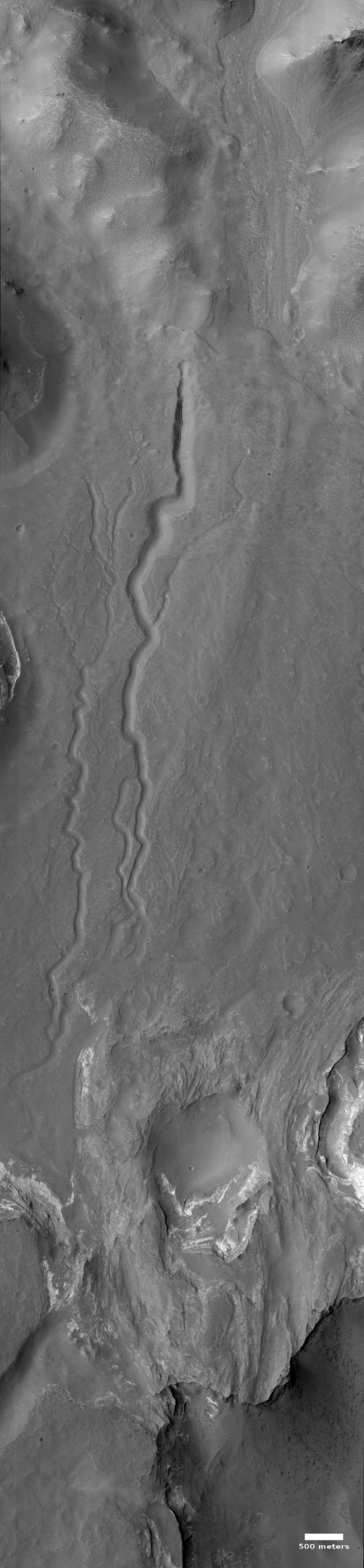
The photo to the right, rotated and reduced to post here, was taken on September 12, 2020 by the high resolution camera on MRO. I normally wouldn’t post the whole image, but to crop it would mean you wouldn’t get the sense of extensive nature of this drainage. Downhill is to the south. The channel apparently passes through three or four stages. First, its northernmost section is in a wide canyon, the floor of which resembles glacial debris (though with a latitude of 27 degrees south this is a bit too close to the equator for ice). More likely we are looking at wind-blown sand and dunes being pulled downhill in the floor of the canyon.

This first canyon is also actually a gap in the rim of a 13-mile-wide unnamed crater. See this MRO context camera image for a wider view.

Next, the drainage becomes a series of meandering small interweaving channels, resembling the channels often seen in beach mud as the tide goes out.

Finally, the channels head into a gap to fall over a sloping cliff into lower terrain.

Nor these stages entirely linked. The first glacial-like stage exiting the gap in the crater appears to drain to the southeast, while the second seems to emanate from what appears to be a very faint small crater now partly buried. Both head south toward the gap, but the path of the eastward drainage appears less obvious. Some of it flowed westward to join the meandering channels but some also appears to work its way south more to the east.

This one image shows a lot of channels, but it is only a very small slice of this whole drainage system. In fact, we are looking here at only one strip of the interior slope of the northern rim of 108-mile-wide Terby Crater.

The overview map below gives the larger context. Terby Crater sits on the northern border of Hellas Basin, which in itself extends another 1,500 miles to the south. From this point the drop in elevation into Hellas is almost four miles.
» Read more

0 comments

Aram Chaos: Illustrating the puzzle of Mars

Aram Chaos
Click for full image.

The geological history of Mars is incredibly complex, and we really don’t know much about it. What we do know right now is based on a limited number of tiny fragments of a much larger story, with those fragments allowing scientists to only make educated guesses on how they fit together.

Many of those guesses will certainly turn out right. Just as many will turn out wrong. At this moment in our exploration of the Red Planet we can only grasp at straws while always keeping an open mind, as later data is surely going to change any conclusions we presently have.

The photo to the right is a good illustration of this struggle. Rotated, cropped, and reduced to post here, it was taken on September 27, 2020 by the high resolution camera on Mars Reconnaissance Orbiter (MRO), and shows what at first glance looks like a stream of white frost or ice descending down a canyon to the south.

That first impression however is entirely wrong. When I asked Chris Okubo of the U.S. Geological Survey, who requested this image from MRO, what it was, he explained,

The white material is not frost. Instead, these are sedimentary rocks comprised primarily of sulfates. The texture to me suggests these are lithified dunes.

Lithified merely means that the dunes have hardened into rock. Sulfates are a salt formed from sulfuric acid, and are on Mars often linked to some complex mineralogy. If you stood there the colors would be white and red, quite beautiful. As Okubo explained,

The sulfates are white to tan in color, but there would also be a lot of red/brown Mars dust on top of it. It would be similar to walking around some of the playas in the desert southwest.

Though these white sulfate deposits have their root in sulfuric acid, Okubo added that they “are in the form of minerals similar to gypsum and so they would be safe to touch.”

What is going on here? As is usually the case, we need to first take a wider view to get some context.
» Read more

0 comments
1 62 63 64 65 66 90