Martian pits or dark splotches?

Martian pits or dark splotches?
Click for full image.

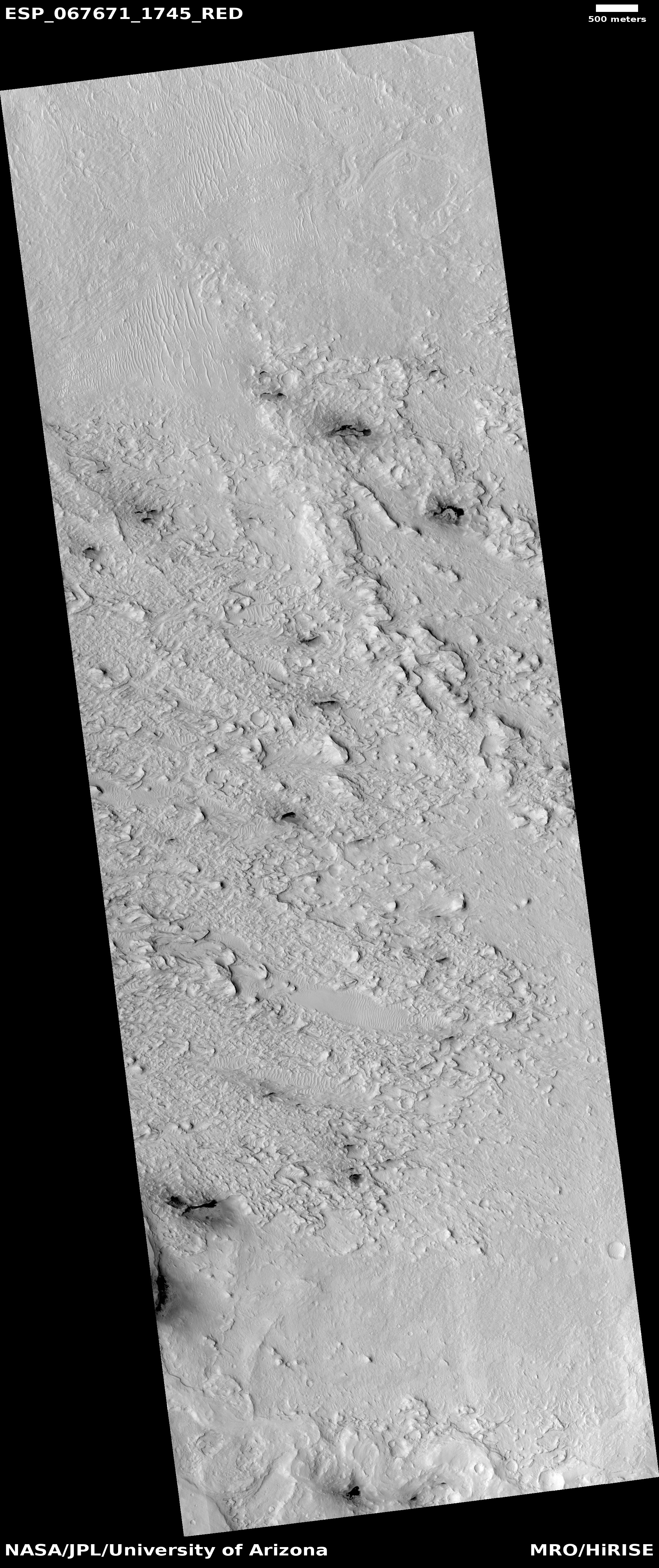
Cool image time! The photo to the right, cropped to post here, was taken on January 2, 2021 by the high resolution camera on Mars Reconnaissance Orbiter (MRO). It shows a windswept sandy region of ridges and dunes with two dark features nestled between ridges.

What are these dark patches? At the available resolution they appear to be deep pits, with the one on the right having a significant overhang. And if these are pits, they would appear significantly different than most of the previously identified Martian pits, which are usually somewhat circular in shape. These features have very complex shapes, as if the pit is conforming itself to the terrain that surrounds it.

The resolution, however, is not good enough to confirm this interpretation. These dark patches could also be exposed volcanic material, darker than the surrounding terrain. The location, as shown in the overview map below, adds weight to this interpretation.
» Read more

2 comments

All systems on Perseverance so far check out good

The Perseverance science team reported this past weekend that all systems on the rover have so far reported back and are operating as expected, including the test helicopter Ingenuity.

Some more images were sent back, all visible at the Perseverance raw image website. The most spectacular new image of Perseverance released however was one taken by the high resolution camera on Mars Reconnaissance Orbiter (MRO) and posted below.
» Read more

0 comments

Partly ice-filled Martian crater?

Partly ice-filled Martian crater?
Click for full image.

Time for another cool Martian image. The photo to the right, rotated, cropped, and reduced to post here, was taken on January 3, 2021 by the high resolution camera on Mars Reconnaissance Orbiter (MRO). The section I have focused on is a single crater about a mile and a half wide.

What makes this crater interesting is the material that appears piled up against the crater’s northern half. Furthermore, both the floor of the crater as well as this piled up material looks like it is eroding away, kind of like a block of ice which is having warm water sprayed on it.

So, is this glacial ice?
» Read more

0 comments

Eroded mound in Mars’ glacier country

Eroded mound in Mars' glacier country
Click for full image.

Cool image time! The image to the right, reduced to post here, was a captioned release today by the science team of the high resolution camera on Mars Reconnaissance Orbiter (MRO). It is located in Deuteronilus Mensae, a region of chaos terrain in the transition zone between the northern lowland plains and the southern cratered highlands that is also part of a 2,000 mile-long band that I call Mars’ glacier country. From the caption, written by Dan Berman, senior scientist at the Planetary Science Institute in Arizona:

Lobate debris aprons are commonly found surrounding dissected plateaus in the Deuteronilus Mensae region of Mars. They have been interpreted as debris-covered glaciers and radar data have shown their interiors to be composed of pure ice.

The mound in this image is slightly removed from most of the other plateaus, and the [debris apron] surrounding it is highly degraded. The sharp scarps on the western and eastern sides of the mound indicate that a great deal of the ice once found in these landforms has since sublimated away, leaving behind these collapsed debris cliffs.

I wonder if further research might find an ice layer in those cliff walls, especially because this photo strongly suggests that much of this mound is made of ice that is sublimating away or has flowed downward to form the debris aprons as well as that central gully.

The overview map below shows its location in Deuteronilus Mensae as well as showing almost all of the entire band of Mars’ glacier country.
» Read more

1 comment

Enigmatic channel on Mars

Enigmatic channel on Mars
Click for full image.

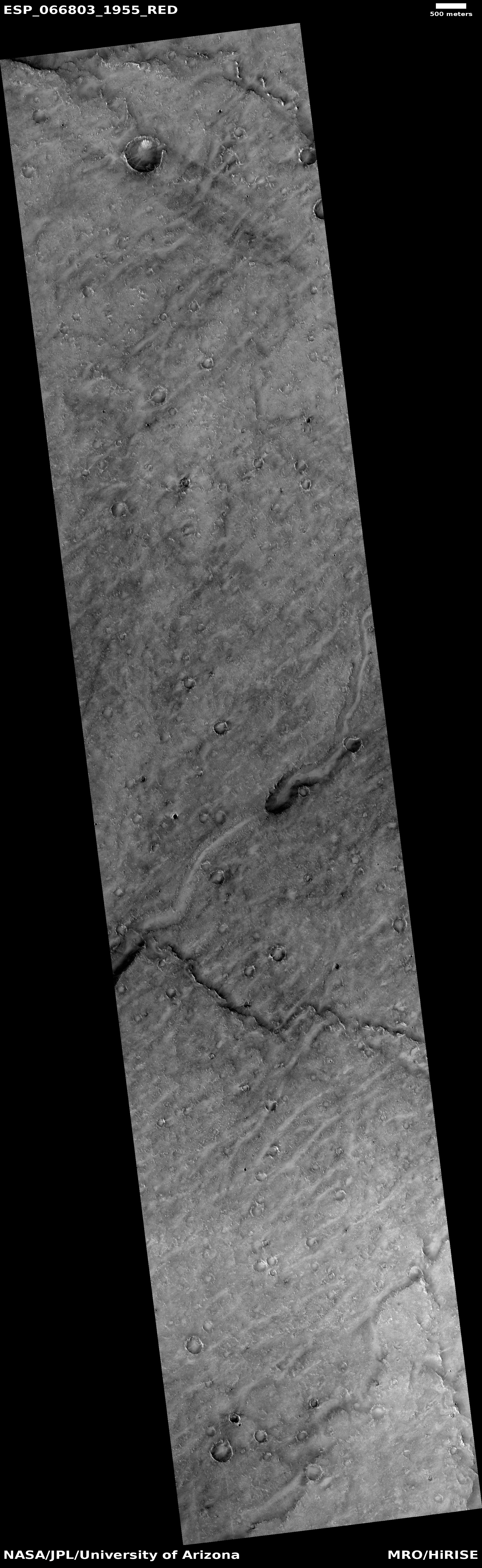
Cool image time. The photo to the right, rotated, cropped, and reduced to post here, was taken on October 26, 2020 by the high resolution camera on Mars Reconnaissance Orbiter (MRO) and labeled by the science team as simply an “Enigmatic Channel in Syrtis Major.”

It shows a channel going downhill to the northeast east in a series of steps, separated cliffs that in the southwest hikers call pour-offs, with the channel becoming initially deeper and then slowly becoming more shallow, until the next pour-off. On Earth the pour-offs would be waterfalls, with a deep pond at the base. On Mars?

Without doubt this channel poses mysteries, but maybe with a little research we can make it less enigmatic. Asl always, the overview map below gives context, and helps give a possible explanation for what created this channel.
» Read more

2 comments

Strange corroding features on Mars

Strange corroding features on Mars
Click for full image.

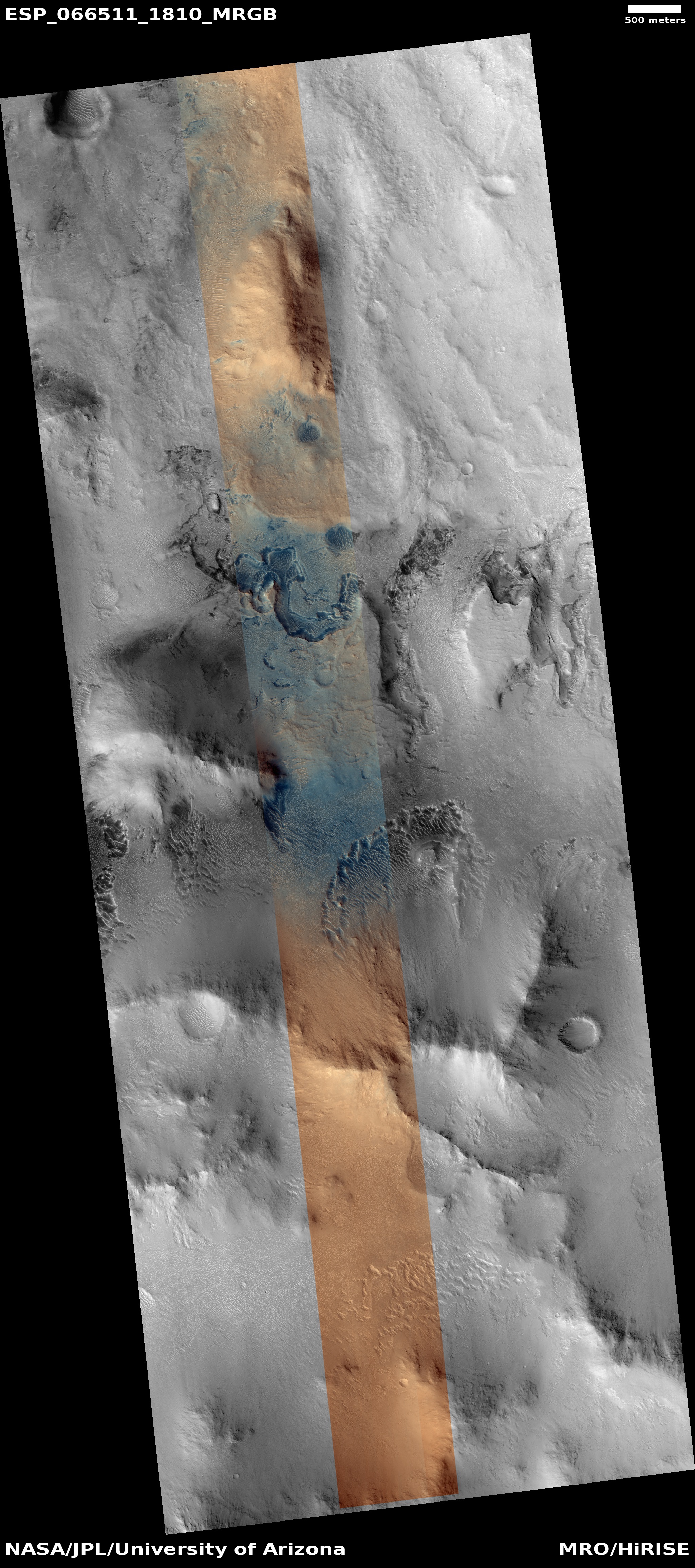
Cool image time! The photo to the right, rotated, cropped, and enhanced to post here, was taken by the high resolution camera on Mars Reconnaissance Orbiter (MRO) on October 4, 2020. It shows what appears to be features that are either corroding or eroding away, with the lower areas filled with rippling sand dunes.

The circular features might be ancient craters. The material that partly fills them might be a layer of dust or sand that the wind is slowly blowing away to dig out the depressions along the southern cliff wall.

According to the MRO science team’s interpretation of the colors produced by the high resolution camera [pdf], the dark blue colors here are likely “coarser-grained materials (sand and rocks)”, while the orange-red material on the higher terrain is likely dust.

Could this material be evidence of buried ice eroding away? At first I thought so, and then I took a look at the photo’s location, as shown in the overview image below.
» Read more

0 comments

New paper: Underlying ice layer seen in Martian gullies at LOW mid-latitudes

Snow on Mars?
Click to see full image.

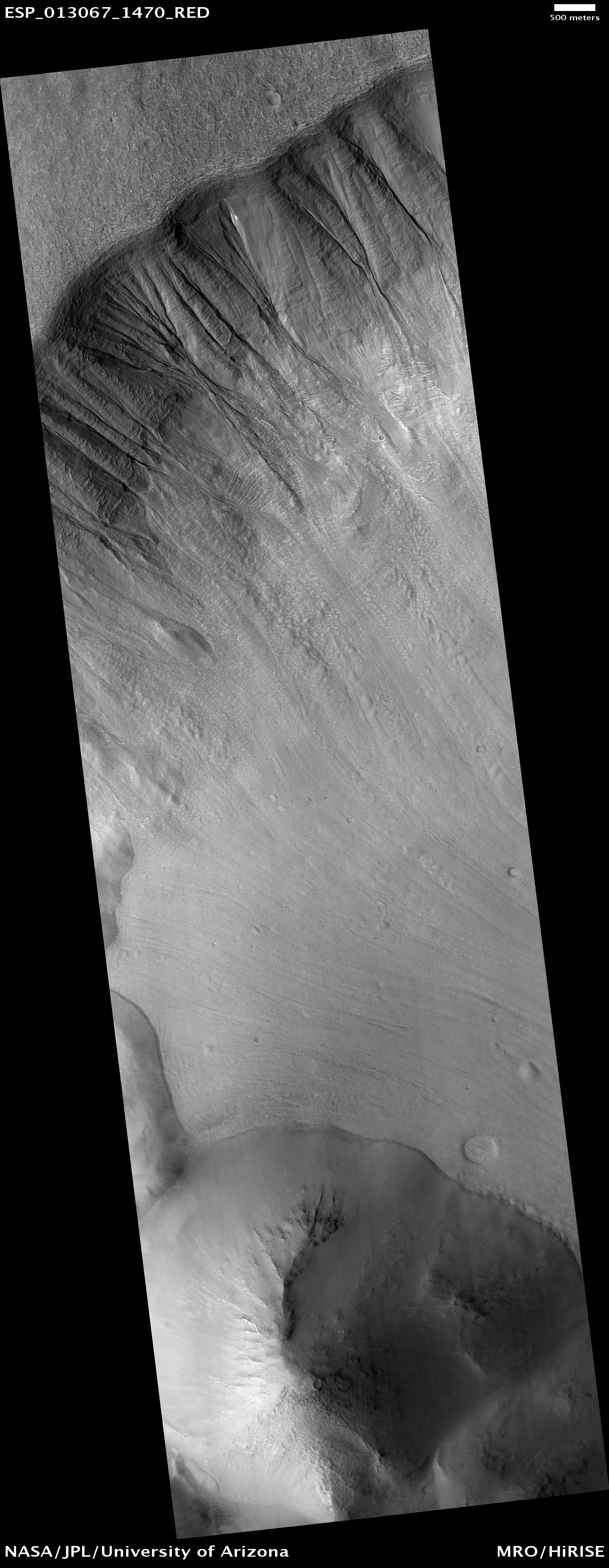
In a paper just published, scientists are proposing that bright areas seen in the low mid-latitude gullies on Mars are the underground ice table newly exposed as surface dust is removed.

This paper is a reiteration in more detail of a previous presentation [pdf] by these same scientists at the 2019 the 50th Lunar and Planetary Science Conference in Texas and reported here in March 2019.

The image to the right, from the paper, was taken by the high resolution camera of Mars Reconnaissance Orbiter (MRO) in 2009, and has been cropped to post here. The white streaks are what the scientists propose is that exposed underground ice table. At 32.9 south latitude, this particular gully would be the closest to the equator that such an ice layer has been identified. All the previous ice layer discoveries have been in the ice scarps found at latitudes above 50 degrees. As the paper’s lead author, Aditya Khuller at Arizona State University, explained in to me in an email, “We believe we are seeing exposures of dusty ice that likely originated as dusty snow.” From their paper:

We suggest … that the light-toned materials are exposed H2O ice. … [T]he appearance, and then subsequent disappearance of these light-toned materials, suggests that they are some form of volatile, such as dusty ice, rather than dust alone. … [The appearance] of these light-toned materials is similar to the >100m thick, light-toned ice deposits exposed on steep mid-latitude scarps, indicating that these materials are probably also ice, with some amount of dust on, and within the ice.

The layer would have likely been laid down as snow during a time period (a long time ago) when the rotational tilt of Mars, its obliquity, was much higher than today’s 25 degrees. At that time the mid-latitudes were colder than the poles, and water was sublimating from the polar ice caps to fall as snow in the mid-latitudes.

The overview map below reveals some additional intriguing possibilities.
» Read more

0 comments

Rover update: The rovers are coming! The rovers are coming!

With the imminent landing on Mars of both the American rover Perseverance only days away on February 18th followed by China’s rover in April, I think it time for a new rover update, not only providing my readers a review of the new landing sites but a look at the most recent travels of Curiosity on Mars and Yutu-2 on the Moon.

Curiosity

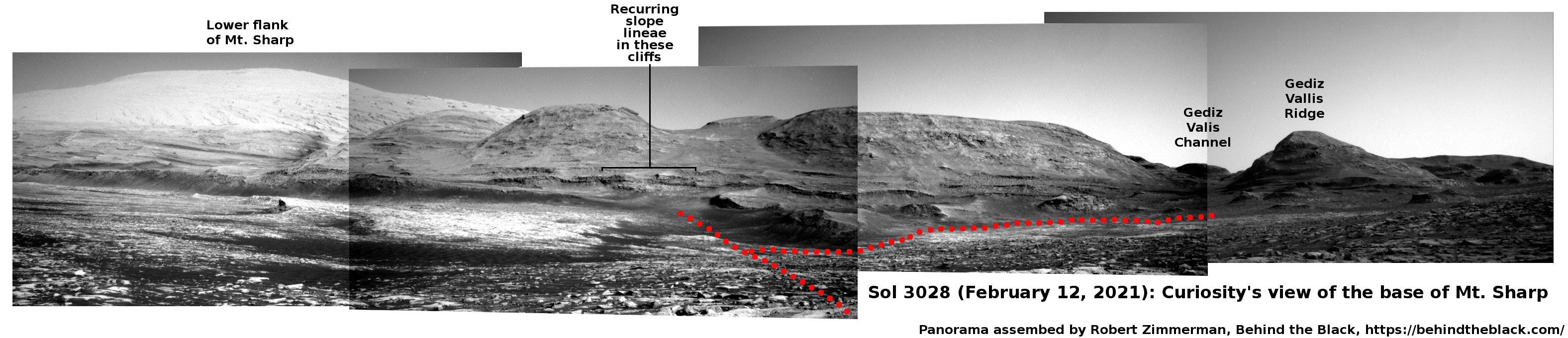
Curiosity's view of the base of Mount Sharp, February 12, 2021
Click for full resolution image.

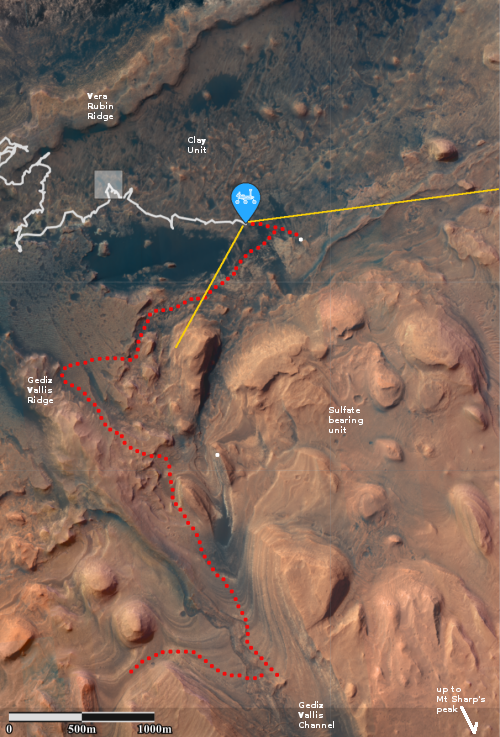
Overview map of Curiosity's most recent and future travels

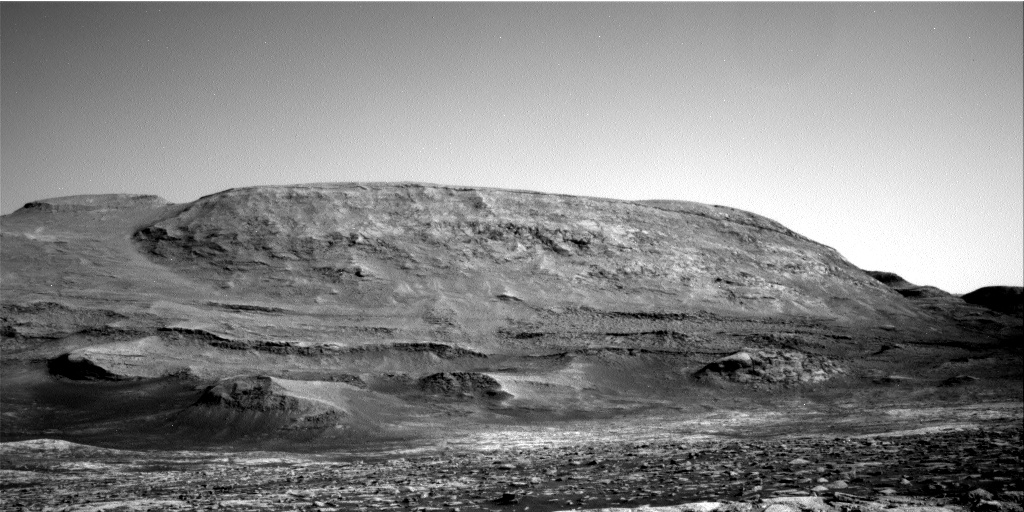
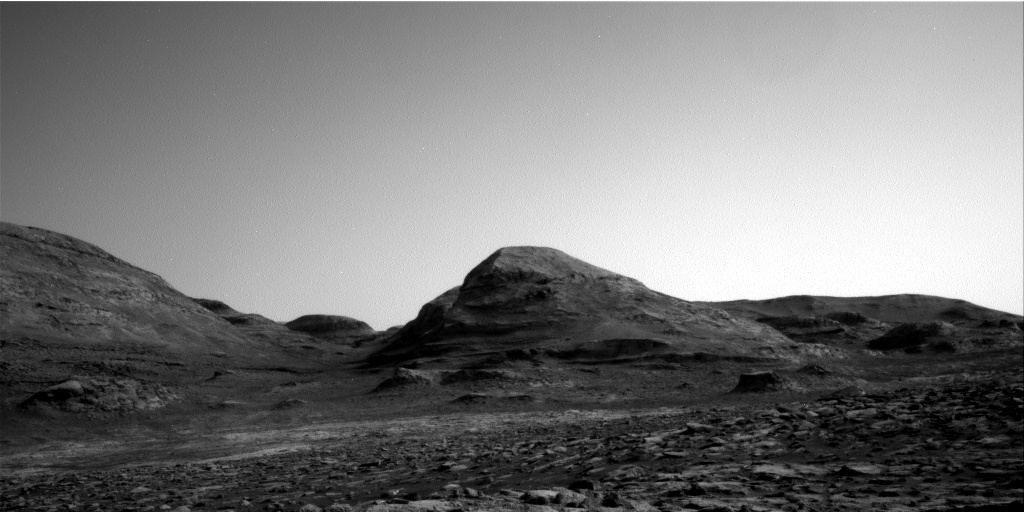
The panorama above, made from four images taken by Curiosity’s right navigation camera on February 12, 2021 (found here, here, here, and here), looks south to the base of Mount Sharp, now only a short distance away. The yellow lines on the overview map to the right show the area this panorama covers. The white line indicates Curiosity’s previous travels. The dotted red line in both images shows Curiosity’s planned route.

The two white dots on the overview map are the locations of the two recurring slope lineae along Curiosity’s route, with the plan to get reasonable close to the first and spend some time there studying it. These lineae are one of Mars’ most intriguing phenomenon, seasonal dark streaks that appear on slopes in the spring and fade by the fall. There are several theories attempting to explain their formation, most proposing the seepage of a brine from below ground, but none has been accepted yet with any enthusiasm.
» Read more

2 comments

Inexplicable ridges in Hellas Basin on Mars

Sinuous ridge in Hellas Basin
Click for full image.

Time for some more cool but mysterious Martian images! The photo to the right, rotated, cropped, and reduced to post here, is the first of two images today, both of which show the ridges but of a completely different nature. Both are located in Hellas Basin in Mars southern hemisphere.

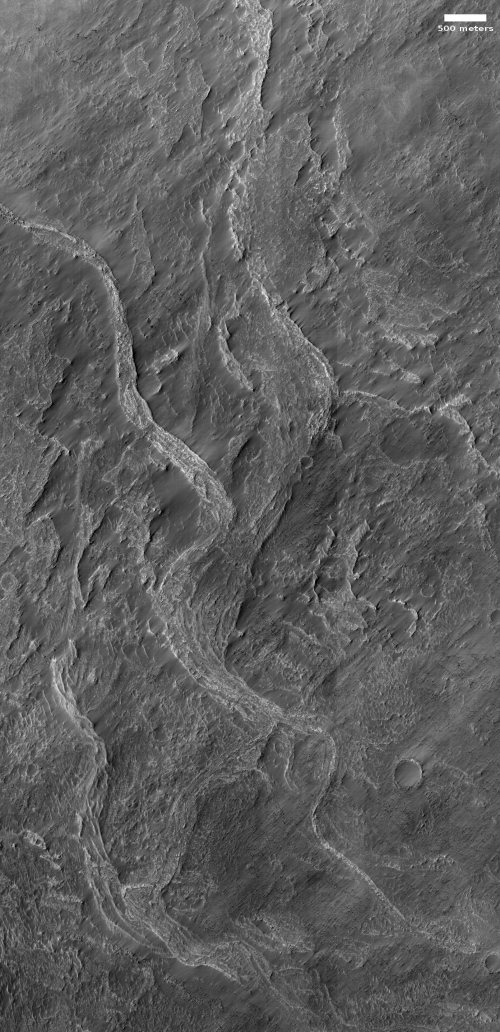
This first picture was taken on September 4, 2020 by the high resolution camera on Mars Reconnaissance Orbiter (MRO), and shows a sinuous complex that resembles to a remarkable extent a set of river tributaries, but is instead a set of raised ridges rather than a canyon system.

Scientists have found more than 10,000 miles of such ridges in the northern hemisphere in Arabia Terra, the most extensive transition zone between the southern highlands and the northern lowlands, and have dubbed them fossilized rivers. From a 2016 press release:

The inverted channels are similar to those found elsewhere on Mars and Earth. They are made of sand and gravel deposited by a river and when the river becomes dry, the channels are left upstanding as the surrounding material erodes. On Earth, inverted channels often occur in dry, desert environments like Oman, Egypt, or Utah, where erosion rates are low – in most other environments, the channels are worn away before they can become inverted. β€œThe networks of inverted channels in Arabia Terra are about 30m high and up to 1–2km wide, so we think they are probably the remains of giant rivers that flowed billions of years ago. Arabia Terra was essentially one massive flood plain bordering the highlands and lowlands of Mars. We think the rivers were active 3.9–3.7 billion years ago, but gradually dried up before being rapidly buried and protected for billions of years, potentially preserving any ancient biological material that might have been present,” added Joel Davis.

Nor are such features on Mars limited to Hellas and Arabia Terra. For a particularly spectacular feature in the cratered highlands see this 2019 post.

The origin of these sinuous ridges in Hellas might have a similar origin as these other fossilized rivers. At present the bottom of Hellas, the deepest basin on Mars, is a place with little signs of ice. In the past there is evidence that lakes once existed here, so we cannot rule out water as a cause.

At the same time, Hellas was formed by a gigantic impact. One cannot dismiss the possibility of a volcanic origin, impact melt left over from the heat of that crash.

Today’s second ridge complex in Hellas looks far different.
» Read more

3 comments

Another “What the heck?!” image on Mars

A
Click for full image.

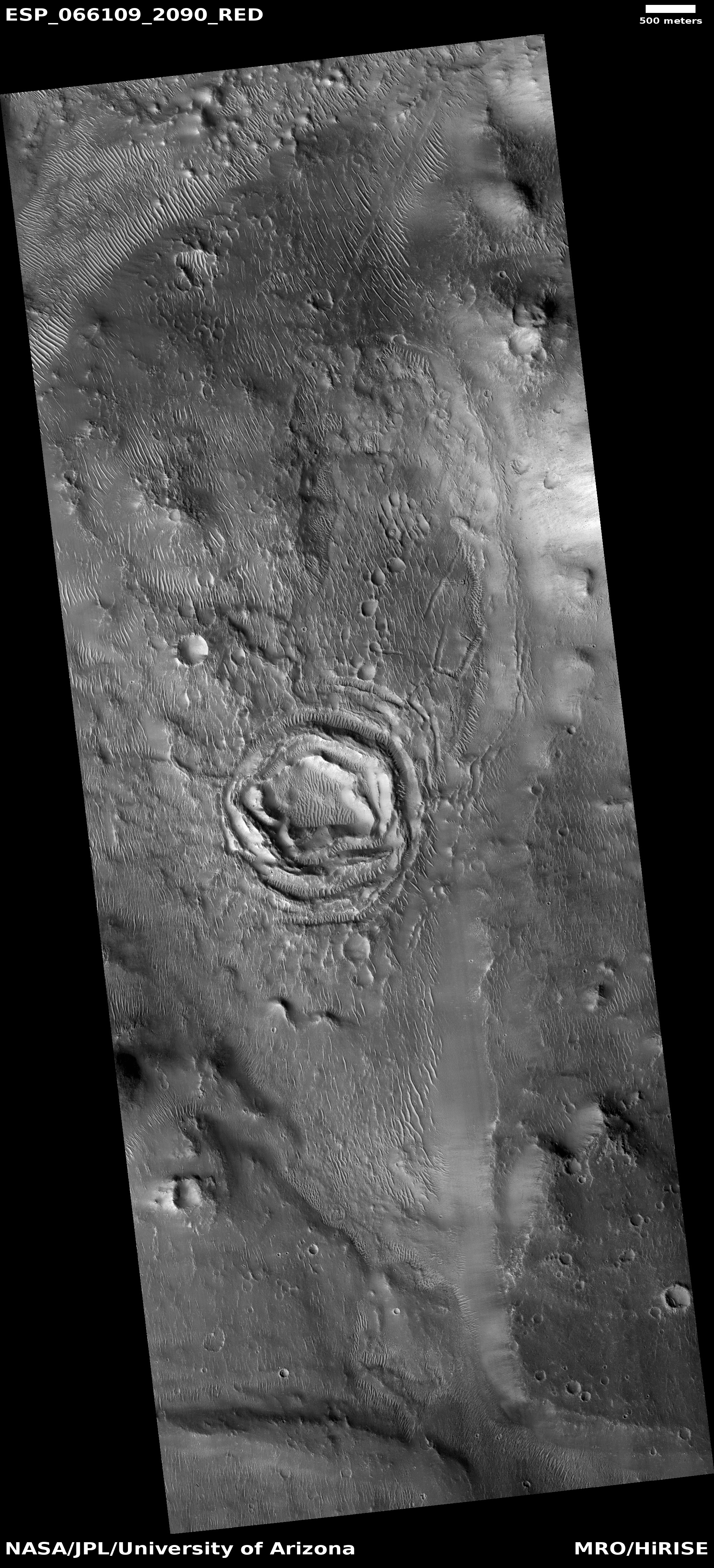
Today’s cool image, taken on September 2, 2020 by the high resolution camera on Mars Reconnaissance Orbiter (MRO) and cropped and reduced to post here, is one that I will make very little attempt to explain. It falls into a category I call “What the heck?!” The uncaptioned website labels this “Ringed Ridges in Kasei Valles”, which merely describes what we see.

This isn’t an impact crater. The rings don’t fit any morphology I’ve ever seen for such features.

Could we be looking at some type of glacial feature? The latitude, 29 degrees north, makes this unlikely but possible. Even so, it sure doesn’t look like it. The ripples in the center and between the ridges are sand dunes, not glacial features.

Might this be a volcanic vent, with the concentric ridges marking multiple eruptions? Maybe, but if so I’ve never seen any volcanic vent or caldera that looked quite like this.

The overview map below gives some context, but hardly explains anything.
» Read more

9 comments

More weird features and changes on Mars

Some strange stuff on Mars
Click for full 2020 photo.

Overview map

Cool image time! The photo to the right, rotated, cropped, reduced, and annotated to post here, was taken on September 28, 2020 by the high resolution camera on Mars Reconnaissance Orbiter (MRO). Uncaptioned and labeled “Reticulate Bedform Change Detection on Arsia Mons West Flank,” it shows a whole bunch of strange features in addition to a change that occurred sometime in the past two years.

I think it also well illustrates in one image how alien Mars is.

The main features in this photo are what scientists have dubbed reticulate bedforms. These features, found mostly in the high elevations on the flanks of the giant volcanoes in the Tharsis Bulge to the west of Valles Marineris, are thought to be ancient dunes made of volcanic dust and debris that has solidified into an aggregate. These dunes are found with a variety of patterns.

Aggregates on the flanks are transported downslope by katabatic winds and form linear and β€œaccordion” morphologies. Materials within the calderas and other depressions remain trapped and are subjected to multidirectional winds, forming an interlinked β€œhoneycomb” texture. In many places on and near the volcanoes, light-toned, low thermal inertia yardangs and indurated surfaces are present.

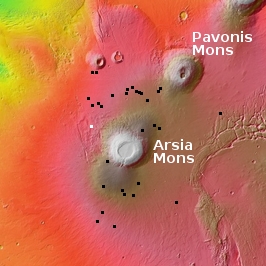
The photo to the right appears to show all three patterns, even though it is located on the northwestern slopes of of Arsia Mons, the southernmost of the string of three giant volcanoes in the Tharsis Bulge. On the overview map to the right, this photo’s location is indicated by the white box. The black boxes indicate the location of all the pits caves that surround Arsia Mons which I have previously posted about on Behind the Black.

It is intriguing that, at least at this point, these particular reticulate bedforms on the slopes of Arsia Mons happen to be in a region where few cave pits have so far been identified. It could be that the conditions that form each are mutually exclusive. If you get pits on the slopes of Martian volcano you can’t have reticulate bedforms. Or maybe not all the pits have yet been located, or the flanks of the volcano has many more reticulate bedforms that I simply have not documented.

Either way, this particular cool image has two areas of interest, as noted by the white boxes above.
» Read more

1 comment

On the edge of Mars’ giant volcanic flood plain

Flows and pitted material on the edge of Mars' great volcanic flood plain
Click for full image.

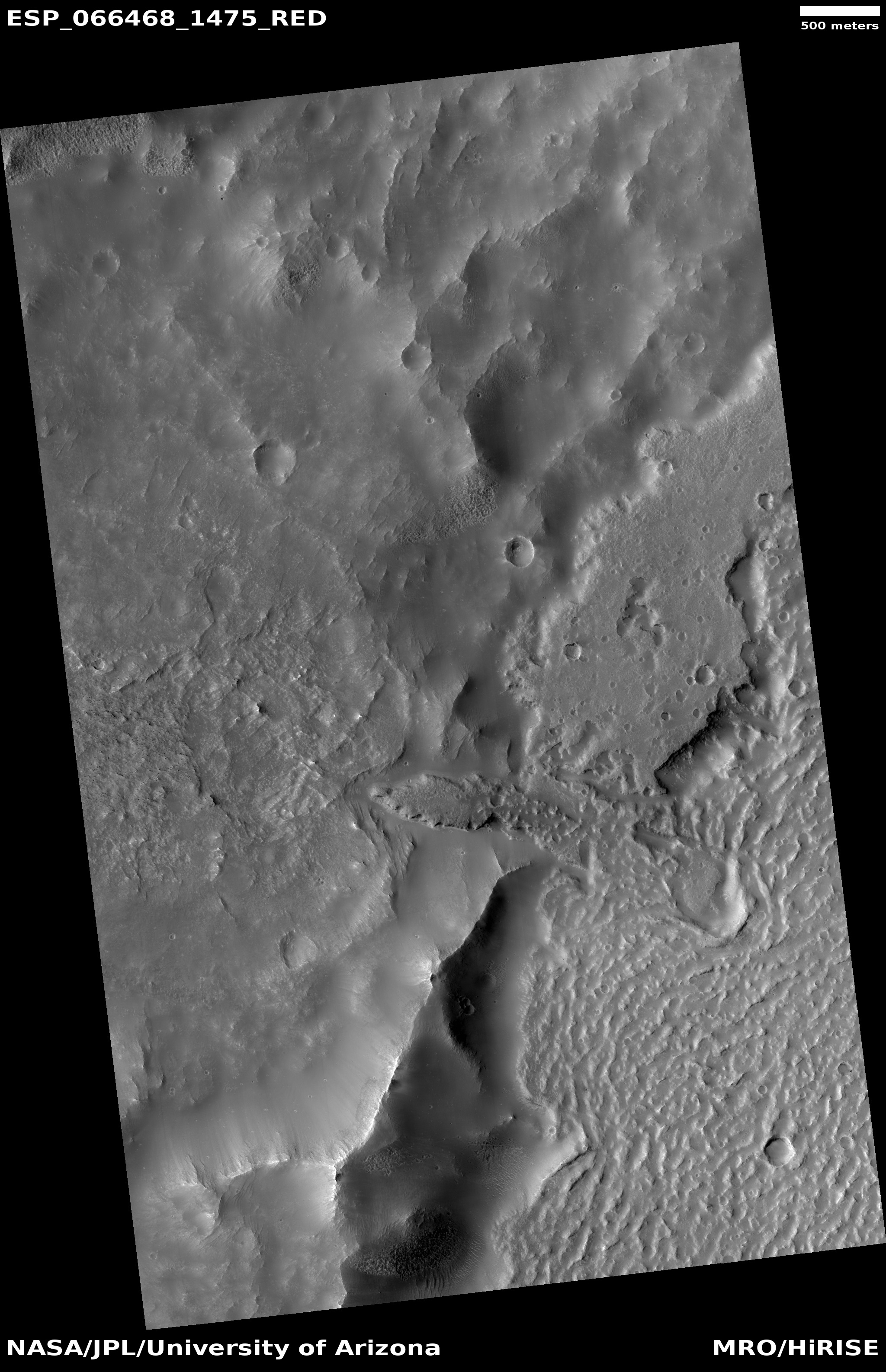
Cool image time! The photo to the right, cropped and reduced to post here, was taken on September 30, 2020 by the high resolution camera on Mars Reconnaissance Orbiter (MRO). Uncaptioned, it shows what the science team labels “Flows and pitted material in Terra Sirenum.”

Downhill is to the southeast, which means the pitted material forms some sort of filled terrain, with the surface eroded similarly everywhere. At a latitude of 32 degrees south, these flows could conceivably be glacial features. Are they?

A wider look might help answer that question. Below is a photo taken by MRO’s context camera, cropped and reduced to post here.
» Read more

2 comments
1 60 61 62 63 64 90