Rover update: Panorama from Curiosity; Perseverance unwinds

Summary: Curiosity has crept to the foot of Mt Sharp at last, while Perseverance checks out its equipment.

Curiosity

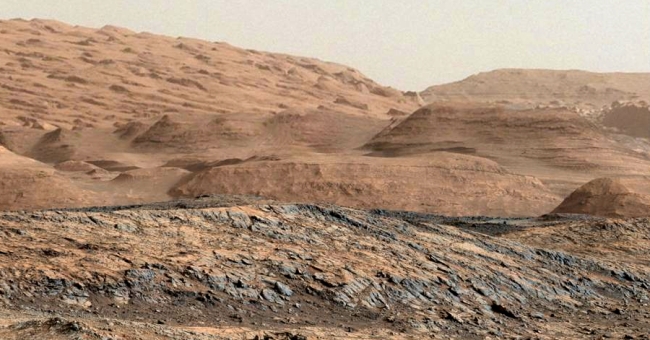
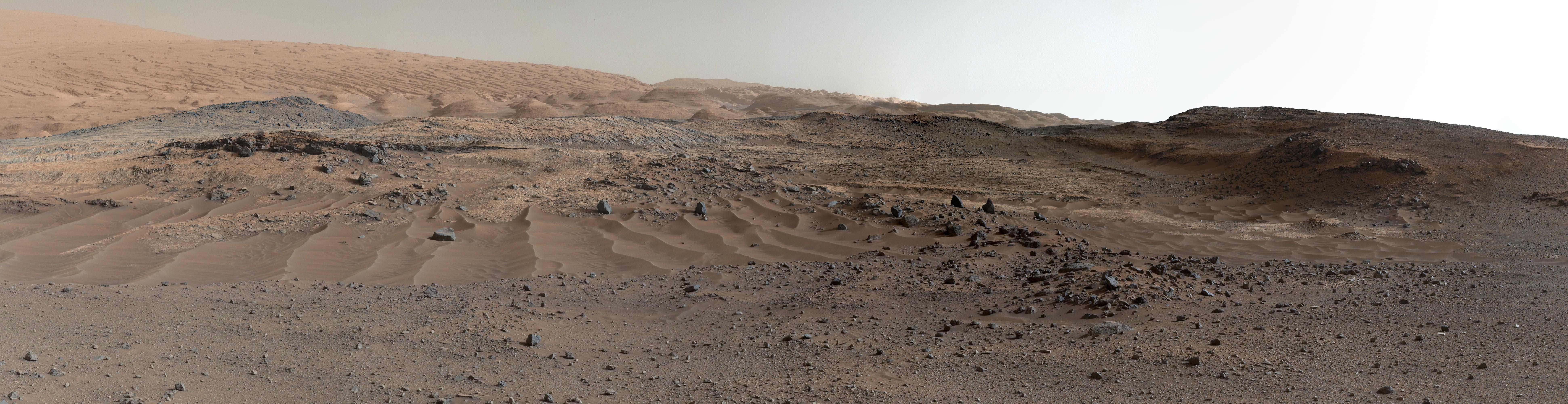
Curiosity panorama Sol 3049
Click for full resolution.

Overview map

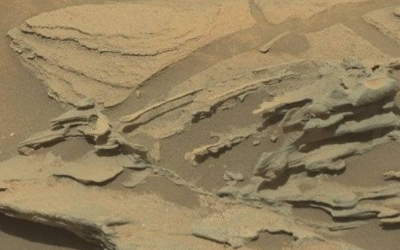
This rover update will be short but very sweet. While the press and public has been oo’ing and ah’ing over the first panorama from Perseverance, Curiosity yesterday produced its own panorama above showing the looming cliffs of Mt. Sharp, now only a short distance away. The original images can be found here, here, here, and here.

The overview map to the right, from the “Where is Curiosity?” webpage, shows the rover’s location, with the yellow lines roughly indicating the view afforded by the panorama above. If you compare this panorama with the one I posted in my previous rover update on February 12, 2021, you can get a sense of how far the rover has traveled in just the past two weeks. It now sits near the end of the red dotted line pointing at the mountain, right next to what had been a distant cliff and now is only a short distance to the rover’s right.

Somewhere on the mountain slopes ahead scientists have spotted in orbiter images recurring slope lineae, seasonal streaks on slopes that appear in the spring and fade as they year passes. As Curiosity arrives at the next geological layer a short distance ahead at the base of these cliffs (dubbed the sulfate unit), it will spend probably several months studying both that sulfate unit as well as those lineae. Expect the rover to drill a few holes for samples as it watches to see any changes that might occur on that lineae.

Now, on to Perseverance!
» Read more

0 comments

Dao Vallis: A giant river of ice on Mars

The glacier in Dao Vallis
Click for full image.

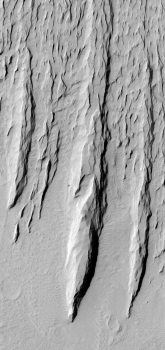
Cool image time! The photo to the right, rotated, cropped, and reduced to post here, was taken on December 26, 2020 by the high resolution camera on Mars Reconnaissance Orbiter (MRO). It shows an apparent glacial flow in a canyon heading downhill to the southwest, with evidence of a gully on its western wall whose collapse apparently squeezed into that glacial flow, pushing it to the east.

What makes this particular image interesting is not its uniqueness but just the opposite. Almost every high resolution picture along the length of this 750 mile long canyon, dubbed Dao Vallis, shows the same thing, an ice-filled ravine with that ice flowing like a river downhill.

The overview map below provides some spectacular context.
» Read more

4 comments

China releases first Tianwen-1 images of rover landing site

The rover landing site for Tianwen-1's rover

The new colonial movement: China yesterday released the first two images taken by its Mars orbiter Tianwen-1 of its planned rover landing site in the northern lowland plains of Mars.

The image to the right is a mosaic of two wide angle photos from the context camera on Mars Reconnaissance Orbiter (MRO). The white cross is the spot of the latitude and longitude that had previously been leaked to the Chinese press as the landing site. The white box shows the area covered by the only high resolution MRO photo, as of October 2020. Since then MRO has taken a number of additional high resolution images of this area.

The red boxes mark the areas covered by Tianwen-1’s two new images. Below is a reduced version of the larger of these two photos.
» Read more

4 comments

Mining country on Mars?

The southern end of Nili Fossae

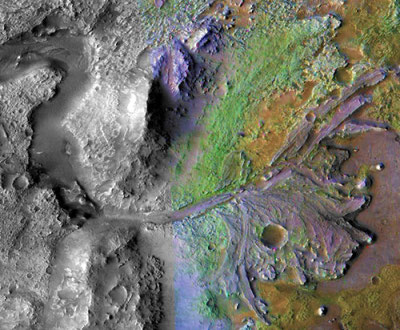
Today’s cool image might very well be giving us a glimpse of one of the most promising regions on Mars for future mining. The photo to the right, rotated, cropped, and reduced, is made up of two context camera images from Mars Reconnaissance Orbiter (MRO), found here and here. I chose to begin with this wider context camera mosaic because this is one of the rare times the context camera is more exciting an image than the close-up high resolution photo.

This photo covers the southern end of the one of the two curved fissures dubbed Nili Fossae and are thought to be left over evidence of the giant impact that created Isidis Basin to the southeast. These two fissures are about 300 miles long, and can be as much as 1,600 feet deep in places. At this southern end, we can see what look like at least two different drainage channels feeding into the fissure.

The overview map below provides the context of this location on Mars, including its relationship to Jezero Crater where Perseverance now sits.
» Read more

1 comment

Perseverance’s first high resolution panorama

Looking west in Perseverance's 1st hi-res panorama
Click for full resolution image.

The photo above is only one small slice from the first high resolution panorama taken by Perseverance on the floor of Jezero Crater. It is also reduced in size to post here.

From the press release:

The camera was commanded to take these images by scanning the mast, or “head,” a full 360-degrees around the horizon visible from the landing site. [In the section above] the top of some of the distant crater rim is cut off … to ensure the images would cover the front ridge of the Jezero Crater’s ancient delta, which is only about 1.25 miles (2 kilometers) away from the rover in the center of this panorama. At that distance and focal length, Mastcam-Z can resolve features as small as about 50 centimeters (1.6 feet) across along the front of the delta.

The mosaic is not white balanced but is instead displayed in a preliminary calibrated version of a natural color composite, approximately simulating the colors of the scene that we would see if we were there viewing it ourselves.

So, this is approximately what you would really see if you were standing next to Perseverance and looked west towards the delta (the low hills in the foreground) and the high crater rim beyond.

3 comments

Cave boxwork on the Martian surface

Boxwork in Wind Cave on Earth
Boxwork inside Wind Cave, South Dakota, mere inches across.

Anyone who has ever visited either Wind or Jewel caves in South Dakota has likely seen some wonderful examples of the cave formation boxwork, formed when the material in cracks is more resistant to erosion that the surrounding bedrock, which once eroded away leaves behind the criss-crossing ridges seen in the picture to the right.

Today’s cool image provides us what appears to be an example of boxwork on Mars. However, unlike on Earth it is not in a cave but on the surface. It is also much larger. Instead of the ridges being almost paper thin and stretching for inches or feet, this Martian boxwork is feet wide with ridges extending hundreds of feet in size, as shown by today’s cool image below.
» Read more

1 comment

A deep south Martian dune with bright patches

Dune with bright patches
Click for full image.

Cool image time! Last week the MRO science team posted a new captioned image entitled “Bright and Dark Dunes” featuring a particularly large single dune in the floor of a 25-mile-wide unnamed crater located at about 68 degrees south latitude. The photo to the right, rotated, cropped, reduced, and color enhanced to post here, shows that dune. According to the caption, written by Colin Dundas of the U.S. Geological Surveyโ€™s Astrogeology Science Center in Arizona,

This image shows a large sand dune with bright patches. Martian dunes near the poles often have bright patches in the spring, when seasonal frost is lingering. However, this image is from late summer, when frost is long gone. What is going on here?

A close-up look with [MRO’s high resolution camera] provides some clues. The bright patches are made up of large ridges that look like wind-blown bedforms. Additionally, the bright patches are yellowish in the infrared-red-blue image. In enhanced color, most sand on Mars is blue but dust is yellow. This suggests that the bright bedforms are either built from, or covered by, dust or material with a different composition.

Thus, the bright patches reveal either aspect of the dune’s underlying structure, either inherent in the bedrock itself, or the texture of its surface that allows it to hold more dust. As Dundas adds, “I think more study would be needed to determine the answer in this particular case.”

There are other aspects of this dune that can be seen by a look at the wider view afforded by MRO’s context camera below.
» Read more

0 comments

Skiing dry ice boulders on Mars, captured in action!

Grooves in dune created by sliding dry ice blocks
Click for full image.

Today’s cool image is an update on a previous cool image published in April 2020 about how scientists believe the grooves seen on the slope of a giant dune in Russell Crater on Mars are believed to be formed by frozen blocks of carbon dioxide sliding down the slope when spring arrives. The photo to the right, taken on March 3, 2020 by the high resolution camera on Mars Reconnaissance Orbiter (MRO) and rotated and cropped to post here, shows these grooves. As I wrote then,

Because the block is sublimating away, the gas acts as a lubricant so that it can slide down the hill. If large enough, the dry ice block will stop at the base of the hill to disappear in a small pit. If small enough, it actually might completely vaporize as it slides, explaining the grooves that appear to gradually fade away.

The scientists actually did a test on Earth, buying a dry ice block at a grocery store and releasing it at the top of a desert dune. Go to my April 2020 link above to see the very cool video.

Several planetary scientists did further combing through many MRO photos of this dune and now think they have spotted examples where the camera actually captured a block as it was sliding downhill.
» Read more

1 comment

Searching for ice in the Martian low latitudes

Low latitude crater with intriguing debris on its floor
Click for full image.

Today’s cool image well illustrates the effort of planetary scientists to map out the range of buried ice on the Martian surface. Taken on December 13, 2020 by the high resolution camera on Mars Reconnaissance Orbiter (MRO) and rotated, cropped, and reduced to post here, it shows a 3.5-mile-wide crater located in the southern cratered highlands, but for those cratered highlands at the very high northern latitude of 24 degrees.

The black streaks on the crater’s interior slopes are probably slope streaks, but these are not the subject of this article. Instead, it is the material that covers the crater’s floor. These features resemble the glacial fill material that scientists have found widespread in the latitude bands between 30 to 60 degrees latitude. However, this crater is farther south, where such ice would not be stable and should have sublimated away.

Could there still be ice here? I emailed the scientist who requested the photo, Colin Dundas of the U.S. Geological Surveyโ€™s Astrogeology Science Center in Arizona, and asked him what I was looking at. His answer:
» Read more

4 comments

Land of rovers

Overview map

Today’s cool image is in honor the two newest Martian rovers, Perseverance (which now sits quite comfortably in Jezero Crater, ready to begin what will probably be more than a decade of exploration on the Martian surface) and China’s yet-to-be-named rover (set to hopefully soft land on Mars some time in late April).

The overview map to the right shows us the region where both rovers shall wander. The black box in Jezero Crater is where Perseverance now sits. The red cross about 1,400 miles away is the believed landing zone for China’s rover, located in Utopia Planitia at about 25 degrees north latitude. The Viking 2 landing site is just off the edge of the northeast corner of the map.

The latitude of 30 degrees, as indicated by the white line, is presently an important dividing line based on our present knowledge of Mars. South of that line the terrain is generally dry, though there is evidence that water in some form (liquid or ice) was once present. North of that line scientists have found evidence of considerable ice below the surface, with its presence becoming increasingly obvious the farther north you go.

Today’s cool image, shown below, is north of that line at 33 degrees latitude in Utopia Planitia, and is marked by the white cross, about 500 miles to the northwest of the Chinese rover’s landing site.
» Read more

3 comments

Tianwen-1 enters parking orbit around Mars

The new colonial movement: According to the Chinese state-run press, the Tianwen-1 orbiter has entered the parking orbit around Mars that it will use for the next three months to conduct reconnaissance of its lander/rover’s landing site.

At 6:29 a.m. (Beijing Time), Tianwen-1 entered the parking orbit, with its closest point to the planet at 280 km and the farthest point at 59,000 km. It will take Tianwen-1 about two Martian days to complete a circle (a Martian day is approximately 40 minutes longer than a day on Earth), the CNSA said.

Tianwen-1, including an orbiter, a lander and a rover, will run in the orbit for about three months.

The CNSA added that payloads on the orbiter will all be switched on for scientific exploration. The medium-resolution camera, high-resolution camera and spectrometer will carry out a detailed investigation on the topography and dusty weather of the pre-selected landing area in preparation for a landing.

China has also begun prepping the rocket that will launch Tianhe, the first module in its space station, sometime this spring. A total of eleven launches are planned over the next two years to assemble the station.

0 comments

Martian pits or dark splotches?

Martian pits or dark splotches?
Click for full image.

Cool image time! The photo to the right, cropped to post here, was taken on January 2, 2021 by the high resolution camera on Mars Reconnaissance Orbiter (MRO). It shows a windswept sandy region of ridges and dunes with two dark features nestled between ridges.

What are these dark patches? At the available resolution they appear to be deep pits, with the one on the right having a significant overhang. And if these are pits, they would appear significantly different than most of the previously identified Martian pits, which are usually somewhat circular in shape. These features have very complex shapes, as if the pit is conforming itself to the terrain that surrounds it.

The resolution, however, is not good enough to confirm this interpretation. These dark patches could also be exposed volcanic material, darker than the surrounding terrain. The location, as shown in the overview map below, adds weight to this interpretation.
» Read more

2 comments
1 105 106 107 108 109 212