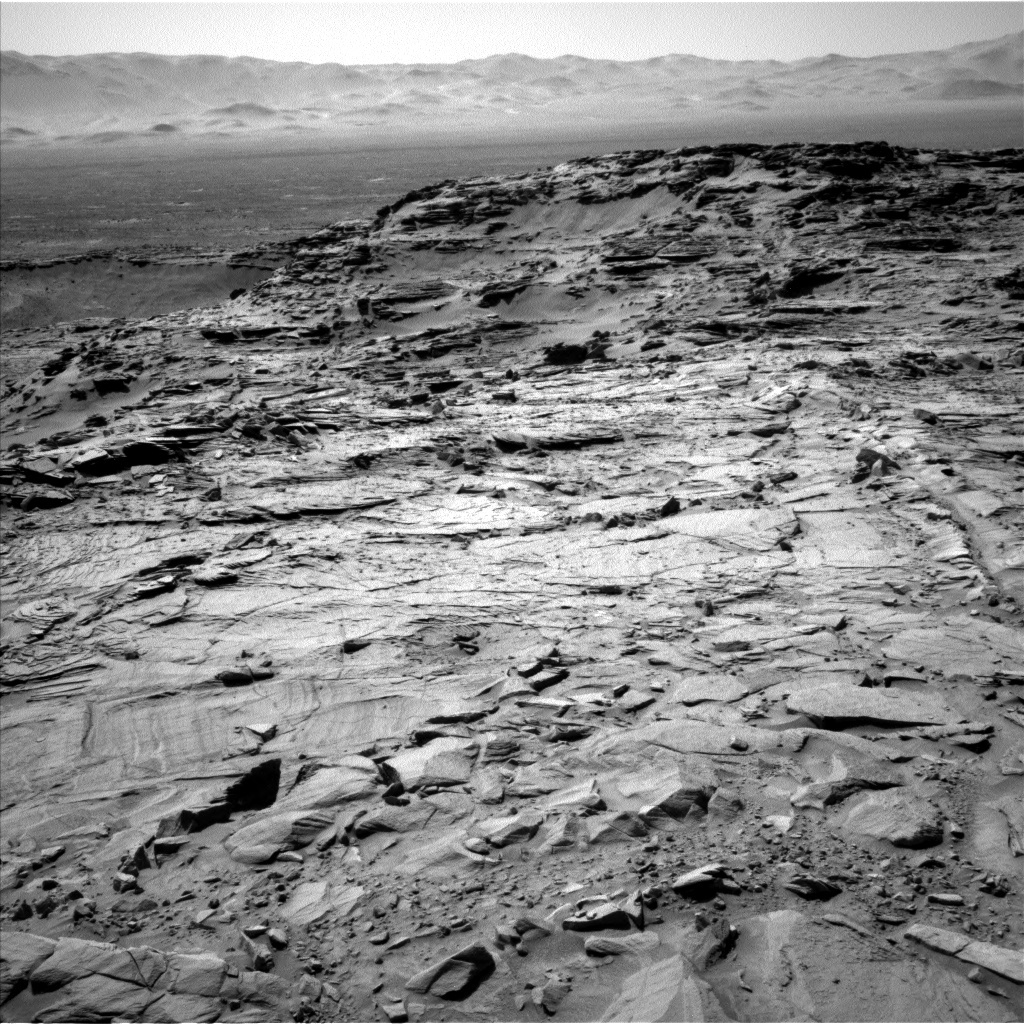
Layers upon layers of Martian volcanic ash

Layers upon layers of Martian volcanic ash
Click for full image.

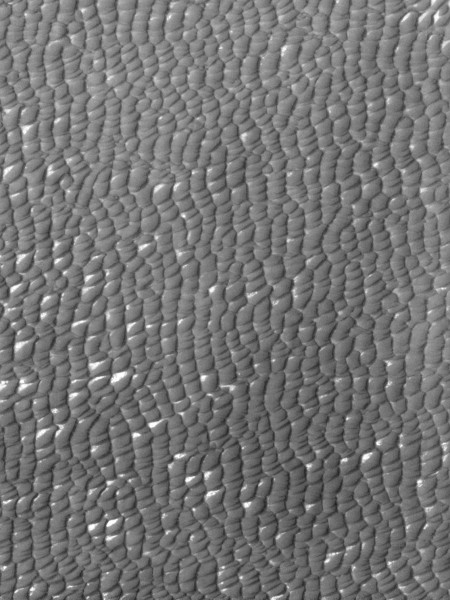
Today’s cool image provides I think a hint at the vast amount of time that has passed on Mars, allowing uncounted major events to occur which each lay down a bit of the geological history, a history that is now piled up on the surface so deeply that it will take decades of research to untangle it.

The photo to the right, cropped and reduced to post here, was taken on December 23, 2020 by the high resolution camera on Mars Reconnaissance Orbiter (MRO). It shows the layered nature of the Medusae Fossae Formation, the largest volcanic ash deposit on Mars (about the land area of India) and thought by some to be the source of most of the dust across the entire red planet.
» Read more

0 comments

Scientists: Mars is losing water seasonally through its atmosphere

The uncertainty of science: Two new studies using data Europe’s Trace Gas Orbiter and Mars Express orbiters have found that Mars is losing water seasonally through its atmosphere.

The studies also found that global dust storms accelerate the process.

Anna and colleagues found that water vapour remained confined to below 60 km when Mars was far from the Sun but extended up to 90 km in altitude when Mars was closest to the Sun. Across a full orbit, the distance between the Sun and the Red Planet ranges from 207 million to 249 million km.

Near the Sun, the warmer temperatures and more intensive circulation in the atmosphere prevented water from freezing out at a certain altitude. “Then, the upper atmosphere becomes moistened and saturated with water, explaining why water escape rates speed up during this season – water is carried higher, aiding its escape to space,” adds Anna.

In years when Mars experienced a global dust storm the upper atmosphere became even wetter, accumulating water in excess at altitudes of over 80 km.

But wait, didn’t planetary scientists just announce that Mars hasn’t lost its water through the atmosphere, but instead lost it when it became chemical trapped in the planet’s soil? Yup, they did, but that was a model based on new ground data. This new result is based on atmospheric data.

Or to put it another way, the model was incomplete. While it could be true that a large bulk of Mars’ water is trapped chemically in the ground, that is not proven, only hypothesized. What has been proven, and is now confirmed by these two studies, is that, depending on weather and season, the water of Mars does leak into its upper atmosphere where it can escape into space, never to return.

What remains unknown is how much water escaped into space, and when. Moreover, the ground-based model could still be right, even if it is true that Mars is losing water through its atmosphere. At the moment the data is too incomplete to answer these questions with any certainty.

Meanwhile, this press release once again gives the false impression that the only water left on Mars is at its poles (and in this case, only the south pole). This is not accurate, based on numerous studies finding evidence of buried ice and glaciers everywhere on the planet down to the 30th latitude, in both the north and south hemispheres. Mars might have far less water now than it did billions of years ago, but it still has plenty, and that water is not found only at the poles.

2 comments

Ingenuity to fly on Mars no earlier than April 8th

NASA and the Perseverance engineering team announced yesterday their specific plans for the first flights oft he Ingenuity helicopter, setting the flight date as no earlier than April 8th.

They are presently driving Perseverance to its “airfield,” a 33×33 foot area. The deployment then will take six days, because there are a number of steps involved to position and place the helicopter on the ground properly.

Once the team is ready to attempt the first flight, Perseverance will receive and relay to Ingenuity the final flight instructions from JPL mission controllers. Several factors will determine the precise time for the flight, including modeling of local wind patterns plus measurements taken by the Mars Environmental Dynamics Analyzer (MEDA) aboard Perseverance. Ingenuity will run its rotors to 2,537 rpm and, if all final self-checks look good, lift off. After climbing at a rate of about 3 feet per second (1 meter per second), the helicopter will hover at 10 feet (3 meters) above the surface for up to 30 seconds. Then, the Mars Helicopter will descend and touch back down on the Martian surface.

Several hours after the first flight has occurred, Perseverance will downlink Ingenuity’s first set of engineering data and, possibly, images and video from the rover’s Navigation Cameras and Mastcam-Z. From the data downlinked that first evening after the flight, the Mars Helicopter team expect to be able to determine if their first attempt to fly at Mars was a success.

The data from this first attempt will determine what they do next.

UPDATE: Below the fold is an illustration of that planned first flight, showing that they hope to send the rover toward the north, take some images, and then fly it back to its airfield, with a second landing site option at the far end of its flight.
» Read more

0 comments

Twisted and tilted bedrock in Martian crater

tilted strata in Martin Crater
Click for full image.

Cool image time! The photo to the right, rotated cropped, and reduced to post here, is only a small example of the strangely tilted and twisted strata in the central peak region of 38-mile-wide Martin Crater on Mars. The full image shows more.

The picture was taken on January 12, 2021 by the high resolution camera on Mars Reconnaissance Orbiter (MRO). The section I’ve cropped out shows a series of stratified strata that are are not only significantly tipped from the horizontal, but have also been bent and deformed.

The crater itself is located about 260 miles south of Valles Marineris, as shown on the overview map below.
» Read more

2 comments

Perseverance dumps debris shield in preparation for Ingenuity deployment

Dumped debris shield under Perseverance
Click for full image.

On March 21st the Perseverance engineering team released the debris shield that had been attached to the bottom of the rover to protect the Ingenuity helicopter during its journey to Mars, and thus began the deployment process for releasing the helicopter itself.

The photo to the right, cropped and reduced to post here, shows that debris shield on the ground. The rover will next drive away from this spot and find the flat area where the helicopter will be placed on the ground for its April flight.

9 comments

A visit to Cydonia on Mars

Strange geology in Cydonia on Mars
Click for full image.

Cool image time! The Cydonia region on Mars, located at around 30-40 degrees north latitude in the northern lowland plains just beyond the transition zone up to the southern cratered highlands, is well known to many on Earth because it was here that the Viking-1 orbiter took a picture of a mesa that, because of the sun angle, made its shadows resemble a face. Thus was born the “Face on Mars” that consumed the shallow-minded among us — and thus the culture, media, and Hollywood — absurdly for decades, until Mars Global Surveyor took the first high resolution image and proved without doubt what was really obvious from the beginning, that it was nothing more than a mesa.

Cydonia however remains a very intriguing region of Mars, mostly because it is home to a lot of strange geology, as shown by the photo to the right, rotated, cropped, and reduced to post here. Taken on January 16, 2021 by the high resolution camera on Mars Reconnaissance Orbiter (MRO), it shows some of that strange and inexplicable geology.

While Cydonia is inside that 30-60 degree latitude band where MRO has imaged numerous glacial-type features, I do not know if many such features have been found there. Except for the pits and depressions in the photo’s lower right — which suggest decay in an ice sheet — little else at first glance in the picture clearly invokes any of the obvious glacial features one comes to expect. There appear to be what might be lobate flows in the image’s center going from the west to the east, but if they are glacial, they are so decayed to as leave much doubt.

The overview image below shows where Cydonia is on Mars, and helps explain partly what is found here.
» Read more

6 comments

Clouds over Gale Crater

Clouds over Gale Crater
Click for full image.

Cool image time! In today’s download of new images from Curiosity was a large number looking at the sky. by one of the rover’s navigation cameras. As noted in the science team’s most recent update, their aim was to “watch for clouds in the sky at twilight.”

They were apparently very successful. The picture to the right, reduced to post here, is one example. The other pictures show these clouds and other clouds as they change over time.

I don’t have much more to add, other than to say it is quite breath-taking to be able to sit here on Earth and routinely gaze at the weather on Mars.

UPDATE: I do have one more thing to say. If you have any skills at programming and want to figure out how to process the raw images from Curiosity and Perseverance to bring out their color, you might find the video at this link of interest: How Can You Color Process Mars Rover’s Images In DaVinci Resolve?

I am not a computer programming geek, so some of its details went over my head. Nonetheless, it opened a window into the photo-engineering used to turn the rovers’ black-and-white digital data into color.

Hat tip to Patrick Inhofer, who calls himself the photon wrangler at MixingLight.com.

8 comments

Volcanic badlands on Mars

Volcanic badlands on Mars
Click for full image.

Cool image time! The photo to the right, cropped and reduced to post here, was taken on January 29, 2021 by the high resolution camera on Mars Reconnaissance Orbiter (MRO). It shows a particularly ugly region of rough terrain located about 900 miles to the southwest of the giant volcano Arsia Mons, the southernmost of the chain of three giant volcanoes between Olympus Mons and Valles Marineris. The picture sits inside the floor of a very old and degraded 185-mile-wide crater dubbed Koval’sky.

The section I cropped out was picked at random, because the entire full image looked like this. Though only a handful of images have been taken of the floor of Koval’sky Crater by MRO’s high resolution camera, all show similar rough terrain. In June 2017 the MRO science team posted one of those few such photos with the following caption:
» Read more

4 comments

SpaceX narrows Mars landing site for Starship to four prime locations

The prime and secondary Martian landing sites for Starship

Capitalism in space: During this week’s 52nd Lunar and Planetary Science Conference, one poster [pdf] caught my eye as something significant. It was titled “SpaceX Starship Landing Sites on Mars.” The map to the right is figure 1 from that poster, annotated slightly by me based my earlier stories about SpaceX’s use of the high resolution camera on Mars Reconnaissance Orbiter (MRO) to research potential Martian landing sites for its Starship spacecraft. The stars indicate MRO images, most of which were described and linked to in my last major post about this SpaceX effort in November 2019.

The red spots covering some stars are the big story: SpaceX has narrowed its choice for its Starship landing site to four prime locations (indicated by the bright red spots) and three backup locations (indicated by the dark red spots). The images under the red spots numbered 2, 4, and 6 were linked to in my November 2019 post. The images under red spots marked by a “D” are earlier images taken by MRO when SpaceX was researching a potential Dragon landing site. The images under red spots labeled 1P and MRO are subsequent images taken by MRO since November 2019, with the 1P image previously linked to in a post in April 2020 entitled “The icy Phlegra Mountains: Mars’ future second city.”

The poster outlined why the prime candidate sites — PM1, EM16, AP1, and AP9 — were favored. For example, PM-1 in the Phlegra Mountains “…has the lowest latitude and elevation of the group, a clear association with LDAs [lobate debris aprons that resemble glacial features], well developed polygons, and has the highest SWIM [Subsurface Water Ice Mapping] score for geomorphic indicators of ice.”

EM 16 “…has a clear association with an LDA with nearby brain terrain and the strongest radar return for shallow ice and the highest combined SWIM score.”

AP1 “…appears to be the safest site and has a moderate combined SWIM score for ice.”

AP9 “…has the thickest ice from radar returns and geomorphology indicating shallow ice. It has the highest combined SWIM score for ice, but appears slightly rocky and rough.”

Below the fold are images, rotated, cropped, and reduced to post here, of the four primary landing sites, as well as links to the full images of all four plus the three back-up sites (AP8, EM15, and PM7).
» Read more

15 comments

A drainage channel on Mars

A drainage channel on Mars
Click for full image.

Today’s cool image from Mars highlights what is probably the biggest geological conundrum the red planet presents for planetary scientists. The photo to the right, rotated, cropped, and reduced to post here, was taken on February 1, 2021 by the high resolution camera on Mars Reconnaissance Orbiter (MRO). Though I have cropped it, I have cropped out very little, because the entire meandering drainage valley is its most interesting feature, and that takes up almost the entire image.

The photo was simply labeled by the camera team a “terrain sample northwest of Sytinskaya Crater”, so I suspect this was taken not in connection with any specific research but because they must use the camera at a regular intervals to maintain its temperature, and when they have gaps in their schedule they try to pick spots of interest in areas that have not had many high resolution photos taken. In this case however I suspect the location choice was very far from random, as they clearly wanted to capture this drainage system, in its entirety.

I called this merely a drainage channel without indicating what caused the channel, be it liquid water, ice, or wind, because in this case that is a main question. At first glance an Earthman will immediately suspect water, which is what scientists supposed for the last half century. The problem with that conclusion is that the Martian atmosphere is too cold and thin for liquid water to exist on its surface, and though there seems to be plenty of evidence that liquid water once existed there, no scientist has yet come up with a completely accepted climate model that allows for such conditions in anytime in Mars’ past.

The rover Opportunity found that some channels it explored might have been carved by wind, though to our human eyes it seems unlikely that a meandering tributary system such as this could have been carved by wind. The possibility however must not be dismissed out of hand, since Mars is an alien planet and alien things (to Earth) happen there.

The overview map below might provide some context.
» Read more

0 comments

What it sounds like when Perseverance moves

NASA has released audio recorded by one of Perseverance’s microphones as the rover completed one of its earliest drives.

NASA released two versions of the audio — one 90-second file edited and processed to filter out background noise, and another 16-minute clip with raw, unfiltered sound.

…Perseverance recorded the sounds during a 90-foot (27.3-meter) drive March 7, according to NASA. The rover’s top speed is a little less than 0.1 mph, or about 152 meters per hour.

The longer, raw audio clip includes a high-pitched scratching noise. The origin of the sound remains a mystery. “Perseverance’s engineering team continues to evaluate the source of the scratching noise, which may either be electromagnetic interference from one of the rover’s electronics boxes or interactions between the mobility system and the Martian surface,” NASA said in a statement. “The EDL microphone was not intended for surface operations and had limited testing in this configuration before launch.”

You can hear the recordings at the link.

In addition, the science team has picked the location where Perseverance will deploy the Ingenuity helicopter. A briefing will be held next week on March 23rd to outline the schedule for its test flight, now set for sometime in early April.

3 comments

Quakes on Mars as seen by InSight

Martian quake map as seen by InSight

After completing its first full Martian year on the surface of the Red Planet, the scientists for the lander InSight today gave a report [pdf] of their results at this year’s annual 52nd Lunar and Planetary Science Conference, normally held in Texas but being done virtually this year out of terror of the coronavirus.

All told the lander’s seismometer has, as of just a few days ago, detected just over 500 quakes. The map to the right, showing the most distinct quakes and their locations, was adapted from a different presentation [pdf] at the conference. The numbers indicate the sols after landing when these quakes were detected.

This is essentially the region on Mars that I call volcano country. Some of the lava flood plains here are the youngest on Mars. To the east just beyond the edge of the map is the Tharsis Bulge, which holds Olympus Mons and the string of three giant volcanoes to its east. South of Cereberus Fossae but north of the yellow-colored cratered highlands is the vast Medusae Fossae Formation, the largest volcanic ash deposit on Mars.

The quakes suggest they are occurring as large blocks shift along faults, creating fissures and cracks that geologists call grabens. The long fissures of Cereberus Fossae are considered an example of grabens, so this activity suggests that shifting is still going on in the region.

In addition to outlining the location of the detected volcanoes, the presentation today summarized these other discoveries made by InSight about Mars’ interior structure:

  • The crust of Mars has likely two or three layers either 12 or 24 miles thick, with a total thickness no more than 45 miles. This is much thinner than most scientists had expected.
  • The mantle layer below the crust is estimated at about 250 to 375 miles thick, with a temperature between 1,600 to 1,700 degrees Kelvin. While quite hot, this is a cooler mantle than expected.
  • The core of Mars is somewhere between 1,100 to 1,300 miles in diameter, with a outer layer made of liquid. These results are at the high end of pre-mission expectations.

As already admitted, it was noted that the heat sensor experiment will not be able to provide the interior temperature of Mars, as its digging mole was unable to dig into the ground the 9 to 15 feet planned.

9 comments
1 103 104 105 106 107 212