Scallops of Martian ice

Scallops of Martian ice
Click for full image.

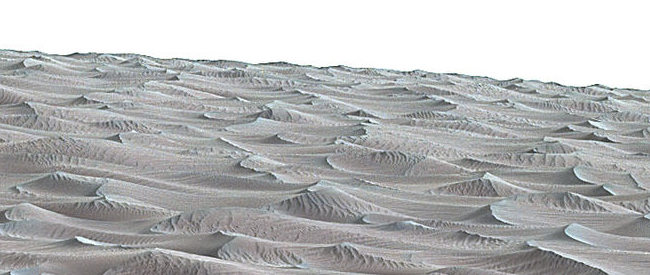
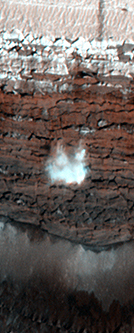
Cool image time! The photo to the right, cropped to post here, was yesterday’s captioned image from the MRO science team. From the caption, written by Shane Byrne of the Lunar and Planetary Lab University of Arizona,

About a third of Mars has water ice just below the dusty surface. Figuring out exactly where is vital for future human explorers. One of the ways scientists do this is to look for landforms that only occur when this buried ice is present. These scallops are one of those diagnostic landforms.

A layer of clean ice lies just below the surface in this image. As the ice ablates away in some spots the surface dust collapses into the hole that’s left. These holes grow into the scallops visible here as more and more ice is lost.

You can see those holes near the top of the scallop’s slopes.
» Read more

0 comments

New hypothesis: Mars didn’t lose water, it got trapped chemically in its crust

Using data from the many orbiters, landers, and rovers sent to Mars, scientists yesterday proposed a new model for the loss of water on Mars, suggesting that instead of escaping through its thin atmosphere it was instead chemically trapped in the planet’s crust.

New data challenges the long-held theory that all of Mars’s water escaped into space

Billions of years ago, the Red Planet was far more blue; according to evidence still found on the surface, abundant water flowed across Mars and forming pools, lakes, and deep oceans. The question, then, is where did all that water go?

The answer: nowhere. According to new research from Caltech and JPL, a significant portion of Mars’s water—between 30 and 99 percent—is trapped within minerals in the planet’s crust. The research challenges the current theory that the Red Planet’s water escaped into space.

First, this is only a model. It proves nothing, and carries many assumptions based on our limited knowledge. We mustn’t accept it at face value.

Second, the first sentence quoted above from this Caltech press release is an example of a trick the scientists have played that our ignorant press has fallen far. What the press release implies superficially is that Mars is now a barren dry place, with little water. Researchers (and readers of Behind the Black) know however that this description is not accurate, that the planet apparently has a lot of water still, only that it is confined as buried ice to latitudes above 30 degrees. Only the equatorial regions appear dry, but not the rest of the planet.

Regardless, this new hypothesis is important if true, as it will help provide an explanation for the Red Planet’s entire geological and climatic history. It might even help solve the mystery of the liquid water that appears to have once existed there, on a planet whose atmosphere is too thin and cold to allow for such a thing.

1 comment

A cracking Martian glacier?

A cracking Martian glacier?
Click for entire image.

Cool image time! The photo to the right, cropped to post here, was taken on December 4, 2020 by the high resolution camera on Mars Reconnaissance Orbiter (MRO)

I have cropped it to show at full resolution the area that contains what the scientists apparently consider the most interesting feature in this image, which they have labeled as “pits forming lines.” These are the vertical cracks and strings of holes that can be seen in this glacier-like flow. In addition, you can see that the cracking is not just vertical, but also extends out in horizontal directions, though the widest cracks are all vertical.

The next image below, which is a lower resolution crop of the full photo, shows a wider view to provide a better picture of the glacier itself.
» Read more

2 comments

How the blobby craters on Mars help map the planet’s existing accessible water

Distorted blobby crater rim in Utopia Planitia
Click for full image.

Today’s cool image on the right, rotated, cropped, and reduced to post here, is part of a series of cool images that have repeatedly shown the blobby and squishy look of crater impact sites in the Martian northern lowland plain dubbed Utopia Planitia. Taken on January 2, 2021 by the high resolution camera on Mars Reconnaissance Orbiter (MRO), it shows the southeast rim of a very distorted crater that appears filled with glacial material and is also surrounded by an apron of smooth material.

At 42 degrees north latitude, it is somewhat expected to find evidence of glacial-like features in such a crater. Moreover, throughout the 30 to 60 degree mid-latitude band in Utopia Planitia are found numerous such blobby craters (other examples found here, here, and here), all suggesting that the impact occurred on a flat plain with a layer of water ice close to the surface. The heat of the impact melted that ice layer. In such a circumstance, the crater rims were easily deformed because as liquid water (for a short time) it could flow into any number of shapes.

At least that’s my theory. According to Colin Dundas of the U.S. Geological Survey’s Astrogeology Science Center in Arizona,

The exact processes that create the patterns are still debated. The flattened/degraded rims are not necessarily related to this morphology, as such craters can have sharp rims, so they may relate to post-impact modification.

In other words, later erosion after the crater formed could have rounded the rim and maybe even distorted it from a circle.

Regardless, the processes that made this crater rim look as it does were clearly widespread, as shown in the wider view below, provided by the context camera on MRO.
» Read more

2 comments

Curiosity faces the mountains

A cropped section from Perseverance's 1st panorama
A cropped section from Perserverance’s 1st panorama.
Click for full image.

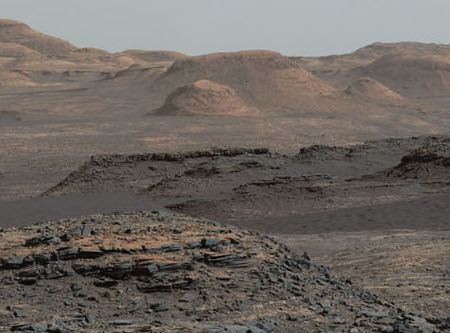
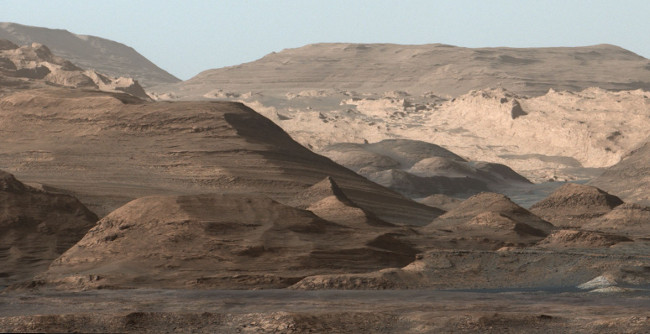
Though the present excitement over the spectacular images and sounds coming down from Perseverance is certainly warranted, what must be understood is that this rover is presently only at the beginning of its journey, and is thus sitting on relatively boring terrain, from a merely visual perspective. The scientists might be excited, but to the general public, all we really are seeing is a flat dusty desert with some scattered rocks on the floor. In the far distance can be seen some hills and mountains (Jezero Crater’s rim), but they are very far away.

Curiosity, which the press and the public has largely forgotten about, is actually just beginning what will likely be the most breath-taking part of its journey. As I noted in my last rover update last week, Curiosity is now at the very base of Mount Sharp, and is about to enter the mountain’s canyons and initial slopes. For its past eight-plus years of roving it has been on the flat floor of Gale Crater, followed by some weaving among the smallest foothills of Mount Sharp. The views have been intriguing and exciting from a research perspective, but hardly breath-taking from a picture-taking point of view.

That is now changing. The picture below, taken by Curiosity just this week, gives us a taste of what is to come.
» Read more

11 comments

Strange ridge ripples on the windswept plateau above Mars’ biggest canyon

Strange ridges on Mars
Click for full image.

Today’s cool image is once again another of what I dub a “what the heck?” photo. The picture to the right, cropped to post here, was taken on December 17, 2020 by the high resolution camera on Mars Reconnaissance Orbiter (MRO) and captures some very strange ridges on the plateau above Mars’ biggest canyon, Valles Marineris.

The image, labeled merely as a “terrain sample,” was taken not as part of any specific research project but scheduled by MRO’s science team in order to maintain the camera’s temperature. When they do this they try to take pictures covering something interesting, but often it is a potshot that sometimes shows little of interest.

In this case the photo shows something very strange. The ridges in the sample are packed into one area only, but if you look at the full image you will see that they are also scattered about randomly and sometimes isolated on the flat plains surrounding this spot.

Interestingly, these ridges resemble the first “What the heck?” image I ever posted in 2019. That photo was located at about the same elevation as these ridges, but due west in the volcanic plains near Mars’s giant volcanoes and just off the western edge of the overview map below.
» Read more

2 comments

First results from UAE’s Al-Amal/Hope Mars orbiter

First data from Al-Amal
Click for full image.

The first science results from the United Arab Emirates Al-Amal Mars orbiter (“Hope” in English) have been released by the American universities operating one instrument.

The image to the right shows that data. The right globes show the areas of actual temperature data for both the Martian surface and atmosphere, with the left globes extrapolating that data across the entire planet.

The purple-green-blue hues show that the measurements were taken of the Martian nightside, although dawn on the planet can be seen on the right-hand side of the surface temperature image, as depicted by the red hues. Features such as Arabia Terra, which has cold nighttime temperatures, can be observed in the upper left portion of the surface temperature data, depicted by the blue and purple hues.

“EMIRS [the infrared spectrometer] is going to acquire about 60 more images like this per week once we transition into the primary science phase of the Emirates Mars Mission,” said EMIRS Instrument Scientist Christopher Edwards, who is an assistant professor and planetary scientist at [Northern Arizona University]. “We’ll use these images and sophisticated computer programs to build up a complete global, daily understanding of the Martian atmospheric components, like dust, water ice, water vapor and atmospheric temperature.” [emphasis mine]

The highlighted words above illustrate the true nature of this U.S./UAE joint mission. Right now the spacecraft is being operated by Emirate engineers in the UAE, but the spacecraft and its instruments were really built by U.S. universities, paid for by the UAE. As such, those American universities remain in charge of running those instruments, though UAE students are also being used to do that work as part of their education.

None of this is to denigrate the effort by the UAE. It used its financial resources to buy the expertise of American universities and companies to build this Mars orbiter, but did so with the express requirement that those American universities and companies also educate and train its people in such work.

That deal however once again illustrates the value of private enterprise and freedom. The UAE wanted to teach its people how to fly a planetary space mission. American universities had the knowledge to do it. The former then bought the skills from the latter, while the latter then got a science mission for free.

A match made in heaven with both benefiting marvelously.

1 comment

A iceberg of water ice floating on a Martian dry ice sea

Ice mesa near Mars' south pole
Click for full image.

British biologist John Haldane once once wrote, “The universe is not only queerer than we suppose, but queerer than we can suppose.”

Today’s cool image to the right, cropped to post here, is a fine example of Haldane’s words. It was taken on January 15, 2021 by the high resolution camera on Mars Reconnaissance Orbiter of a single lone mesalike feature sticking up in a flat expanse of Mars’ south polar dry ice/water ice cap.

I emailed Shane Byrne of the Lunar and Planetary Lab University of Arizona, who had requested the photo, to ask him what he thinks we are looking at. His response:

This region has a thick layer of CO2 ice sandwiched between water ice that’s above and below. CO2 ice is denser than water ice so I think a fragment of water ice of the underlying layer has risen up through the denser CO2 ice that covers this area (what geologists call a diapir).

Byrne also admits this remains merely “just a wild theory,” not yet confirmed.

Assuming this theory to be right, in a sense then this mesa is not really a mesa at all but an iceberg of water, floating not in a saltwater liquid ocean as on Earth but on a frozen sea of dry ice. Talk about queer! The wider shot below, taken by MRO’s context camera, illustrates how isolated this water iceberg is on that dry ice sea.
» Read more

4 comments

Mars: Planet of many glaciers

Moraines on Mars
Click for full image.

Today’s cool image more than simply cool, it reveals a wider picture of Mars that should be quite exciting to future colonists. The photo to the right, rotated, cropped, and reduced to post here, was taken on January 30, 2021 by the high resolution camera on Mars Reconnaissance Orbiter (MRO). What drew my attention to it was the title given to this uncaptioned photo: “Moraine-Like Ridges in Nereidum Montes.”

Moraines are the debris pile pushed ahead of any glacier. The picture shows what appear to be a series of moraines, likely caused by different periods of glacier activity when the glacier was growing. It also suggests that past active periods were more active than later ones, as with each active period the moraine did not get pushed out quite as far.

The location, Nereidum Montes, intrigued me, as I am not that familiar with it. I emailed the scientist who requested the image, Dan Berman, senior scientist at the Planetary Science Institute in Arizona, and asked him for more information. He suggested I read a very recent paper he co-wrote entitled “Ice-rich landforms of the southern mid-latitudes of Mars: A case study in Nereidum Montes.” From that paper I was able to produce the map of Mars below that shows the regions on the planet where scientists now think hold the greatest concentrations of glaciers.
» Read more

0 comments

Yutu-2 and Chang’e-4 reactivated for 28th lunar day on Moon

The new colonial movement: Engineers have reactivated both Yutu-2 and Chang’e-4 to begin their 28th lunar day on the far side of the Moon.

The article, from China’s state-run press, provides only one real tidbit of information, that Yutu-2 has now traveled 429 meters (1,378 feet) from the landing site. They still have about a mile to go to reach their next big geological target, which should take years at the pace the rover is setting.

Both spacecraft though have been unmitigated successes. Their nominal mission had been to survive three lunar day-night cycles, about 90 Earth days. They have survived 28, or more than two years since landing in January 2019.

This success suggests that China’s Mars rover has a good chance of doing as well. Its planned mission length is also 90 days, similar to the Spirit and Opportunity rovers, both of which lasted many years.

0 comments

Perseverance begins journey with 1st test drive

Perseverance's future planned route
Click for full image.

On March 4th the engineers on the Perseverance science team successfully completed the rover’s first test drive.

Ground teams commanded the rover to drive forward, turn in place, and then back up. The first 33-minute test drive covered just 21 feet, or 6.5 meters,but Perseverance will soon travel much farther. “Our first drive went incredibly well,” said Anais Zarifian, a Perseverance mobility test engineer at JPL.

Perseverance has six aluminum wheels, each with titanium spokes for support, and a suspension capable of traveling over rocks as big as the wheels themselves. The one-ton rover is based on the design of NASA’s Curiosity rover, which landed on Mars in 2012, but with some improvements.

The wheels on Perseverance are sightly narrower, have a larger diameter, and are made of thicker materials, Zarifian said. Engineers also changed the tread pattern on the wheels to reduce the risk of damage from sharp rocks, which created dings and cuts in Curiosity’s wheels.

The map above shows the route the science team has presently chosen for Perseverance, a revision from earlier routes created prior to landing. The white dot on the right is the rover’s present position, the blue and purple lines are two alternative routes they are considering for their route to the delta coming out of Neretva Vallis. The yellow route up the delta is especially exciting in that it gets them onto it much sooner than previous plans.

Which route they choose for the initial journey I think will partly depend on which provides the best location to test fly Ingenuity, the experimental helicopter on the rover. Scientists and engineers I am sure are presently poring over high resolution images from Mars Reconnaissance Orbiter (MRO) in order to make that choice. At this link, centered on Perseverance’s present location, you can take a look at all those images by MRO by selecting the arrow icon at the top and then clicking on any red box. Because so many photos have been taken there is a lot of overlap, so each click will give you many pictures to look at.

5 comments

Ice-filled Martian sinkhole

Ice-filled pit on Mars
Click for full image.

Cool image time! The pit shown in the high resolution photo to the right (image rotated, cropped, and reduced to post here) was taken on January 25, 2021 and labeled by the Mars Reconnaissance Orbiter (MRO) “Collapse Pit in Graben with Ice Fill.”

There is a lot of information in that title. First, a graben is a geological feature where a section of terrain drops relative to the surrounding terrain, producing a depression. Second, it appears the graben in this region is mostly filled with debris, probably wind-blown dust or sand or volcanic ash.

Third, at this particular spot the filling material sank, like a sinkhole on Earth, creating the pit.

And fourth, and maybe most intriguing, the scientists think that this pit is now filled with ice. At 47 degrees north latitude, the location is prime for such ice, and the interior material resembles similar glacial features seen in many other mid-latitude craters.
» Read more

2 comments
1 104 105 106 107 108 212