Frozen lava rapids on Mars

Frozen lava rapids on Mars
Click for original image.

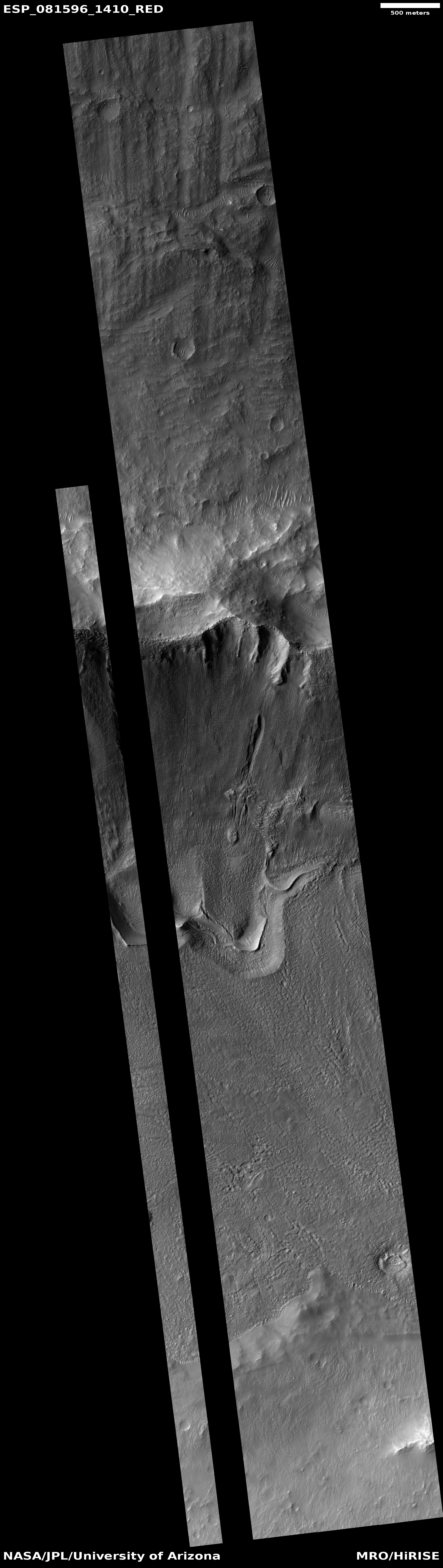
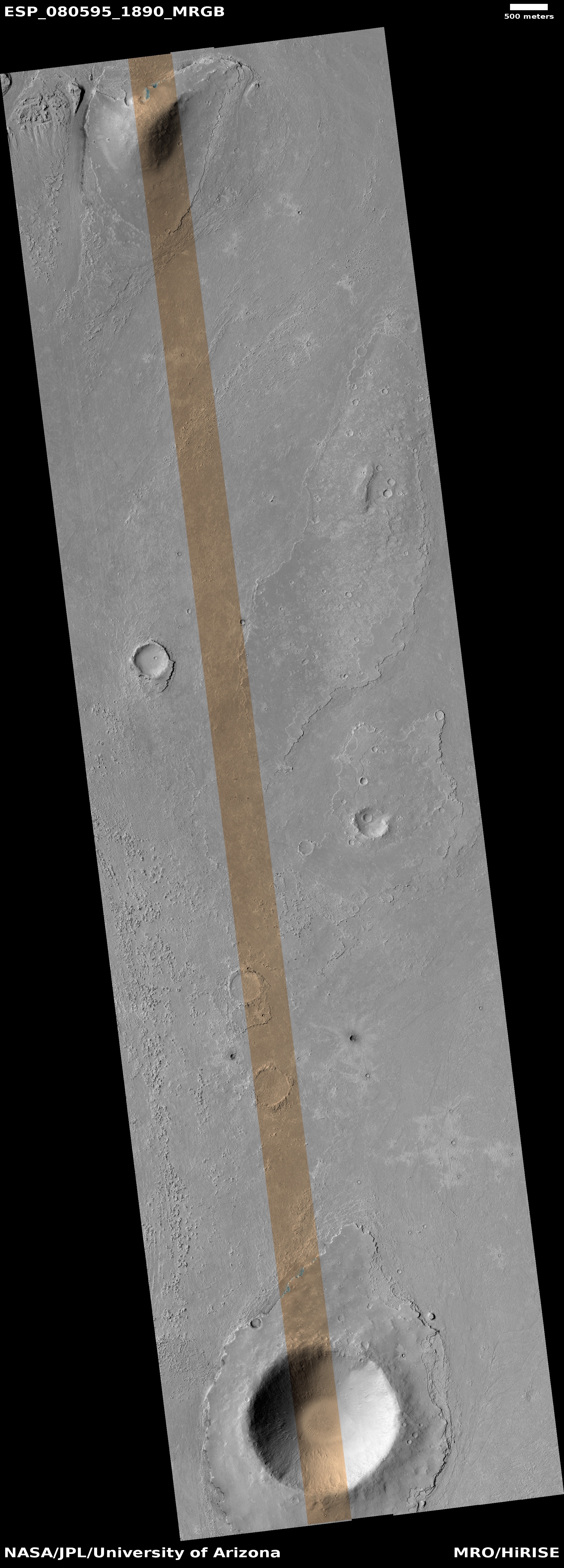
Cool image time! The picture to the right, rotated, cropped, reduced, and sharpened to post here, was taken on October 6, 2023 by the high resolution camera on Mars Reconnaissance Orbiter (MRO), and shows a spot on Mars where lava was squeezed between and around some small peaks as it flowed quickly south, flooding all the low areas in this landscape.

The science team describes the features in the full image as “streamlined”, a description that is literally accurate. As this “stream” of lava rushed past, it “lined” the higher terrain, carving it into tear-dropped shapes.

In the color strip, note the blueish spots at the northern base of the 400-foot-high hill. According to the science team’s explanation [pdf] of the colors in MRO images, “Frost and ice are also relatively blue, but bright, and often concentrated at the poles or on pole-facing slopes.” The picture was taken in summer, so if these bright spots are frost or ice, it suggests they are well shaded from sunlight in those north-facing alcoves. This location is only 9 degrees north of the equator, so finding any near surface ice here is highly unlikely. That frost might exist however is intriguing, to say the least.
» Read more


0 comments

Curiosity’s view of Gale Crater from its new heights on Mount Sharp

Low resolution version of panorama
Click for full resolution version of panorama. For the original images, go here, here, and here.

Overview map

Cool image time! The panorama above was created from three pictures taken on Februay 13, 2024 by the left navigation camera on the Mars rover Curiosity (available here, here, and here). It looks to the north, across Gale Crater and its nearest rim, about twenty miles away. The red dotted line indicates the approximate route Curiosity took to get to this point. The yellow lines on the overview map to the right show the approximate area covered by the panorama.

The images were part of the routine mosaics created by both the left and right navigation cameras for helping engineers plot the rover’s future travels. The pictures that look back at the far rim however also provide important atmospheric data. In this case, the haze tells the scientists how much dust is in the atmosphere. It is presently winter in Gale Crater, which also corresponds to the dust storm season. Thus, the view is very hazy.

Curiosity will likely remain at this location for several more weeks, as the science team is about to begin another drilling campaign. Note the large dark area on the cliff face on the right that is also level with the terrace where Curiosity presently sits. The scientists want to get core data of this layer, and they think they are at a good spot to do so.

1 comment

Martian gullies caused by glacial and water erosion

A gully on the north rim of Niquero Crater
Click for original image.

Cool image time! The picture to the right, rotated, cropped, reduced, and sharpened to post here, was taken on December 23, 2023 by the high resolution camera on Mars Reconnaissance Orbiter (MRO).

The image shows us the north interior rim of 7-mile-wide Niquero Crater on Mars. From the high to the low points the elevation difference is about 2,500 feet, with a steep downhill slope averaging about 18 degrees. The terrain appears to show several avalanche collapses that pushed lower material out of the way, though at the bottom where that material has been pushed aside there is no obvious large debris pile.

The science team labels this image simply “volatiles and gullies”, a label that carries a host of significant information. These gullies, which were among the earliest found by Mars Global Surveyor in the late 1990s, were the first evidence that the surface of Mars had a lot of near surface ice. It is for this reason that this relatively small crater on Mars has a name. Most craters this small remain unnamed, but the gullies on Niquero’s north slopes required more study, and thus the crater was given a name.

Subsequent orbital imagery has now shown that craters like Niquero, located in latitudes higher than 30 degrees, quite often are filled with glacial debris. In fact, the material that these avalanches pushed aside at the base of the slope is that glacial material, protected by a thin layer of dust and debris. The avalanche essentially disturbed that protected layer, and thus the debris pile (made up mostly of ice) sublimated away when warmed by sunlight. Thus. no big debris pile.

The gullies tend to be on the pole-facing slopes. Scientists believe they are the remnant evidence of ancient glaciers that grew on these slopes because they were protected from sunlight. In subsequent eons, when the climate on Mars changed, those glaciers collapsed, leaving behind the gullies we see now.
» Read more

0 comments

India proposes to send its own helicopter to Mars

India has now considering adding its own helicopter to its next Mars mission, dubbed the Martian Boundary Layer Explorer (Marble).

While ISROโ€™s rotorcraft is still in the conceptual stage, the agency envisions a drone that can fly as high as 100 meters in the thin Martian air. Along with the Marble instrument suite, the drone is expected to carry various sensors, including temperature, humidity, pressure, wind speed, electric field, trace species, and dust sensors.

Whether this mission will include a lander, rover, or orbiter as well is very unclear, which suggests strongly the entire mission profile is presently very much undecided as yet.

2 comments

Alternating dark and light terraces inside Valles Marineris

Overview map

Alternating dark and light layered terraces in Valles Marineris
Click for original image.

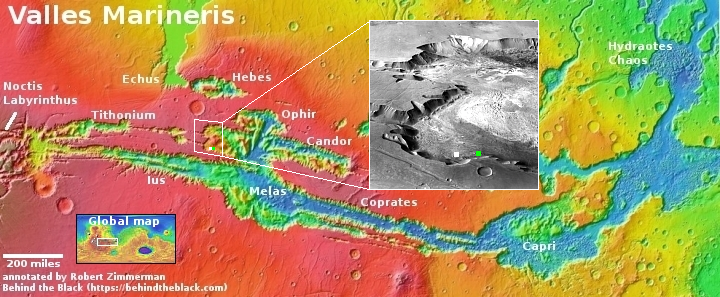
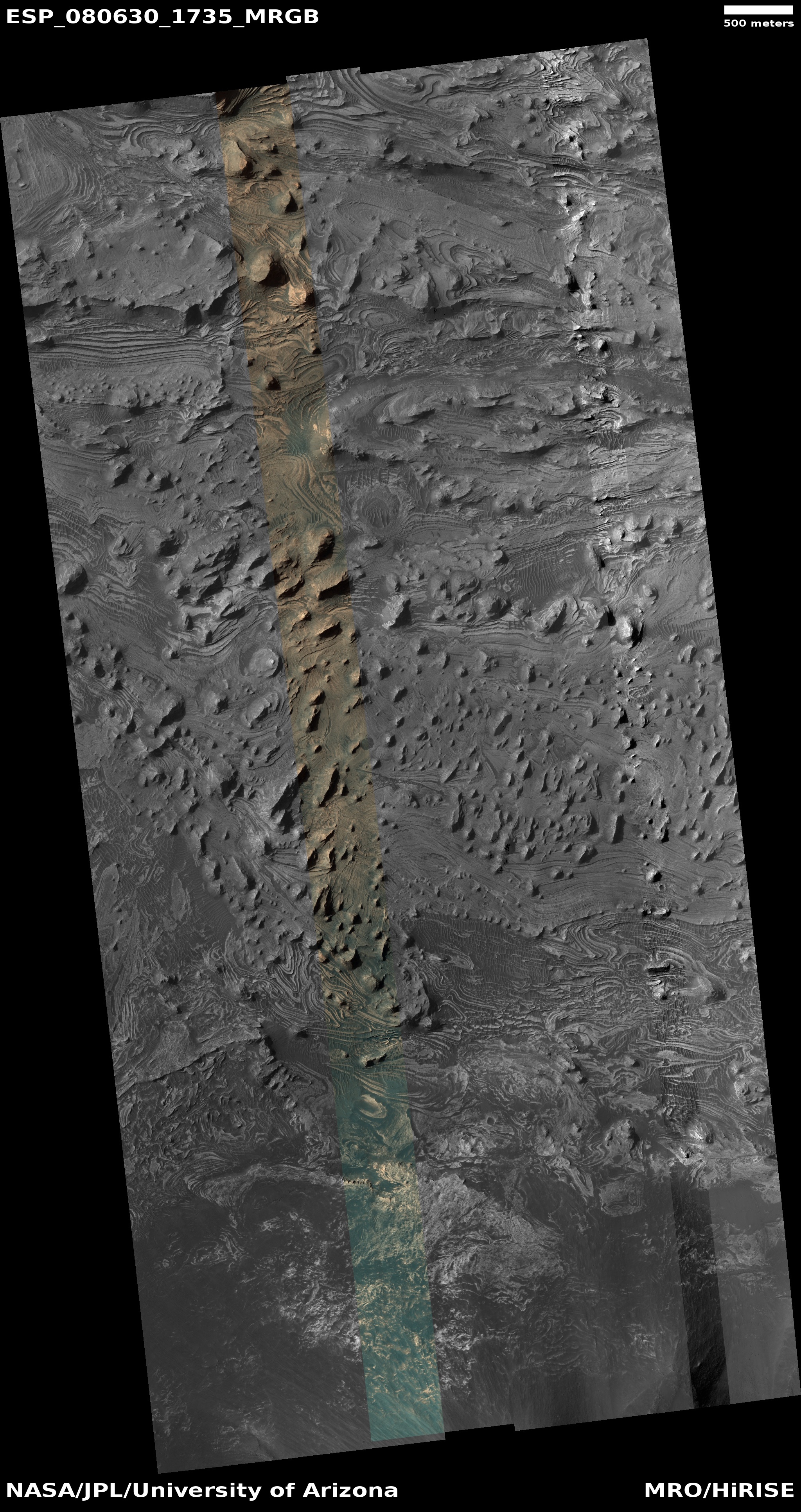
Cool image time! The picture to the right, cropped and enhanced to post here, was taken on October 9, 2023 by the high resolution camera on Mars Reconnaissance Orbiter (MRO), and shows what appear to be the somewhat typical terrain at this location, in a part of the giant Martian canyon Valles Marineris dubbed West Candor Chasma. For example, I featured similar swirls in August 2022 at a place only about six miles to the east, that spot indicated by the green dot on the overview map above. The white dot marks the location of today’s image.

So, what are we looking at? The elevation drop from the high and low points is only about 180 feet, but in that short distance it appears there are more than two dozen visible layers, and those layers form terraces that alternate between bright and dark material.

The shape of the swirls also suggest that a flow of some kind, either water, ice, or wind, moved from the northwest to the southeast, carving these terraces as it descended the stair steps downward. It is also just as likely that we are seeing repeated lava flows going downhill to the southeast, each even laying another layer on top of the preceeding one. And it is also possible that we are looking at a combination of both.

The alternating dark and light layers suggest that each dark layer was an event that put down dark material, such as volcanic dust, that was subsequently covered with light material, with this process repeating itself many times over the eons.

That the floor of this part of Valles Marineris is uniquely covered in this manner is in itself intriguing. Why here, and not elsewhere within the canyon?

1 comment

The alien surface of Mars

The alien surface of Gediz Vallis
Click for original image.

Overview map
Click for interactive map.

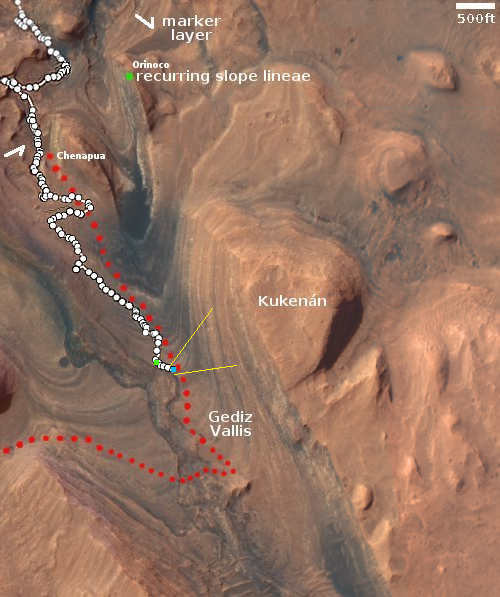
Cool image time! The picture above, brightened slightly to post here, was taken on February 15, 2024 by the right navigation camera on the Mars rover Curiosity. It looks east at the looming cliff face of the mountain Kukenan that the rover has been traveling beside for the last six months. On the overview map to the right the yellow lines indicate roughly the area covered by this picture. The blue dot marks Curiosity’s present position, while the green dot marks its position on February 5, 2024. As you can see, the rover is making slow but steady progress uphill into Gediz Vallis.

This image illustrates the alien landscape of Mars quite beautifully. First, there is absolutely no life in this picture. On Earth you would be hard pressed to find any spot on the surface that doesn’t have at least some plant life.

Second, there is the rocky layered nature of this mountain. When the Curiosity science team first announced its future route plans (the red dotted line) to drive into this canyon back in 2019, the orbital images of these layers from Mars Reconnaissance Orbiter (MRO) had suggested the terrain here would be reminiscent of The Wave in northern Arizona, a smooth series of curved layers smoothed nicely over time by the wind.

As you can see, there is no smoothness here. Instead, every single layer here is infused with broken rock, suggesting that each layer is structurally weak. As erosion exposes each, the layer breaks up, crumbling into the chaos in this picture. The curved nature of the terrain at the bottom of the picture however does suggest that some sort of flow once percolated down this canyon, either liquid water or glacial ice, carving the layers into this curved floor.

3 comments

The shoreline of a Martian lava sea

The shoreline of a Martian lava sea
Click for original image.

Cool image time! The picture to the right, cropped, reduced, and enhanced to post here, was taken on October 2, 2023 by the high resolution camera on Mars Reconnaissance Orbiter (MRO).

The science team labeled this a “lava margin.” The darker material on the right is apparently a newer deposit of lava, flowing on top of the lighter lava on the left. The newer deposit is only about three feet thick, so it had to have flowed fast almost like water to cover this large area with such a thin layer before freezing. Even so, this new lava layer has a roughness greater than the older layer below it. Either the older layer is smoother because of erosion from wind over eons, or the lava in these two layers was comprised of slightly different materials that froze with different textures.

The small ridges appear to be wrinkle ridges, created when material shrinks as it freezes.

This margin marks the edge of a very large flood lava event, as illustrated by the overview map below.
» Read more

0 comments

Spiders on the rim of a Martian crater

Spiders on the rim of a Martian crater
Click for original image.

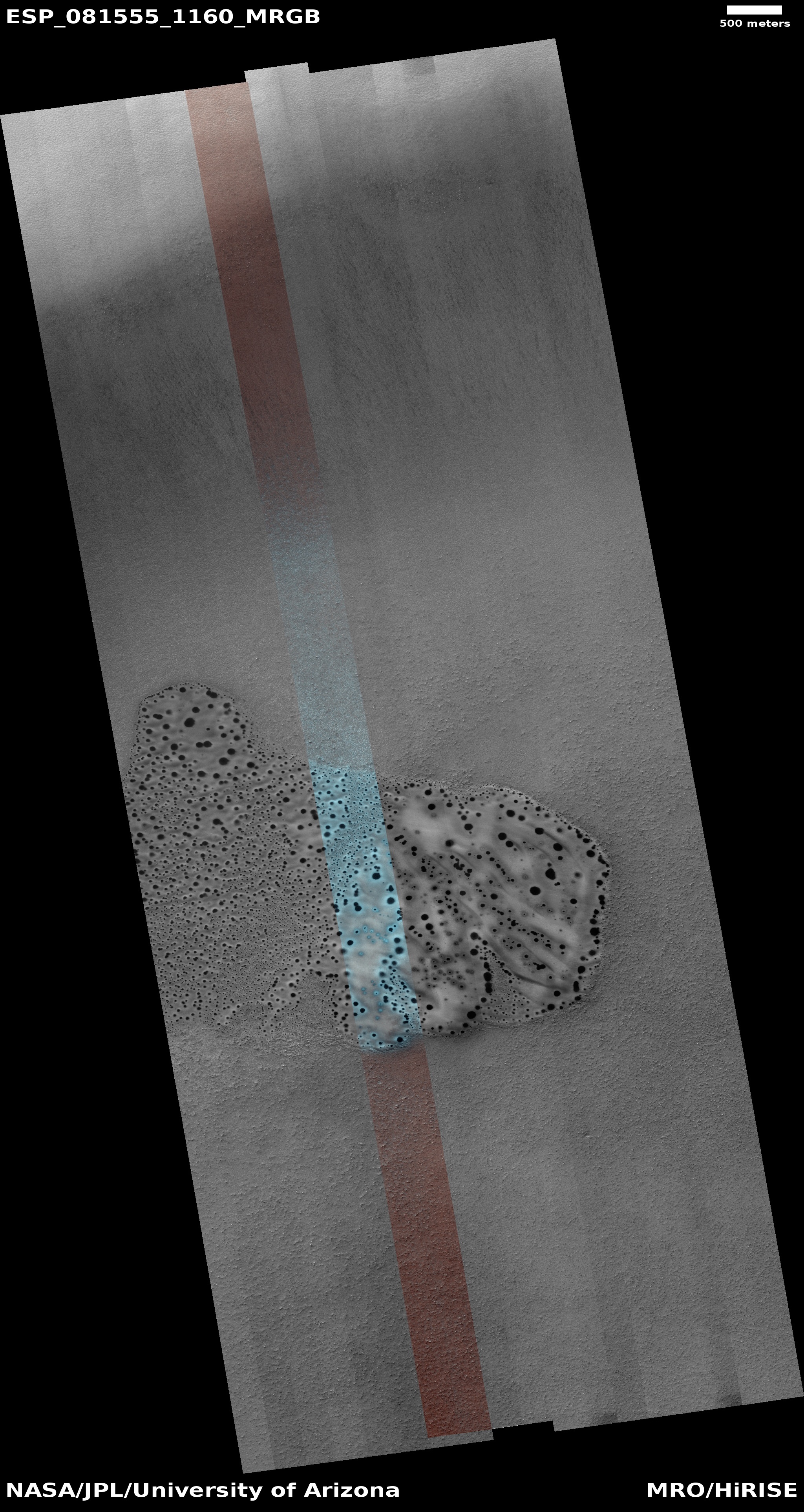
Cool image time! The picture to the right, cropped to post here, was taken on December 29, 2023 by the high resolution camera on Mars Reconnaissance Orbiter (MRO). It shows strange spidery formations on the rim of a 17-mile-wide crater about 500 miles from the south pole of Mars.

Scientists think these spider features are formed due to the seasonal cycle on Mars. In the winter at the poles the carbon dioxide in the atmosphere falls as snow in the polar regions, creating a thin dry ice mantle that covers everything. When spring arrives, sunlight goes through the clear mantle to heat its base, causing that dry ice to sublimate into gas that is trapped below the mantle. Eventually that mantle cracks at a weak point and the gas escapes, spewing dark dust on its top. By summer the mantle is entirely gone, and the black splotches disappear as they blend back into the same colored ground.

At the south pole the ground appears to be firmer and more structurally sound than at the north pole. The trapped gas appears to travel upward along the same tributary paths to the same escape points each year, thus carving these spidery features that are permanent features.
» Read more

1 comment

One instrument on Perseverance has a problem

One of the instruments on the Mars rover Perseverance appears to have a problem that is preventing it from using its laser to collect spectroscopic data of the nearby Martian surface.

Data and imagery from NASAโ€™s Perseverance Mars rover indicate one of two covers that keep dust from accumulating on the optics of the SHERLOC instrument remains partially open. In this position, the cover interferes with science data collection operations. Mounted on the roverโ€™s robotic arm, SHERLOC uses cameras, a spectrometer, and a laser to search for organic compounds and minerals that have been altered in watery environments and may be signs of past microbial life.

The mission determined on Jan. 6 that the cover was oriented in such a position that some of its operation modes could not successfully operate. An engineering team has been investigating to determine the root cause and possible solutions. Recently, the cover partially opened. To better understand the behavior of the coverโ€™s motor, the team has been sending commands to the instrument that alter the amount of power being fed to it.

Should this troubleshooting fail to fix the dust cover, the rover’s other instruments can still compensate, gathering spectroscopy in other ways. Losing SHERLOC however will still reduce the data that Perseverance can obtain.

0 comments

German-built mini-rover for Japanese Phobos mission shipped to Japan

A German-built mini-rover, dubbed Idefix, has now been shipped to Japan to intergrate it as a secondary payload on that country’s MMX mission to the Martian moon Phobos.

The rover itself weighs 25 kilograms (55 pounds), is 51 centimeters long (20 inches), and is designed to explore up to 100 meters of Phobosโ€™ surface. During one of MMXโ€™s closest approaches to Phobos, the rover will be released at an altitude between 40 and 100 meters above the surface and touch down on Phobos. The drop utilizes the low gravity of Phobos, which will allow IDEFIX to just fall onto the surface, roll, and then raise itself to prepare for the roughly three-month-long mission. The gravity of Phobos is only roughly 1/1000th of the gravity of Earth, which can be attributed to the moonโ€™s small size. Phobos only has a diameter of approximately 27 kilometers.

โ€œThanks to the low gravity, IDEFIX will need between 60 to 80 seconds from release to the touchdown on Phobos. The impact will be with less than one meter per second,โ€ explained Professor Markus Grebenstein, who is DLRโ€™s project lead for IDEFIX, in an interview with NSF.

If all goes right, the rover’s mission will last at least 100 days. MMX itself it scheduled to reach Phobos in 2029.

Meanwhile, scientists used one of the Perseverance’s high resolution cameras to capture another partial eclipse of the Sun by Phobos. This is not the first such Phobos eclipse that Perseverance has photographed (see for example here and here), but it is neat nonetheless.

0 comments

Martian dunes with strange splotches

Martian dunes with splotches

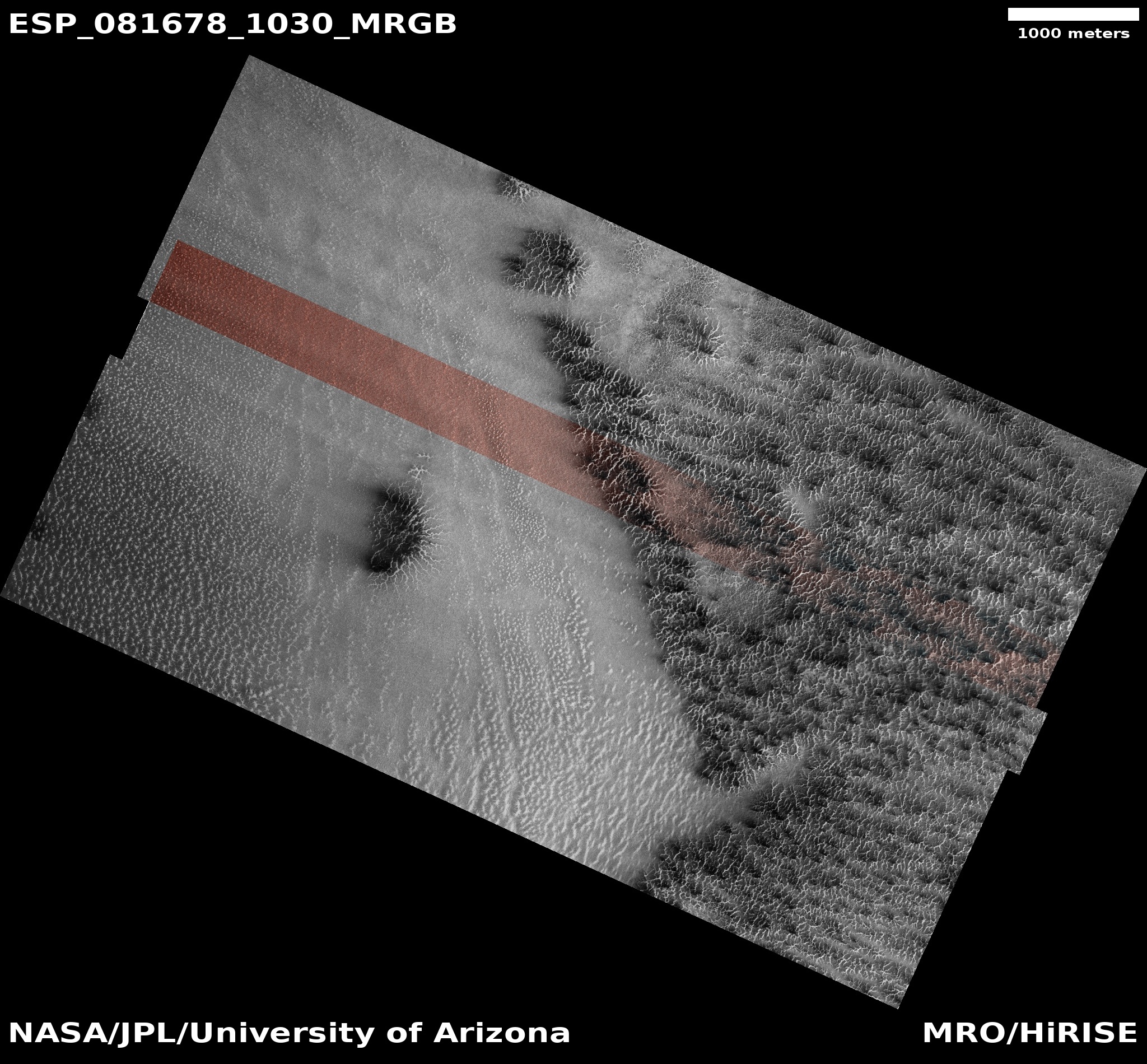
Cool image time! The picture to the right, cropped to post here, was taken on December 20, 2023 by the high resolution camera on Mars Reconnaissance Orbiter (MRO). It shows what the science team labels as “Dunes with Blotches.”

The blotches, or as I call them splotches, are the round dark patches on dunes themselves. Though their darkness is reminiscent of the dark patches that appear as spider features in the south polar regions of Mars, there are problems linking the two. The spiders form when the winter mantle of dry ice that falls as snow begins to weaken when the Sun reappears in the spring. Sunlight travels through the clear dry ice to warm the base of the mantle, causing it to sublimate into carbon dioxide gas. That gas however is trapped at the base, and only escapes when the thin mantle cracks at weak points. As the gas puffs out it carries with it dust, which leaves dark patches on the surface that disappear when the mantle disappears entirely by summer.

In the southern hemisphere at the poles the ground is somewhat stable, so the trapped gas appears to travel along the same paths each year to the same weak spots. This in turn causes it to carve spidery patterns in the ground, like river tributaries, except here the tributaries of gas flow uphill to their escape point. At the north pole the ground is not as stable. Instead we have many dunes, so that the dry ice mantle sublimates away at different places each year. There is no chance to form such spider patterns over time.

Making these splotches more puzzling is the season. This picture was taken in the winter, at a time one would think no dry ice is sublimating away.
» Read more

0 comments

More hiking possibilities on Mars!

More hiking possibilities on Mars
Click for original image.

Cool image time! The picture to the right, rotated, cropped, reduced, and sharpened to post here, was taken on September 27, 2023 by the high resolution camera on Mars Reconniassance Orbiter (MRO). Dubbed a “terrain sample” by the science team, this picture was likely chosen not as part of any specific research project but to fill a gap in the camera schedule so as to maintain that camera’s proper temperature.

When the team needs to do this they try to pick interesting targets. In this case the location is the region of many many parallel north-south fissures that extend for more than 800 miles south of the giant but relative flat shield volcano Alba Mons. These fissures are grabens, cracks formed when underground pressure pushed the ground up and caused it to spread and crack.

What attracted me to this picture is the ridgeline. It struck me as a wonderful place to hike. I have even indicated in red the likely route any trail-maker would pick to go from the valley below up onto the ridge, and then along its knifelike edge to the south. The height of the cliff down to the east valley averages about six hundred feet, guaranteeing beautiful scenery the entire length.
» Read more

0 comments
1 29 30 31 32 33 212