InSight team releases a global map of Mars’ seismic zones

Global map of quakes on Mars
Click for original image.

In a new paper that reviewed the entire archive of Mars quakes detected by the seismometer on InSight during its four years of operation on the Martian surface from 2018 to 2022, scientists have now released an updated global map showing the regions on Mars where seismic activity is most common. From the abstract:

Seismicity on Mars occurs mostly along or north of the boundary between the southern highlands and northern lowlands. Valles Marineris is seismically more active than previous catalogs of located events imply. Further, we show evidence that two events likely originate from the Olympus Mons region.

The map to the right is figure 6 from the paper, and shows clearly the sum total of InSight’s data. The yellow triangle marks InSight’s landing spot. The red line delineates the distant quakes from the nearby quakes detected by InSight. The green line is what the scientists identify as the border between the northern lowland plains and the southern cratered highlands. The data suggests that transition point could be linked geologically in some manner to the quakes themselves.

Though the majority of the detected quakes were in the Cerberus Fossae region, the data also suggests two other seismic active regions, one under the giant canyon Valles Marineris and the other south of Mars’ largest volcano, Olympus Mons.

0 comments

NASA reveals three year delay in its New Frontiers planetary mission program

NASA last week revealed that because of “budget uncertainty” it will not begin accepting project proposals in its New Frontiers planetary mission program this fall as planned, and will in fact not begin accepting new proposals until 2026.

At a NASA SMD town hall meeting July 27, Lori Glaze, director of NASA’s planetary science division, warned a potential extended delay in the release of the New Frontiers AO. “If the planetary science funding levels that are anticipated as a result of this tight budget environment are actually realized over the next two or so years,” she said, “it is unlikely we’ll be able to solicit New Frontiers perhaps not before 2026.” That delay was made official with the release of the community announcement.

The draft AO sought proposals for missions on six topics, as recommended by the planetary science decadal survey in 2011: a comet surface sample return, a mission to Jupiter’s volcanic moon Io, a lunar geophysical network, a sample return mission to the moon’s South Pole-Aitken Basin, a mission to characterize the potential habitability of Saturn’s icy moon Enceladus and a probe of Saturn’s atmosphere.

The New Frontiers program previously funded the New Horizons mission to Pluto, the Juno mission to Jupiter, and the OSIRIS-REx asteroid mission to Bennu.

The article at the first link above as well as the NASA officials quoted attempt falsely to blame the budget problems on the Republican House leadership, which insisted that the committee which reviews the NASA budget as well as the budgets of Justice and Commerce cut 28.8% from among those agencies in its 2024 budget review. That committee (as well as the Senate) however was very generous to NASA, essentially giving it the same budget as previously, with only a 1% cut, while slashing budgets for departments in Justice and Commerce to make up the difference.

The real blame for this delay in NASA’s planetary program almost certainly falls on the Mars Sample Return mission, which has seen gigantic budget overruns that are apparently swallowing the entire future planetary program. NASA’s planetary budget can’t pay for any other new planetary missions as long as it must pay for the cost overruns for the sample return mission.

This is no surprise, as we’ve seen this movie before. When Webb’s budget ballooned 20x, from its proposed $500 million to $10 billion, it essentially shut down the rest of NASA’s astrophysics program, delaying or cancelling all other space telescope projects for more than a decade. Now the planetary program is experiencing its own version of this same pain.

The problem is the Mars Sample Return mission itself. Its design has been haphazard and sloppy and constantly changing. It is also reliant on older technology ideas that will soon be made obsolete by Starship/Superheavy. NASA would be wiser to delay that project to await the development of the launch capabilities that will make it cost effective, and let a fleet of other missions happen instead.

I guarantee however that NASA won’t do that, because it will require some boldness. The philosophy in Washington remains the same: Do the same failed thing over and over again in the vain hope it might work next time.

4 comments

Residue ice in southern mid-latitude Martian crater?

Residue ice in the southern mid-latitudes of Mars?
Click for original image.

Cool image time! The picture to the right, rotated, cropped, reduced, and sharpened to post here, was taken on April 10, 2023 by the high resolution camera on Mars Reconnaissance Orbiter (MRO). It shows an unnamed 1.2-mile-wide crater at about 35 degrees south latitude with what appears to be residual glacial ice hugging its north interior wall.

As this is in the southern hemisphere, the ground immediately below the south-facing interior wall of the crater is going to be in shadow the most, and thus it will also be the place where any surface or near-surface ice will survive the longest. In this case it appears that from the bumpy nature of that residual ice it has also been sublimating away. Within it however remains the faint hint of multiple layers, suggesting about a dozen past climate cycles with each new cycle producing a new but smaller layer with less ice.

The material in the southern half of the crater floor appears to be dust formed into ripple dunes.
» Read more

0 comments

Flow channels on Mars

Flow channels on Mars
Click for original image.

Cool image time! The picture to the right, rotated, cropped, reduced, and sharpened to post here, was taken on May 13, 2023 by the high resolution camera on Mars Reconnaissance Orbiter (MRO). It shows what the scientists call a “channel and depression”, though to my eye everything looks like flow channels, descending to the east.

The drop from the narrow northern channel to wider southern channel is about 200 feet, with the small crater on the left sitting about halfway between. To our Earthbound eyes, something clearly flowed downhill from that northern channel into the wider channel. What we don’t know now is what the material was that did the flowing?

Was it liquid water? Glaciers? The overview map below provides some context, though it doesn’t actually provide an answer.
» Read more

0 comments

August 24, 2023 Quick space links

Courtesy of BtB’s stringer Jay.


  • Perseverance science team touts rover’s 19th core sample
  • If you listen closely to the two scientists in the video, they really can only guess about much of this geology, since Perseverance does not have the same geological capabilites as Curiosity. They can make some superficial analysis of the rocks, but the more detailed work will have to wait until those core samples are returned to Earth. Curiosity however can not only drill, but it has equipment to analyze those drill samples itself, there. While Curiosity can’t do what an Earth lab would do, it does it now. With Perseverance we will have to wait a decade or more to get to the samples.

5 comments

Big mountains everywhere inside Valles Marineris

Big mountains in Valles Marineris
Click for original image.

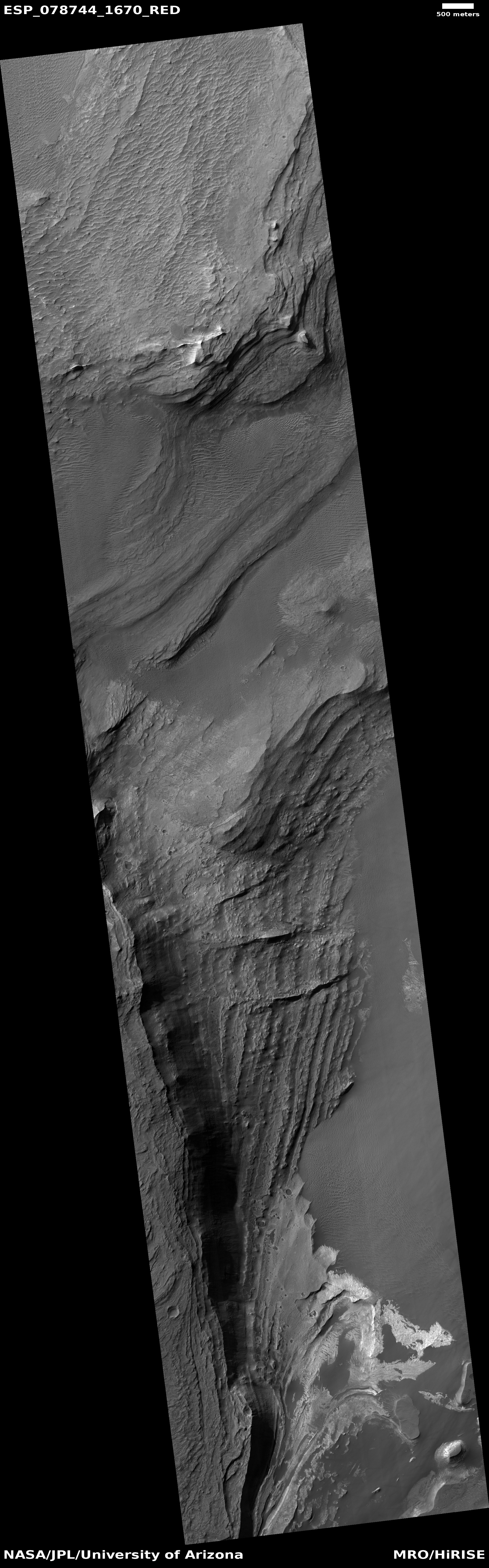
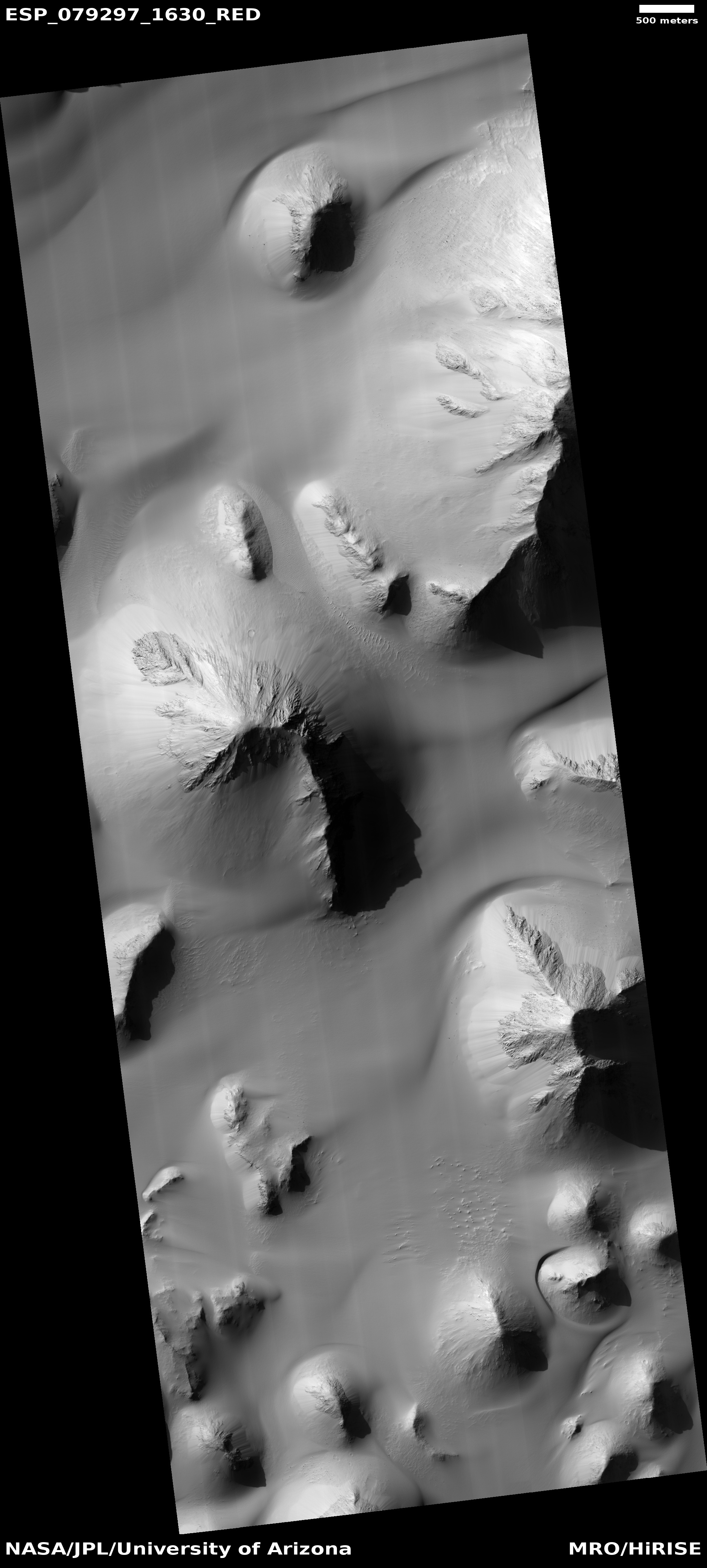
While the giant canyon Valles Marineris on Mars is known best as the biggest known canyon in the solar system — large enough to cover the continental United States several times over — that size tends to diminish the mountainous nature of its interior. Today’s cool image attempts once again (see for example these earlier posts here, here, here, here, and here) to illustrate that stupendous and mountainous nature.

The picture to the right, rotated, cropped, reduced, and sharpened to post here, was taken on May 15, 2023 by the high resolution camera on Mars Reconnaissance Orbiter (MRO). The goal of the picture was to get a better view of the numerous layers of this terraced cliff wall. What I see, however from my tourist’s perspective, is a steep wall that descends almost 4,500 feet from the high to the low point in just over three miles. This is as steep if not steeper than the walls of the Grand Canyon.
» Read more

2 comments

Where the Martian landscape begins to dry out

Where Mars begins to dry out
Click for original image.

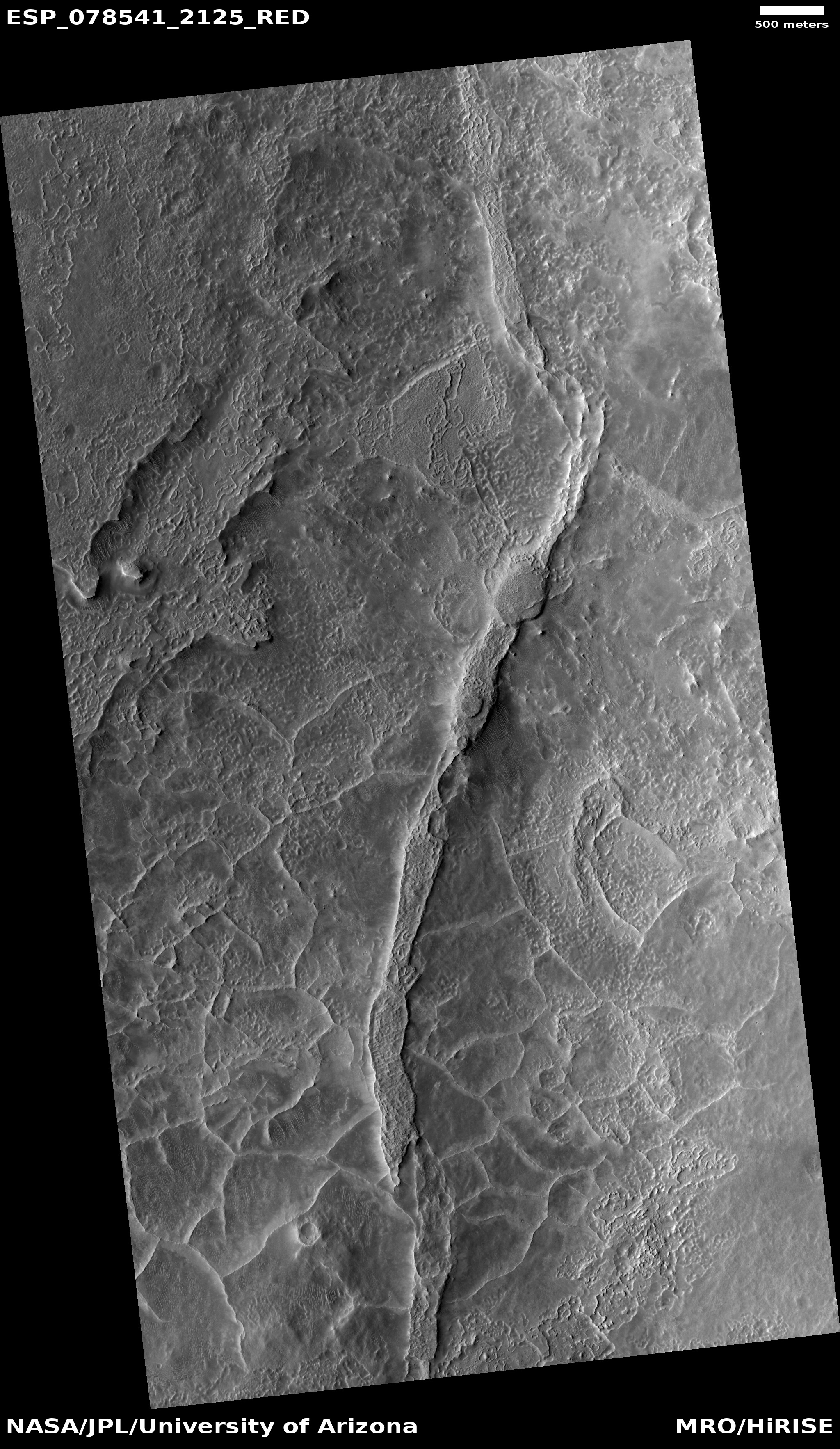
Today’s cool image to the right, cropped, reduced, and sharpened to post here, provides us a glimpse at the lower mid-latitudes of Mars where the terrain is beginning to dry out as we move south. The picture was taken on April 29, 2023 by the high resolution camera on Mars Reconnaissance Orbiter (MRO), and shows what the scientists label “large linear features.”

The main north-south ridge is only about 20-25 feet high, and its meandering nature (which can be seen more clearly in the full image) suggests it is possibly an inverted channel, formed when the bed of a former canyon gets compressed by the water or ice that flows through it, and when the surrounding terrain gets eroded away that channel bed becomes a ridge.

These ridges however could also possibly be volcanic dikes, where magma had pushed up through fractures and faults to form these more resistant ridges.
» Read more

0 comments

The very tip of a thousand-mile-long crack on Mars

The very tip of a 1000-mile-long Martian crack
Click for original image.

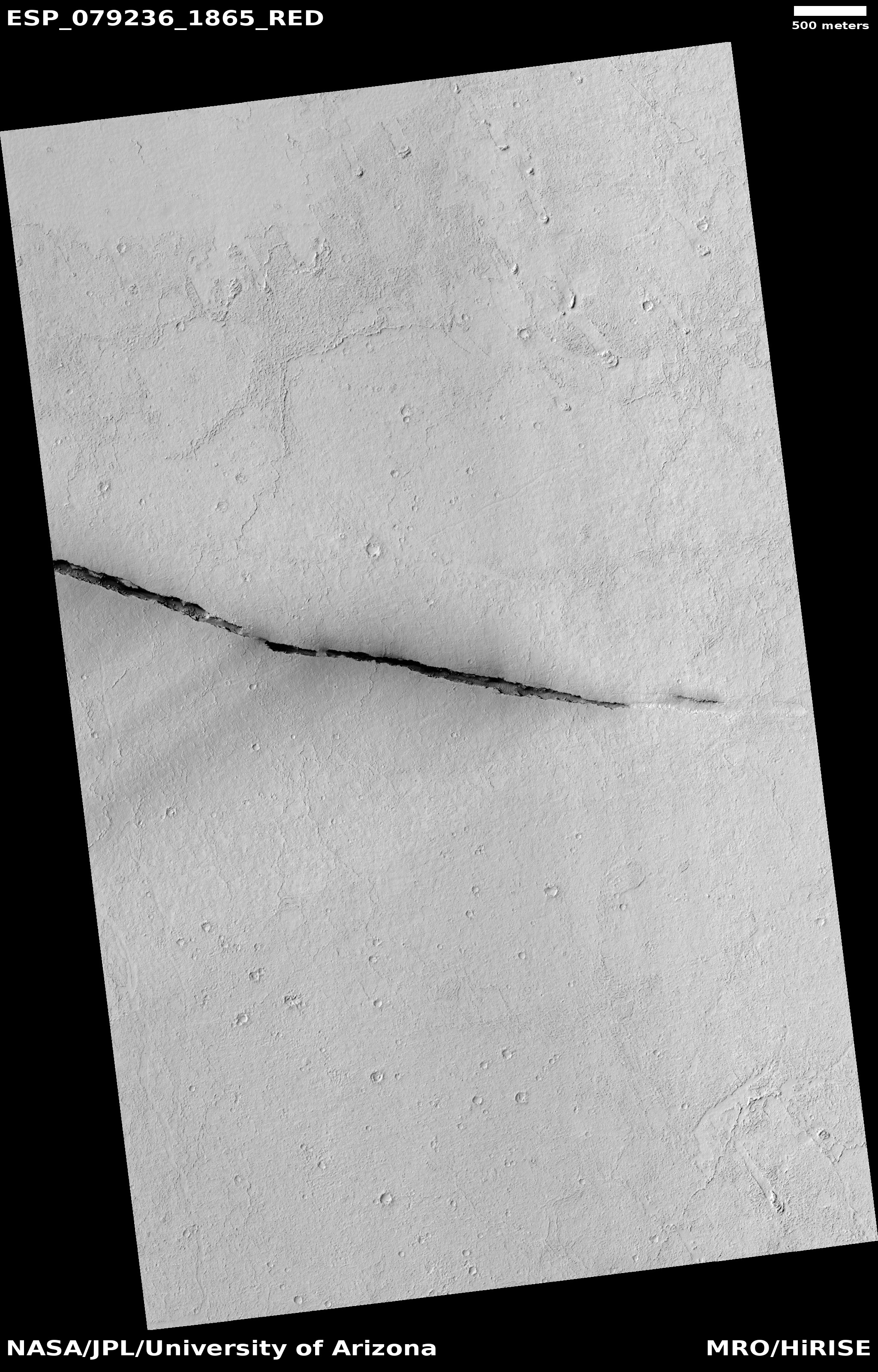
Cool image time! The picture to the right, rotated, cropped, reduced, and sharpened to post here, was taken on June 22, 2023 by the high resolution camera on Mars Reconnaissance Orbiter (MRO). It shows what the scientists label as “The tip of Cerberus Fossae,” a thousand-mile-long crack in the surface of Mars formed when the ground was pulled apart by underground forces.

If you look closely at the picture’s right edge, you can see that beyond the end of the fissure it actually continues but appears filled with material. In the full picture this however is the end of the crack. Beyond this point the ground is as smooth and as generally featureless as seen within the picture itself, and as also shown in this MRO context camera view of the same area.

Cerberus Fossae is actually three parallel cracks, with this the northernmost one. The eastern tip of the middle crack was previously highlighted in a cool image in July 2022.
» Read more

0 comments

A Martian wedding cake surrounded by brain terrain

Brain terrain surrounding a Martian wedding cake
Click for original image.

Of all many cool images I’ve posted, today might take the cake (pun intended) for the best illustration of the alien nature of Mars. The picture to the right, cropped, reduced, and sharpened to post here, was taken on June 28, 2023 by the high resolution camera on Mars Reconnaissance Orbiter (MRO), and shows what the scientists simply label as “flow features.”

I personally don’t see any obvious flow features in the full image, unless one wants to call the brain terrain that covers this entire plain a flow feature. Brain terrain is a feature unique to Mars whose origin remains a mystery to geologists. As noted by scientists in captioned MRO image in 2019:

You are staring at one of the unsolved mysteries on Mars. This surface texture of interconnected ridges and troughs, referred to as “brain terrain” is found throughout the mid-latitude regions of Mars.

…This bizarrely textured terrain may be directly related to the water-ice that lies beneath the surface. One hypothesis is that when the buried water-ice sublimates (changes from a solid to a gas), it forms the troughs in the ice. The formation of these features might be an active process that is slowly occurring since HiRISE [MRO’s high resolution camera] has yet to detect significant changes in these terrains.

The wedding cake inside the small crater to the upper right only adds to the alienness of this terrain.
» Read more

1 comment

Mars’ endless cycles of glacial activity

Overview map

Mars' endless cycles of glacial activity
Click for original image.

While the images being sent to us from Mars Reconnaissance Orbiter (MRO) repeatedly show features that appear convincingly like glaciers, the data is also beginning to tantalize us with evidence of the endless glacial cycles that have occurred on Mars.

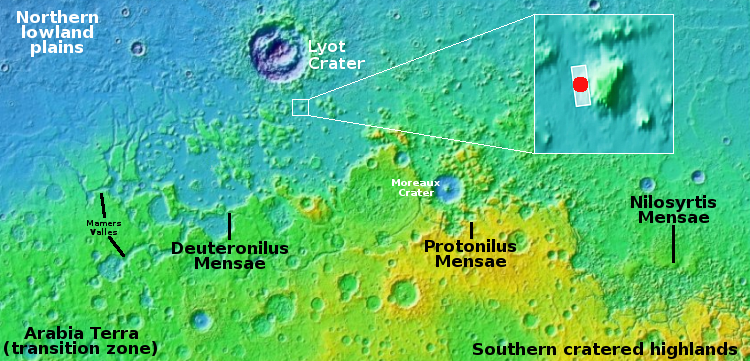
The picture to the right, cropped, reduced, and sharpened to post here, was taken on June 27, 2023 by MRO’s high resolution camera. The red dot in the inset of the overview map above shows the location, the western flanks of an apron that surrounds a 3,800-foot-high mesa in the chaos region Deuteronilus Mensae, the western end of the 2,000-mile-long mid-latitude strip of chaos regions I dub glacier country, because every image seems to show some form of glacial feature.

Today’s picture is no different. The apron shown here drops the last 1,000 feet of the mesa’s total 3,800-foot height, during which it shows dozens of what the scientists label “parallel lines.” These lines likely reveal the layers of glacial ice in this apron, with the older layers larger and more extensive. Apparently, with each growth cycle the glacier obtained less snow from the atmosphere, so the more recent layers grew less.

In other words, the amount of water on Mars has been declining with time.

Untangling these numerous layers will undoubtedly give us a remarkably detailed history of Mars entire geological history. Unfortunately, that untangling cannot happen until we have boots on the ground, on Mars, able to drill core samples from many different places.

0 comments

The inexplicable behavior of Martian dust devils

The inexpicable behavior of Martian dust devils
Click for original image.

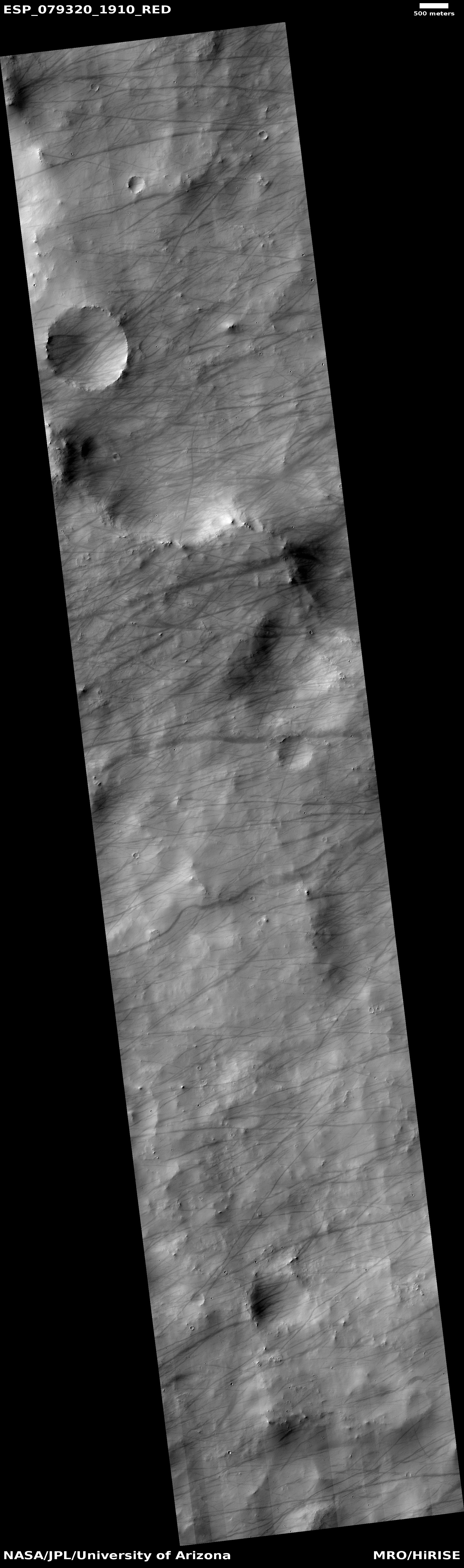
Today’s cool image illustrates the puzzling inclination of Martian dust devils to strongly favor specific regions on the Martian surface, for reasons that at present no one can confidently explain.

The picture to the right, rotated, cropped, reduced, and sharpened to post here, was taken on June 28, 2023 by the high resolution camera on Mars Reconnaissance Orbiter (MRO). It shows a plethora of dust devil tracks, almost all of which have an east-west orientation. Moreover, the tracks seem uninfluenced by the surface topography, continuing on their path without deviation, even as they cross cliffs, craters, and mounds. The orientation tells us the direction of the prevailing winds, though I don’t know if those winds blow to the east or to the west.

What makes this image revealing is that a gathering of such dust devil tracks is seen so rarely in other MRO high resolution photographs. I look at a lot of MRO pictures, and though dust devil tracks are not rare, most images don’t show this many. Apparently, there are specific conditions on Mars that cause a lot of tracks to appear in specific locations, either because atmospheric conditions create a lot more dust devils, or the ground conditions allow the tracks to become more visible.
» Read more

6 comments

An avalanche in the West Virginia of Mars

An avalanche in the West Virginia of Mars
Click for original image.

Cool image time! The picture to the right, rotated, cropped, and reduced to post here, was taken on June 27, 2023 by the high resolution camera on Mars Reconnaissance Orbiter (MRO).

I have cropped it to focus on this one hill, about 900 feet high (though the elevation data from MRO is somewhat uncertain at this resolution), because of that major landslide on its northern slopes. At some point in the past a major piece of the exposed bedrock at the top broke off and slide about halfway down the mountain, almost as a unit, settling on the alluvial fill that comprises the bottom half of the hill’s flanks.

The bedrock surrounding the peak is also of interest because of its gullies, all of which were created by downward flowing material. Was it ice? Water? Sand? Or maybe a combination of two or three? If water or ice was involved it was a very long time ago, as this location is in the dry equatorial regions of Mars. There is little known near-surface ice here.
» Read more

1 comment
1 40 41 42 43 44 212