Ingenuity’s 55th flight completed

Overview map
Click for interactive map.

The Ingenuity engineering team today updated the helicopter’s flight log, showing that the 55th flight occurred on August 12, 2023, one day later than originally planned, and flew 881 feet for 143 seconds, 61 feet and 9 seconds longer than planned.

The overview map above shows the present locations of both Perseverance and Ingenuity. The green dot marks Ingenuity’s new position, while the blue dot marks where Perseverance presently sits in Jezero Crater. Based on this map, the main goal of the flight was apparently to fly Ingenuity over a route that Perseverance will likely use to return to its planned route, as indicated by the red dotted line.

0 comments

Residual ice on the shaded north-facing slope of northern Martian crater

Residual ice on Mars?
Click for original image.

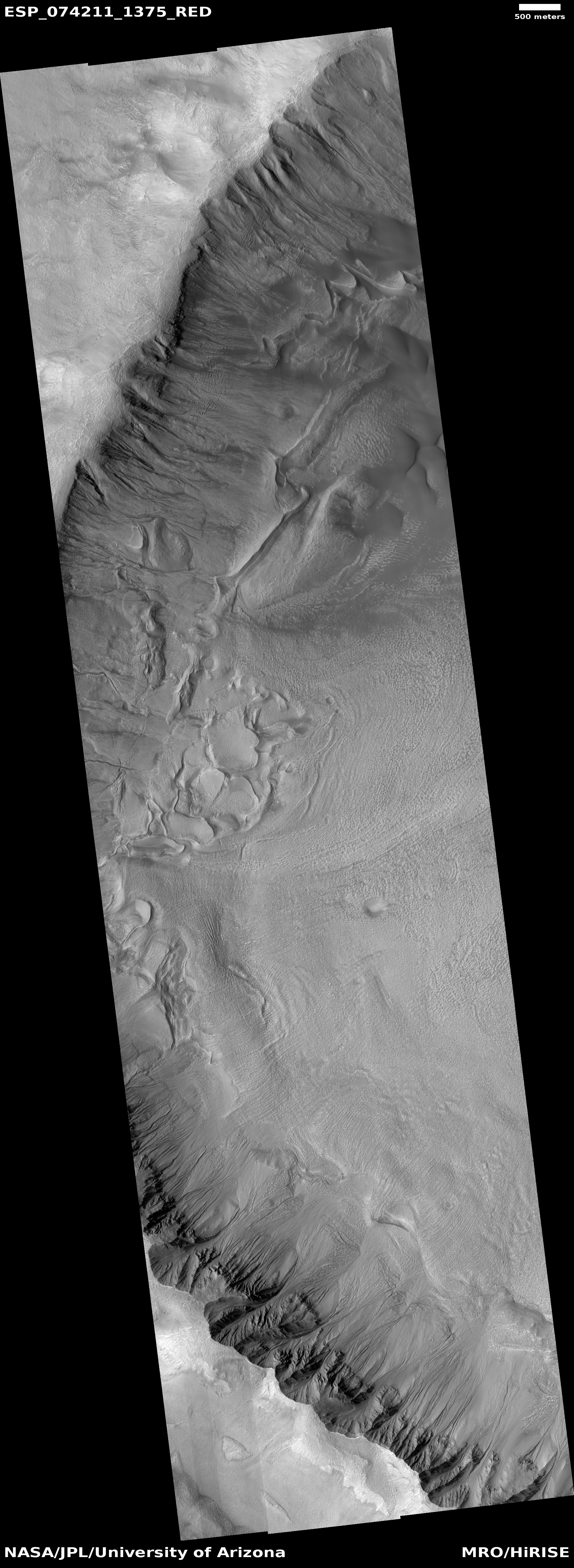
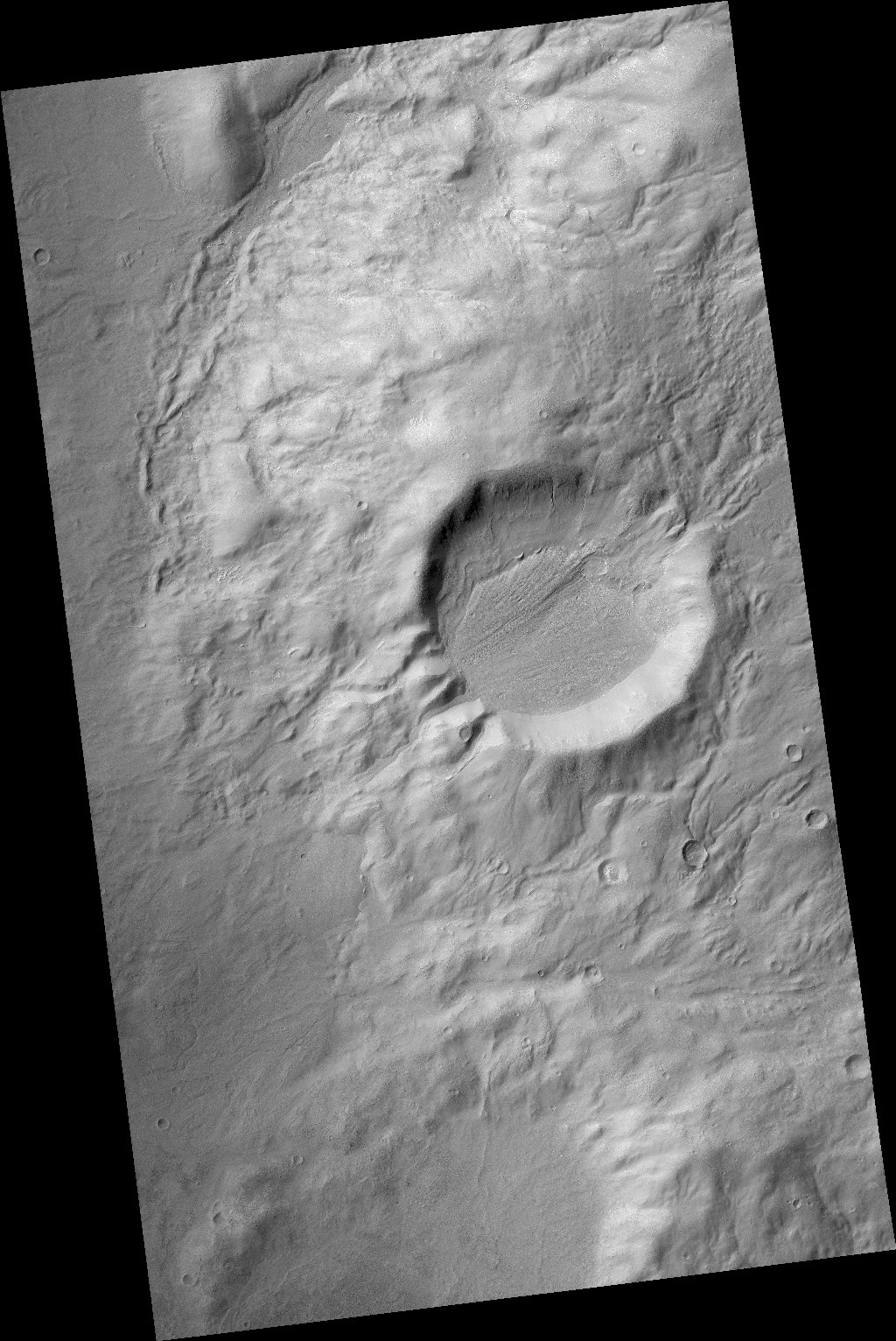
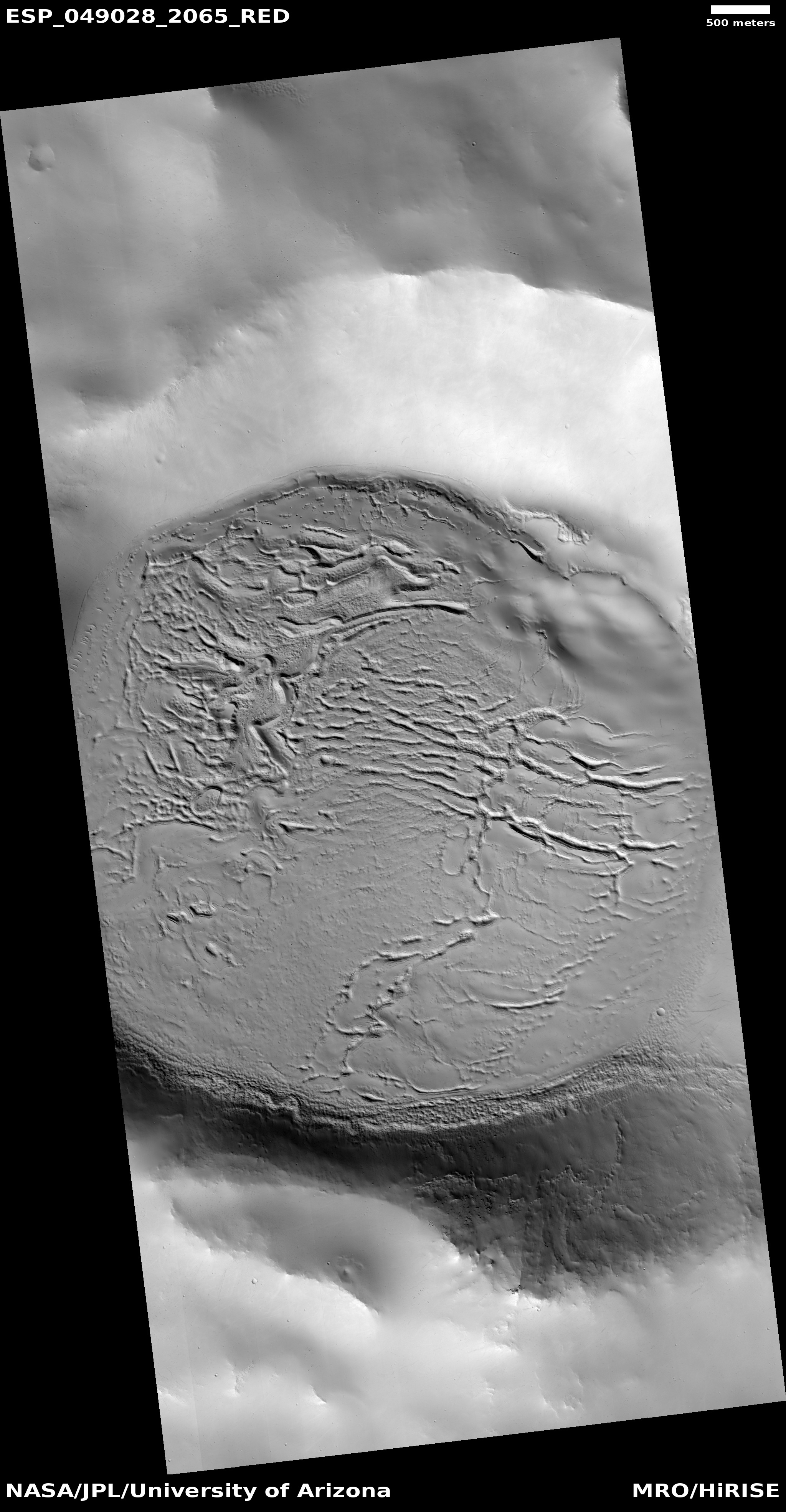
Cool image time! The picture to the right, rotated, cropped, reduced, and sharpened to post here, was taken on April 10, 2023 by the high resolution camera on Mars Reconnaissance Orbiter (MRO). In the headline I am speculating a bit when I call that pile of material bunched up against the interior slope of this unnamed 18-mile-wide crater residual ice. No data is available to me that proves that assumption, but the look, the location, and the general previous data from Mars all tell me that this is what it is.

First, the location within the crater. Everyone who has lived in the northern latitudes where snow falls knows that snow will remain in the shaded slopes that face north — where less direct sunlight falls — much longer than in places where there is more sunlight. You can sometimes even find this residual snow as late as June and July in some such spots.

This phenomenon will be no different on Mars. In those alcoves this material, which looks exactly like glacial features found in many other places in the mid-latitudes of Mars (such as inside the small half-mile-wide crater in the lower left), is well protected, so that even when the rest of the ice sublimated away within the crater it remained. The cliff wall rises five hundred feet to the south, blocking sunlight so that for most of the year little directly sunlight touches this surface.
» Read more

0 comments

The flat and mostly featureless flood lava plains of Mars

The flat and mostly featureless lava plains of Mars
Click for original image.

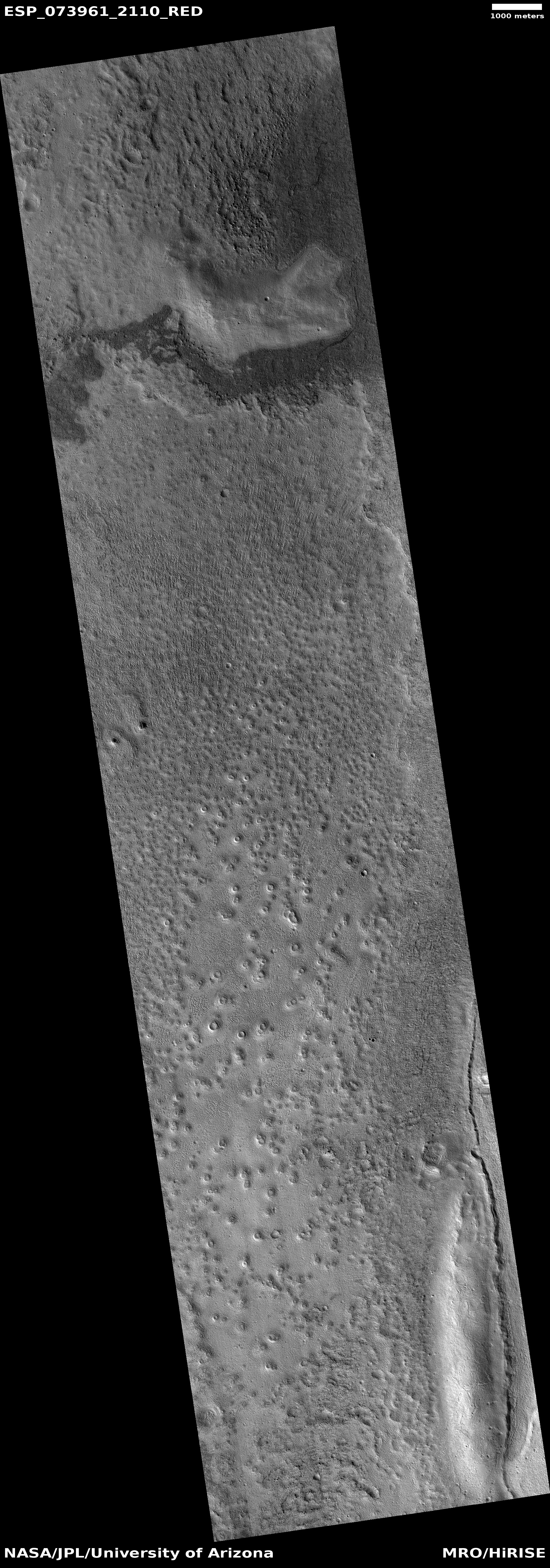
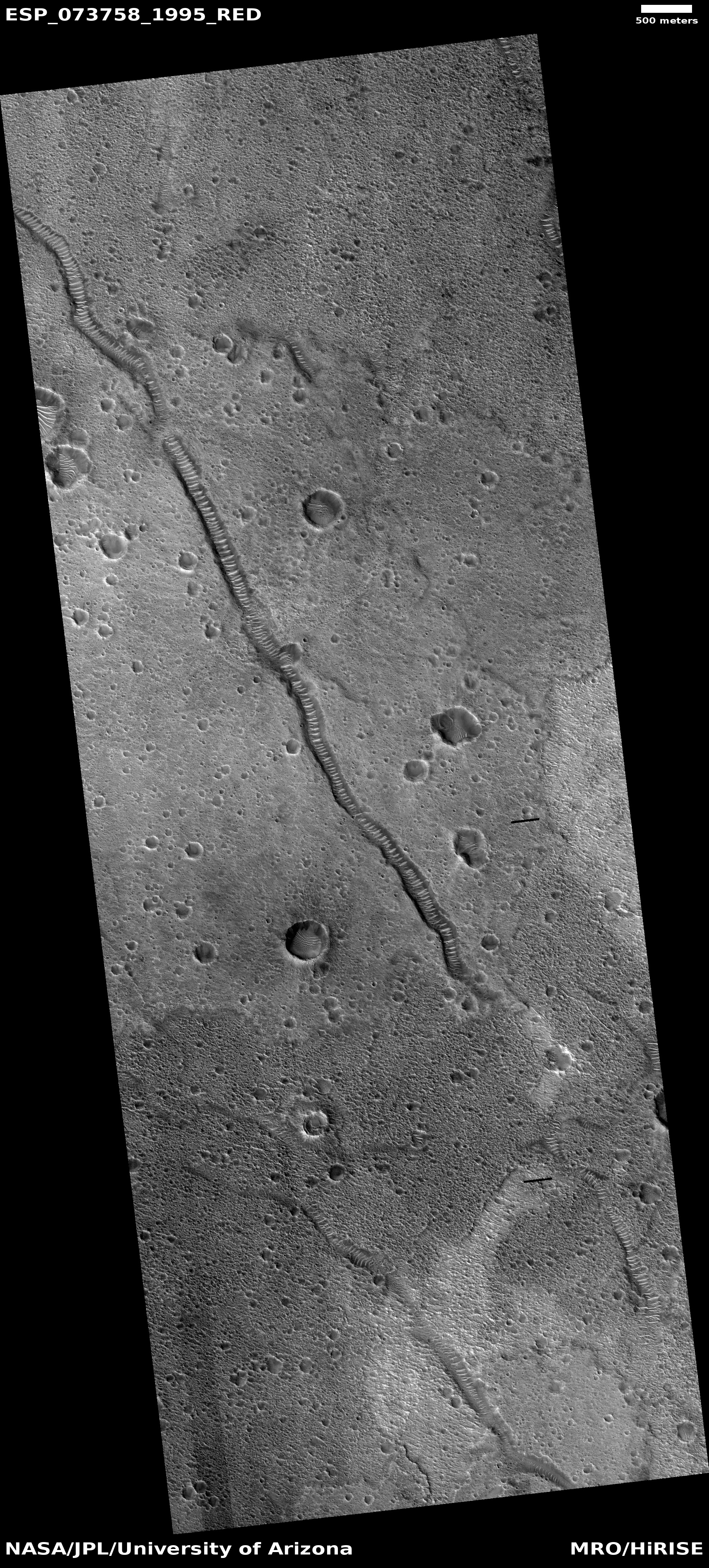
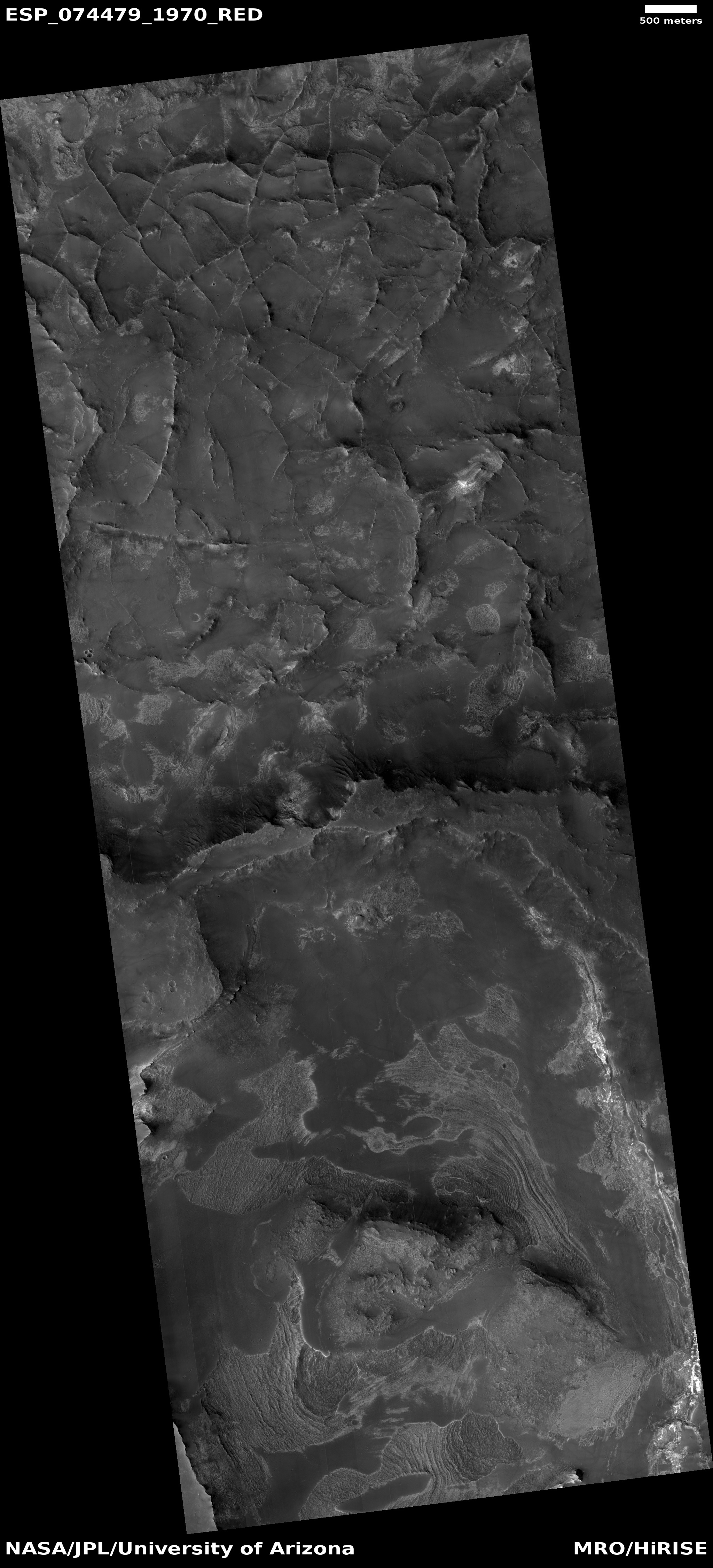
Cool image time! The picture to the right, rotated, cropped, reduced, and sharpened to post here, was taken on July 3, 2023 by the high resolution camera on Mars Reconnaissance Orbiter (MRO). Dubbed a “terrain sample” by the camera team, it was likely taken not as part of any scientist’s specific research program but to fill a gap in the camera’s schedule in order to maintain its proper temperature. When the camera team needs to do this they try to pick something of interest that is below during that gap.

In this case MRO was over the vast flood lava plains of Mars where for many hundreds of miles the only features are small variations produced from different overlapping lava flood events. The layers of lava in this region in fact appear so thick that there are relatively few places where the older topography still sticks up through the lava. In the case of this picture, the ridges might indicate such buried topography, but they also might simply be dikes of lava, pushed up through fissures from underground.
» Read more

0 comments

Perseverance videotapes Ingenuity’s 54th flight, a short hop up and down

Ingenuity in flight on August 3, 2023

As I predicted last week, the Perseverance science team have successfully filmed the 54th flight of Ingenuity on August 3, 2023, using the high resolution cameras on masts on top of the Mars rover.

I have embedded that movie below. The image to the right is a screen capture from that movie, when the helicopter was hovering at sixteen feet elevation. Since Perseverance was about 200 feet away to the northeast, the horizon line in the background is the southwest rim of Jezero crater, about ten miles away, with the intervening hills about five miles closer.

The flight was a simple hop, up and down, to verify Ingenuity’s systems after its previous flight had ended prematurely.

The helicopter’s 55th flight was scheduled to occur yesterday, traveling 820 feet for 134 seconds, but so far there is no word on whether it happened as planned.
» Read more

2 comments

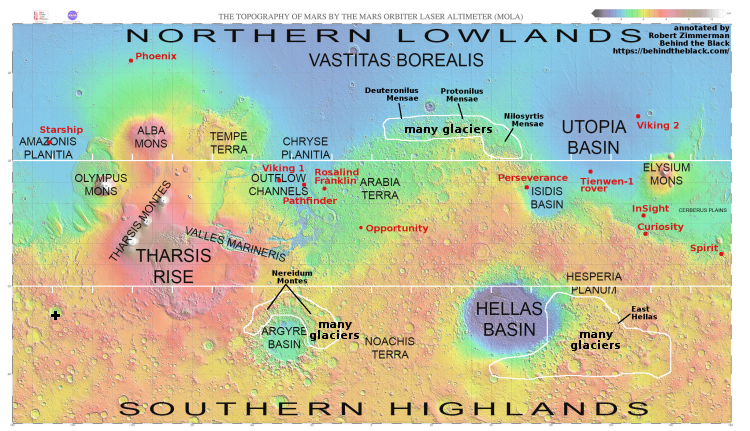
The icy mountains close to where SpaceX hopes to land Starship on Mars

The icy mountains near Starship's landing site on Mars
Click for original image.

Cool image time! The photo to the right, rotated, cropped, reduced, and sharpened to post here, was taken on June 25, 2023 by the high resolution camera on Mars Reconnaissance Orbiter (MRO). Labeled as showing “flow features” by the scientists, it gives us a nice example of many of the different types of glacial and near-surface ice features seen routinely in the Martian latitudes above 30 degrees, especially in the northern hemisphere.

First there is the apron around the mound. Its layering suggests the many cycles that Mars’ climate has undergone as its rotational tilt swung back and forth from as low as 11 to as much as 60 degrees (it is presently at 25 degrees).

The mound, with those two depressions at its peak, suggests the possibility that it is some form of ice/mud volcano, similar to the suspected ice/mud volcanoes routinely seen in the northern lowland plains of Utopia Basin.
» Read more

4 comments

Martian craters or volcanoes?

Martian craters or volcanoes?
Click for original image.

Cool image time! The picture to the right, cropped and reduced to post here, was taken on June 30, 2023 by the high resolution camera on Mars Reconnaissance Orbiter (MRO). The scientists label these features “cones” because many of the depressions sit on top of a mound or hill, suggesting some form of volcanic feature, either from erupting lava, ice, or mud.

Yet, are they volcanoes? Some or even many could instead be impact craters, created when a asteroid broke up during infall, creating a spray of bolides. Erosion of surrounding terrain can create what scientists call pedestal craters, but if all these craters were from an impact than all would either be pedestal craters, or not. Instead, we have a mix of some craters above and others level with the terrain.
» Read more

1 comment

Ingenuity snaps picture of Perseverance during 54th flight

Perseverance as seen by Ingenuity on August 8th
Click for original image.

During Ingenuity’s 54th flight, a short vertical hop sixteen feet up and down that lasted only 25 seconds, the helicopter’s color camera managed to get a picture of the rover Perseverance, only about 200 feet away to the north.

That picture, cropped and enhanced to post here, is to the right. It shows Perseverance just inside the picture’s upper edge. Its graininess illustrates in a sense the engineering test nature of Ingenuity. It was never expected to last this long and to take actual scouting or science imagery. It was supposed to complete a 30 day program of a handful of test flights, proving it was possible to fly in Mars’ very thin atmosphere (1/1000th that of Earth). Instead, it has lasted years, and completed 54 flights, keeping ahead of Perseverance and providing the rover team scouting images of the ground they wish to travel.

1 comment

Ingenuity completes 54th flight, a short hop after previous flight ended prematurely

Overview map
Click for interactive map.

According to the Ingenuity engineering team, Ingenuity has successfully completed its 54th flight on Mars, a short 25 second hop up and down that was done to try to figure out why the previous flight previous flight, #53, had ended prematurely.

Flight 53 was planned as a 136-second scouting flight dedicated to collecting imagery of the planetโ€™s surface for the Perseverance Mars rover science team. The complicated flight profile included flying north 666 feet (203 meters) at an altitude of 16 feet (5 meters) and a speed of 5.6 mph (2.5 meters per second), then descending vertically to 8 feet (2.5 meters), where it would hover and obtain imagery of a rocky outcrop. Ingenuity would then climb straight up to 33 feet (10 meters) to allow its hazard divert system to initiate before descending vertically to touch down.

Instead, the helicopter executed the first half of its autonomous journey, flying north at an altitude of 16 feet (5 meters) for 466 feet (142 meters). Then a flight-contingency program was triggered, and Ingenuity automatically landed. The total flight time was 74 seconds.

This explains why, after the 53rd flight, the engineering team had not immediately added that flight to the helicopter’s flight log. That log is now updated to include both the 53rd and 54th flights, but the data from the 53rd flight was held back until after the 54th flight was completed.

The green dot in the overview map above shows Ingenuity’s present position, only a few feet to the west from its previous position shown here. The blue dot indicates Perseverance’s present position. The red dotted line indicates the planned route of the rover.

1 comment

Curiosity under the shadow of a Martian mountain

Panorama showing Kukenan on August 8, 2023
Click for full resolution. For original images, go here and here.

Overview map
Click for interactive map

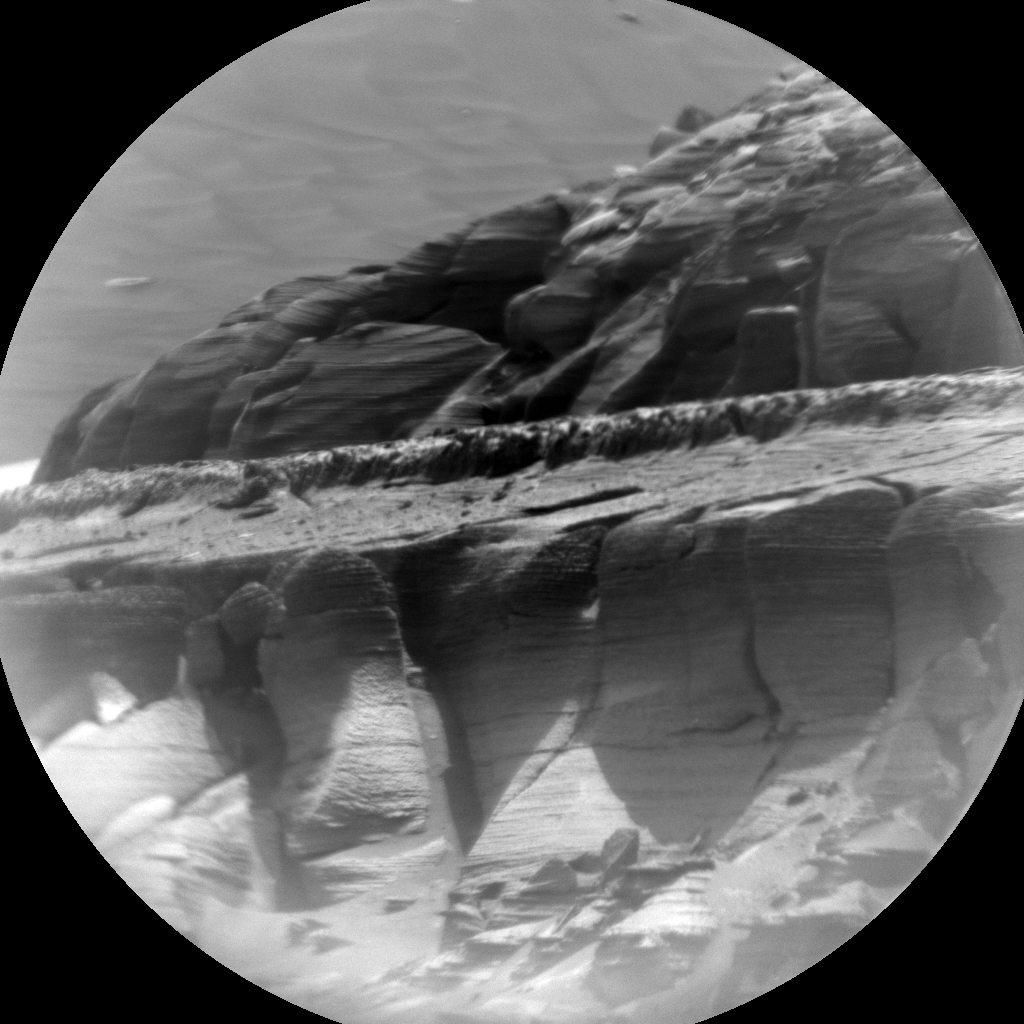
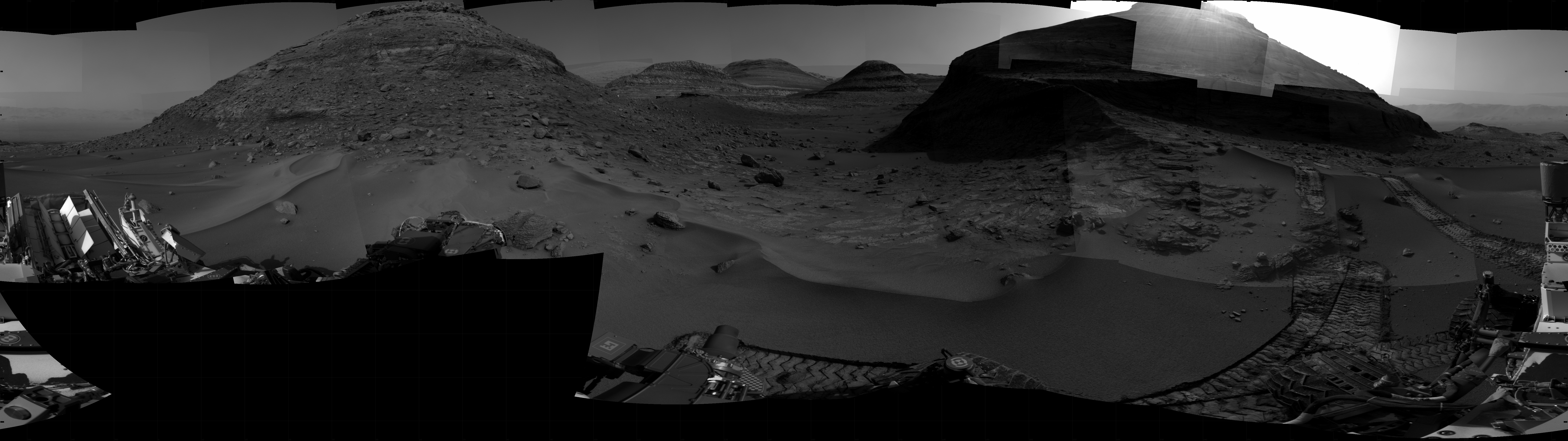
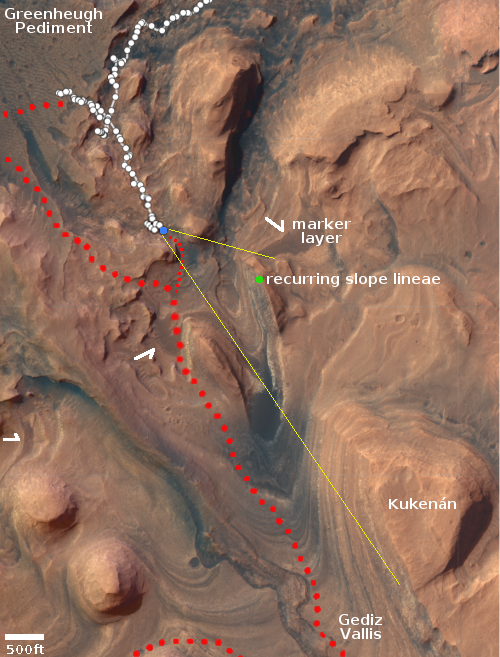
Another cool image to start the week! The panorama above was created using two navigation images taken by Curiosity on August 8, 2023. It looks almost due west at the dramatic western wall of 400-foot-high Kukenan butte.

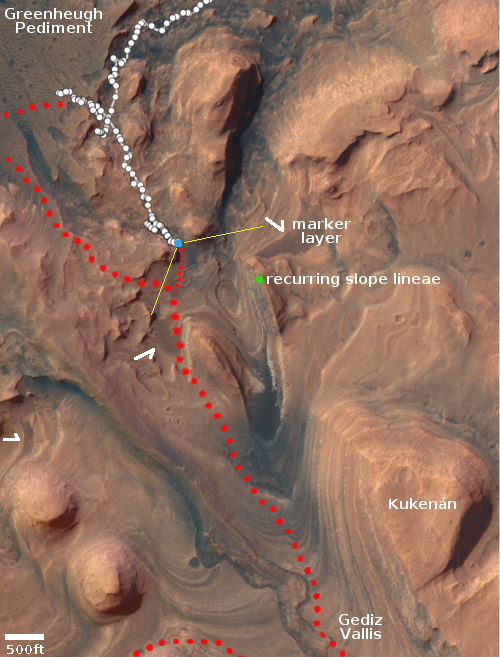
The blue dot on the overview map to the right marks Curiosity’s present location. The yellow lines indicate approximately the area covered by the panorama above. The red dotted line indicates the rover’s planned route.

Recently JPL issued a press release touting the efforts of its engineers to overcome the very steep and rocky terrain that Curiosity is presently traversing, an effort that I have documented repeated in the past few months (see posts here and here). They had been trying to send Curiosity straight up the mountain, to no success, and finally decided to do what every hiker and trail-maker does routinely, do back and forth switchbacks to reduce the grade per step.

In June they headed slowly uphill going east. In July they turned back and worked their way uphill going west, heading back to the Jau crater complex to get a quick look at these craters, then turned again in August to head back east, slowly working uphill along the contour lines. As they do this the rover is moving closer and closer to Kukenan, the largest butte so far studied in the foothills of Mount Sharp.

This panorama is one of the best illustrations of the very complex geological history of Mars. Each layer signals a past cycle in Mars’ very cyclic history, created because of the red planet’s wide swings of rotational tilt over time. Once underground, these layers have become exposed because erosion over the eons has slowly removed the material that once buried it, leaving the butte behind.

0 comments

A hiking paradise on Mars!

A hiking paradise on Mars
Click for original image.

Cool image time! The picture to the right, cropped, reduced, sharpened, and annotated to post here, was taken on May 21, 2023 by the high resolution camera on Mars Reconnaissance Orbiter (MRO). It shows one of Mars’ more impressive mountains with the Sun somewhat low in the western sky, resulting in the long dark shadows on the eastern slopes.

The line is my quick attempt to mark the obvious route that would be taken along that ridge line to get from the bottom to the top. This could be a hiking trail, or a road. In either case, the elevation gain from the bottom of the ridge to the plateau on top would be about 3,900 feet in about a mile and a half, very steep for Earth — at approximately a 26 degree grade — but probably quite doable in the one-third Martian gravity.

The lower end of my proposed route however is hardly the bottom of the mountain. The slope, now alluvial fill made up of dust and debris from above, continues downhill for another 5,400 feet. All told, from top to bottom the elevation gain is about 9,300 feet over 8.5 miles.
» Read more

4 comments

The dry and mountainous terrain west of Jezero Crater

The dry and mountainous terrain west of Jezero Crater
Click for original image.

Since my earlier update today about Perseverance and Ingenuity mentioned the very diverse and strange geology known to exist west of Jezero Crater and where the rover is eventually headed, I thought it worthwhile to post another cool image of that terrain.

The picture to the right, rotated, cropped, reduced and sharpened to post here, was taken on May 22, 2023 by the high resolution camera on Mars Reconnaissance Orbiter (MRO). Labeled a “terrain sample” image, the location was likely chosen by the camera team in order to fill a gap in the camera’s schedule so that they can maintain its proper temperature. Having a gap that put the spacecraft over this region to the west of Jezero was however a great opportunity to get another look at this rocky, mountainous, and very parched terrain, located in Mars’ very dry equatorial regions.
» Read more

0 comments

Perseverance snaps new close-up of Ingenuity

Overview map
Click for interactive map.

Ingenuity as seen by Perseverance on August 2, 2023
Ingenuity as seen by Perseverance on August 2, 2023.
Click for original image.

Cool image time! With Perseverance and Ingenuity in the past week getting close together for the first time in months, the Perseverance team naturally turned its high resolution mast cameras at the helicopter. The picture to the right, cropped, reduced, and sharpened to post here, was taken on August 2, 2023 by the rover’s left mast camera, showing Ingenuity only about two hundred feet away.

The blue dot on the overview map above shows Perseverance’s present location, with the green dot marking Ingenuity’s. The picture to the right is therefore looking almost due south. The red dotted line indicates the rover’s planned route, moving towards Neretva Vallis, the gap in the rim of Jezero Crater from which the delta had flowed, eons ago. The rover’s goal is to eventually enter that gap and explore the very diverse and strange geology known to exist outside the crater to the west.

We should also expect even better images of Ingenuity in the next week. Its 54th flight is scheduled for today, in which the engineering team wants to send the helicopter on a simple straight up and down hop of sixteen feet in order to better “localize” the helicopter. With Perseverance less than two hundred feet away, its cameras should be able to assemble a great movie of that flight.

1 comment
1 41 42 43 44 45 212