Inspector General: NASA’s lunar rover VIPER mission on schedule, with some cost increases

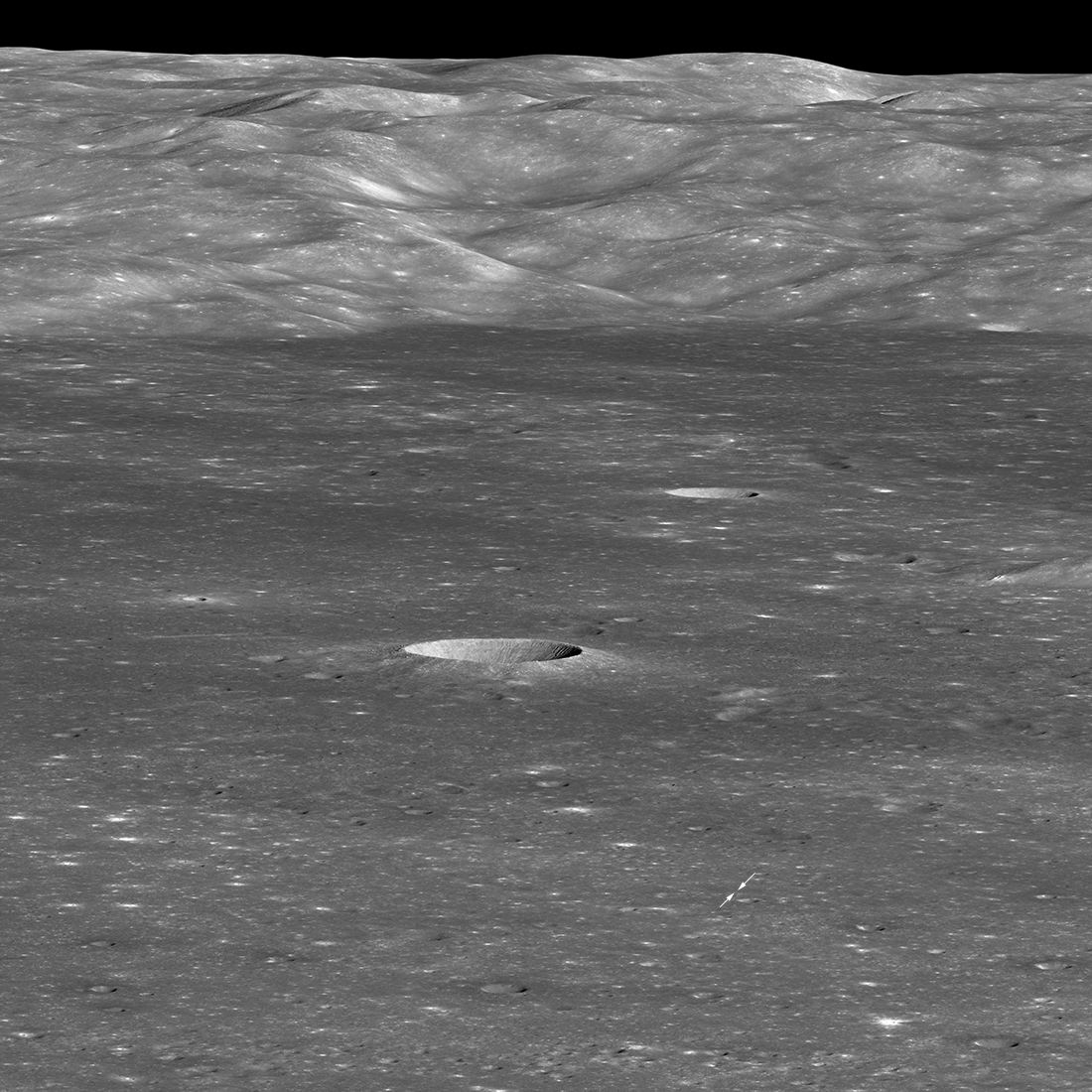
VIPER's planned route on the Moon

According to a report [pdf] issued today by NASA’s inspector general, the agency’s VIPER lunar rover mission is generally on schedule for its ’23 launch, though it has experienced some cost increases and still carries some scheduling risks, mostly related to the development of Astrobotic’s commercial Griffin lunar lander, and its precursor Peregrine mission that ULA hopes to launch on its first Vulcan rocket test.

Although Astrobotic personnel explained that Griffin’s development schedule is largely independent of its Peregrine mission, the Peregrine Lander—planned to launch in 2022—has multiple systems and subsystems that will also be used on Griffin. Therefore, any technical problems with these systems may adversely affect development of the Griffin Lander because Astrobotic would only have about a year, depending on the Peregrine launch date and start of lunar operations, to resolve the issues prior to NASA delivering VIPER for integration and launch. Furthermore, any failures during the Peregrine mission may lead to Griffin delays as NASA and Astrobotic investigate the failures and develop corrective actions.

In addition, VIPER long-lead acquisitions—such as the rover solar power array and avionics unit—have been affected by aerospace industry supply chain delays caused by COVID-19 as have delivery of computer boards and motor parts. Both of these issues have impacted design verification testing needed for the mission’s Critical Design Review, while COVID-19 also delayed some component development schedules.

Peregrine’s launch has been delayed by a year because Vulcan has been delayed because of Blue Origin’s problems with the BE-4 rocket engine. Though ULA hopes the Vulcan/Peregrine launch can occur late this year, that date remains very much in doubt. Further launch delays would thus threaten the launch of Griffin and VIPER.

As for the cost increases, the IG found that NASA had been forced to increase the budget for VIPER by 18.1%, a relatively minor increase compared to many of NASA’s other big projects. The IG noted however that further cost overruns are very possible, especially if the Peregrine mission experiences problems.

The photo above shows the rover’s presently planned route in the relatively flat area about 85 miles from the Moon’s south pole and near the western edge of Nobile Crater (pronounced No-BEEL-e).

1 comment

Europe to put instrument on Japanese rover being launched and landed on the Moon by India

The new colonial movement: The European Space Agency (ESA) has signed an agreement with Japan’s space agency JAXA to put a science instrument on a Japanese rover that will be launched by India to the Moon and landed there on an Indian lander.

Under the deal, ESA would provide instruments for the Japanese rover, which would be used in the exploration of the Moon’s south pole under the mission targeted for 2024. … The lunar endeavour between the Indian Space Research Organisation (ISRO) and JAXA is called the Lunar Polar Exploration Mission (LUPEX) which aims to launch an Indian lander and a Japanese rover to the Moon.

In the next three years a lot of landers and rovers are planning to land on the Moon, most built by private American companies flying NASA and private payloads, but also joined by probes being sent by Russia, China, and now this Japanese-Indian-European mission. Even if only half succeed, the exploration of the lunar surface will still be quite busy.

0 comments

The most valuable real estate on the Moon

The most valuable real estate on the Moon
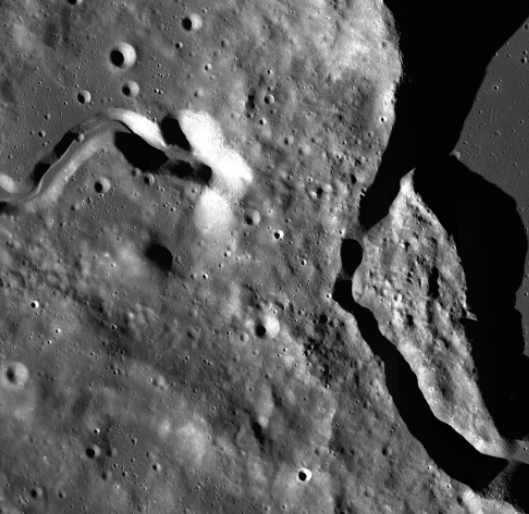
Click for full image.

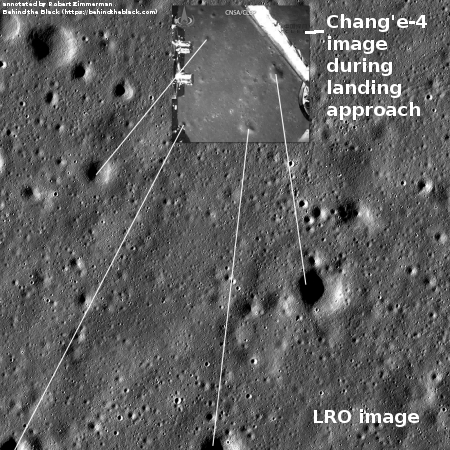
Cool image time! The photo to the right, reduced and annotated to post here, is an oblique view of the terrain near Shackelton Crater and the Moon’s south pole, taken by Lunar Reconnaissance Orbiter (LRO) and released today.

Shackleton-de Gerlache ridge, about 9 miles long, is considered one of the prime landing sites for both a manned Artemis mission as well as the unmanned Nova-C lander from the commercial company Intuitive Machines. To facilitate planning, scientists have created a very detailed geomorphic map [pdf] of this region. As explained at the first link above,

Going back to time-proven traditions of the Apollo missions, geomorphic maps at a very large scale are needed to effectively guide and inform landing site selection, traverse planning, and in-situ landscape interpretation by rovers and astronauts. We assembled a geomorphic map covering a candidate landing site on the Shackleton-de Gerlache-ridge and the adjacent rim of Shackleton crater. The map was derived from one meter per pixel NAC image mosaics and five meters per pixel digital elevation models (DEM) from Lunar Orbiter Laser Altimeter (LOLA) ranging measurements.

Such geology maps guide planning and exploration, but actual images tell us what the first explorers will see. Below is a close-up overhead view of small area at the intersection of the ridge and the rim of Shackleton.
» Read more

5 comments

South Korea to build its own unmanned lunar lander

The new colonial movement: The government of South Korea has begun a project to build its own unmanned lunar lander, scheduled for launch sometime in the 2030s.

South Korea presented an action plan to develop a lunar lander weighing more than 1.5 tons that would carry out scientific research on the surface of the moon in the 2030s. The project is to begin in 2024 after a preliminary feasibility study.

The Ministry of Science and ICT would form a working group of industry-academic experts to conduct research on a lunar lander and draw up strategies and detailed plans by August 2022. It is a follow-up project to launch a lunar orbiter in August 2022. The lunar lander will be lifted by a next-generation homemade rocket.

The goal is to encourage the country’s own aerospace industry. The working group will spend the next month recruiting South Korean companies to join the project.

South Korea however has to first get its own homemade rocket, Nuri, to successfully launch. The first launch attempt in October 2021 failed, and the second has been delayed to fix the cause.

0 comments

Startup Astrolab unveils its manned lunar rover design

Capitalism in space: A small startup company, Astrolab, yesterday unveiled its concept for a manned lunar rover, designed for NASA’s Artemis program.

The company has already built a full scale prototype, which it tested in Death Valley. It also intends to try to win NASA’s contract for building it, with bidding expected to begin in only a few months.

Astrolab will likely have major competition for the LTV contract. Lockheed Martin announced in May 2021 a partnership with General Motors to design lunar rovers but said at the time their concept was still in the early stages. Northrop Grumman announced in November it was working with several companies on a lunar rover design but also provided few technical details.

By contrast, Astrolab, based in Hawthorne, California, is a 15-person company founded two years ago after [Jaret Matthews, the founder of the company,] left SpaceX.

In a rational world, Astrolab’s small size and newness would not matter, if its design was best. In the strange world of our modern federal government, however, the political clout of big companies like General Motors and Northrop Grumman could easily be more important, even if their designs are mediocre and cost much more. Their designs might not be inferior, but their clout cannot be ignored. It will make Astrolab’s success far more difficult, requiring this startup to offer something much more superior to have a chance of winning.

At the same time, the competition might very well force the older big space companies to up their game, which will be all to the good, for everyone.

0 comments

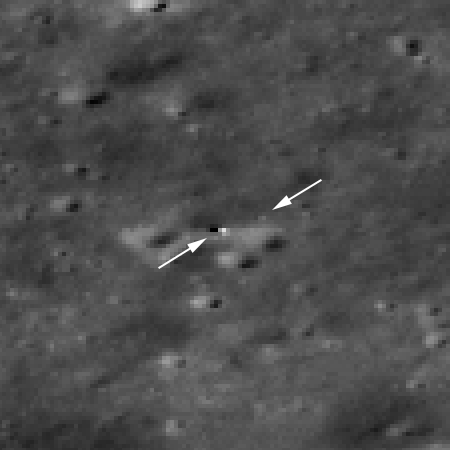
Chinese rocket stage impacts Moon

What is believed to be an abandoned upper stage from a Chinese launch in 2014 is now believed to have impacted the Moon’s far side, as predicted by the estimates of its orbital mechanics.

None of this story is certain, other than amateur astronomers had identified an abandoned uppers stage that they calculated would hit the Moon on March 4th. While the data strongly suggests it was an upper stage from a Chinese launch, that is not confirmed. And so far we do not have confirmation of the impact either. Expect images identifying the impact site from Lunar Reconnaissance Orbiter (LRO) in the next few months.

3 comments

Scientists: Yutu-2 spots tiny glass globules similar to those found by Apollo astronauts

According to a paper just published Chinese scientists running the Yutu-2 rover on the far side of the Moon have spotted several tiny glass globules similar to those found by Apollo astronauts.

Xiao and his team believe the small spheres, which are between 0.59 and 0.79 inches (1.5 to 2.5 centimeters) across, were probably formed by relatively recent meteor impacts. Specifically, the researchers believe that the globules formed from anorthosite, a volcanically-formed rock rich in the mineral feldspar, after a high-energy impact melted the rock and reformed into spheres.

In appearance these Yutu-2 globules appear translucent, unlike the Apollo globules which were either dark or opaque. Since the rover did not do spectroscopy on these objects before moving on, however, their actual make-up is unknown, with the speculations by the researchers above merely that, speculations, though reasonable.

0 comments

China denies the rocket stage about to hit the Moon comes from its rocket

A Chinese official yesterday claimed that the abandoned rocket stage that will hit the Moon on or about March 4th does not come from its 2014 Long March 3C rocket that tested technology for the later launched Chang’e-5 lunar sample return mission, as suggested by amateur astronomers and an engineer at JPL.

“According to China’s monitoring, the upper stage of the rocket related to the Chang’e-5 mission entered into Earth’s atmosphere and completely burned up,” Foreign Ministry spokesperson Wang Wenbin said Feb. 21.

Space tracking data from the Space Force’s 18th Space Control Squadron suggests that 2014-065B—the international designator for the rocket stage in question—reentered the atmosphere in October 2015, a year after launch, apparently backing China’s claim.

We are thus left with a mystery. If that abandoned upper stage did not come from either a SpaceX or Chinese launch, what launch did it come from? Or is it a rocket stage at all? Could it be a previously unidentified asteroid?

There is also the possibility that it is a piece from that Chinese launch, considering how the orbital data matches so well. The stage could have split or broken apart, with one part falling in the ocean as monitored by the Space Force, and the other section now heading for the Moon. If so, China is likely denying this fact for propaganda reasons.

6 comments

You can now buy payload space on a lunar rover!

Capitalism in space: Lunar Outpost, which is building a mini-rover that will fly on the private Intuitive Machines lunar lander scheduled for launch later this year, has now partnered with the company Copernic to sell the rover’s spare payload space to whoever wants to buy it.

Lunar Outpost of Evergreen, Colorado, is preparing to send a 10-kilogram robotic rover to the moon on an Intuitive Machines lander and SpaceX Falcon 9 rocket later this year. While the lander’s primary payload is a Nokia LTE 4G technology demonstration, Lunar Outpost is working with Copernic Space to sell an additional 3.475 kilograms on its first Mobile Autonomous Prospecting Platform (MAPP).

…Copernic Space created the online platform to streamline the process of buying and selling space-related products and services like shares in a space startup, satellite sensor tasking or payload space. By applying blockchain technology, Copernic Space converts space assets into non-fungible or digital tokens, which are designed to be bought and sold online.

For the next 11 days, Lunar Outpost is selling a gram of payload capacity on its MAPP Lunar Rover for $4,250. The minimum order is 100 grams. In April, the public sale begins, allowing people to buy or sell as little as one-hundredth of a gram of payload space.

It appears purchase will be by using blockchain currency, and appears to also involve the purchase of “non-fungible or digital tokens”.

Normally I would applaud this effort, but the addition of these digital tokens makes the sale process seem less than straightforward and even a little suspicious. What exactly are customers buying? And what exactly will go to the Moon? Copernic’s website describes this process, but even there its seems exceedingly vague and uncomfortably like a con game.

From what I can gather, customers who buy payload space can use Copernic to create these non-fungible tokens which can then be resold to others to make back some of the cost. I wonder, however, why would anyone buy these tokens in the first place. As far as I can tell, they have absolutely no value in the real world.

1 comment

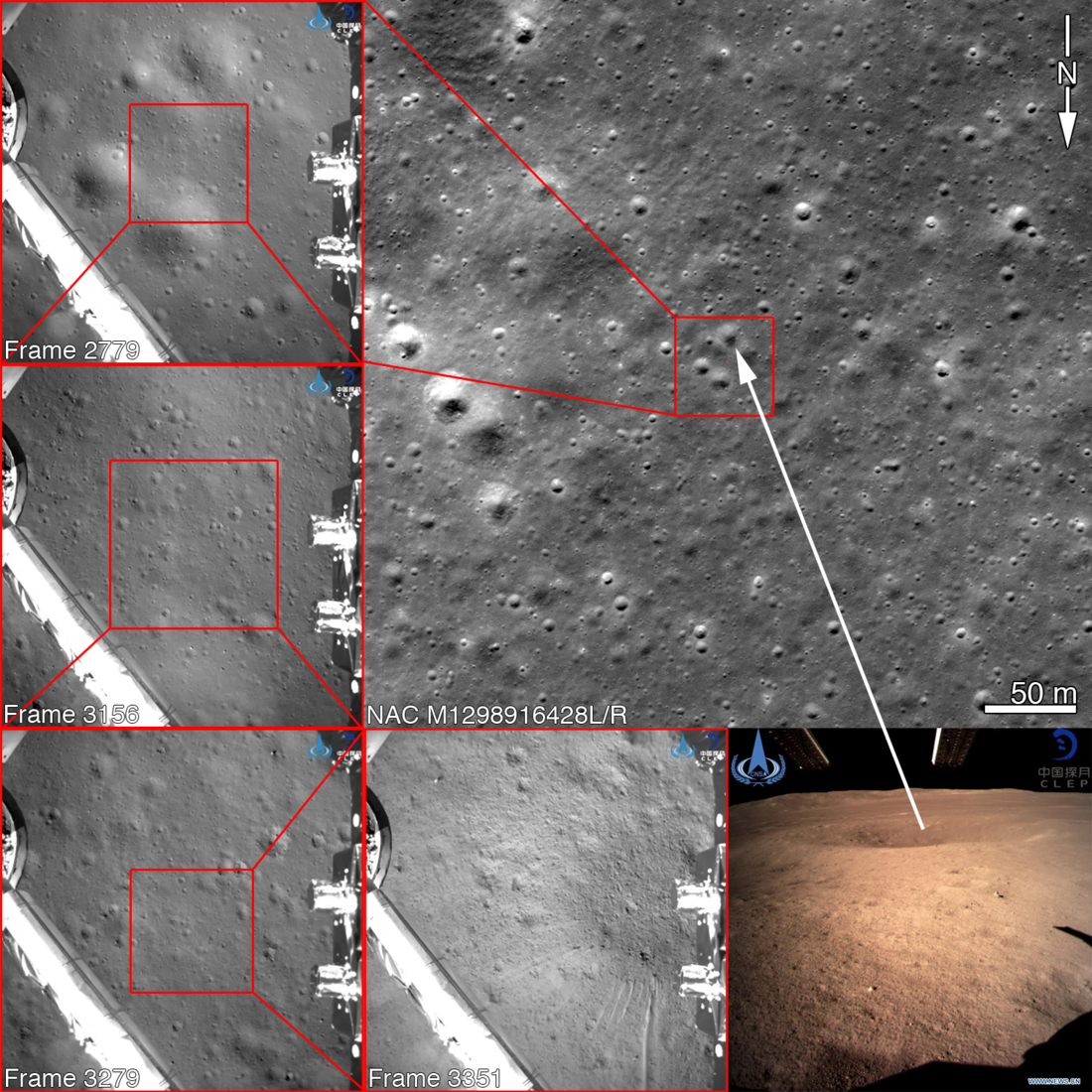
China tests lunar orbital maneuvers using last in-space component of Chang’e-5 sample return mission

China appears to be using the last in-space component of its Chang’e-5 sample return mission, left in lunar orbit after the samples came back to Earth and the sample ascent capsule was sent crashing to the lunar surface, to test a variety of lunar orbital maneuvers that could be used in future missions.

Chinese engineers have apparently moved it from a near-Moon orbit to what is called a distant retrograde orbit (DRO), shifting back and forth from the Lagrange points on each side of the Moon with respect to the Earth. Though some spacecraft in the Artemis program are planned to use this orbit, this is the first time anyone has done so.

[S]pacecraft activity tracker Jonathan McDowell, also an astrophysicist at the Harvard-Smithsonian Center, told SpaceNews that he believes China is probably using the Chang’e-5 spacecraft gaining experience with astrodynamics. “They are using it as a toy to play around with. It is clearly useful as a stable lunar orbit for future missions, I just don’t think it’s a specific precursor.”

This activity is also par for the course for China. They have previously used other leftover lunar spacecraft to test different orbital maneuvers. The activity also confirms China’s determination to continue its exploration and settlement of the Moon.

0 comments

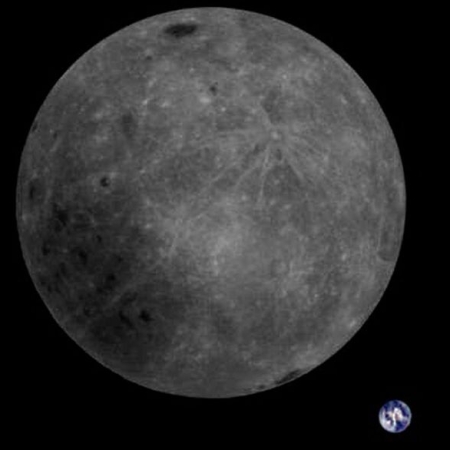
Astronomers form lobbying group to block development on Moon’s far side

Lunar zone reserved solely for astronomers
Lunar zone reserved exclusively for radio astronomers

In order to allow them to someday in the future maybe consider the idea of possibly building space-based radio telescopes on the Moon, astronomers have now formed a new lobbying group to advocate the creation of a zone more than a thousand miles wide on the Moon’s far side where all future development will be forbidden.

The new committee is chaired by Claudio Maccone, an Italian SETI (search for extraterrestrial intelligence) astronomer, space scientist and mathematician. Maccone supports creation of a Protected Antipode Circle or PAC, a large circular piece of lunar landscape about 1,130 miles (1,820 kilometers) wide that would become the most shielded area of the moon’s far side.

“PAC does not overlap with other areas of interest to human activity,” he said. “PAC is the only area of the far side that will never be reached by the radiation emitted by future space bases located at the L4 and L5 Lagrangian points of the Earth-moon system.”

In view of these unique features, Maccone believes the PAC should be officially recognized by the United Nations as an international protected area, where radio contamination by humans is curbed, now and into the future.

In other words, these astronomers want to be given, for free, full ownership of the region in the center circle on the graphic above for future radio telescopes, even though at present they have no plans or projects to build such things.

Though the idea of creating a region protected from radio signals so that good radio astronomy can be conducted has merit, no one should have the slightest sympathy for this request by astronomers. Why should anyone give them this vast amount of real estate when astronomers have shown so little interest in building any telescopes in space, anywhere?

Only after the astronomical community finally proposes an actual radio telescope for installation at this site should this request be given the slightest attention. Before that, it is merely a stupid power grab by elitists who deserve nothing from nobody.

11 comments

Rocket stage to hit Moon is from Chinese rocket, not Falcon 9 upper stage

Astronomers have now concluded that the rocket stage that will impact the Moon on March 4th is not an abandoned the Falcon 9 upper stage that launched the DISCOVR satellite in 2015, but an upper stage from a Chinese rocket.

It was an engineer at NASA’s Jet Propulsion Laboratory, Jon Giorgini, who realized this object was not in fact the upper stage of a Falcon 9 rocket. He wrote to Gray on Saturday morning explaining that the DSCOVR spacecraft’s trajectory did not go particularly close to the Moon, and that it would therefore be a little strange if the second stage strayed close enough to strike it. This prompted Gray to dig back into his data, and identify other potential candidates.

He soon found one—the Chinese Chang’e 5-T1 mission launched in October 2014 on a Long March 3C rocket. This lunar mission sent a small spacecraft to the Moon as a precursor test for an eventual lunar sample return mission. The launch time and lunar trajectory are almost an exact match for the orbit of the object that will hit the Moon in March.

Regardless, it will be very useful to pindown the exact impact time and place so that astronomers can observe it.

4 comments
1 37 38 39 40 41 94