Trees from space
We need to find them! Trees from space, planted here on Earth. You can see the known list here.
We need to find them! Trees from space, planted here on Earth. You can see the known list here.
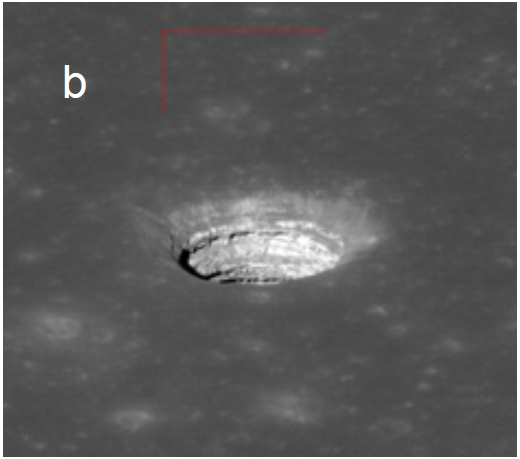
More images of lunar cave pits have been posted by the scientists of Lunar Reconnaissance Orbiter (LRO). They have also published their first paper [pdf] about these cave pits for the 2011 Lunar and Planetary Science Conference taking place in March. The paper summarizes, with images, what is know about the three pits on the Moon that have each been imaged a number of times at different angles and lighting situations.
One of the competitor’s for the Google Lunar X prize has signed a contract with SpaceX to use the Falcon 9 to get its spacecraft to the Moon. Key quote:
The Falcon 9 upper stage will sling Astrobotic on a four-day cruise to the Moon. Astrobotic will then orbit the moon to align for landing. The spacecraft will land softly, precisely and safely using technologies pioneered by Carnegie Mellon University for guiding autonomous cars. The rover will explore for three months, operate continuously during the lunar days, and hibernate through the lunar nights. The lander will sustain payload operations with generous power and communications.
If you’re interested, seats are available for a tourist trip around the moon in a Soyuz capsule. And the Russians say the Soyuz is ready to go!
An Israeli team has entered the Google Lunar X Prize competition, hoping to land a nanosat on the moon for only $8 million.
Keith Cowing is trying to locate a missing spectacular blow-up poster of the Lunar Orbiter “Earthrise” image from 1966, shown here.
The early Lunar Orbiter images, taken in the mid-1960s, have been reprocessed and recovered, in a spectacular manner.
Using old Apollo data, scientists have detected the Moon’s molten core.
Amateur astronomer Thierry Legault traveled to Oman to not only photograph the Moon as it eclipsed the Sun on January 4, but also capture the International Space Station at the same moment. The image he took of both as they crossed in front of the Sun is amazing.
An evening pause: The Christmas eve telecast by the Apollo 8 astronauts from lunar orbit, December 24, 1968, probably the most listened to space telecast in history. The story behind how and why these men said what they did is the central theme of my first book, Genesis, the Story of Apollo 8.
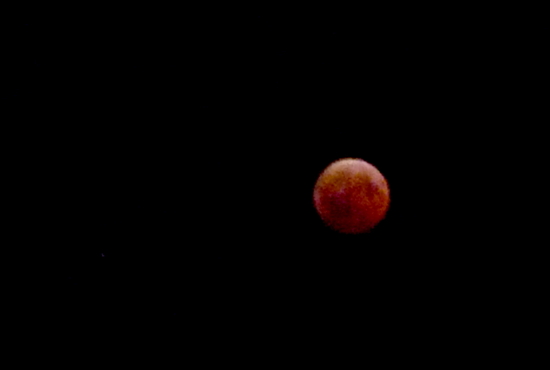
Last night’s lunar eclipse, as photographed by Jeff Bliss in Pleasanton, California.
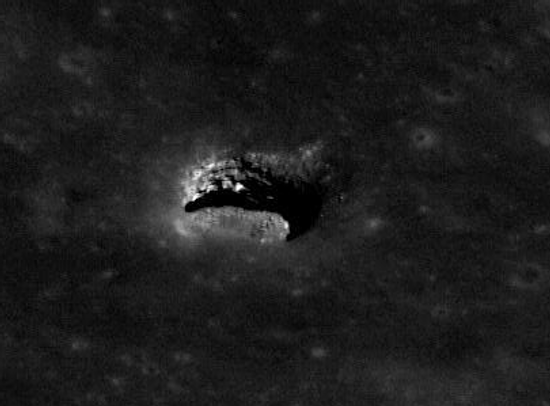
NASA engineer James Fincannon emailed me the image below, cropped from this Lunar Reconnaissance Orbiter scan. It shows a side view of the same lunar pit previously discussed by me in July (here and here).
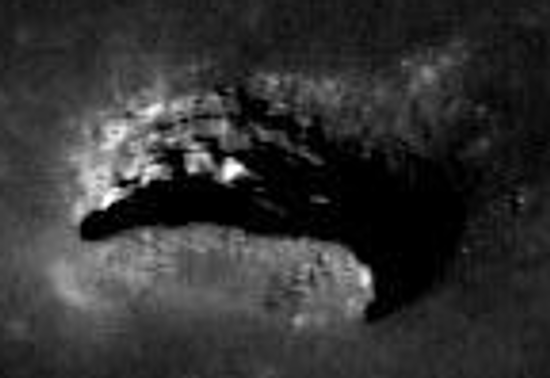
This image below was almost certainly ordered up by LRO scientists after seeing the images above so that they could get a look at the pit’s walls. I have further cropped it and blown it up so we can get a really good look too! See the second image below.
In this side view, we are looking across the top of the pit at the far wall and floor. On that far wall you can see what look like three coarse horizontal layers, below which is a deeply shadowed floor layer that is probably either cave passage or a significant overhang. Further processing will probably be bring out some further details and hopefully answer this question.
In a previous post, I had noted that this wall is probably about 200 feet deep. This new image thus gives any experienced rock-climber or caver a very nice sense of what a rappel down the side of that pit would be like. To me, it reminds me of some of the open-air cave pits I’ve rappelled into in New Mexico.
Update: I should note that that overhang/cave entrance at the bottom of the pit is probably at least 30 feet high. An impressive entrance, indeed.
Also, lunar scientist Paul Spudis emailed me with these comments:
[The pit] is very similar to some tube systems that I have studied in Hawaii. The wall units are exposed lava flows. They are probably all from the event which made this flow — a single flow can be made up of multiple flow units, hence, the apparent “layering.”
Of course, getting into an open pit and then moving through open void lava tubes that radiate from it are two different things. In terrestrial tube systems, many tubes are open and accessible but sometimes they are not. They can be blocked up by frozen lava or rubble from adjacent tube collapse.
Unfortunately, I don’t think we’re going to know what the situation on the Moon is until we get there. However, I must say, this particular area looks very promising.
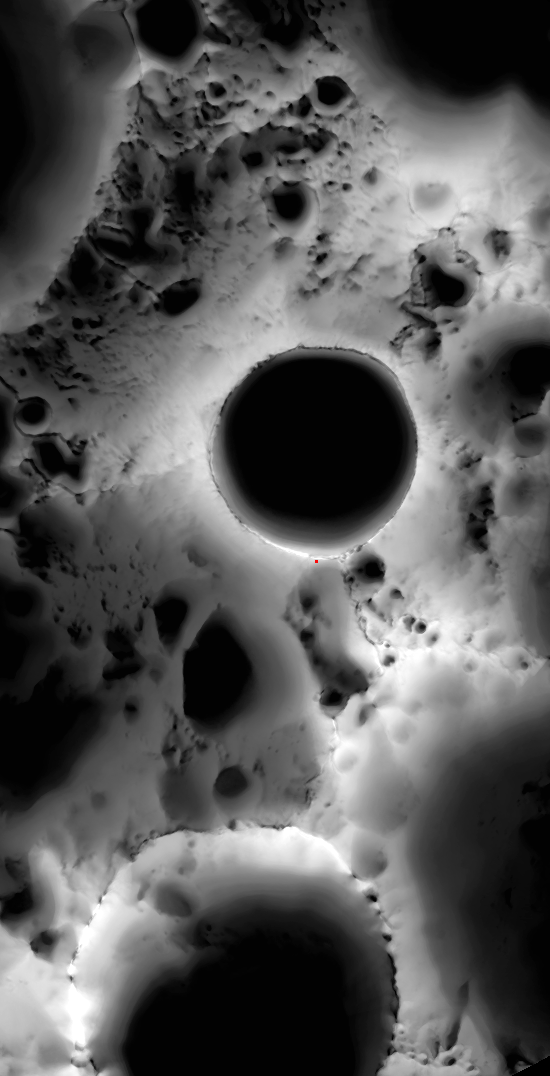
The image below was produced by Lunar Reconnaissance Orbiter by assembling data from numerous images over six months. The levels of brightness and darkness indicate the percentage of time in which an area is sunlight. The red dot just below the rim of Shackleton shows the approximate location of the south pole.
As you can see, the rim of Shackleton Crater nearest the south pole is illuminated by the sun most of the time, while the nearby crater floor never gets sunlight. This data confirms what Japanese scientists found using their lunar probe, Kaguya. The south pole has the ideal combination of locations with nearly continuous bright sunlight (to provide power) and nearly continuous darkness (where explorers will likely find significant amounts of frozen water), making this is an excellent location to build that first lunar base. And from the image you can see that the Shackleton Crater rim is not the only spot near the south pole with these conditions.
Also, if you look at the close-up image of Shackleton’s rim that I posted here, you will see that there is plenty of room to land and set up residence.
A Croatian space mission to the Moon?
Videos from the Chinese lunar probe, Chang’e 2.
Take a look at these spectacular images China released from its Chang’e 2 lunar probe that they say show potential landing sites for later Chinese probes.
China today released the first photos taken by Chang’e 2, its second lunar orbiter launched on October 1. More here, including one image.
The private race to the Moon, led by the Google Lunar X Prize. Key quote:
The Google Lunar X PRIZE offers a total of $30 million in prize money to the first privately funded teams to land robots on the Moon that explore the lunar surface by moving at least 500 meters and by sending back two packages of high definition video and photos we call Mooncasts. Unlike our first competition, the $10 million Ansari X PRIZE, the Google Lunar X PRIZE isn’t a ‘winner take all’ proposition: instead, we have a $20 million Grand Prize, a Second Place Prize that will award $5 million to the second team to meet all of the requirements, a series of technical bonus missions that can allow teams to earn as much as an additional $4 million, and a $1 million award that will go to teams that make the greatest contribution to stimulating diversity in space exploration and, more generally, in science, technology, engineering, and mathematics.
The competition operates on a “payment on delivery” model: the prize money is only given to teams after they complete a successful mission, meaning that each team needs to raise all the capital needed to design, develop and conduct their missions on their own. We’re now three years into a fairly long effort: the prize is available until all of the prize purses are claimed or until the end of the year 2015. Last week, we accepted our 24th team into the competition.
Paul Spudis provides a very detailed analysis of the recently released LCROSS lunar results. Key quote:
The Near-IR spectrometers on the LCROSS shepherding satellite detected abundant water (H2O) but also hydrogen sulfide (H2S), ammonia (NH3), methanol (CH3OH), methane (CH4), ethylene (C2H4) and sulfur dioxide (SO2). The uv-vis spectrometer found carbon dioxide (CO2), sodium, silver, and cyanide (CN). Aboard the distant LRO spacecraft, the ultraviolet LAMP imager detected hydrogen (H2), nitrogen, carbon monoxide (CO), sodium, mercury, zinc, gold (!), and calcium. But water, present in quantities between 5 and 10 weight percent, is the most abundant volatile substance present.