Endless ash fields on Mars

Endless ash fields on Mars
Click for original image.

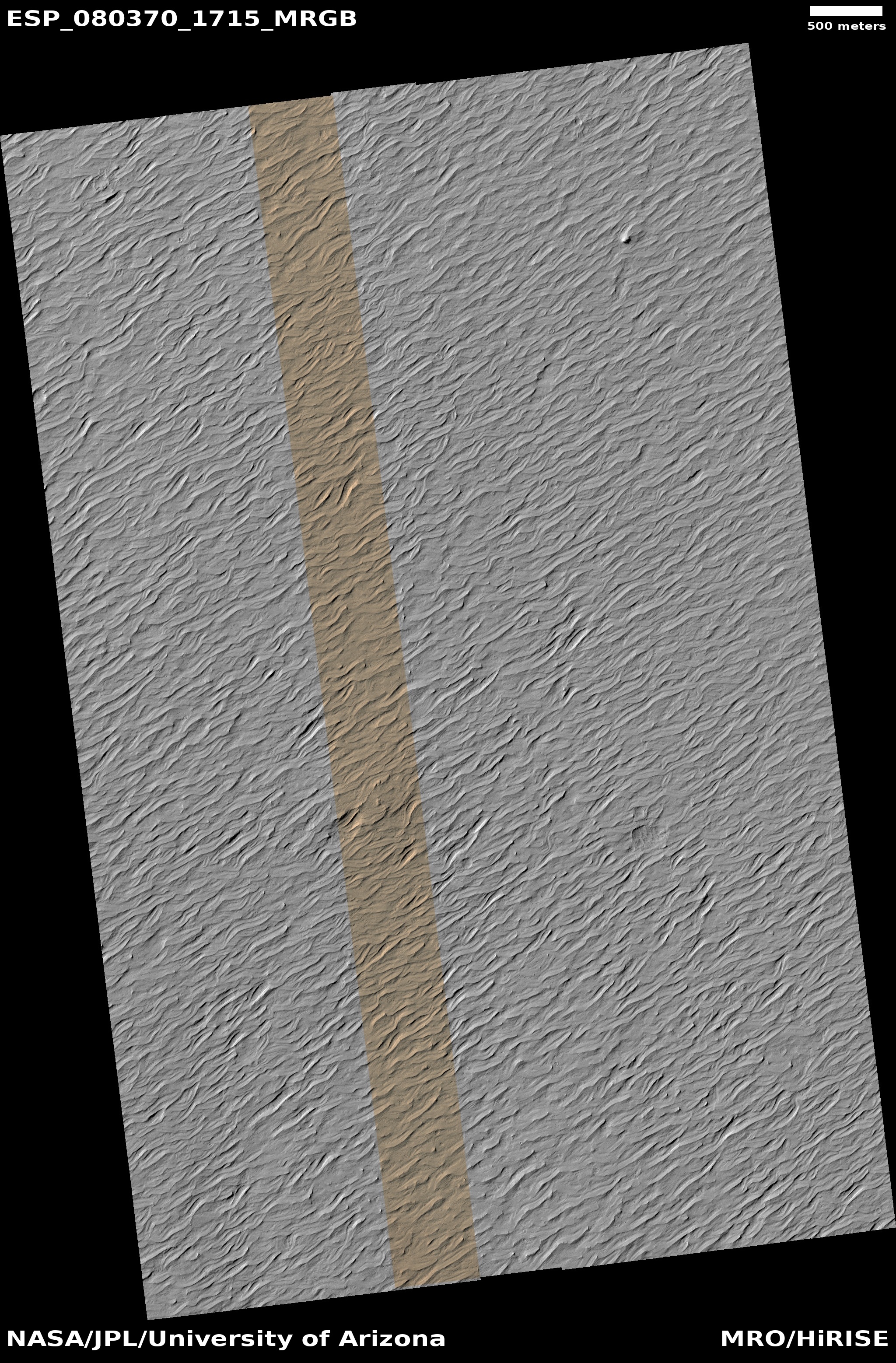
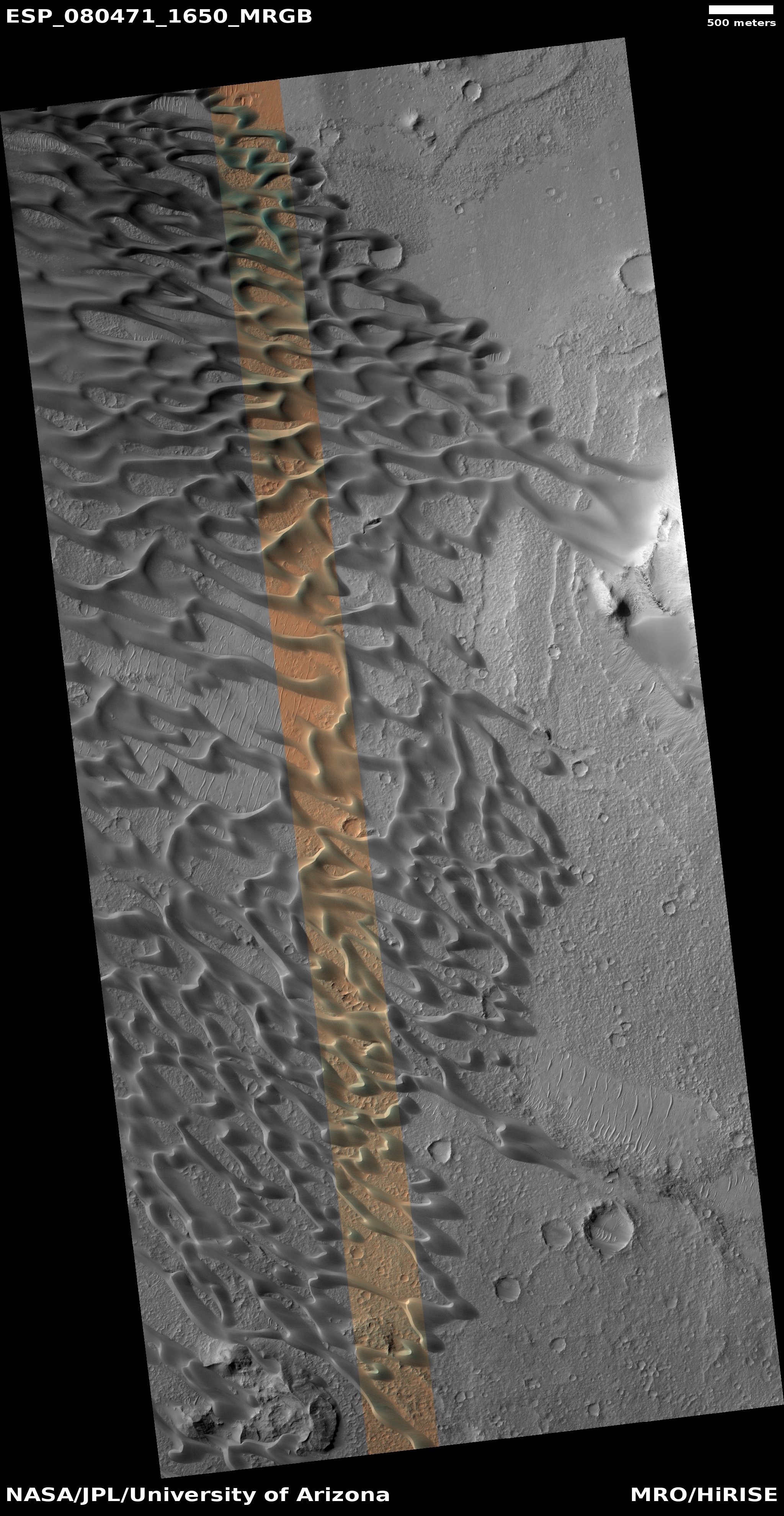
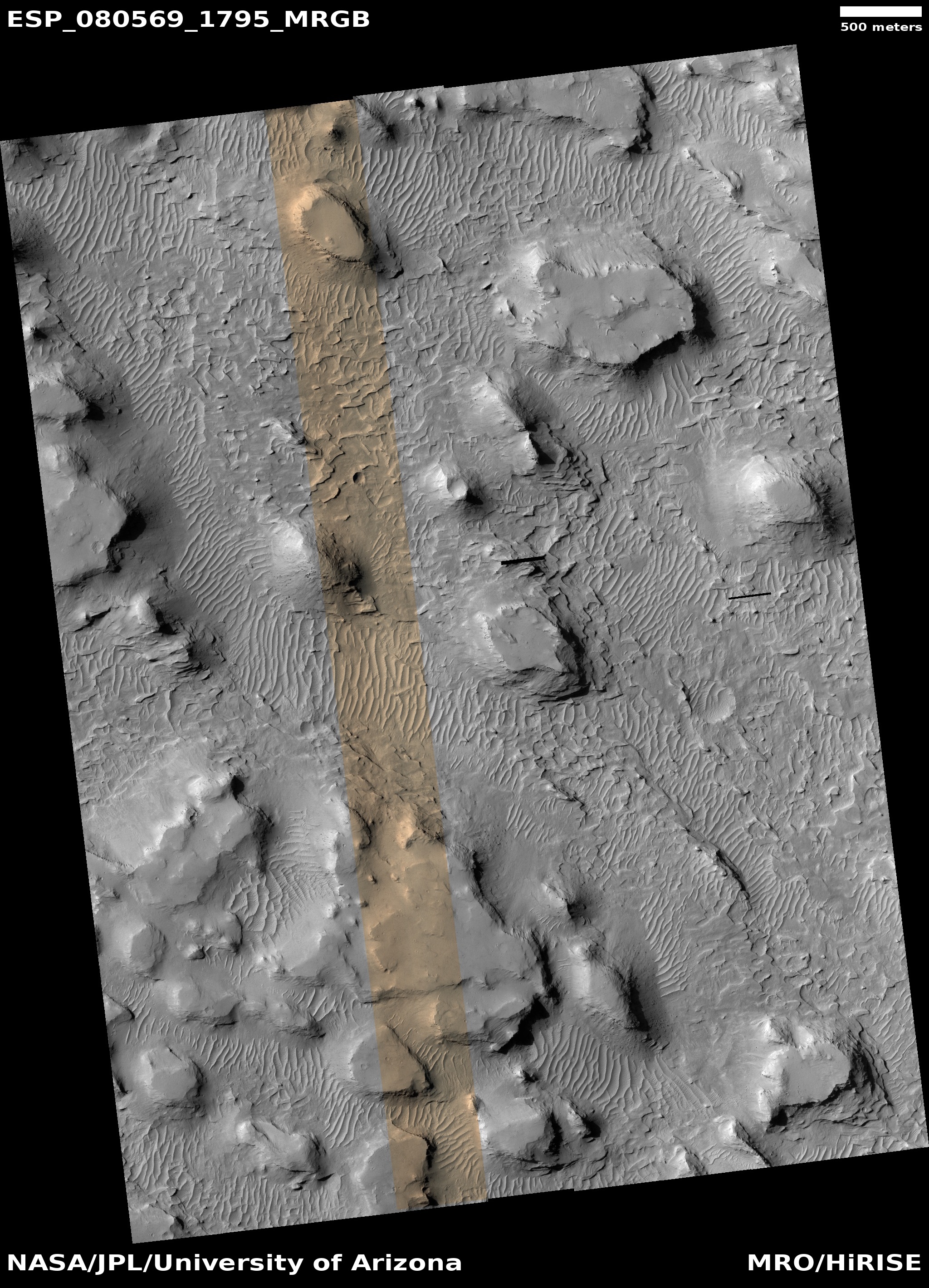
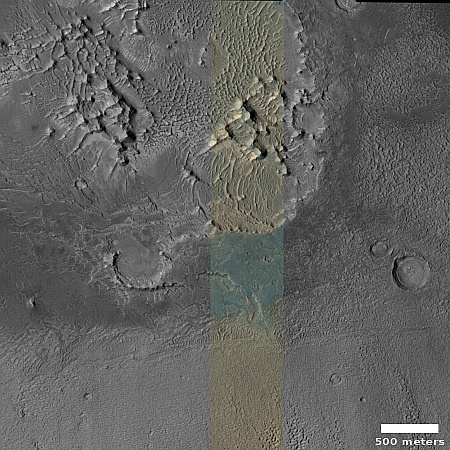
Cool image time! The picture to the right, cropped, reduced, and sharpened to post here, was taken on September 18, 2023 by the high resolution camera on Mars Reconnaissance Orbiter (MRO).

It shows the very typical surface on a high plateau in Mars’ dry tropical regions. The dunes you see here, in this very small slice, cover a region about 80 miles square, with the prevailing winds appearing to consistently blow from the northeast to the southwest and forming these endless striations.

The dunes are made of volcanic ash, and the size of this particular ash field gives us a sense of the past volcanic activity that once dominated the red planet. Once, the atmosphere was filled with ash, which covered the ground across large regions. In the subsequent eons the thin Martian atmosphere has reshaped and piled that ash into giant mounds hundreds of miles across, with the surface striated as we see here.
» Read more

4 comments

Layered volcanic vent on Mars

Layered volcanic vent on Mars
Click for original image.

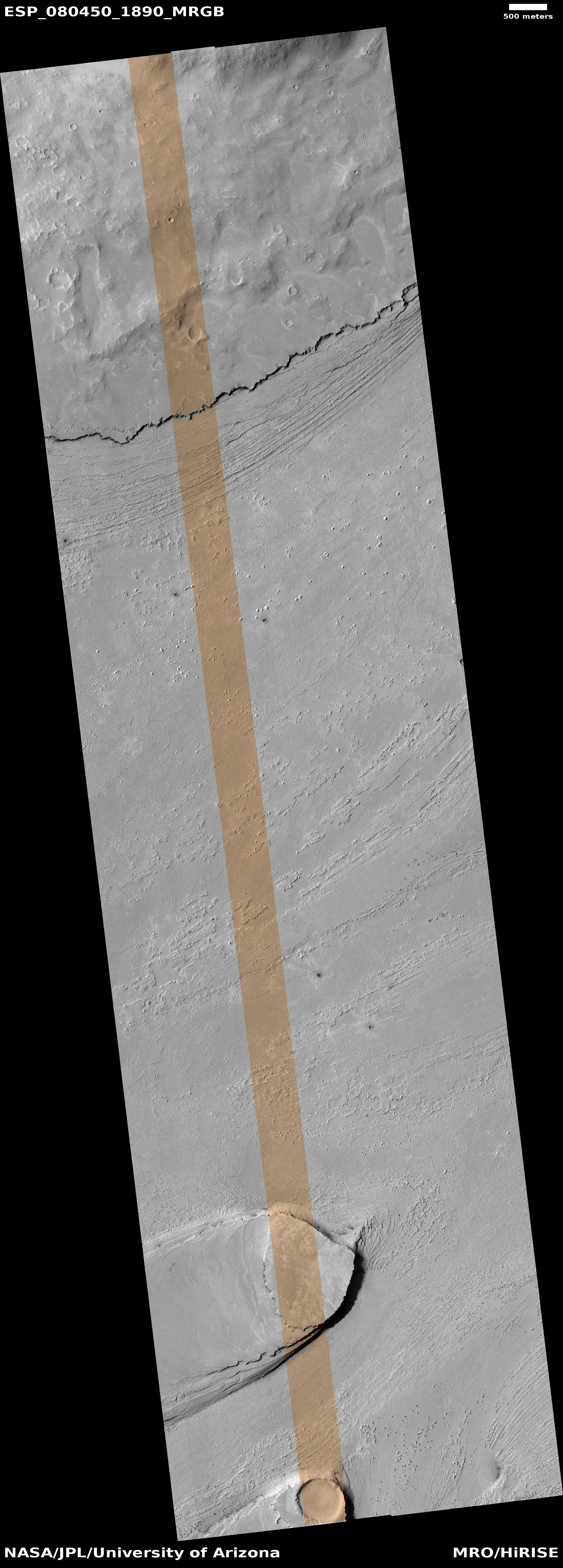
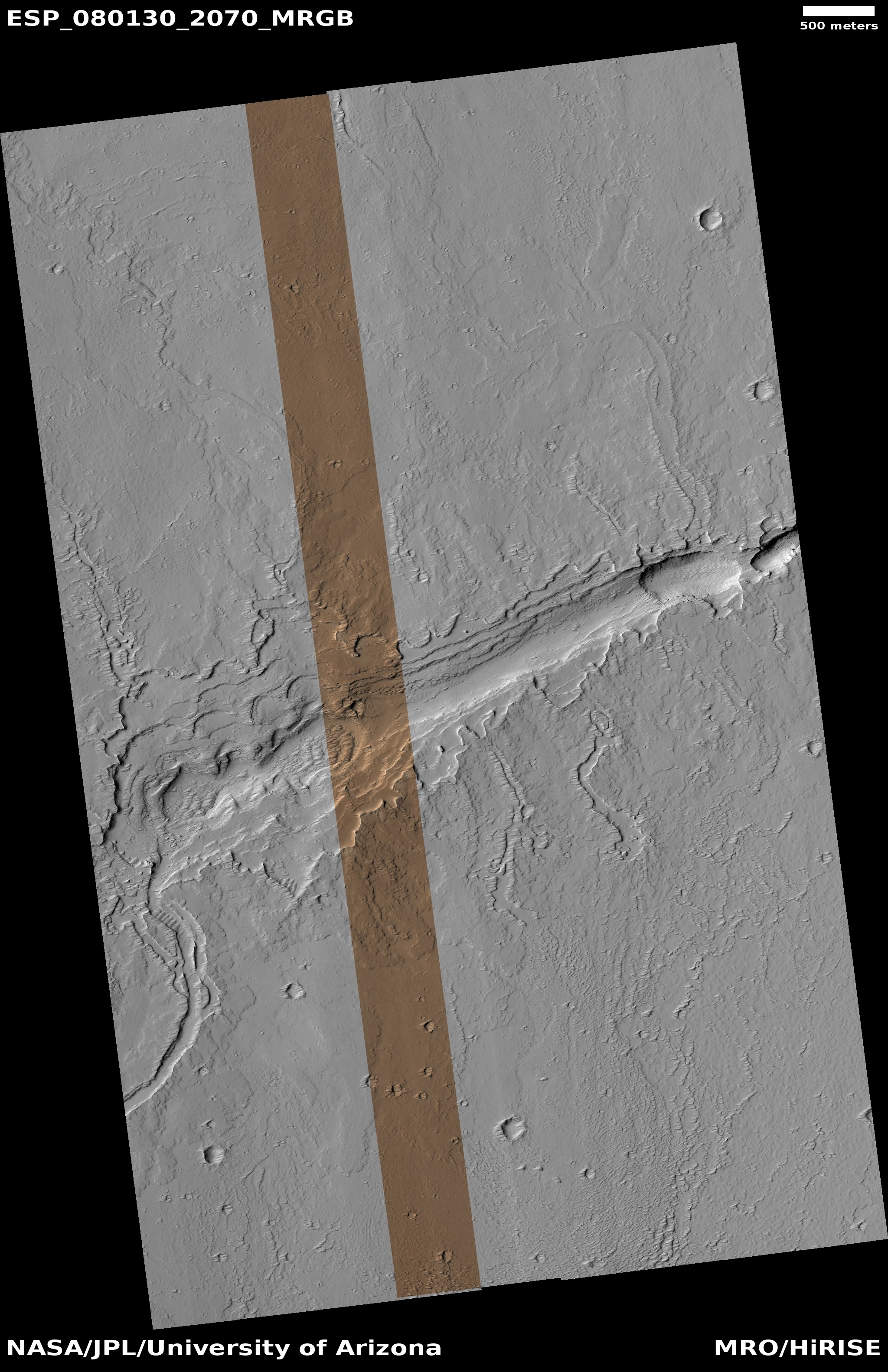
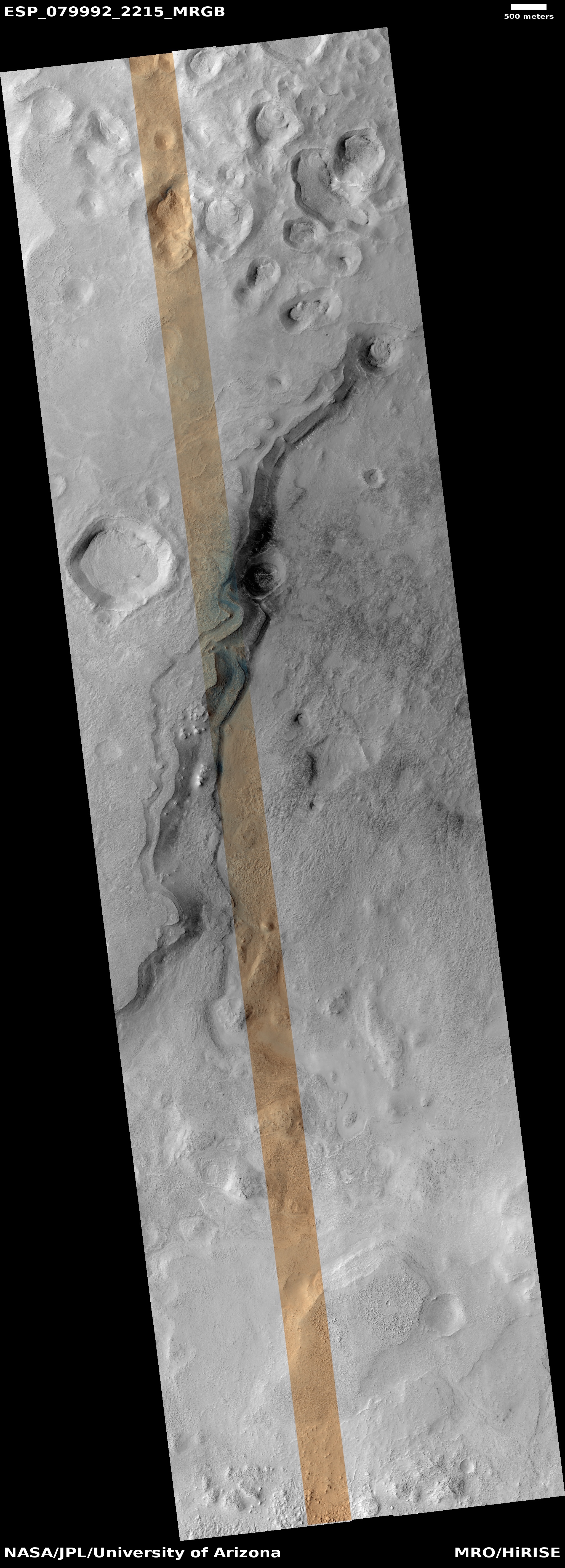
Cool image time! The picture to the right, rotated, cropped, reduced, and sharpened to post here, was taken on August 31, 2023 by the high resolution camera on Mars Reconnaissance Orbiter (MRO), and shows what the science team labels as a “vent near Olympica Fossae.”

The grade within the fissure is downhill to its center. Outside the vent the grade is downhill to the north and south, with the overall grade sloping to the west as well. Note the layers on each side of the depression. Each indicates another volcanic flood event that laid down another layer of lava. At some point this vent either blew up through those layers, or it had remained opened during all those many events, the lava flowing out and acting like water to erode the layers on the north and the south.

As always, the scale of Martian geology is daunting, as shown by the overview map below.
» Read more

0 comments

Canyons formed from the giant crack that splits Mars

Canyons formed by the giant crack that splits Mars
Click for original image.

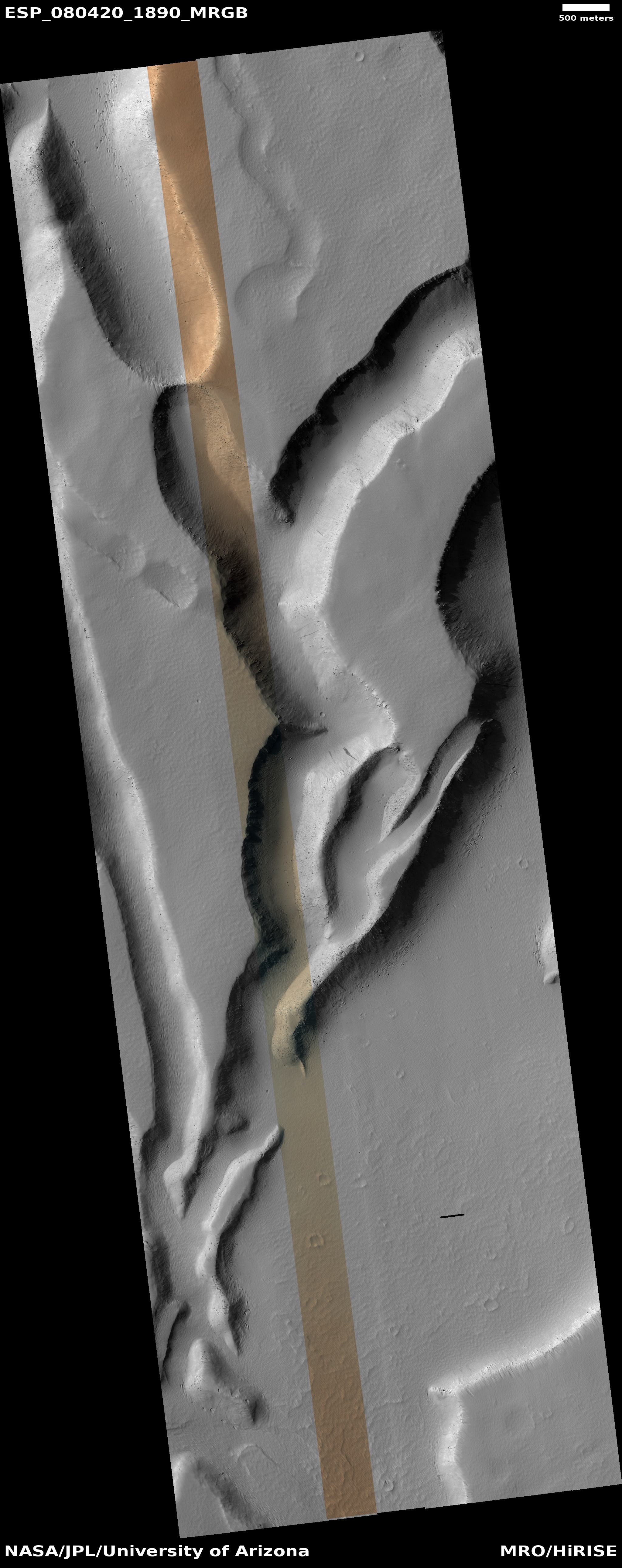
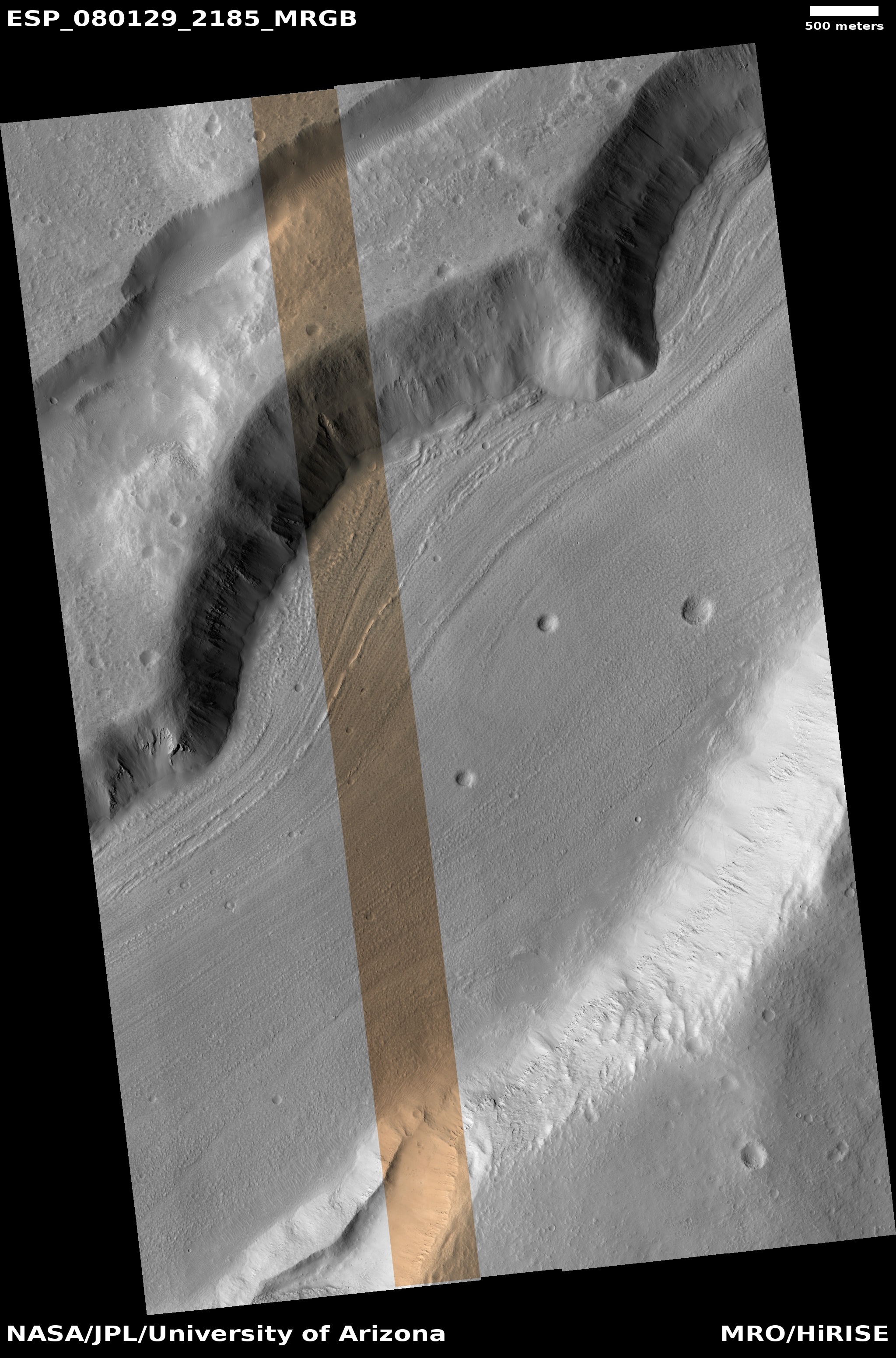
Cool image time! The photo to the right, cropped, reduced, and sharpened to post here, was taken on September 22, 2023 by the high resolution camera on Mars Reconnaissance Orbiter (MRO). It shows a complex of north-south trending canyons, with easternmost cliff about 400 feet high (though the full drop to the large canyon on its east is closer to 800 feet).

These canyons however have nothing to do with ice or water flow. They were formed by underground tectonic forces that pushed the ground upward, forced it to split and form cracks. Those cracks in turn produced these canyons. In some cases, such as the depression on top of the central ridge, the formation process probably occurred because fissures formed below ground, causing the surface to sag.

As always, the hiker in me wants to walk up the nose of that ridge and then along its western edge, with the western canyon on my left and that smaller depression on my right.

The larger context of this location is in itself even more spectacular.
» Read more

0 comments

The mining potential on Mars

The mining potential on Mars
Click for original image.

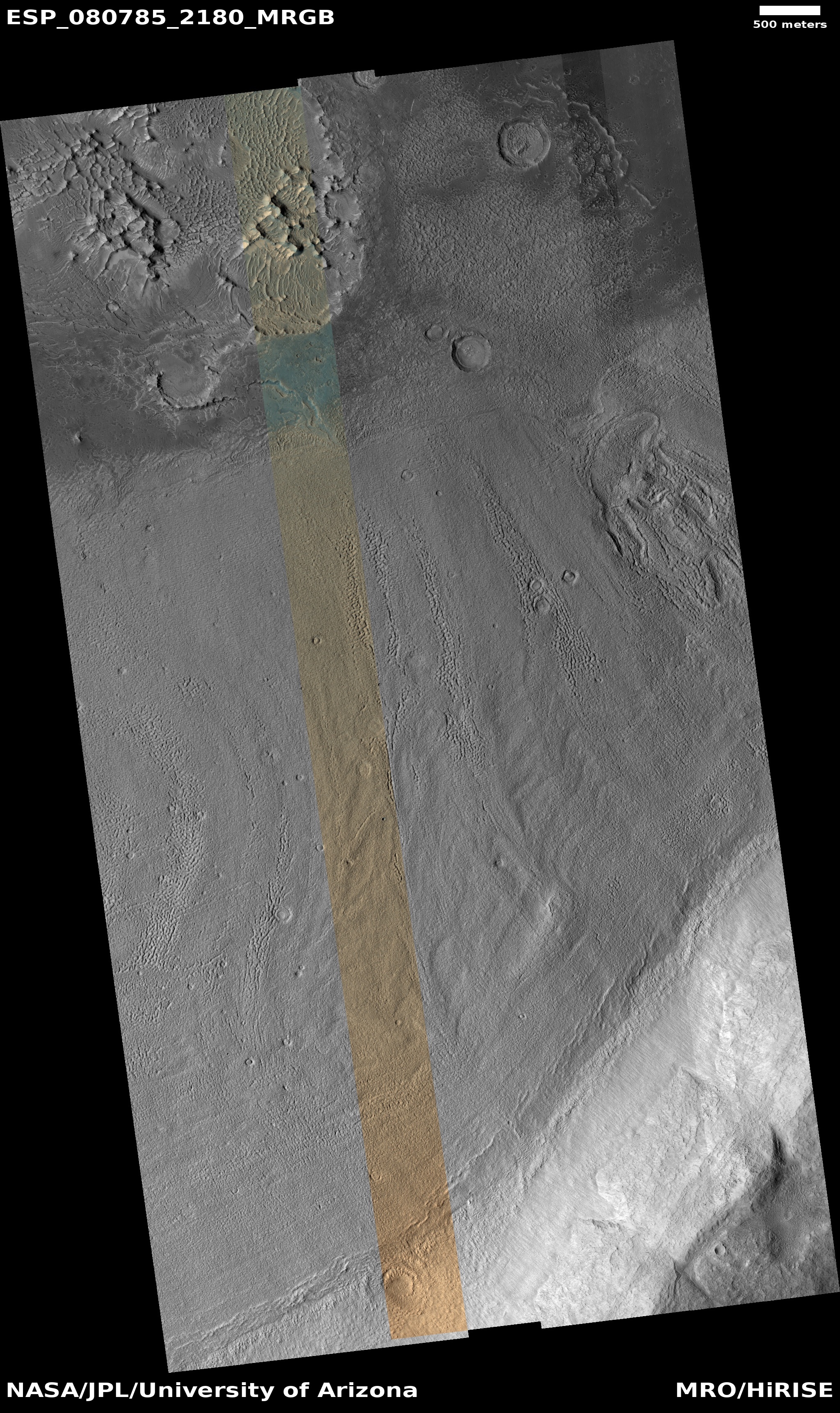
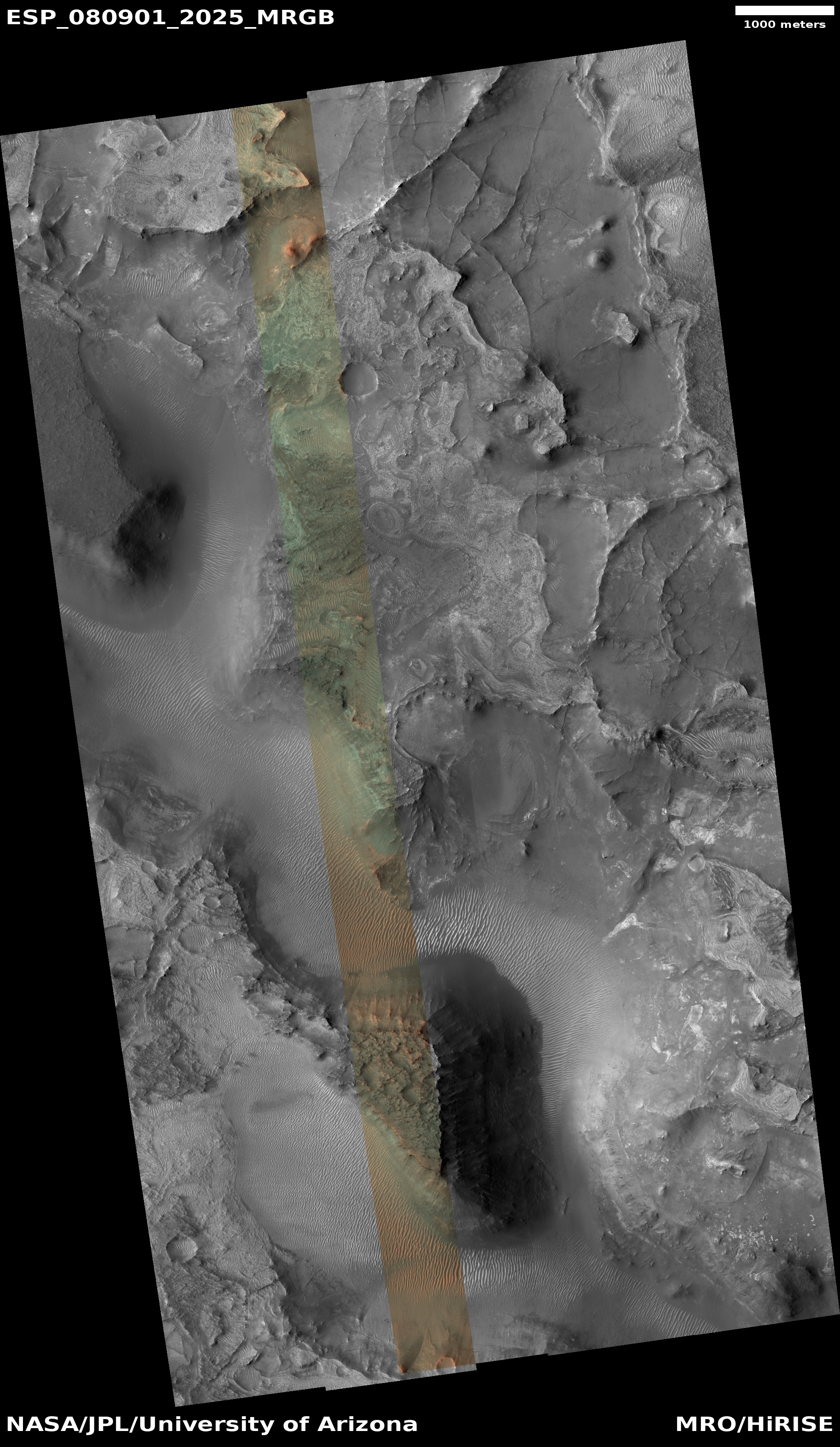
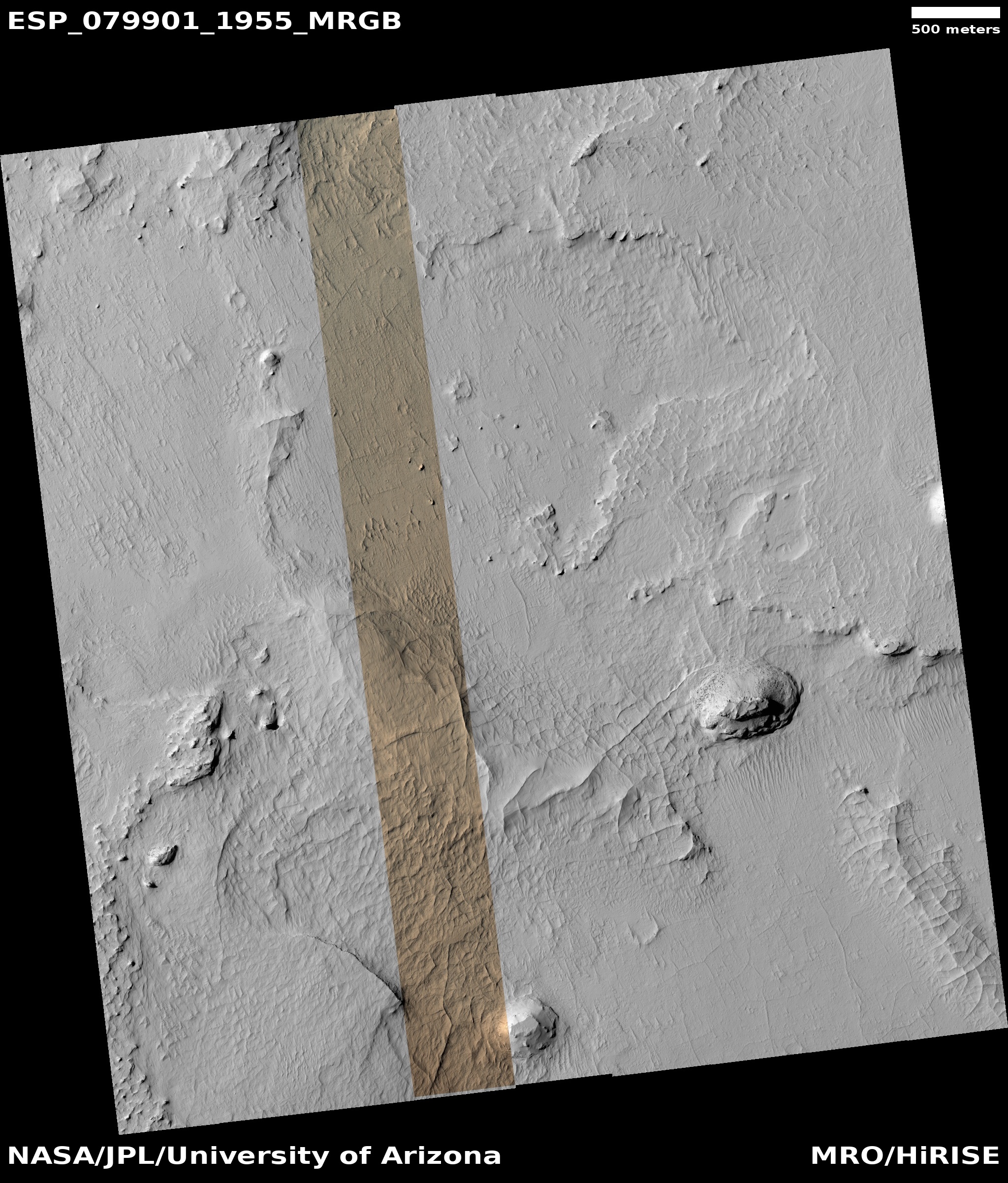
Cool image time! The picture to the right, cropped, reduced, and sharpened to post here, was taken on October 30, 2023 by the high resolution camera on Mars Reconnaissance Orbiter (MRO). Labeled simply as a “terrain sample,” it was probably taken not as part of any specific research project but to fill a gap in the schedule in order to properly maintain the camera’s temperature.

Nonetheless, the larger region where this photo is located is one of great interest to scientists as well as to future explorers. First note the colors. The wide variations between the bright orange of that peak (only a few tens of feet high) and the light orange and aqua-green of the bedrock to the north and south suggest a terrain with a lot of different materials within it.

The location is in the dry equatorial regions, so the swirls visible on the plateaus north and south of that small peak are not related to near surface ice. Instead, this is warped bedrock, with those swirls also suggesting material of a varied nature, exposed to the surface by erosion processes.
» Read more

1 comment

Dunes on the floor of Valles Marineris

Overview map

Dunes on the floor of Valles Marineris
Click for original image.

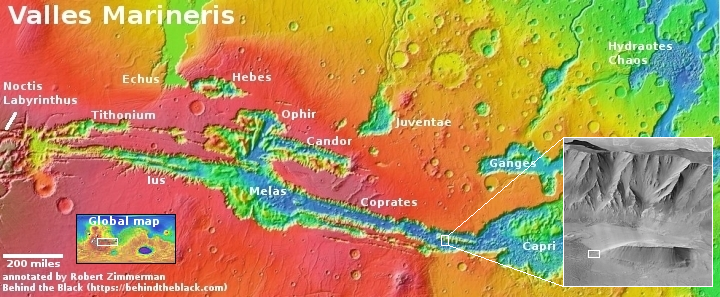
Cool image time! The picture to the right, cropped, reduced, and sharpened to post here, was taken on September 26, 2023 by the high resolution camera on Mars Reconnaissance Orbiter (MRO). It shows a field of scattered elongated dunes on a flat older surface with craters and what appear to be smaller ripple dunes (in the lower left). The large elongated dunes tend to be oriented in an east-west manner, while the older tiny ripple dunes appear to have a north-south orientation.

Very clearly the larger dunes appear to be traveling across that flat older surface, though whether there is any documented movement is unknown. Generally (though there are exceptions) scientists have found most of the dunes on Mars to be either inactive, or if they are moving because of the wind that movement is very tiny per year. In this case there is one dark spot on the dunes, near the center of the picture, where it appears a collapse might have occurred, suggesting recent change.

On the center right of the picture is the end point of a long ridgeline extending 10 to 12 miles to the east and rising about 7,300 feet, as shown in the overview map above. The small rectangle in the inset shows the area covered by the photograph.

At the base of that ridgeline can be seen a series of terraces descending to the west, suggesting that this hill might be volcanic in nature, with each terrace indicating a separate lava flow. The location is in the dry equatorial regions, so near-surface ice is likely not an explanation.

In the inset the mountain wall to the north is the large mountain chain that bisects this part of Valles Marineris. It overwhelms this small 7,300-foot-high ridge, rising more than 22,000 feet from these dunes with its high point still one or two thousand feet below the rim of Valles Marineris itself.

Once again, the grand scenery of Mars amazes. Imaging hiking a trail along that ridgeline, with the mountains rising far above you to the north and south.

0 comments

Mapping the major lava flood events in Mars’ volcano country

The volcanic events in Mars' volcano country
Click for original map.

In a paper just released, scientists have used the orbital data from Mars Reconnaissance Orbiter (MRO) to map on Mars forty different past volcanic eruptions of extensive flood lava covering large regions, all within the region I dub “volcano country” because its entire surface seems mostly shaped by flows of lava.

The map above, figure 1 from the paper, shows the study area (within the white rectangle), with its global context and additional information added by me on the right. Most of the largest earthquakes detected by InSight ran from north-to-south down the center of the white box. The named features are all large flood lava events, with the youngest being Athabasca. Within the Cerburus Plains feature the researchers mapped many smaller events which brought the total up to forty. From the abstract:

An area almost as large as Europe was investigated. The study revealed the products of more than 40 volcanic events, with one of the largest flows infilling Athabasca Valles with a volume of 4,000 km3. The surface appearance and material properties suggest that Elysium Planitia is composed of basalt, the most common type of lava on Earth. The area also experienced several large floods of water, and there is evidence that lava and water interacted in the past. However, while there could be ice in the ground today, it likely occurs in small patches.

None of these flood lava events involved the gigantic volcanoes that surround this region. Instead, the lava erupted from vents within this region, and then flowed downgrade to flood large areas, sometimes covering over parts of earlier lava floods. All also flowed much faster than lava on Earth, flooding vast regions — comparable to entire countries — often in mere weeks.

0 comments

Isolated mesa on Mars

An Isolated mesa on Mars
Click for original image.

Cool image time! The picture to the right, cropped, reduced, and sharpened to post here, was taken on August 13, 2023 by the high resolution camera on Mars Reconnaissance Orbiter (MRO).

The central butte is about 100 feet high. Not only are its flanks terraced, suggesting sedimentary layers, note the many black dots on its northern slopes. Those dots appear to be many boulders that appear to have rolled down the slopes to settle mostly near the mesa’s base.

The boxwork ridges to the west and south suggest the ground was fractured in some event to produce cracks, which were later filled with material that was erosion resistent. As the terrain was worn away by wind it left these ridges behind.

The prevailing winds in this region are believed to blow mostly to the south, which might explain the parallel ridges south of the mesa. Or not. On this I am guessing entirely.
» Read more

0 comments

A glacial lake on Mars?

A glacial lake in a
Click for original image.

Cool image time! The picture to the right, rotated, cropped, reduced, and sharpened to post here, was taken on August 30, 2023 by the high resolution camera on Mars Reconnaissance Orbiter (MRO).

It shows what appears to be a glacial flow of ice, flowing downhill to the southwest and inside a wide canyon about three miles across. The canyon rims to the north and south are about 2,000 to 2,100 feet above the canyon’s lowest point, indicated by the string of “+” signs.

This close-up view immediately suggests a canyon whose glacier flows outward to the southwest into open lowland terrain, though the three craters, because they are undistorted, suggests that this flow is presently not active. That suggestion however would be wrong. It is always necessary to understand Martian geology to not only take close-in views at high resolution, but to zoom back and see the terrain in context.
» Read more

1 comment

Glacial layers in Mars’ glacier country

Glacial layers in Mars' glacier country
Click for original image.

Cool image time! The picture to the right, cropped, reduced, and sharpened to post here, was taken on August 20, 2023 by the high resolution camera on Mars Reconnaissance Orbiter (MRO). It features a 250-foot-high north-south cliff that appears to have numerous horizontal layers within it.

Moreover, both on the plateau above the cliff as well as the floor below it, the entire surface seems to resemble a thick snow/ice field, made even more evident by the distortion of many craters and the apparent glacial material inside each crater.

The layers suggest that this ice was laid down in a series of cycles. During cold periods snow fell and accumulated as ice over time. When things became warmer some of that ice sublimated away, but not all. With the next cold cycle a new layer was put down.

The many layers suggest many climate cycles on Mars, none of which were caused by SUVs or coal-firing electrical power stations.
» Read more

1 comment

A land of buttes on Mars

A land of buttes on Mars
Click for original image.

Cool image time! The picture to the right, cropped, reduced, and sharpened to post here, was taken on October 4, 2023 by the high resolution camera on Mars Reconnaissance Orbiter (MRO). Labeled a “terrain sample” by the science team, it was likely shot not as part of any specific research project but to fill a gap in the schedule so as to maintain the camera’s proper temperature. When the camera team has to do this they try to pick targets that are of some interest. Usually they succeed, considering the enormous gaps we presently have of Mars’ geological history.

This picture is no different. It shows a land of buttes and mesas, all ranging from 20 to 200 feet high, surrounded by canyons filled with ripple dunes of Martian dust. If you look at the floor of those canyons closely, you will notice that where there are no ripple dunes the ground is slightly higher and smooth. It is as if that ground was a kind of sandstone that was eroded away by wind into sand, which then formed the dunes.
» Read more

0 comments

Another minor canyon on Mars that would be a world wonder on Earth

Another minor canyon on Mars
Click for original image.

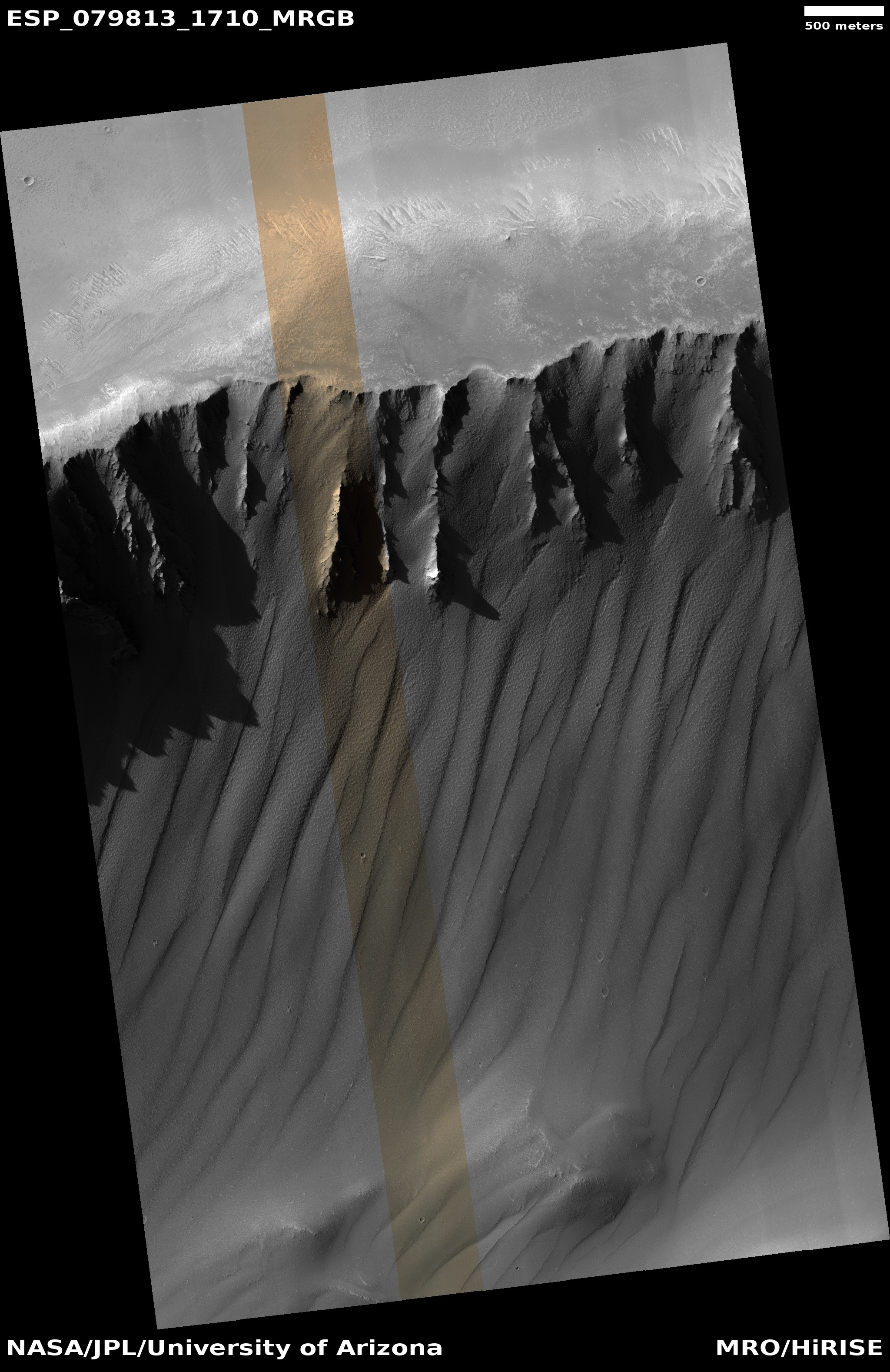
Cool image time! The picture to the right, rotated, cropped, reduced, and sharpened to post here, was taken on August 6, 2023 by the high resolution camera on Mars Reconnaissance Orbiter (MRO). It shows the steep north canyon wall of one small part of the Martian canyon complex dubbed Noctis Labyrinthus

The elevation drop in this picture is about 8,000 feet, but the canyon’s lowest point is several miles further south and another 7,000 feet lower down. What is most intriguing about the geology here is its age. If you look at the full resolution image, you will see that there are scattered small craters on the smooth slopes that resemble sand that gravity and wind is shaping into those long streaks heading downhill.

Those craters, however tell us that these smooth slopes are very old, and have not changed in a long time. Furthermore, though the material appears to look like soft sand, the craters also tell us it long ago hardened into a kind of rock. If wind is shaping this material, it must be a very slow process.

The light areas on the rim as well as the ridge peaks below the rim suggest the presence of geological variety, which fits with other data that says Noctis Labyrinthus has a wide variety of minerals.
» Read more

2 comments

The end of a 400-mile-long Martian escarpment

The end of a 400-mile-long escarpment
Click for original image.

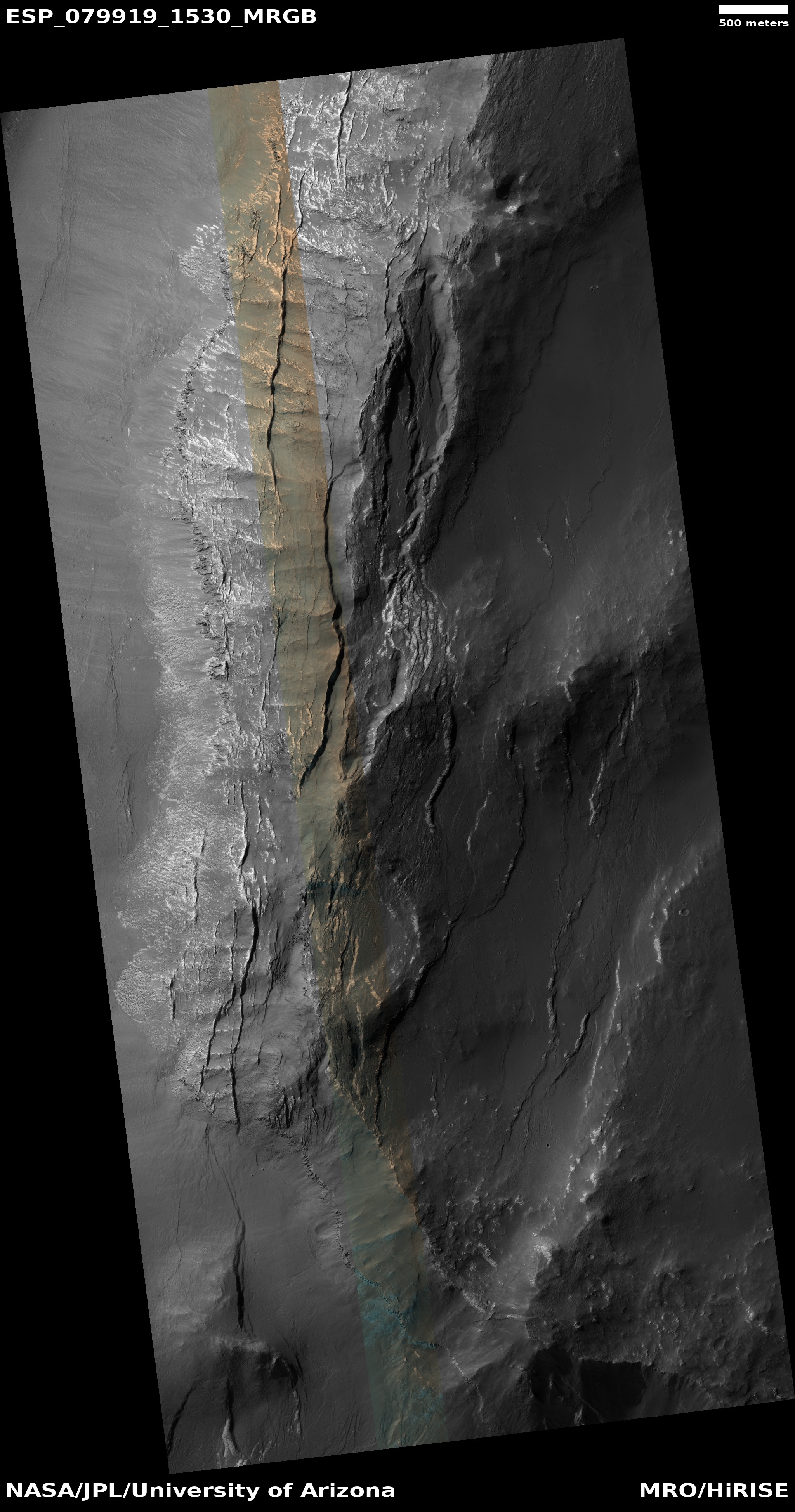
Cool image time! The picture to the right, cropped, reduced, and enhanced to post here, was taken on August 14, 2023 by the high resolution camera on Mars Reconnaissance Orbiter. It shows the cracked top of a enscarpment, with the bottom point to the west about 2,400 feet lower in elevation.

The north-south cracks at the top of the cliff indicate faults. They also suggest that the cliff itself its slowly separating from eastern plateau. North from this point, beyond the edge of this picture, are several places where such a separation has already occurred, with the collapsed cliff leaving a wide pile of landslide debris at the base.

This cliff actually continues north for another 400 miles, suggesting that the ground shifted along this entire distance, with the ground to the east going up and ground to the west going down. Because the cliff is such a distinct and large feature, it has its own name, Claritas Rupes, “rupes” being the Latin word for cliff.
» Read more

0 comments

Martian crater or mud caldera?

Martian crater or volcano?
Click for original image.

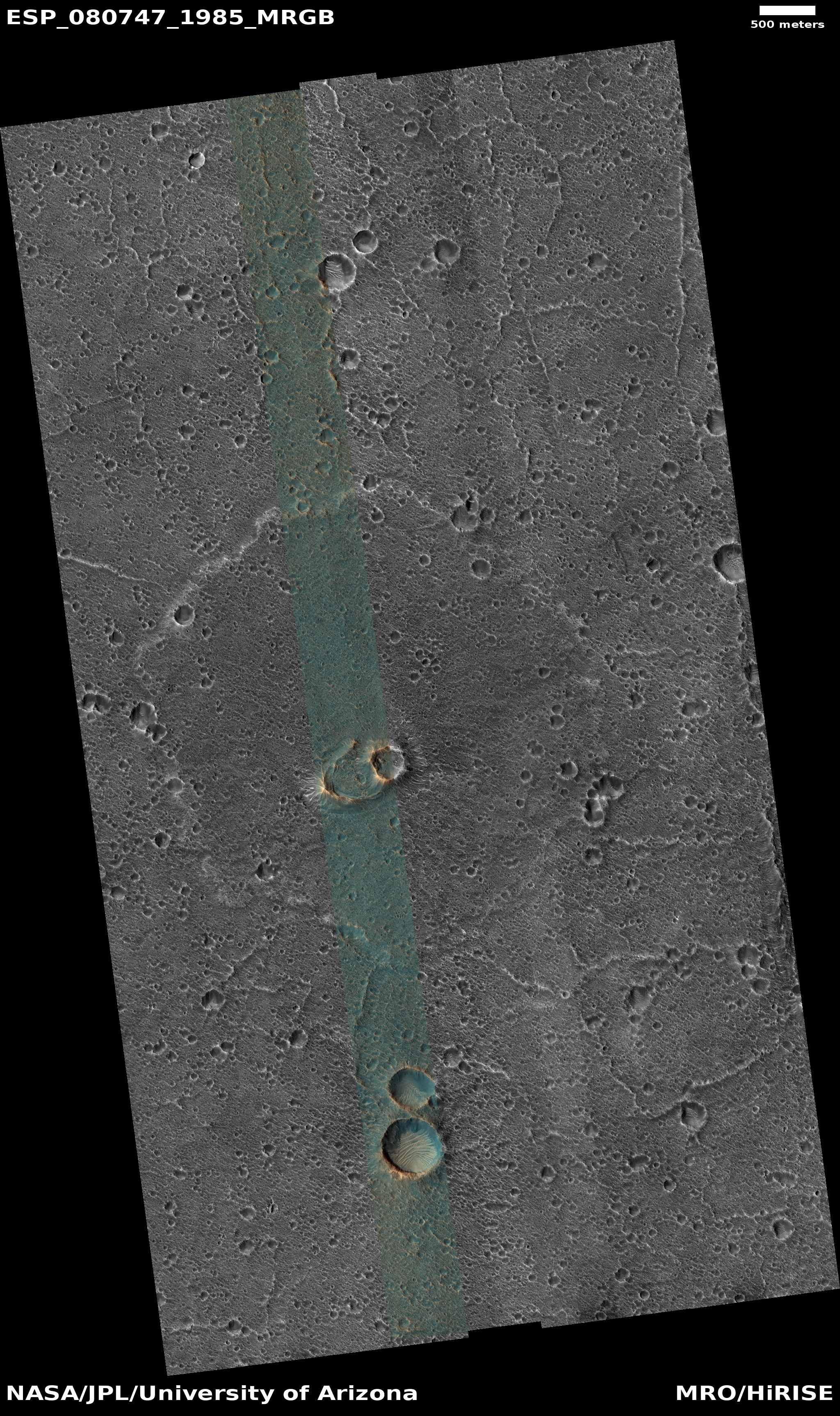
Cool image time! The picture to the right, cropped, reduced, and sharpened to post here, was taken on October 18, 2023 by the high resolution camera on Mars Reconnaissance Orbiter (MRO).

The scientists only call this a “feature,” likely because they don’t wish to guess as to its nature without more data. However, the 2.5 mile wide splash apron around the central double crater certainly merits a closer look. That double crater could be from impact, but it also could be a caldera, with the apron the result of material that flowed from the caldera.

That there appear to be fewer craters on the apron than on the surrounding terrain strengthens this last hypothesis. The apron would have erased many earlier impact craters, resulting in this lower count.

The location however suggests that if this feature was volcanic in origin it might not have been spewing out magma.
» Read more

0 comments

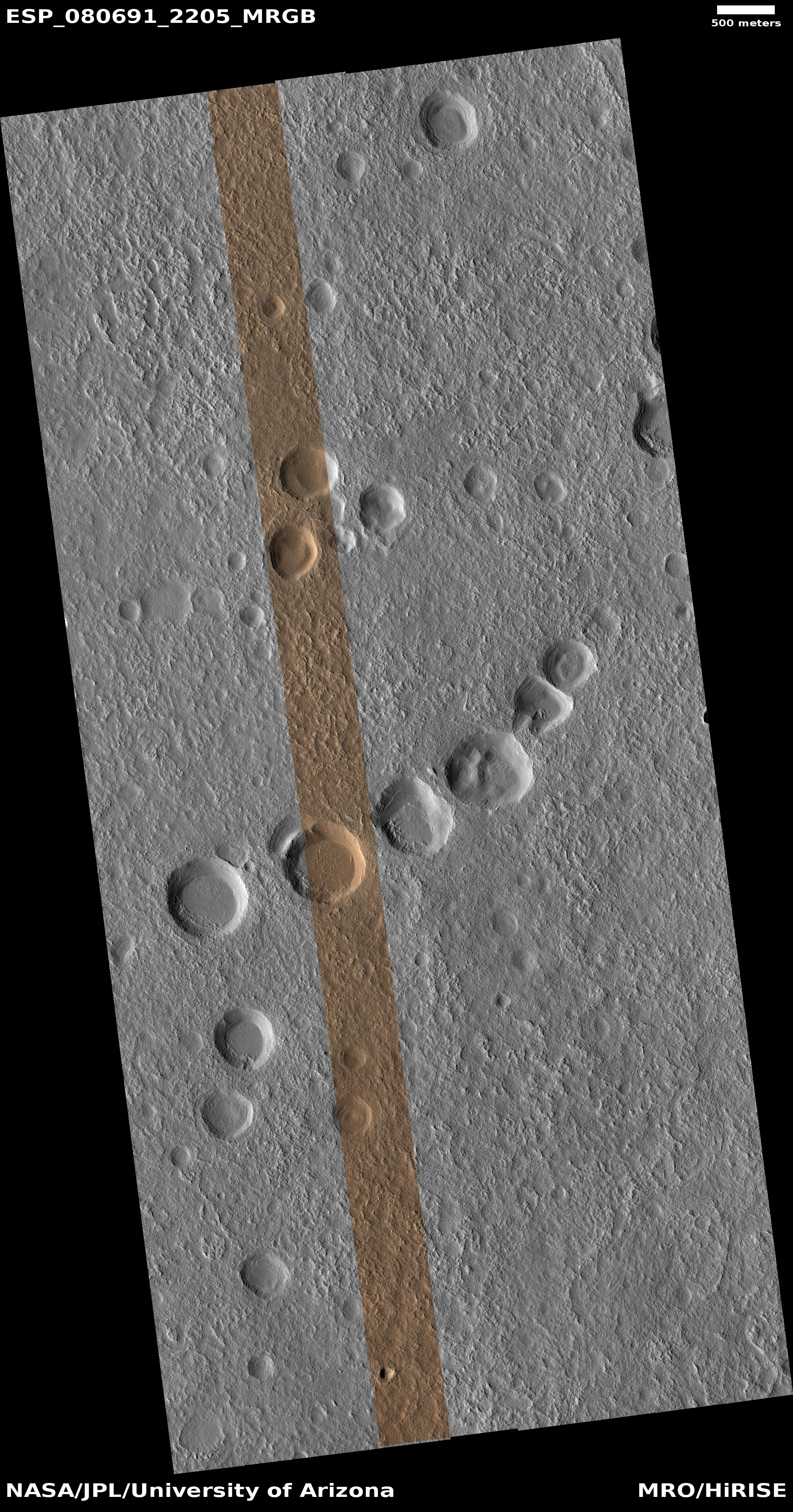
Craters in a row

Craters in a row
Click for original image.

Cool image time from Mars! The picture to the right, rotated, cropped, reduced, and sharpened to post here, was taken on October 13, 2023 by the high resolution camera on Mars Reconnaissance Orbiter (MRO). It highlights a string of craters, all lined up in an almost straight line.

Were these craters caused by the impact of an asteroid that broke up as it burned its way through the thin Martian atmosphere? The lack of any raised rims argues instead that these are sinks produced not from impact but from a collapse into a void below, possibly a fault line.

Yet, almost all of the craters in this image, even those not part of this crater string, show no raised rims. If sinks, the voids below don’t seem to follow any pattern, which once again argues in favor of random impacts, with the string produced by a bolide breaking up just prior to hitting the ground.
» Read more

3 comments

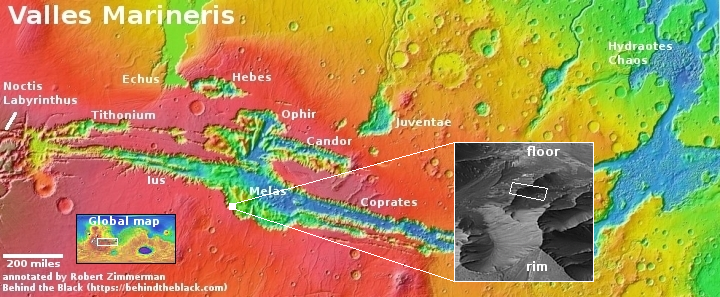
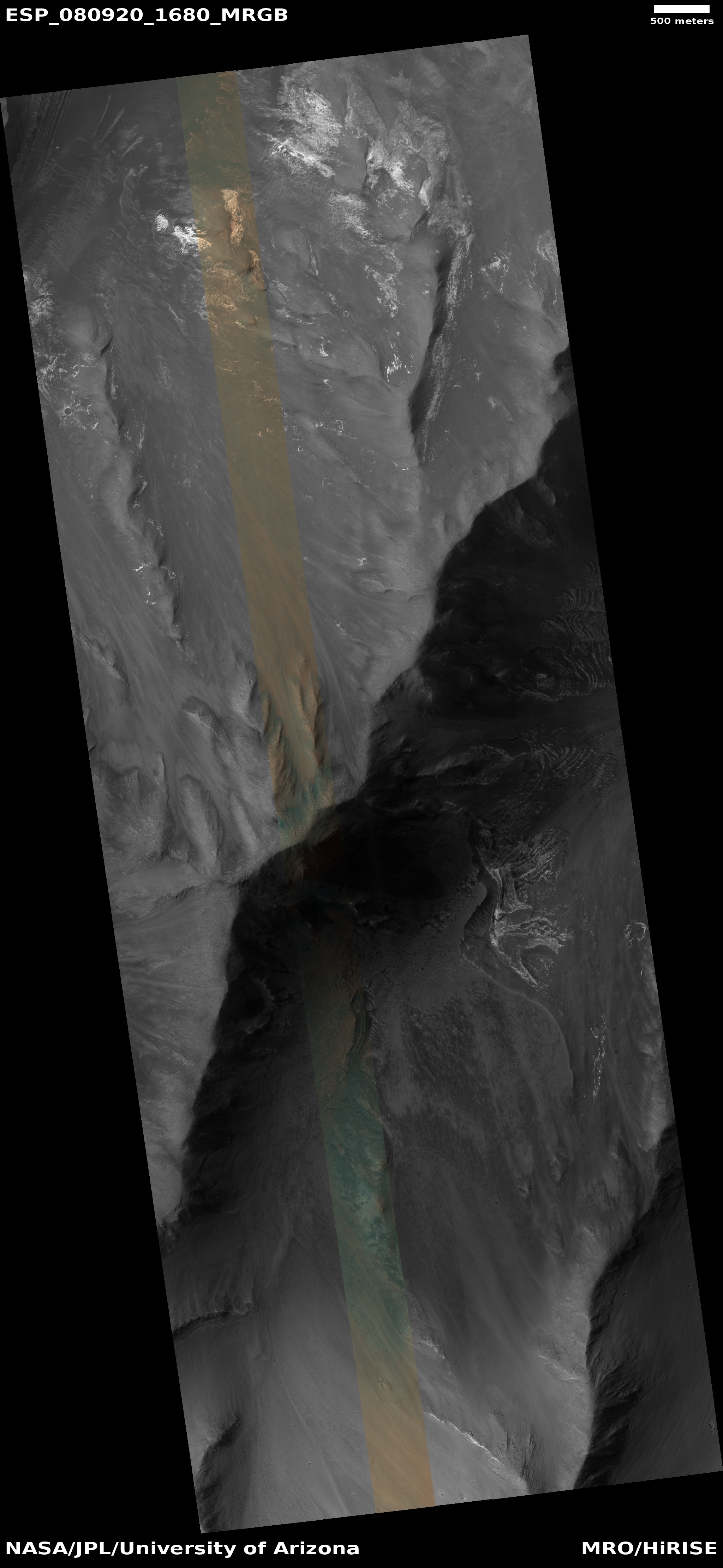
The steep mountain slopes inside Valles Marineris

Overview map

The steep mountain slopes inside Valles Marineris
Click for full image.

Time for another cool image showing the dramatically steep terrain of Valles Marineris on Mars, the largest known canyon in the solar system. The picture to the right, cropped, reduced, and enhanced to post here, was taken on October 31, 2023 by the high resolution camera on Mars Reconnaissance Orbiter (MRO).

The scientists rightly label this picture “Steep Slopes in West Melas Chasma”. The red dot marks the high point on this ridgeline. The green dot at the upper left marks the lowest point in the picture, about 4,800 feet below the peak. The blue dot on the right edge marks the low point on the ridge’s eastern flank, about 4,600 feet below the peak. The cliff to the east of the peak drops quickly about 1,300 feet in less than a mile.

On the overview map above, the white dot marks the location. The inset is an oblique view, created from a global mosaic of MRO’s context camera images, with the white rectangle indicating approximately the area covered by the picture above.

The immense scale of Valles Marineris must once again be noted. The elevations in this picture are comparable to the descent you make hiking down from the South Rim of the Grand Canyon. They pale however when compared to Valles Marineris. In the inset I have indicated the rim and floor of Valles Marineris in this part of the canyon. The elevation distance between the two is 18,000 feet.

In other words, the canyon to the east of this ridge is quite comparable in size to the Earth’s Grand Canyon, and it is hardly noticeable within the larger canyon of Valles Marineris.

0 comments

Big Martian gullies partly filled with glacial material

Overview map

Big Martian gullies partly filled with glacial material

Cool image time! The picture to the right, cropped, reduced, and sharpened to post here, was taken on August 18, 2023 by the high resolution camera on Mars Reconnaissance Orbiter (MRO). It shows what the scientists dub as “large gullies with infilled alcoves.”

Gullies on Mars were one of the first discoveries by orbiters of small-scalle potential water-caused features on the Red Planet. The favorite explanation for their formation today involves the seasonal freeze-thaw cycle, combined with the deposition of ice and dry ice frost in the winter. When that ice and dry ice sublimates away in the spring it causes collapse and erosion, widening the gullies.

These gullies also exhibit evidence that underground and glacial ice might contribute as well. The material in the largest gullies looks like a mixture of glacial material and dust and debris. It could also be that there is ice impregnated in the ground, which can cause large collapses when it sublimates away.

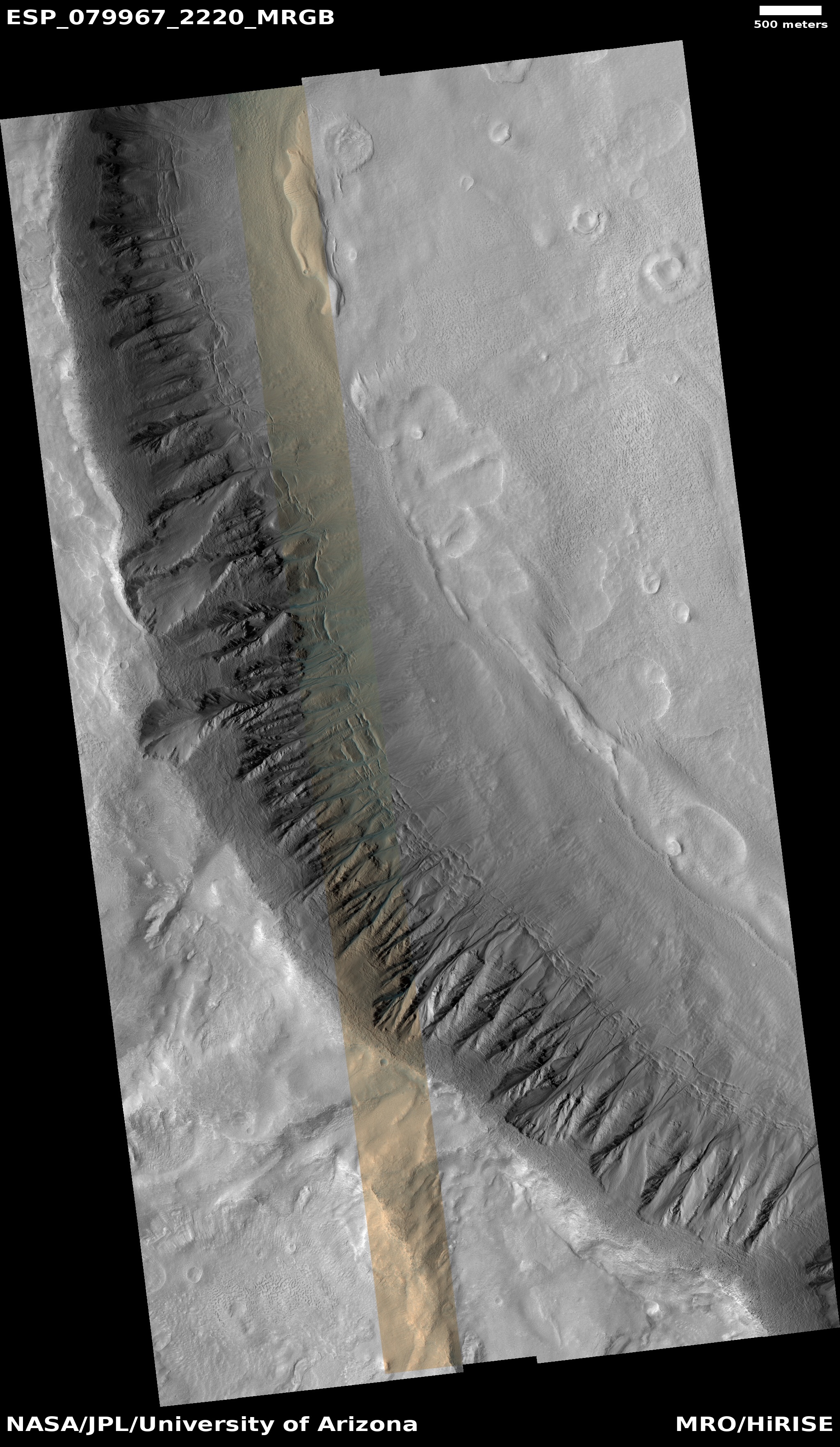
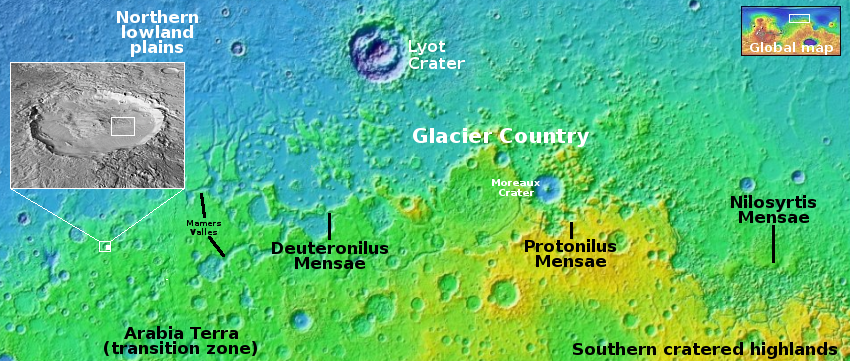
The white rectangle on the overview map and inset above marks the location of this picture, on the western rim of a 13-mile-wide unnamed crater inside the western portion of the 2,000-mile-long mid-latitude strip on Mars I dub glacier country, since every image from orbit shows evidence of glaciers.

This picture is no different, as the horizontal cracks at the base of the crater rim suggests the glacier that fills the crater floor is being pulled apart by gravity at its edges. The elevation drop from the top of the rim to the floor is about 3,200 feet, so any ice on that slope will definitely be stressed by gravity. Such cracks are therefore not surprising.

0 comments

Mars Reconnaissance Orbiter takes another look at the non-face on Mars

The non-face on Mars
Click for original image

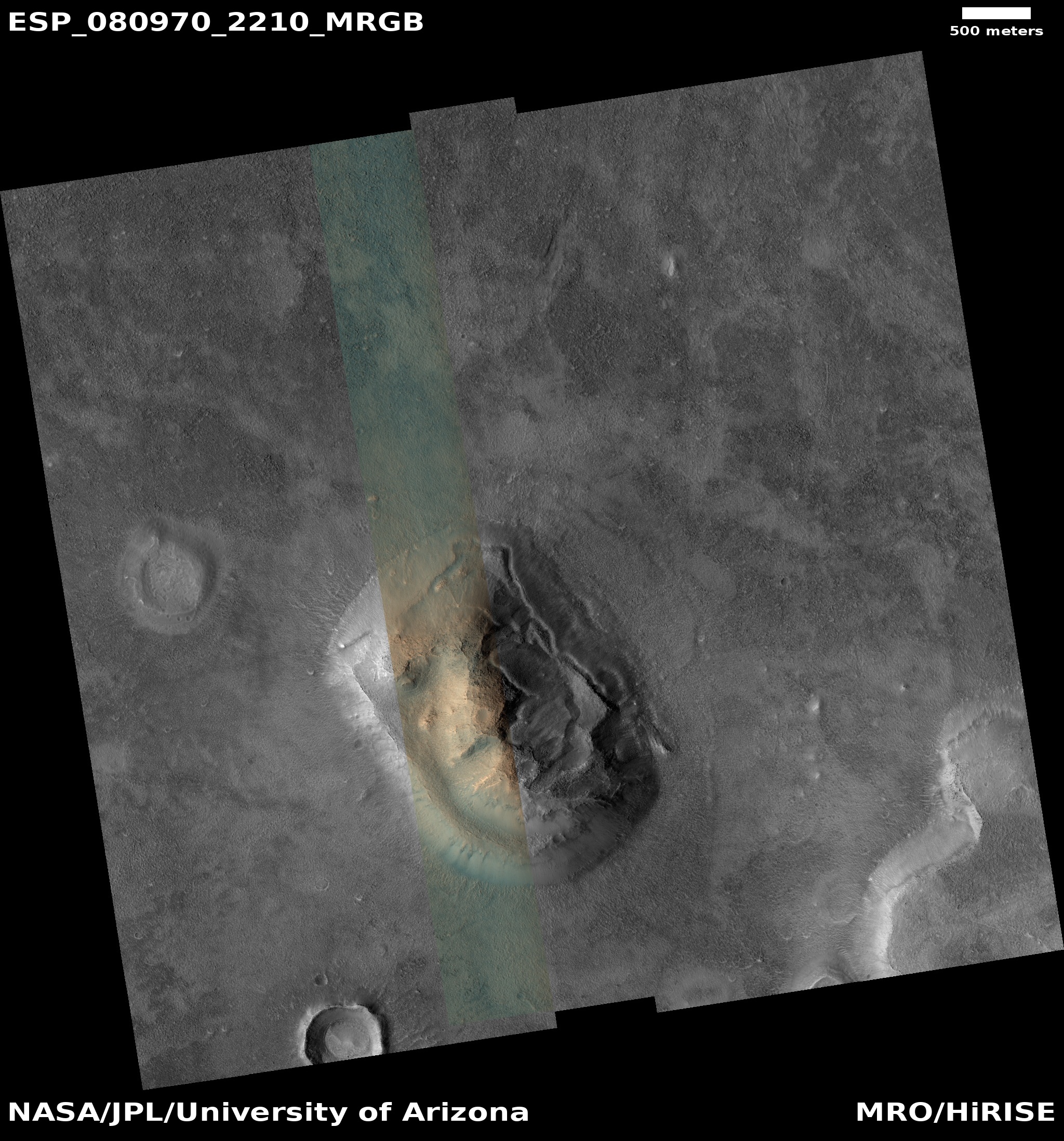
In 2007, shortly after it began science operations in Mars orbit, the science team for Mars Reconnaissance Orbiter (MRO) pointed its high resolution camera at the so-called “Face on Mars”, taking a picture that confirmed (as had Mars Global Surveyor several years earlier) that this “face” was a non-face, simply a mesa whose features made it appear roughly facelike in low resolution imagery.

Now, more than sixteen years later, scientists have used MRO to take a new picture of the non-face mesa. That picture is to the right, cropped, reduced, and sharpened to post here. Compared to the 2007 photo the new photo has far better lighting conditions, revealing many details on the mesa’s eastern half that were mostly obscured by shadows previously.

In fact, these new details strongly suggest that the depression on the mesa’s eastern slopes harbors a decaying glacier. At least, that is what the features there resemble.
» Read more

11 comments

Lava-filled Martian crater

Lava-filled Martian crater
Click for original image.

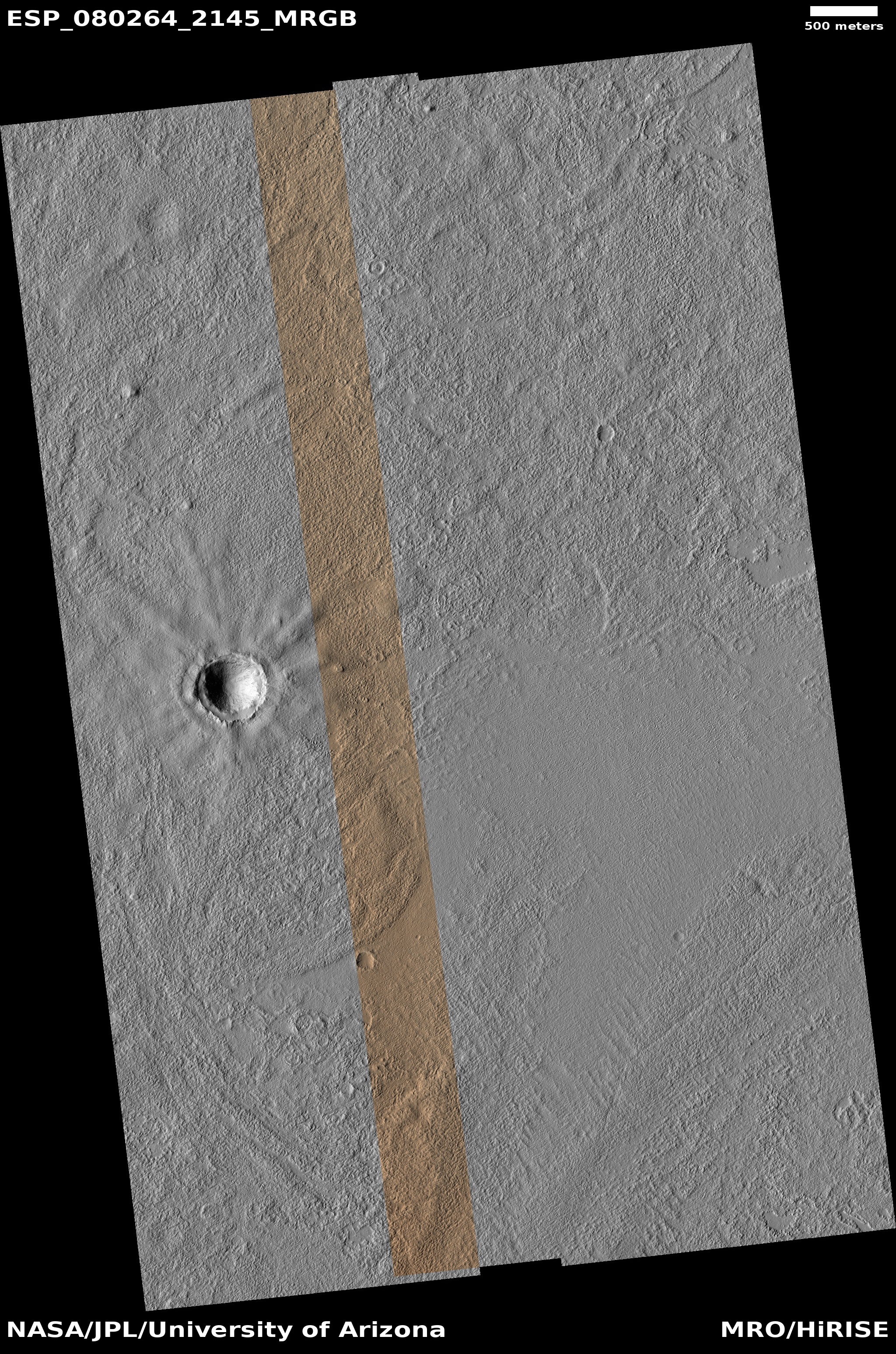
Cool image time! The picture to the right, rotated, cropped, reduced, and sharpened to post here, was taken on July 10, 2023 by the high resolution camera on Mars Reconnaissance Orbiter (MRO). It shows the northeast corner of an unnamed 7-mile-wide crater, located near the equator in the dry Martian tropics.

The MRO science team labels this “crater and lava fill”, suggesting that the crater interior is filled with lava material. The nature of that crater floor reinforces this conclusion, as it is relatively smooth and does not have rough aspects of glacial material found in craters in the mid-latitudes. Instead, it looks like a frozen lake of lava that has the peaks of mostly buried features poking up at various spots.

What makes this crater interesting however are the gullies on the northern interior rim. Gullies on Mars are normally thought to be associated with some water-frost-ice process, probably seasonal, where the thaw-freeze cycle causes small collapses and avalanches. Yet, this crater is almost at the equator, in a very dry region where no evidence of near-surface ice is found. Gullies here suggest the hypothesis for explaining the gullies on Mars have not quite solved the mystery.
» Read more

1 comment

Communications resume with Mars orbiters and rovers

It now appears that communications have resumed between Mars and the Earth, the planets having moved do that the Sun is no longer in between. From an update by the Curiosity science team today:

Mars has just emerged from its solar conjunction period, when sending commands to all Mars spacecraft was not safe for three weeks since the Red Planet was behind the Sun as seen from Earth. During that time, Curiosity followed a long plan of instructions covering Sols 4004-4022 which were uploaded to the rover during the week of October 30. The early word on is that the rover weathered the long blackout period just fine.

During the black-out the rovers had continued to upload data to the orbiters above, and some of that data was relayed back to Earth this past weekend, though the relay was “spotty” with some data packages lost.

Communications have now cleared up, and so we should expect both Curiosity and Perseverance to resume full operations again.

0 comments

Thick windblown ash in Mars’ largest mountain region

Thick windblown ash near Mars' largest volcano
Click for original picture.

The cool image to the right, rotated, cropped, reduced, and sharpened to post here, was taken on September 1, 2023 by the high resolution camera on Mars Reconnaissance Orbiter (MRO), and shows what the scientists label as “Erosional Features on Olympus Mons.”

What is eroding? Based on the picture itself the first guess is volcanic ash, as these features strongly resemble the many features seen in the Medusae Fossae Formation, the largest volcanic ash field on Mars — about the size of the subcontinent of India.

Medusae however is many thousand miles away, and is not apparently related to any specific volcano. These features are instead directly linked to Olympus Mons, the largest known volcano in the solar system. However, much of the terrain for many hundreds of miles around Olympus is covered with flood lava, which was deposited and hardened quickly to form smooth featureless plains that have resisted much erosion over the eons. Here the terrain is clearly eroded, which suggests that if the material here is volcanic, it was laid down not by flood lava but by falling ash that got compressed but was easily friable and could be blown away by the winds of Mars’ thin atmosphere.
» Read more

0 comments
1 12 13 14 15 16 54