Kazakhstan looking for commercial rocket startups outside Russia to launch from Baikonur

The Kazakhstan government is now hoping to convert portions of its Baikonur spaceport not leased by Russia so that international rocket startups, or maybe its own commercial rocket startup, could launch from there.

While much of the site is still under Russian lease, Kazakhstan acquired the 100 km² Zenit launch site and assembly centre in 2018, and earlier this year took over the former “Gagarin” launch pad, which is now a tourist attraction. This opens the door for Astana [Kazakhstan’s capital] to negotiate directly with foreign operators.

… To give itself an edge and capitalise on the site’s potential, Kazakhstan plans to set up a special economic zone for “national space projects and foreign start-ups.” Kazakhstan’s Prime Minister Olzhas Bektenov has already confirmed talks with India’s Skyroot, China’s Deep Blue Aerospace, and several European firms. “We briefly discussed options for launch pads or joint grant applications,” confirmed Christian Schiemer, CEO of Germany’s HyImpulse. Other interested parties include Germany’s OHB and Rocket Factory Augsburg, as well as Airbus Defence & Space and Luxembourg’s SES.

China has also held talks about using Baikonur.

All of this however is very speculative, with sources expressing skepticism.

Kazakhstan however increasingly needs to do something to save Baikonur. At the moment the Russians have only one active launchpad, for its Soyuz-2 rocket. Two other launchpads for its Proton rocket are listed as active, but that rocket is largely retired. A fourth launchpad for Russia’s proposed new Soyuz-5 rocket remains unfinished, its future uncertain. With Russia increasingly shifting launches to its new Vostochny spaceport in the far east, it is very possible that it will eventually abandon Baikonur.

Kazakhstan has other reasons to make deals with foreign startups. Such deals will make it more independent from its untrustworthy neighbor to the north.

4 comments

China completes two launches today

China today completed two launches using two different rockets from two different spaceports.

First, its Long March 4C rocket lifted off from its Xichang spaceport in southwest China, placing what its state-run press described as a satellite designed to do “space environment exploration and related technology tests,” No other information was released.

Next, its Long March 6A rocket lifted off from its Taiyuan spaceport in north China, placing the ninth set of Guowang satellites into orbit for a planned 13,000 constellation designed to compete with Starlink and Kuiper. This launch placed five satellites into orbit, bringing the total launched so far to 72.

In both cases, no word was released on where the rockets’ lower stages crashed inside China. This is especially significant for the Long March 4C rocket, which uses very toxic hypergolic fuels and lifted off from a spaceport much more inland than the Long March 6A.

The leaders in the 2025 launch race:

100 SpaceX
46 China
11 Rocket Lab
9 Russia

SpaceX now leads the rest of the world in successful launches, 100 to 79.

7 comments

A protest of boats now intends to violate the range and prevent the next Starship/Superheavy test launch

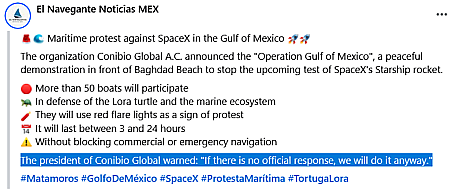
Protest announcement.
Protest announcement. Click for original.

A Mexico activist group now plans to launch a fleet of boats that plan to violate the range and prevent the next Starship/Superheavy test launch.

A translated version of the protest announcement can be seen to the right. From the first link above:

A Mexican environmental group, Comité Global A.C., said it plans to protest the launch by sending boats into the Gulf of Mexico near Starbase. If they enter designated safety areas during the planned launch period, they could delay the mission.

The group’s leader said the Matamoros Port Authority gave permission for the protest dubbed “Operación Golfo de México.” It will also include protesters on Playa Bagdad, a Mexican beach just south of the Rio Grande where people often gather for Starship launches.

I have not yet gotten confirmation that the local port authority has approved this protest as the organization claims, but it also appears that this activist group intends to show up in boats regardless. If so, this protest could easily cause the next test launch, now scheduled for August 24, 2025, to be delayed endlessly.

It seems this is a matter for Trump and the Coast Guard. Someone must move in and remove these boats, arresting and fining the occupants for violating launch range restrictions that apply to all international waters.

Hat tip to reader Richard M.

34 comments

California’s Coastal Commission again rejects an increase in SpaceX’s launch rate at Vandenberg

Wants to be a dictator

As expected, the California Coastal Commission yesterday again rejected the proposed doubling of launches by SpaceX at the Vandenberg Space Force Base, from 50 to 100 launches per year, claiming this time it would destroy the environment.

“The sonic booms and their impacts on California’s people, wildlife and property are extremely concerning,” Commissioner Linda Escalante said at a hearing Thursday in Calabasas. “The negative impacts on public access, natural resources and environmental health warrant our scrutiny under California as a standard of review.”

The commissioners and its staff also argued that the launches were not related to national security or military purposes, but instead acted “to expand SpaceX’s commercial telecommunications network rather than serve federal agencies.” See the staff report [pdf] issued prior to the meeting.

The simple fact remains that it is a privately owned company engaged in activities primarily for its own commercial business. It is not a public federal agency or conducting its launches on
behalf of the federal government. It should therefore be regulated accordingly. [emphasis mine]

How dare SpaceX try to make a profit as a private company in America? And how dare the Space Force act as a servant of the people to provide this private company service? What have we come to?! Is communism and top-down authoritarian rule no longer America’s fundamental purpose?

Nor are the claims of the commission about the environment valid. » Read more

11 comments

Jared Isaacman proves in an op-ed today why Trump dumped him

Jared Isaacman
Jared Isaacman has now proven he was
the wrong man for NASA administrator

In an op-ed posted today by Jared Isaacman and Newt Gingrich, the two men pushed the idea that NASA should lead a new “mini-Manhattan Project” to develop “nuclear-electric-powered spaceships” in order to conquer the heavens.

The President’s budget calls for an eventual pivot away from NASA’s Space Launch System (SLS)—leaving the heavy-lift rocket business to a capable commercial industry. That pivot should be toward something no other agency, organization, or company is capable of accomplishing: building a fleet of nuclear-electric-powered spaceships and extending America’s reach in the ultimate high ground of space.

The NASA centers, workforce, and contractors that manage, assemble, and test SLS are suited to take on this inspiring and necessary challenge. NASA Center at Michoud, for example, built landing craft during WWII, the Saturn V during the space race, the Space Shuttle, and the SLS. It is now waiting for the next logical evolution to ensure the competitiveness of our national space capabilities.

Oy. What piffle. » Read more

41 comments

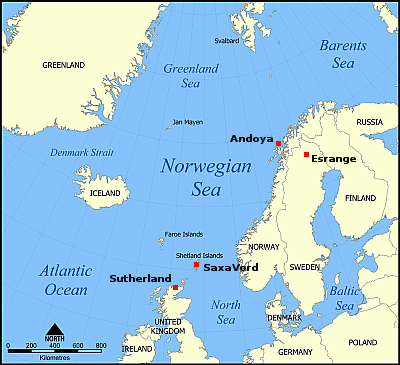
Founder of SaxaVord spaceport passes away

Frank Strang, who first proposed the SaxaVord spaceport on the island of Unst in the Shetland Islands in 2017, died yesterday at 67 from cancer, having never seen a single launch from the spaceport almost entirely due to the odious red tape of the United Kingdom.

When Strang announced last month that he had cancer, he also said he hoped to live long enough to see the first launch. The German rocket startup Rocket Factory Augsburg plans its first launch later this year, though this schedule is not firm. Its launch attempt last year was cancelled when the first stage failed during its last static fire test on the launchpad. Whether the UK’s Civil Aviation Authority will issue a launch permit on time remains decidedly unclear.

1 comment

FCC eliminates red tape for both satellite companies and space stations

The Federal Communications Commission (FCC) this week announced [pdf] that it has changed a number of regulations to streamline its licensing in connection with satellite constellations, ground stations, and new space stations.

Today’s reforms intend to boost the nascent Ground-Station-as-a-Service (GSaaS) business model that allows multiple satellite systems to share the same ground station. The new rules eliminate needless paperwork and clear regulatory barriers to GSaaS, a business model that gives satellite operators—especially startups and emerging growth companies—the ability to send and receive signals without having to build their own ground infrastructure.

…The Order establishes a new process for ground station operators to receive a baseline license without first identifying a specific satellite point of communication. For each new point of communication, only a simple FCC notification will be needed. This one change would eliminate approximately 49% of earth station modification applications.

Today’s action further streamlines and expedites the application process for space stations and earth
stations by moving away from regulations that require FCC approval for making even the smallest
changes to a satellite system.

The direction of regulation has shifted 180 degrees since Trump’s election. Under Biden, federal agencies were constantly tasked to increase oversight so that it often took years to get approvals. Under Trump, those same agencies are now beginning to eliminate regulation across the board.

Elections matter. Anyone who says all politicians are the same is either ignorant or lying.

1 comment

Starlink now available in Israel

After a year of regulatory paperwork, the Israel government has finally allowed SpaceX to offer Starlink to customers in Israel proper, but not in the West Bank or Gaza.

The company received an operating license from the Communications Ministry last year, following lengthy negotiations and regulatory procedures, but its launch was delayed until now. The restriction on coverage in the West Bank and Gaza is likely due to security concerns over potential use by hostile actors.

Expect the usual leftist anti-Semites to accuse Israel of bigotry for excluding access to Palestinians, but until those Palestinians show some willingness to live with Israel in peace (something they so far show no signs in doing, especially in Gaza), this policy makes perfect sense.

20 comments

Azerbaijan officials hold cooperation talks with SpaceX

In connection with the visit of Azerbaijan’s president to the United States, he and other officials held a meeting with SpaceX vice president Stephanie Bednarek to discuss possible areas of cooperation. From Azerbaijan’s state-run press:

At the meeting, we noted Azerbaijan’s economic potential, strategic development directions, and favorable investment climate. We discussed prospects for cooperation with SpaceX, including partnership opportunities in the application of innovative and space technologies, artificial intelligence solutions, and knowledge and experience transfer.

In plain language, Azerbaijan is considering buying services from SpaceX. That it is doing so underlines once again the negative consequences of Putin’s invasion of the Ukraine. Azerbaijan now fears Russia, and is looking elsewhere for aid. It also senses Russia’s increasing weakness, economically, technologically, and militarily, making it more willing to forge alliances with others.

11 comments

The word that best describes our present NASA lunar program is “delusional.”

Artemis, a program based on fantasy

Increasingly it appears everyone in Congress, the White House, and NASA, as well as our bankrupt mainstream press, has become utterly divorced from reality in talking about NASA’s Artemis lunar program. The claims are always absurd and never deal with the hard facts on the ground. Instead, it is always “Americans are piorneers! We are great at building things! We are going to beat China to the Moon!”

An interview of interim NASA administration (and Transportation secretary) Sean Duffy yesterday on the Sean Hannity Show made all these delusions very clear. First Hannity introduced Duffy by stating with bald-faced ignorance that “NASA has a brand-new program. It is called Artemis that aims to get astronauts back on the Moon in the next couple of years.”

I emphasize “brand-new” because anyone who has done even two seconds of research on the web will know that Artemis has existed now for more than a decade. Hannity illustrates his incompetence right off the bat.

Duffy then proceeds to insist that the next Artemis mission, dubbed Artemis-2, will fly in April 2026 and send four astronauts around the Moon, followed by the Artemis-3 manned landing one year later.

Being an incompetent member of the propaganda press, Hannity of course accepts these claims without question. He fails to question Duffy about the serious issues with the Orion heat shield, which experienced extensive unexpected damage that is still not understood during its return on the first Artemis mission in 2022.

Nor does either Duffy or Hannity mention the fact that for Artemis to land humans on the Moon SpaceX’s Starship not only has to become operational for human passengers, it needs an in-orbit refueling capability that does not yet exist. I have full confidence that SpaceX will eventually succeed in achieving these benchmarks, but I also doubt it will be able to do it by mid-2027, as claimed by Duffy.

Duffy and Hannity however are not alone in living in this dream world. » Read more

36 comments

California Coastal Commission to reconsider SpaceX’s Vandenberg launch proposal

The California Coastal Commission has now scheduled a meeting on August 14, 2025 to reconsider SpaceX’s request to double its launch rate at Vandenberg Space Force Base from 50 to 100 launches per year.

Though it has no real authority over the base, and though the Space Force has indicated it has no objections to SpaceX’s proposal, the commission rejected that increase in a 6-4 vote in October 2024, but did so not because the commissioners thought it would harm California’s beaches, but because they did not like Elon Musk’s endorsement and campaigning for Donald Trump during the election campaign.

SpaceX has subsequently sued, with a judge ruling two weeks ago that the suit can go forward. Based on the statements made by commissioners in October, SpaceX has an excellent case, and will likely win in court.

It appears the commission is now acting to possibly stave off that suit. The article at the link also notes that the make-up of the commission has changed since that October meeting, with at least one of the commissioners who expressed the most hate against Elon Musk, Gretchen Newsom, is no longer a member.

At the same time, the hostility to Musk and SpaceX for environmental reasons appears to still exist within the commission. Either way, in the end SpaceX’s launch rate at Vandenberg is going to increase, since the military is agreeable to the change.

5 comments

South Korea transfers its government-built Nuri rocket to private company

Capitalism in space: South Korea’s space agency KARI has now completed the transfer of its government-built Nuri rocket to the private South Korea company Hanwha Aerospace.

The transfer includes a total of 16,050 technical documents. While some 2 trillion won ($1.45 billion) in public funds was invested in developing the Nuri rocket, the two sides agreed on a technology transfer fee of 24 billion won, based on direct research and development costs. The agreement comes nearly two years and 10 months after Hanwha Aerospace was selected as the preferred negotiator.

Under the contract, Hanwha Aerospace has secured exclusive rights to lead Nuri production until 2032, which coincides with the government’s target for the next-generation Korean launch vehicle. [emphasis mine]

The highlighted phrase is important, as it shows that this transfer is not completely shifting space development and ownership from the government to the private sector. Hanwha is going to operate the rocket, but it does not appear to own it, nor is it clear it will be allowed to market it to others for profit. Furthermore, it is not Hanwha but KARI that will be developing the next-generation rocket, using government funds.

The dominance of the South Korean government is also reflected in the cost, as the article notes that the Nuri rocket costs “per kilogram … about 10 times that of SpaceX’s reusable Falcon 9.” Like all governments, KARI was not focused on profit in developing Nuri, so it built a rocket uncompetitive in the present launch market.

Still, this deal indicates the South Korean government’s recognition that it must foster a robust private sector aerospace industry if it truly wishes to enter the space age. This deal is thus just a first step.

6 comments

Texas Space Commission hands $5 million to proposed spaceport in the middle of Texas

US and Mexico
Click for source.

In what can only be seen by anyone with any objectivity as a political payoff that has no chance of ever producing anything worthwhile, the Texas Space Commission (TSC) has given the Midland International Air and Space Port a $5 million grant to develop its proposed spaceport for vertical rockets in the middle of west Texas.

The spaceport is one of three facilities — along with ILC Aerospace in Houston and SylLab Systems in Plano — that received grant funding as part of the Space Exploration and Aeronautics Research Fund (SEARF). The SEARF provides funding to eligible companies, including government entities that the TSC is partnered with, to fund such purposes as technology development, research, workforce training, curation of materials and development of infrastructure. In its history, the SEARF fund has provided $126 million worth of grant money to 22 different projects.

…Although requested and managed by the city of Midland, the vertical launch site will be in Balmorhea in Reeves County, around the same site as the International Rocket Engineering Competition earlier this summer. The area can currently support suborbital rocket launches, but the vertical launch site is expected to support orbital flight, which will complement their horizontal launch system and high speed corridor for hypersonic flight.

The map to the right shows the location of Midland and Balmorhea. As you can see, this site makes no sense for vertical rocket launches, unless every rocket launched from the site is completely reusable. Even then, it faces major political hurdles to get permission to fly rockets over all the neighboring communities and states. The FAA would certainly have doubts.

In other words, this $5 million grant is a nice pay-off from one government agency to another, with its only purpose to spread some graft around.

That the Hearst-owned Midland Reporter-Telegram news article at the link recognizes none of this, and simply and naively spouts the propaganda put forth by government officials, once again illustrates the bankruptcy of our so-called “mainstream” press.

8 comments

The journal Science retracts 15-year-old paper that proposed arsenic as basic element of life

The death of science: Though numerous later research had rejected the conclusions of a 2010 research paper that had suggested a bacteria found at Mono Lake in Californa was using arsenic instead of phosphorus in its DNA, the journal Science that published that paper has now retracted it.

In a blog post accompanying this week’s retraction notice, Science’s current Editor-in-Chief Holden Thorp and Valda Vinson, executive editor of the Science family of journals, emphasize there is no suggestion of foul play in the GFAJ-1 paper. Instead, pointing to subsequent commentary and research that suggest some of the paper’s findings stem from contamination, not arsenic use by bacteria, they write: “Science believes that the key conclusion of the paper is based on flawed data.”

Speaking with Science’s News team, which operates independently from its research arm, study co-author and Arizona State University geochemist Ariel Anbar says the team disputes that assessment and has already addressed the referenced criticisms. “We stand by the data,” he adds.

Anbar added this in this report at Nature:

By contrast, one of the paper’s authors, Ariel Anbar, a geochemist at Arizona State University in Tempe, says that there are no mistakes in the paper’s data. He says that the data could be interpreted in a number of ways, but “you don’t retract because of a dispute about data interpretation”. If that’s the standard you were to apply, he says, “you’d have to retract half the literature”.

This action underlines the decline in open-mindedness in the academic field. It did not suffice to simply demonstrate in later papers that the paper’s conclusions were questionable. It was necessary to cancel it entirely, to airbrush it from history.

10 comments

Like the Senate the House appropriation committee rejects Trump’s NASA cuts, but differently

The NASA 2026 budget approved this week by the House appropriation committee has rejected the 24% cut proposed by the Trump administration, in a similar manner as the parallel Senate committee.

However, the two congressional committees are not in agreement on any of their spending proposals.

The totals recommended by the two committees are similar — $24.8 billion in the House, $24.9 billion in the Senate — but the specifics are different in many cases.

For example, the House wants to spend $300 million for NASA’s very messed-up Mars Sample Return project, while the Senate eliminated it entirely. The House also increases NASA’s manned exploration budget over Trump’s proposal, while the Senate cuts it. In science spending the House is less generous than the Senate, though both houses reject Trump’s cuts. In education the House agrees with Trump, zeroing out that funding, while the Senate wants to increase the ’25 budget slightly.

Before the 2026 budget is approved the two houses will have to negotiate an agreement to make their numbers match. What has usually happened in past negotiations is that the houses agree to approve the highest spending numbers in any budget item so that nothing gets cut and the budget continues to go up uncontrollably. We should not be surprised if our corrupt Congress does exactly that.

Even so, we should expect Trump to force significant changes at NASA, including budget reductions. Recent Supreme Court rulings have confirmed the president’s right to reorganize and even eliminate bureaucracies, as long as Congress doesn’t specify a particular spending item.

1 comment

Mexico’s president says it will investigate SpaceX for doing salvage operations off its coast

Mexico to SpaceX:
Mexico to SpaceX: “Nice business you got here. Shame
if something happened to it.”

You can’t win with these people: First Mexico’s president Claudia Sheinbaum complained loudly about the debris that landed or washed up on its beaches after several of SpaceX’s Starship/Superheavy test launches, demanding an investigation followed by sanctions against the company.

Now Sheinbaum is complaining and demanding a new investigation about SpaceX’s effort the last two weeks to salvage and remove that debris from the ocean off its coast.

During a passage of her daily press conference, Sheinbaum said the agencies are analyzing whether the company has to be sanctioned after its unit tasked with clearing debris from the Starship launch, located in the Gulf of Mexico, worked without proper authorization. “We are investigating but the Environment, Navy, Digital Transformation, Government and Foreign Relations secretariats are conducting their research. The study is practically done,” Sheinbaum said.

Navy Secretary Raymundo Pedro Morales Angeles said the company hired by SpaceX to retrieve debris from its Starship rocket was allowed to enter the country but didn’t fulfill the requirements to work and ended up leaving the country.

If this behavior doesn’t prove Sheinbaum’s lust for power and control, nothing will. She doesn’t really care about Mexico’s beaches or environment. If she did, she would celebrate SpaceX’s salvage operations. What she really doesn’t like is that someone is doing something without her permission. She is the boss, and SpaceX better remember that!

22 comments

Study identifies range of interference produced by Starlink satellites

In analyzing about 76 million radio images produced by the new Square Kilometer Array (SKA) in Australia scientists have found within them signals produced by SpaceX’s Starlink satellites.

PhD candidate and study lead Dylan Grigg said the team detected more than 112,000 radio emissions from 1806 Starlink satellites, making it the most comprehensive catalogue of satellite radio emissions at low frequencies to date. “Starlink is the most immediate and frequent source of potential interference for radio astronomy: it launched 477 satellites during this study’s four-month data collection period alone,” Mr Grigg said. “In some datasets, we found up to 30 per cent of our images showed interference from a Starlink satellite.”

Mr Grigg said the issue wasn’t just the number of satellites, but the strength of the signals and the frequencies they were visible at. “Some satellites were detected emitting in bands where no signals are supposed to be present at all, such as the 703 satellites we identified at 150.8 MHz, which is meant to be protected for radio astronomy,” Mr Grigg said. “Because they may come from components like onboard electronics and they’re not part of an intentional signal, astronomers can’t easily predict them or filter them out.”

The researchers were careful to note that SpaceX has been following all international regulations, and that these signals are not a violation of any law or regulation. Further, they emphasized that “Discussions we have had with SpaceX on the topic have been constructive.”

Because many other such constellations are now being launched — with several from China that normally does not negotiate these issues like SpaceX — the scientists want new international regulations imposed to protect their work.

More and more it seems astronomers should simply move their operations into space or the Moon, where such issues will not exist. Getting above the atmosphere and away from our modern technological society provides so many benefits for research the move should be a no-brainer. That it is now also much cheaper to do it (thanks to SpaceX) makes the move even more practical.

For some reason however the idea seems too difficult for many astronomers to fathom.

1 comment

Rocket Lab’s new Neutron rocket faces red tape delays at Wallops

Proposed dredged channel
Proposed dredged channel. Click for original.

We’re here to help you! Rocket Lab appears to be having regulatory problems getting approvals to transport hardware for its new Neutron rocket to its new launchpad at the Mid-Atlantic Regional Spaceport (MARS) on Wallops Island in Virginia, delays that might prevent it from launching as planned later this year.

It appears the company needs to dredge a deeper channel to ship the heavier Neutron hardware into Wallops, but it has not been able to begin work because of approval delays by the federal government.

The dredging project was approved by VMRC [Virginia Marine Resources Commission] in May, but the company has yet to start digging because it’s still awaiting federal sign-off from the Army Corps of Engineers.

Lacking this approval and unable to get the channel ready for this year’s launch, the company is seeking permission to use a stop-gap different approach to transport the hardware through these shallow waters.

Kedging, a little-known nautical method, is used to ensure the barges can safely navigate the existing shallow channel. Workers would use a series of anchors and lines to steer the barge through the shallow waters. The company is seeking permission to use this method through the end of June 2026 or until the dredging work is complete, whichever comes first.

Lacking an okay to do even this alternative approach, Rocket Lab will be forced to transport the hardware using “ramps and cranes,” an approach that is impractical in the long run for achieving a profitable launch pace. It also would likely result in not meeting its targeted launch date before the end of 2025 for the first Neutron launch.

8 comments

Senegal to sign Artemis Accords

According to a NASA announcement today, Senegal will become the 56th nation to sign Artemis Accords tomorrow.

The full list of nations now part of this American space alliance: Angola, Argentina, Armenia, Australia, Austria, Bahrain, Bangladesh, Belgium, Brazil, Bulgaria, Canada, Chile, Colombia, Cyprus, Czech Republic, Denmark, Dominican Republic, Ecuador, Estonia, Finland, France, Germany, Greece, Iceland, India, Israel, Italy, Japan, Liechtenstein, Lithuania, Luxembourg, Mexico, the Netherlands, New Zealand, Nigeria, Norway, Panama, Peru, Poland, Romania, Rwanda, Saudi Arabia, Senegal, Singapore, Slovakia, Slovenia, South Korea, Spain, Sweden, Switzerland, Thailand, the United Kingdom, the United Arab Emirates, the Ukraine, the United States and Uruguay.

It remains unclear whether the second Trump administration has taken a new interest in using this alliance to renew the accords’ original goals, of encouraging private enterprise and property rights in space. The Biden had shifted the purpose away from those goals towards the more globalist approach represented by the Outer Space Treaty.

2 comments

Trump administration moving to reduce rocket launch environmental regulations

FAA logo

According to a draft executive order that has not yet been released, the Trump administration is planning a major revision of the FAA’s environmental and launch regulations that has badly impacted rocket companies, with the goal of streamlining licensing.

The order would give Trump even more direct control over the space industry’s chief regulator by turning the civil servant position leading the FAA’s Office of Commercial Space Transportation into a political appointment. The last head of the office and two other top officials recently took voluntary separation offers.

The order would also create a new adviser to the transportation secretary to shepherd in deregulation of the space industry.

…The draft order also seeks to restrict the authority of state coastal officials who have challenged commercial launch companies like SpaceX, documents show. It could lead to federal officials interfering with state efforts to enforce their environmental rules when they conflict with the construction or operation of spaceports.

The order would also have the secretary of transportation ‘reevaluate, amend, or rescind’ sections of Part 450, the FAA licensing regulations that it imposed during the Biden administration that was supposed to streamline licensing but ended up adding considerable new red tape which contributed significantly to squelching the new launch industry that had popped up during the first Trump term.

As is usual for the propaganda press, the article at the link implies that these changes would result in horrible environmental consequences as well as increased safety risks to the public. What it does not note is that these changes appear to simply return the regulatory framework back to what existed prior to the Biden administration, a framework that had existed for more than a half century previously. The environment and public safety did just fine under those more freedom-oriented rules. I am sure both will do just fine again.

This order might also help explain Trump’s decision to withdraw Jared Isaacman as NASA administrator and appoint Transportation Secretary Sean Duffy as interim NASA administrator. The order puts much of this work on his head, and having him in charge of NASA will likely aid that work.

2 comments
1 6 7 8 9 10 388