SLIM goes dark

SLIM's landing zone
Map showing SLIM landing zone on the Moon.
Click for interactive map.

The Japanese lunar lander SLIM has failed to respond to ground commands sent soon after dawn, ending the lander’s fourth night on the Moon.

SLIM was never expected to survive the harsh conditions of even a single 14-day-long lunar night after landing on the Moon in January 2024. Its primary mission had been to test precision autonomous landings, which it did successfully (though it landed on its side when one nozzle fell off just before touchdown). Yet, it then survived three lunar nights, resuming communications at dawn.

Its failure now is therefore no surprise, and actually marks a magnificent engineering success. The spacecraft’s hardware was proven robust enough to survive the very cold temperatures during lunar night, and suggests that future Japanese lunar landers using SLIM designs will function as well.

1 comment

Avio completes static fire test of the upper stage of its grounded Vega-C rocket

The Italian company Avio yesterday completed a full static fire test of the solid-fueled upper stage of its grounded Vega-C rocket, proving that the second redesign of its nozzle now works.

The initial post-test review indicates that the new nozzle assembly performed as expected throughout the scheduled 94 seconds burning time of the test, simulating a nominal in-flight performance.

The Zefiro-40 is a 7.6 m tall rocket motor, loaded with over 36 tonnes of solid propellant. For this test the motor was installed on its horizontal test bench. Zefiro-40 is developed and manufactured by Avio in their Colleferro factory near Rome, Italy.

A second firing-test will be conducted after the summer to confirm the data collected today. Avio engineers will review the data from the first test to prepare for a second test in October that will then qualify the second stage Zefiro-40 solid rocket motor for a return-to-flight by end 2024 from Europeโ€™s Spaceport in French Guiana.

The nozzle — originally built in the Ukraine — had failed during a launch in December 2022. Then Avio’s first redesign failed in a ground test in July 2023.

With this launch, the Vega-C is poised to resume operations by the end of the year. Those operations will be different however in one major respect. While previously the rocket was built by Avio but owned and controlled by the European Space Agency’s commercial arm, Arianespace, its ownership has been transferred back to Avio. Arianespace is now merely a “launch service provider” according to the press release. I suspect this means that Arianespace handles the launch in French Guiana, something that will also soon be taken from it because control of that spaceport is also being returned to the French space agency CNES.

0 comments

China launches four satellites from sea platform

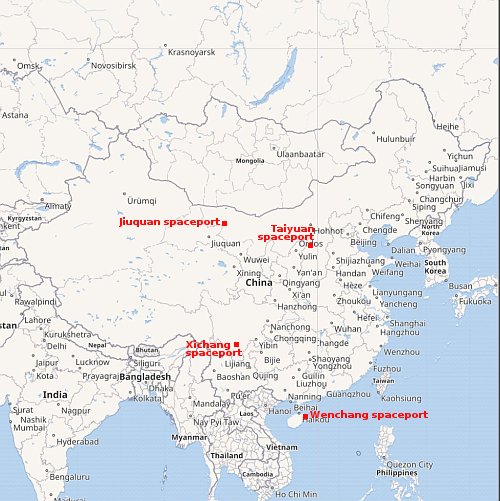
China's spaceports

The Chinese pseudo-company Galactic Energy today launched four satellites, its Ceres-1 rocket lifting off from its sea platform stationed off the coast of Shandong province, as shown on the map to the right.

As is usual now for China’s state-run press, the news report made no mention of the company, though unlike previous reports it did mention that the rocket was “commercial.” Since it does nothing without the full permission of the Chinese government, however, this is not a real independent company, with full ownership of its rocket. At any time the communists who run China can grab it for their own uses.

The leaders in the 2024 launch race:

57 SpaceX
24 China
7 Russia
6 Rocket Lab

American private enterprise still leads the world combined in successful launches, 65 to 37, while SpaceX by itself leads the entire world, including other American companies, 57 to 45.

1 comment

SpaceX launches European/Japanese climate satellite

SpaceX today successfully launched a joint European/Japanese satellite designed to study the climate, its Falcon 9 rocket lifting off from Vandenberg in California.

The first stage completed its seventh flight, landing safely back at Vandenberg. This was also SpaceX’s second launch today, from opposite coasts.

The leaders in the 2024 launch race:

57 SpaceX
23 China
7 Russia
6 Rocket Lab

American private enterprise now leads the world combined in successful launches, 65 to 36, while SpaceX by itself leads the entire world, including other American companies, 57 to 44.

4 comments

Need a kidney transplant? You better be poor according to new DEI proposed rules

The Biden administration: still dedicated to segregation!

โ€œSegregation today, segregation tomorrow, segregation forever!โ€ According to new rules proposed by the Biden administration “to root our racial bias,” a pilot program will favor low-income patients in providing them kidney transplants.

The proposal, which Becerra’s agency announced on May 8, would place 90 of the nation’s 257 transplant hospitals into a pilot program that uses an annual point system to grade participants. Under the system, a successful kidney transplant counts as one point. A transplant furnished to a low-income patient, however, counts as 1.2 points thanks to a “health equity performance adjustment,” thus incentivizing the hospitals to prioritize such patients. At the end of each year, those points are applied to a transplant quota. Hospitals that meet their quota receive as much as $8,000 per transplant; those that don’t may have to pay up to $2,000 per transplant.

While the proposal uses income to categorize patients rather than race, Becerra made clear that the scoring system is meant to address racial concerns. In his statement announcing the proposal, he touted the Biden administration’s “concrete steps to remove racial bias โ€ฆ in the transplant process.”

» Read more

5 comments

Chinese pseudo-company files plans for 10,000 satellite constellation

A Chinese pseudo-company has now filed plans for launching a 10,000 satellite constellation, the third such Chinese constellation planned.

A Chinese firm linked to commercial rocket maker Landspace has filed a notification with the ITU for a constellation comprising 10,000 satellites. Shanghai Lanjian Hongqing Technology Company, also known as Hongqing Technology, filed an Advance Publication Information (API) with the International Telecommunication Union (ITU) May 24. The filing outlines plans for a constellation named Honghu-3. It is to total 10,000 satellites across 160 orbital planes.

…The Honghu constellation plan appears to be the third 10,000-plus satellite megaconstellation planned by Chinese entities. It follows the national Guowang plan and the Shanghai-backed G60 Starlink proposal, both of which have been approved by Chinaโ€™s National Development and Reform Commission (NDRC). First batches of satellites for the pair are expected to launch in the coming months.

This new plan will likely not start launching satellites before 2025. Nonetheless, with these three large Chinese constellations plus both Starlink and Amazon’s Kuiper constellation, low Earth orbit is going to begin to get very crowded.

0 comments

North Korea’s orbital Chollima-1 rocket explodes shortly after launch

North Korea’s third launch of its orbital Chollima-1 rocket, supposedly carrying a spy satellite, failed today when the first stage exploded shortly after launch.

North Korea’s official state news agency said it launched a spy satellite aboard a new rocket from its main space centre tonight. But it added that the rocket blew up during a first-stage flight soon after liftoff due to a suspected engine problem.

Video of the explosion showed up on social media almost immediately. I have embedded that video below.

Based on when the explosion occurred — early in the flight — and the planned flight path east from North Korea’s west coast Sohai spaceport, the rocket debris very likely crashed inside North Korea, its toxic hypergolic fuels pouring down possibly in habitable areas.
» Read more

0 comments

Pressure from free-speech law firm forces Chase to eliminate language that allowed it debank conservatives

JP Morgan Chase: eager to blacklist you for your opinions
Maybe slightly less eager, but only slightly less

Bring a gun to a knife fight: For reasons that appear related to pressure from the conservative free-speech law firm the Alliance Defending Freedom (ADF), JPMorgan Chase has eliminated language in its payment services policy statement that allowed it to cancel conservative clients merely because it disliked those clients’ politics.

JPMorgan Chase, the largest bank in the U.S., rolled back its WePay service that required merchants to refrain from accepting payments or using the service for activities related to “social risk issues,” which the bank defined as anything “subject to allegation and impacts related to hate groups, systemic racism, sexual harassment and corporate culture.”

The language was removed from the company’s WePay terms of service, the Alliance for Defending Freedom (ADF) discovered this month.

For the past three years ADF has issued what it calls its Viewpoint Diversity Score Business Index, designed to “measure corporate respect for free speech and religious freedom across 43 performance indicators.” Each year it consults with the 85 corporations on its list in an attempt to get them to eliminate policies that encourage the debanking of conservative individuals or organizations. In the case of Chase, a sustained effort over two years eventually caused the company to remove that language.
» Read more

2 comments

Today’s Blacklisted American: To celebrate Memorial Day, a federal official bans the American flag

Brooke Merrell:
Brooke Merrell: Proud to ban the American flag

In another example of the fundamental hostility that federal officials feel for their country, officials at Alaskaโ€™s Denali National Park recently told contractors working in the park they were forbidden from flying Old Glory on their trucks and equipment, as construction workers have done for more than a century.

According to the contractor, Denali National Park Superintendent Brooke Merrell contacted the man overseeing the federal highways project, claiming there had been complaints about the U.S. flags, and notifying him that bridge workers must stop flying the stars and stripes from their vehicles because it detracts from the โ€œpark experience.โ€
Denali National Park Superintendent Brooke Merrell

โ€œThe trucks are flying these American flags, about a foot atop the trucks, about three-foot by four-foot flags, and they said they donโ€™t want this,โ€ the contractor explained. โ€œTheyโ€™re saying it isnโ€™t conducive and it doesnโ€™t fit the park experience.โ€

Up until this week, however, the flags were displayed without incident. It was only when the park began running tour buses that the order was given to take down the flags, he added.

» Read more

12 comments

South Korea establishes its own version of NASA

The South Korean government today announced the establishment of its own version of NASA, dubbed the Korea AeroSpace Administration (KASA), with what appears to be a focus on establishing a long term space program and using this to foster an aerospace commercial sector.

KASA was established under a special law passed by the National Assembly in January to unify government organizations in charge of space policy and projects. Based in Sacheon, South Gyeongsang Province, KASA has an annual budget of 758.9 billion won ($556 million) this year. The agency currently has around 110 employees and will eventually have a total of 293.

In March, the government established the 2024 Space Development Promotion Action Plan and set five major missions โ€” including space exploration, space transportation, space industry, space security and space science.

In line with the government’s policy, KASA will establish a roadmap for Koreaโ€™s space exploration and plans to promote reusable launch vehicles, development of the countryโ€™s own global positioning system (GPS) and a lunar lander program. In particular, it plans to develop a lunar lander with a goal of landing on the moon in 2032, and to design and develop engines to enter the commercial launch service market.

A second South Korea news report quotes the head of this new agency as follows:

“Until now, the country’s space development projects have been led by the government,” Yoon Young-bin, KASA’s inaugural chief, said earlier. “The most important role of the space agency will be supporting the private sector to lead space development.”

He pointed out that the world’s space industry is moving toward the so-called “new space” era, where private companies are actively leading innovation in space technologies with more economic feasibility. “The global paradigm is shifting,” Yoon said, noting that top space companies, such as SpaceX, have developed reusable space rockets and launched a group of small satellites with capabilities similar to medium- and large-sized satellites.

If KASA maintains this approach, then South Korea’s future as a space power is bright. If instead KASA moves to control all space development, including the design and ownership of its rockets and spacecraft, then that program will be stifled, as America’s was by NASA for forty years after the 1960s space race.

0 comments

China’s X-37B releases object in orbit

China’s copy of the U.S.’s military’s X-37B reusable mini-shuttle, dubbed Shenlong apparently released an object during its ongoing third orbital mission.

A new object (59884/2023-195G) has been cataloged associated with the Chinese CSSHQ spaceplane in a 602 x 608 km x 50.0 deg orbit. It seems to have been ejected about 1900 UTC May 24.

It is possibly this object is to test recapture maneuvers, as was done by during the mini-shuttle’s previous flight. It is also possible this release is preliminary to the end of the mission and the return of Shenlong to Earth. It is also possible it has a completely different purpose, since China has released practically no information about this spaceplane or any of its missions.

The present mission began a little more than seven months ago, releasing six small satellites a few days after launch. The previous two lasted two days and 276 days respectively. As with everything else, we have no idea how much longer it will remain in orbit.

0 comments

North Korea notifies Japan of planned orbital launch

North Korea

North Korea today notified Japan that it plans a new orbital launch sometime between today and June 3, 2024, indicating several potential drop zones for the rocket’s lower stages.

It designated three areas where debris will fall — two west of the Korean Peninsula and the other east of the Philippines’ island of Luzon, according to the news outlet.

Pyongyang has made public a plan to launch three more satellites this year following its first military reconnaissance satellite launch in November.

The launch will apparently take place from North Korea’s Sohai spaceport on its west coast, and will fly over the country heading east. The payload will also likely be a reconnaissance satellite of some kind, similar to what the country launched in November 2023.

2 comments
1 127 128 129 130 131 988