Another win for a blacklisted professor

Professor Timothy Jackson
Music historian Timothy Jackson

Fight! Fight! Fight! After the public University of North Texas (UNT) blacklisted and dismissed professor Timothy Jackson in 2020 from his job as editor of the music history journal he founded for daring to express some academic conclusions the faculty and students didn’t like, he sued.

After a five year battle, Jackson and the university have now settled out of court, with the terms of the settlement [pdf] largely a big win for Jackson.

First the background: In 2019 woke music theorist Philip Ewell of Hunter College in New York gave a presentation to the Society of Music Theory where he claimed 20th century music theorist Heinrich Schenker was a “virulent racist” whose “racist views infected his music theoretical arguments.”

Jackson, who had devoted his career studying Schenker and had co-founded at the university the Journal of Schenkerian Studies focused expressly on Schenker’s works, knew this was patently untrue. For example, Schenker was also a Jew who was a victim of German anti-Semitism and lost many relatives in the Holocaust, facts that Ewell somehow did not think important to mention. To counter Ewell’s historical slanders, Jackson decided to dedicate the next issue of the journal to this issue, presenting essays from both sides. He even asked Ewell to write an essay.

Ewell did not respond. In Jackson’s own essay he outlined in detail the historical facts — as he knew them as an expert on this subject — that put the lie to Ewell’s claims. As Jackson noted, “Ewell peddled a ‘conspiracy theory’ that is ‘part and parcel of the much broader current of Black anti-semitism.'”

Instead of celebrating this perfect example of free speech, the university immediately moved to punish Jackson.
» Read more

6 comments

House follows Senate in canceling most of Trump’s proposed NASA budget cuts

Like pigs at the trough

The House appropriations committee’s draft budget for NASA has followed the Senate appropriations committee in canceling all of Trump’s proposed NASA budget cuts, though it has shifted that funding significantly from science to manned space operations.

The House Appropriations Committee released the draft text of their version of the FY2026 Commerce-Justice-Science bill that funds NASA today. Like their Senate counterpart, the House committee would essentially keep NASA at its current funding level instead of imposing the severe 24.3 percent budget cut proposed by the Trump Administration. The CJS bill also includes almost $2 million for a White House National Space Council even though the Trump Administration has yet to establish one.

Unlike the Senate, which mostly kept the budget the same across all NASA departments, this House draft budget would reduce science and aeronautics spending from about $8.2 billion to $6.8 billion. Trump had requested only $4.5 billion for these departments.

In turn, the House would increase Trump’s request for NASA’s manned operations from $10.8 billion to $11.9 billion. Note that Trump’s proposed budget had already called for an increase here, so the House is clearly shifting funding to manned space in an enthusiastic manner.

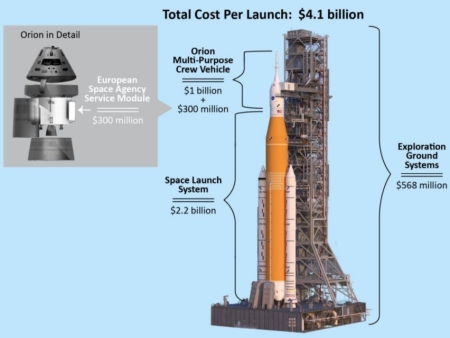
At the same time, the House continues funding for the SLS and Orion programs Trump wishes to cancel. Both of these projects are over budget and behind schedule. Neither is very useful in the long run for exploring the solar system. If the House truly wanted to save money, it could easily fund all the cuts in science by cutting the billions spent yearly on these pork projects, and still lower NASA’s budget in total.

Based on the draft budget’s language [pdf], it is unclear whether the House has also funded the Lunar Gateway space station, as the Senate has, another useless pork project that Trump wishes to cancel.

I should note that the appropriations committee’s overall draft budget [pdf] does reduce the federal budget by about 2.8 percent. This is a marked change from past budgets, which often claimed (a lie) to cut spending but really only reduced the rate of budget growth. It appears the House is finally making some effort to shrink the size of the budget, though that effort is quite wimpy.

1 comment

China launches cargo ship to its Tiangong-3 space station

China today successfully launched a new Tianzhou cargo ship to its Tiangong-3 space station, its Long March 7 rocket lifting off from its coastal Wenchang spaceport.

The freighter subsequently docked with the station about three hours later.

The leaders in the 2025 launch race:

86 SpaceX
37 China
10 Rocket Lab
8 Russia

SpaceX still leads the rest of the world in successful launches, 86 to 64.

0 comments

Third Indian state announces a space policy to encourage private enterprise

India map

A third state in India, Andhra Pradesh, has now released its own space policy, designed to create what it calls “manufacturing clusters”, centered around India’s main spaceport at Sriharikota.

The A.P. Space Policy (4.0) 2025-30 is valid for five years from the date of issue (July 13, 2025), or till a new policy is announced. A technical committee will be constituted under the Commissioner of Industries to vet and process applications for land allotment in the Space Cities proposed to be developed along the Hyderabad-Bengaluru Industrial Corridor in Sri Sathya Sai district and in Tirupati (Routhasuramala).

The government will form an SPV, ‘AP Space City Corporation’, which will drive all initiatives related to the development of the above Space Cities, and serve as the central agency to coordinate infrastructure development, raise start-up funds, attract investments, facilitate industry partnerships, build partnerships to attract global demand, and liaise with all GoI [Government of India] entities for tapping the domestic demand.

The previous two state space policies in Tamil Nadu and Gujarat, announced in April, had similar goals aimed at promoting the establishment of private aerospace companies within their regions.

Whether Andhra Pradesh’s policy will work carries uncertainties. Its advantage is that it is linked to India’s primary spaceport. Its disadvantage lies in the complex bureaucracy the state is creating in conjunction with these “Space Cities.” Such bureaucracies are rarely helpful for new businesses.

0 comments

Suborbital test launch from Oman’s Duqm spaceport scrubbed

Middle East, showing Oman's proposed spaceport
The Middle East, showing the location of
Oman’s proposed spaceport at Duqm.

A suborbital test launch from Oman’s Duqm spaceport was scrubbed yesterday due to” a technical issue” with the rocket.

DUQM: Etlaq Spaceport’s highly anticipated experimental rocket launch mission “Duqm-2” was aborted due to a technical issue on Sunday, July 13, 2025. Consequently, the launch has been postponed until “a replacement solution is developed,” it stated.

This was the second attempt launch scrubbed at Duqm, officially labeled the Etlaq Spaceport. The first, an attempt by a Middle East startup to do a vertical take-off and landing of a prototype small rocket, was scrubbed in April due to weather and technical issues. No new launch date has been scheduled.

The spaceport had announced in April a schedule of five launches before the end of the year. Two have now been scrubbed. All appear to have major financing from the Oman government. I suspect all have been pushed too hard and too fast by the government for PR reasons, which explains the two scrubs and the lack of a new launch schedule.

1 comment

Judge narrows SpaceX lawsuit against California Coastal Commission

Though U.S. district judge Stanley Blumenfeld ruled in May that SpaceX’s lawsuit against California Coastal Commission for targeting the company because the commissioners did not like Elon Musk’s political views can proceed, in early July he also narrowed the lawsuit significantly.

Blumenfeld granted a motion to dismiss violations of the First Amendment and due process against the commission and individual members based on lack of standing, sovereign immunity and failure to state a claim, but allowed allegations of “biased attempts to regulate SpaceX’s activity” and unlawfully demanding a CDP to proceed.

“In sum, SpaceX has plausibly alleged a ripe, nonspeculative case or controversy over whether it must obtain a CDP to continue its Falcon 9 launches,” Blumenfeld said in his order. “The credible threat that defendants will bring an enforcement action and subject SpaceX to daily fines for not having a CDP — which defendants pointedly do not disavow — is sufficient to establish an actual injury under Article III [of the U.S. Constitution].”

It appears the judge acted to protect the commissioners themselves from direct liability, using the made-up concept from the 20th century that government employees are somehow wholly immune from any responsibility for their actions.

Nonetheless, SpaceX has a great case, and is very likely to win in court, a victory that could very well cause the coastal commission and the state of California serious monetary pain.

4 comments

Senate committee moves to cancel most of Trump’s proposed NASA budget cuts

Like pigs at the trough

We’ll just print it! Though disagreements prevented the Senate’s appropriations committee from approving the 2026 bills covering the commerce, justice, and science agencies of the federal government (including NASA) , the committee yesterday appeared poised to cancel most of Trump’s proposed NASA budget cuts and even add more spending across the board.

Sen. Chris Van Hollen (D-Maryland), the top Democrat on the CJS subcommittee, said this morning the bill would fund NASA at $24.9 billion, slightly above its current $24.8 billion level, with the Science Mission Directorate (SMD) remaining level at $7.3 billion.

By contrast, the Trump Administration wants to cut NASA overall by $6 billion, from $24.8 billion to $18.8 billion. SMD’s portion would drop 47 percent, from $7.3 billion to $3.9 billion.

The disagreements centered not on NASA, but on the Trump administration’s effort to cancel a very expensive new FBI headquarters building in the Maryland suburbs and instead shift the agency to an already existing building in DC. Van Hollen opposed this, and the ensuing political maneuvering forced the committee to cancel the vote.

This bill would once again continue full funding for SLS, Orion, and Lunar Gateway. It also includes funding for NASA’s very messed-up Mars Sample Return mission (which comprises the large bulk of the money added back in for science). From this it appears that the Republicans in the Senate are quite willing to join the Democrats in spending money wildly, as they have for decades. They have no interest in gaining some control over the out-of-control federal budget, in any way, as Trump is attempting to do.

What remains unknown is this: Who has the support of the American people? The election suggests the public agrees with Trump. History suggests that this support for cutting the budget is actually very shallow, and that while the public says it wants that budget brought under control, it refuses to accept any specific cuts to any program. “Cut the budget, but don’t you dare cut the programs I like!”

It is my sense that the public’s view is changing, and it is now quite ready to allow big cuts across the board. The problem is that the vested interests in Congress and in the DC work force are quite powerful, and appear to still control the actions of our corrupt elected officials.

Thus, the more of that work force that Trump can eliminate as quickly as possible, on his own, the more chance he will have to eventually bring this budget under some control.

28 comments

SpaceX gets approval to build oxygen plant at Boca Chica

SpaceX today received the okay from Cameron County to build a plant at Boca Chica to produce oxygen from the atmosphere for use in its Superheavy/Starship rocket.

The commissioners voted, 3-1, to give Elon Musk’s rocket company a beachfront construction certificate and dune protection permit, allowing the company to build a modern-day factory akin to an oil refinery to produce gases needed for space flight launches.

The plant will consist of 20 structures on 1.66 acres. The enclosed site will include a tower that will reach 159 feet, or about 15 stories high, much shorter than the nearby launch tower, which stretches 480 feet high. It is set to be built about 280 feet inland from the line of vegetation, which is where the dunes begin. The factory will separate air into nitrogen and oxygen. SpaceX utilizes liquid oxygen as a propellant and liquid nitrogen for testing and operations.

By having the facility on site, SpaceX hopes to make the delivery of those gases more efficient by eliminating the need to have dozens of trucks deliver them from Brownsville. The company says they need more than 200 trucks of liquid nitrogen and oxygen delivered for each launch, a SpaceX engineer told the county during a meeting last week.

As usual, the same cranks who always complain about this stuff are given space by this news outlet to whine, but the truth is that the commission’s vote well reflects the attitude of the local community. It supports what SpaceX is doing, because of the prosperity the company is bringing to this formerly depressed region.

Moreover, this facility will not only save SpaceX money and make it easier to launch more frequently, it is likely environmentally beneficial. I suspect the facility will be relatively clean compared to the truck convoys it will replace.

Hat tip Robert Pratt of Pratt on Texas.

6 comments

Why did Trump suddenly pick Transportation Secretary Sean Duffy to become temporary head of NASA?

The reason for Trump’s sudden decision yesterday to name Transportation Secretary Sean Duffy as interim NASA administrator, replacing long-time NASA manager Janet Piro — who had held the job since Trump took office — remains unclear.

This article suggests the president wanted someone with more political clout who was also part of his inner circle.

Two articles (here and here) imply the decision was related to the recent clashes politically between Trump and Musk, adding that Duffy and Musk have been reported to be in conflict over air traffic controller issues. Picking Duffy thus directly reduces Musk’s influence at NASA.

The truth is that we really don’t know exactly what motives brought Trump to make this appointment. It could be that Trump wants someone in charge who will have the political clout to push through his proposed NASA cuts. It also could be Trump wants someone with that clout to review those cuts and change them.

The bottom line is that NASA remains a political football, a situation that in the end had done decades of harm to the American space industry. The sooner it can be made irrelevant and replaced by a commercial, competitive, and (most important) profitable space industry, the better.

We really don’t need a “space agency.” We didn’t have such a thing when we settled the American west.

9 comments

SpaceX finally passes final regulatory hurdle to sell Starlink in India

You might get deja-vu from this story, since I have reported repeatedly in the past that SpaceX has finally gotten regulatory approval to sell Starlink in India.

However, India’s complex regulatory framework — leftover from the days of British rule and strengthened for decades after independence when the strongly socialist Congress Party ruled — ended up requiring SpaceX to leap multiple regulatory hurdles to get the Starlink approved. According to news reports today, that last licensing hurdle has now finally been leaped.

The final approval marks a crucial milestone that will pave the way for the Musk-led company to launch its commercial satellite operations in the country. The Elon Musk-led company has been waiting for regulatory approvals since 2022 to operate legally in India. With this approval, Starlink has become the third company to enter the satellite space in India after Reliance Jio and Eutelsat’s OneWeb, in which Bharti Airtel, led by Sunil Mittal, is a shareholder.

Does this mean SpaceX can now sell Starlink in India? Of course not:

The next step for Starlink is to secure spectrum from the government, which will likely be assigned in the coming months. It also needs to set up infrastructure on the ground. One of the most critical aspects of Starlink’s India foray will be its compliance with the country’s security rules.

Since Starlink doesn’t need a complex ground infrastructure, selling terminals directly to customers, the infrastructure mentioned in the quote likely involves partnering Starlink operations with the Indian telecommunications companies Airtell and Jio, so that they get a piece of the action.

0 comments

The walls of Jericho blocking Trump’s effort to streamline government have now fallen

Trump defiant after being shot
Trump defiant

Fight! Fight! Fight! The Supreme Court ruling yesterday that allowed Trump’s plan to reorganize and reduce the federal workforce to go forward was far more significant than most realize. It in fact tells us that opposition to Trump’s effort is dissolving, and that he will have the ability in the last three years of his present term in office to complete this effort in a manner that will reshape the federal bureaucracy in ways so radical we will not recognize it when he is done — assuming Trump maintains his present aggressive effort.

First the background. In February Trump issued an executive order requiring agency managements throughout the executive branch to institute plans for reducing staffing signficiantly.

Titled “Implementing The President’s ‘Department of Government Efficiency’ Workforce Optimization Initiative,” the executive order also severely limits federal departments’ ability to bring on more staffers and mandates that agency heads closely coordinate with their DOGE representatives on future hiring plans. Once the hiring freeze that Trump put in place is lifted, agencies will only be allowed to replace one of every four employees who leave and hiring will be restricted to the highest-need areas.

Plus, agencies will not be able to fill vacancies for career positions that DOGE team leaders think should remain open, unless the department head determines they should be filled. DOGE leaders at each agency will file a monthly hiring report to DOGE.

Not surprisingly numerous lawsuits were immediately filed to block this order, claiming that Trump was required to get Congressional approval for such actions.
» Read more

11 comments

Coalition of space companies begs Congress to fund office designed to track satellites

A coalition of 450 space companies has now submitted letters to both the House and Senate begging Congress to not kill the funding for an office in NOAA created during the first Trump administration and designed to help manage satellite traffic in orbit.

A coalition of space industry associations representing hundreds of companies is urging Congress to reject Trump Administration plans to kill the nascent Traffic Coordination System for Space (TraCSS). Developed through NOAA’s Office of Space Commerce, TraCSS began beta testing last fall to provide data to civil and commercial satellite operators to avoid collisions. Just as the system is finally taking shape, it is targeted for elimination in the FY2026 budget request. The Senate Appropriations Committee takes up that proposal on Thursday when it marks up the Commerce-Justice-Science (CJS) bill that includes NOAA.

This new office was first conceived as a replacement for the tracking that the U.S. military has been doing since Sputnik was launched in 1957, information that it provides free to the industry. It appears Trump in his second administration has now concluded this new NOAA office is essentially redundant and therefore unnecessary.

The letters to the House [pdf] and Senate [pdf] urge Congress to reinstate the $65 million in spending for this NOAA office, but offer no suggestions on what to cut to fund this extra cost. Instead, like all such lobbying efforts, it expects Congress to simply print money to pay for the expense.

Meanwhile, it remains a valid question why this additional office is needed if the military has been doing the job quite successfully for the last three-quarters of a century. The letters argue this is a job better suited to a civil agency, but why? The military has to do it anyway for security reasons. Why waste money on a duplicate effort?

6 comments
1 50 51 52 53 54 988