Searching for ice in the Martian low latitudes

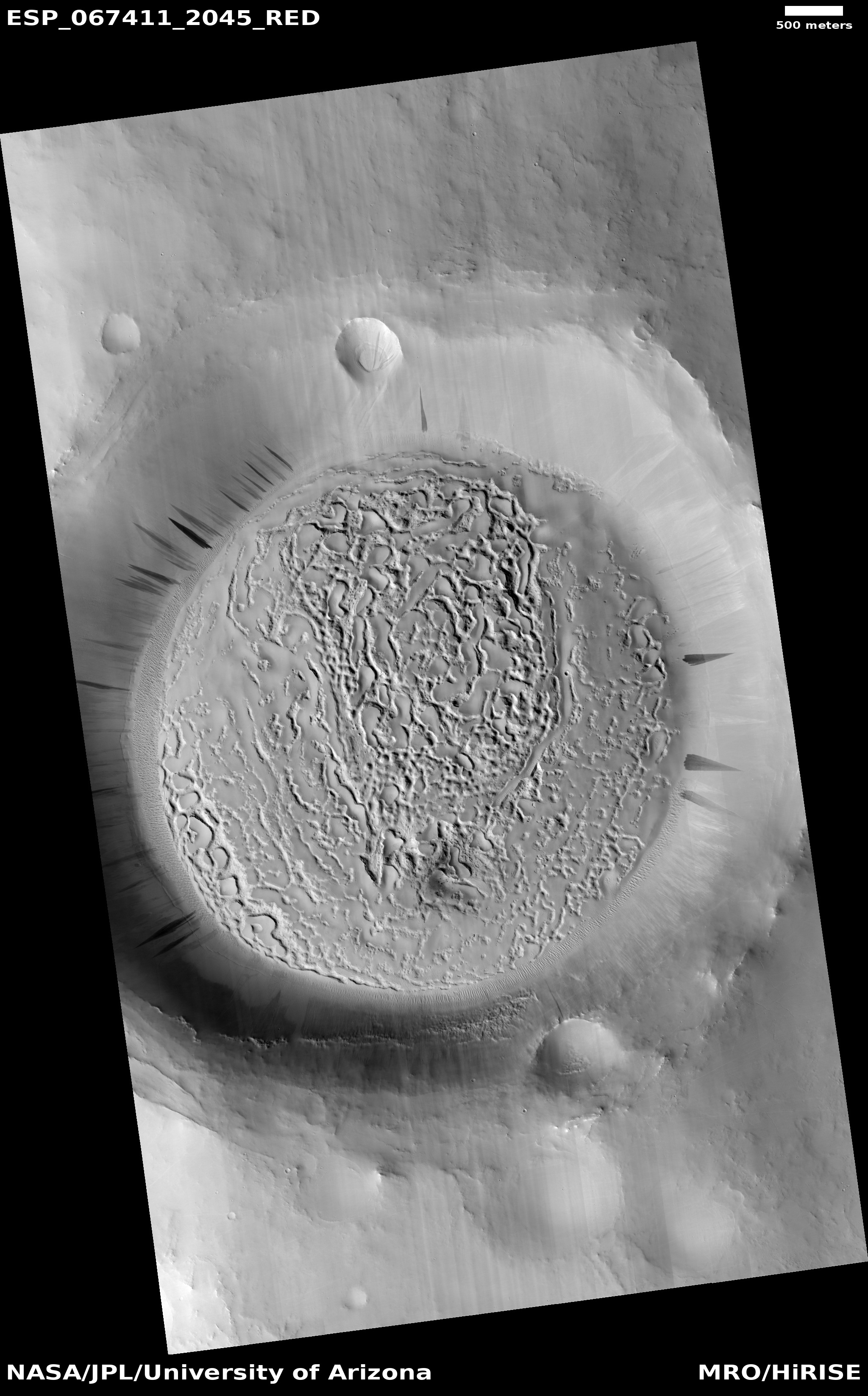
Low latitude crater with intriguing debris on its floor
Click for full image.

Today’s cool image well illustrates the effort of planetary scientists to map out the range of buried ice on the Martian surface. Taken on December 13, 2020 by the high resolution camera on Mars Reconnaissance Orbiter (MRO) and rotated, cropped, and reduced to post here, it shows a 3.5-mile-wide crater located in the southern cratered highlands, but for those cratered highlands at the very high northern latitude of 24 degrees.

The black streaks on the crater’s interior slopes are probably slope streaks, but these are not the subject of this article. Instead, it is the material that covers the crater’s floor. These features resemble the glacial fill material that scientists have found widespread in the latitude bands between 30 to 60 degrees latitude. However, this crater is farther south, where such ice would not be stable and should have sublimated away.

Could there still be ice here? I emailed the scientist who requested the photo, Colin Dundas of the U.S. Geological Survey’s Astrogeology Science Center in Arizona, and asked him what I was looking at. His answer:
» Read more

4 comments

China commits to building its own SLS

The new colonial movement: China yesterday officially announced that it has approved construction of a heavy-lift rocket, dubbed Long March 9, that would by 2030 be able to put 140 tons into orbit.

The rocket is planned to have a lift capacity of 140 metric tons, with the capability of sending 50 or more tons into lunar orbit. It would be an immense vehicle, with a 10-meter diameter core and 5-meter side boosters. China would also like to eventually make the rocket, or at least part of it, reusable.

China is also developing another large rocket more comparable to the Falcon Heavy, though this other rocket has no name and information about it is more scarce.

Both projects indicate the long term commitment of the Chinese government to its space program. They also indicate that the present-day international competition to get into space is fueling far more development than the last forty years of international cooperation.

Whether these giant government rockets from China will be practical and efficient is an unanswered question. Just building something to compete is not the same thing as actually competing. The rockets have to be affordable, with the ability to launch frequently to make in-space exploration possible. If not, they will nothing more than big photo ops for incompetent politicians, kind of like SLS is for the U.S.

15 comments

Parker looks at Venus

Venus as seen by the Parker Solar Probe
Click for full image.

During its July 2020 fly-by of Venus, the Parker Solar Probe used its wide field camera to snap a picture of the planet, cropped and reduced to post here on the right.

The photo surprised the scientists in that it apparently was able to detect some major surface features through Venus’ thick cloud cover.

WISPR is designed to take images of the solar corona and inner heliosphere in visible light, as well as images of the solar wind and its structures as they approach and fly by the spacecraft. At Venus, the camera detected a bright rim around the edge of the planet that may be nightglow — light emitted by oxygen atoms high in the atmosphere that recombine into molecules in the nightside. The prominent dark feature in the center of the image is Aphrodite Terra, the largest highland region on the Venusian surface. The feature appears dark because of its lower temperature, about 85 degrees Fahrenheit (30 degrees Celsius) cooler than its surroundings.

That aspect of the image took the team by surprise, said Angelos Vourlidas, the WISPR project scientist from the Johns Hopkins Applied Physics Laboratory (APL) in Laurel, Maryland, who coordinated a WISPR imaging campaign with Japan’s Venus-orbiting Akatsuki mission. “WISPR is tailored and tested for visible light observations. We expected to see clouds, but the camera peered right through to the surface.”

“WISPR effectively captured the thermal emission of the Venusian surface,” said Brian Wood, an astrophysicist and WISPR team member from the U.S. Naval Research Laboratory in Washington, D.C. “It’s very similar to images acquired by the Akatsuki spacecraft at near-infrared wavelengths.”

This surprising observation sent the WISPR team back to the lab to measure the instrument’s sensitivity to infrared light. If WISPR can indeed pick up near-infrared wavelengths of light, the unforeseen capability would provide new opportunities to study dust around the Sun and in the inner solar system. If it can’t pick up extra infrared wavelengths, then these images — showing signatures of features on Venus’ surface — may have revealed a previously unknown “window” through the Venusian atmosphere.

The streaks in the picture come from cosmic rays.

3 comments

Land of rovers

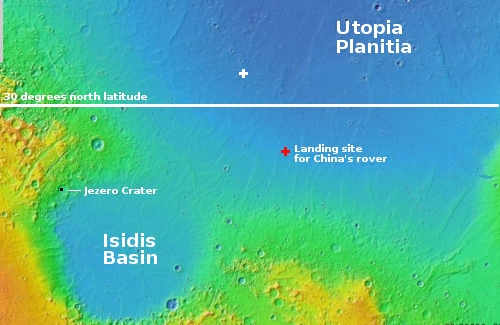
Overview map

Today’s cool image is in honor the two newest Martian rovers, Perseverance (which now sits quite comfortably in Jezero Crater, ready to begin what will probably be more than a decade of exploration on the Martian surface) and China’s yet-to-be-named rover (set to hopefully soft land on Mars some time in late April).

The overview map to the right shows us the region where both rovers shall wander. The black box in Jezero Crater is where Perseverance now sits. The red cross about 1,400 miles away is the believed landing zone for China’s rover, located in Utopia Planitia at about 25 degrees north latitude. The Viking 2 landing site is just off the edge of the northeast corner of the map.

The latitude of 30 degrees, as indicated by the white line, is presently an important dividing line based on our present knowledge of Mars. South of that line the terrain is generally dry, though there is evidence that water in some form (liquid or ice) was once present. North of that line scientists have found evidence of considerable ice below the surface, with its presence becoming increasingly obvious the farther north you go.

Today’s cool image, shown below, is north of that line at 33 degrees latitude in Utopia Planitia, and is marked by the white cross, about 500 miles to the northwest of the Chinese rover’s landing site.
» Read more

3 comments

Tianwen-1 enters parking orbit around Mars

The new colonial movement: According to the Chinese state-run press, the Tianwen-1 orbiter has entered the parking orbit around Mars that it will use for the next three months to conduct reconnaissance of its lander/rover’s landing site.

At 6:29 a.m. (Beijing Time), Tianwen-1 entered the parking orbit, with its closest point to the planet at 280 km and the farthest point at 59,000 km. It will take Tianwen-1 about two Martian days to complete a circle (a Martian day is approximately 40 minutes longer than a day on Earth), the CNSA said.

Tianwen-1, including an orbiter, a lander and a rover, will run in the orbit for about three months.

The CNSA added that payloads on the orbiter will all be switched on for scientific exploration. The medium-resolution camera, high-resolution camera and spectrometer will carry out a detailed investigation on the topography and dusty weather of the pre-selected landing area in preparation for a landing.

China has also begun prepping the rocket that will launch Tianhe, the first module in its space station, sometime this spring. A total of eleven launches are planned over the next two years to assemble the station.

0 comments

First air leak crack on ISS has not grown

A inspection of the first air leak crack that had been found and patched in the Zvezda module on ISS last year has found that it apparently not increased in size since then.

The size of a crack in the intermediate chamber of the Russian Zvezda module aboard the International Space Station (ISS) remains unchanged, cosmonaut Sergei Ryzhikov reported to Russia’s Flight Control Center on Wednesday. “It [the length] has not changed. As in the previous measurements, I do not see any changes,” Ryzhikov said during his talks with Mission Control broadcast on NASA’s website.

On February 23, the cosmonaut carried out work with a microscope to trace another possible air leak. The photos of the work were transmitted to Earth and the video from GoPro cameras will be sent via the Russian broadband communications system. After completing the work, the cosmonaut reinstalled the patch in the area of the crack.

This Russian report is decidedly unclear about some details. Though it appears the astronaut was using the microscope to inspect another leak, he also apparently removed the patch on the first leak to check the crack for any changes, then replaced it. How one removes and replaces such a patch is a puzzle however. Such things are generally not removable.

No matter. The important detail is that the crack has not grown. If it was a stress fracture the recent dockings of spacecraft to the nearby port might cause it to grow. That it has not is good news.

The bad news is that the inspection did not find the second small leak that is thought to be in this same Zvezda module.

2 comments

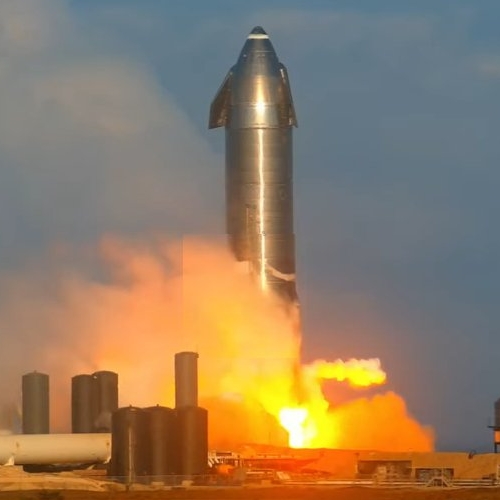
Starship #10 completes launch dress rehearsal & static fire test

Starship #10 at static fire test
Screen capture from LabPadre live stream.

Capitalism in space: Starship #10 today successfully completed a launch dress rehearsal and static fire test in preparation for a planned 30 to 40 thousand foot test flight, possibly as soon as February 25th.

The Starship SN10 (“Serial No. 10”) vehicle performed its first “static fire” test on Tuesday (Feb. 23), lighting up its three Raptor engines for a few seconds at 6:03 p.m. EST (2303 GMT) at SpaceX’s South Texas site, near the Gulf Coast settlement of Boca Chica Village.

Static fires, in which engines briefly ignite while a rocket stays anchored to the ground, are a common preflight checkout for SpaceX. If all went well with today’s test, SN10 remains on track to launch soon — perhaps as early as Thursday (Feb. 25) — on a 6-mile-high (10 kilometers) demonstration flight into the South Texas skies.

I personally think it would be quite ironic if this Starship flies on the same day the second SLS static fire test had been originally scheduled but postponed. The contrast between the two development programs continues to be stark and astonishing. While one program has been flying test articles repeatedly as well as doing numerous engine and tank tests, the other has had trouble getting one static fire test completed without a hitch.

UPDATE: Apparently they have decided to swap out one Raptor engine based on the results of the static fire test, and thus will not do a flight tomorrow.

1 comment

Martian pits or dark splotches?

Martian pits or dark splotches?
Click for full image.

Cool image time! The photo to the right, cropped to post here, was taken on January 2, 2021 by the high resolution camera on Mars Reconnaissance Orbiter (MRO). It shows a windswept sandy region of ridges and dunes with two dark features nestled between ridges.

What are these dark patches? At the available resolution they appear to be deep pits, with the one on the right having a significant overhang. And if these are pits, they would appear significantly different than most of the previously identified Martian pits, which are usually somewhat circular in shape. These features have very complex shapes, as if the pit is conforming itself to the terrain that surrounds it.

The resolution, however, is not good enough to confirm this interpretation. These dark patches could also be exposed volcanic material, darker than the surrounding terrain. The location, as shown in the overview map below, adds weight to this interpretation.
» Read more

2 comments

Rumors: Biden considering former Senator Bill Nelson for NASA administrator

According to leaks to the press yesterday, the Biden administration is considering hiring former Florida senator Bill Nelson to become NASA’s administrator.

That the DC rumor mill is abuzz with this story suggests that the White House is putting out a trial balloon to see the reaction to such a choice. At first glance Nelson appears a good pick. Before he was defeated in his last election by Republican Rick Scott (R-Florida), he had been one of Congress’s biggest advocates for space exploration and NASA. He had even flown as an astronaut on the shuttle back in 1986, just weeks before Challenger broke up during launch.

However, there are several issues that would make this a very poor choice. First, Nelson’s advocacy for NASA was centered on funding big space, not private enterprise. Nelson was one of those legislators who mandated the construction of SLS, and resisted for years NASA’s new commercial space effort.

Second, Nelson’s last years in Congress revealed that he had lost touch with some of the basic concepts of freedom and property rights that founded the United States. For example, he was one of a group of bi-partisan senators that in 2018 proposed a law that would have denied Americans their second, fifth, sixth, and seventh amendment rights by proactively forbidding them the right to buy firearms merely because a Washington bureaucrat decided to put them on a no-fly list. The law was a mindless emotional response to a terrible school shooting that killed a lot of children, and its proposal illustrated that its sponsors were no longer thinking, but emoting blindly.

That Nelson joined in and was willing to give the government so much power does not make him the best choice to lead NASA as it tries to become just another customer being served by an independent robust and free market of space companies.

Finally, and maybe most important, Nelson is 78 years old. In his last years in office he showed his age. I watched him struggle as both a speaker and legislator during hearings in 2017. His enthusiasm for space was unchecked, but his sharpness was gone.

If chosen to run NASA he will make a good bookend for his president, who has also shown clear signs of failing mental health. Under such weak leadership, it will be the bureaucracy that will rule, and the track record of NASA’s bureaucracy has not been good. It resisted for decades ceding power to the private sector, wanting instead to maintain control over all rocket and spacecraft development, including what those rockets and spacecraft would do. Only in the past decade has that power been wrested from its grasp.

Given power again I expect it to use that power to return to its old ways and squelch the emerging free and competitive aerospace market. This will not be good for either the exploration of space, or for America itself.

4 comments

Second passenger chosen for private manned SpaceX mission

Capitalism in space: Jared Isaacman, who has purchased an entire Dragon/Falcon 9 flight for the first private commercial manned mission scheduled for later this year, has picked the flight’s second passenger.

The second member of a four-person crew for what’s likely to be the first privately funded orbital space tour has been identified: She’s Hayley Arceneaux, a 29-year-old physician assistant who works at St. Jude Children’s Research Hospital in Memphis, Tenn. — and was successfully treated for bone cancer at St. Jude almost two decades ago.

Arceneaux was invited to be part of the Inspiration4 mission weeks ago by its commander and principal funder, Shift4 Payments CEO and founder Jared Isaacman — but her identity was kept secret until today.

This choice fits Isaacman’s main goal, which is to use the publicity of the flight in raise money for St. Jude’s. So far almost $10 million has been raised.

Two more passengers need to be chosen. One will be picked from a lottery of people who donate to St. Jude’s, with the second being an entrepreneur picked by a panel of judges. The deadline to enter both slots closes on February 28th.

As for the flight itself, it will spend two to four days in orbit.

0 comments

First panorama from Perseverance

The Perseverance science team has released the first panorama taken by the Perseverance rover after landing on Mars February 18th.

Below the fold however I have embedded something far better than the science team’s mosaic. Andrew Bodrev has taken these same navigation camera images and created a 360 degree virtual reality panorama, one that you can pan and tilt at your own pleasure. The view also includes the sounds of the Martian winds from the rover’s microphone. If you pause it you won’t hear the sounds, but you can scan and rotate for as long as you want.

» Read more

5 comments
1 100 101 102 103 104 126