Strange ridge ripples on the windswept plateau above Mars’ biggest canyon
Strange ridges on Mars
Click for full image.

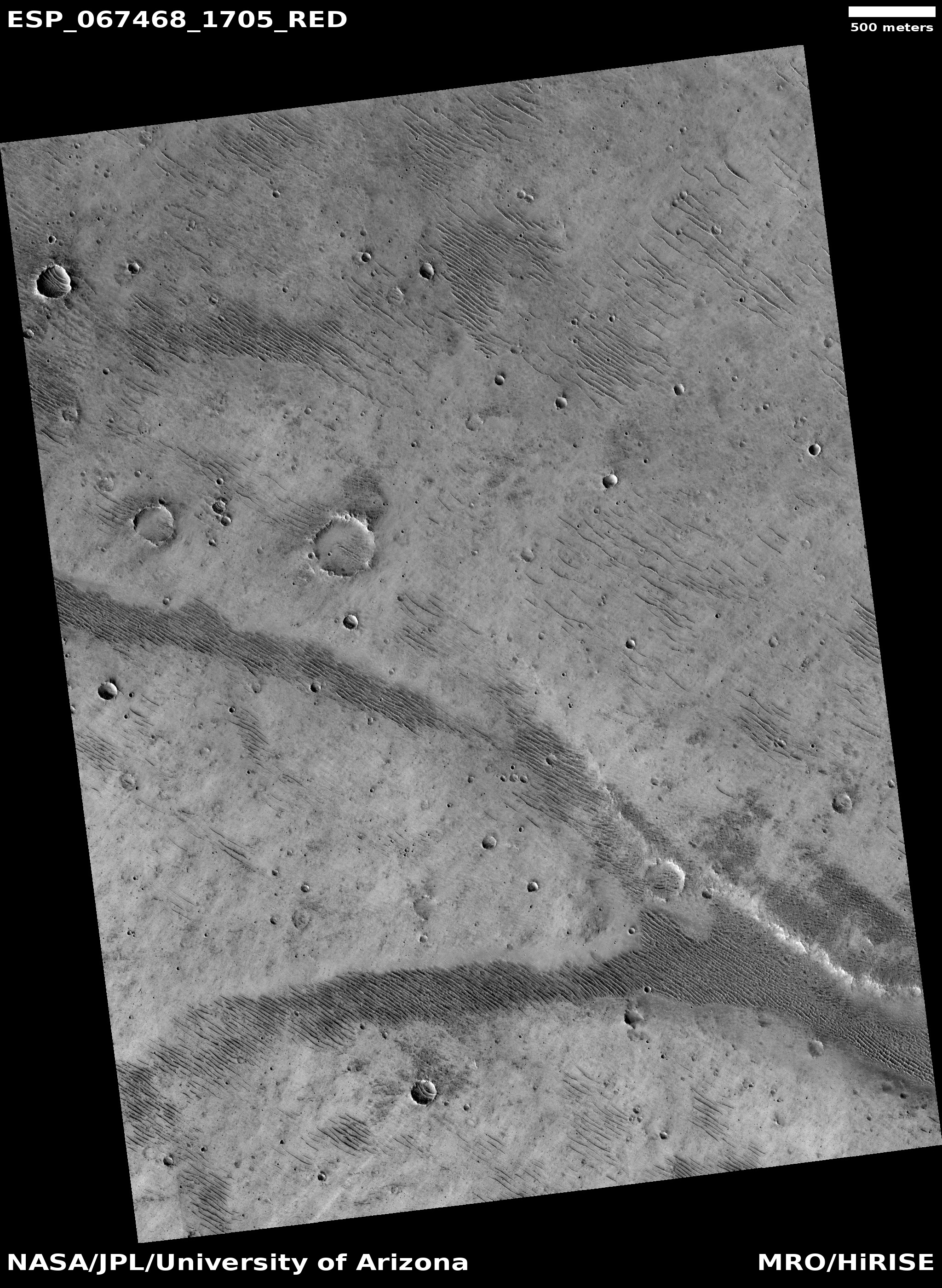
Today’s cool image is once again another of what I dub a “what the heck?” photo. The picture to the right, cropped to post here, was taken on December 17, 2020 by the high resolution camera on Mars Reconnaissance Orbiter (MRO) and captures some very strange ridges on the plateau above Mars’ biggest canyon, Valles Marineris.

The image, labeled merely as a “terrain sample,” was taken not as part of any specific research project but scheduled by MRO’s science team in order to maintain the camera’s temperature. When they do this they try to take pictures covering something interesting, but often it is a potshot that sometimes shows little of interest.

In this case the photo shows something very strange. The ridges in the sample are packed into one area only, but if you look at the full image you will see that they are also scattered about randomly and sometimes isolated on the flat plains surrounding this spot.

Interestingly, these ridges resemble the first “What the heck?” image I ever posted in 2019. That photo was located at about the same elevation as these ridges, but due west in the volcanic plains near Mars’s giant volcanoes and just off the western edge of the overview map below.
» Read more
2 comments

Nicaragua forms space agency

The new colonial movement? In what appears to be a complete surprise within its own scientific community, the government of Nicaragua today announced the formation of its own space agency.

[T]he National Assembly approved the creation of the agency for the “defence of supreme interests” in space. It will seek “to expand the country’s capacities in the educational, industrial, scientific and technological branches”, according to president Daniel Ortega´s proposal.

The article at the link provides little information about this government effort, and instead is mostly filled with commentary by other scientists expressing their opposition to it. Nor can I blame them. Unlike rich countries like the UAE, Nicaragua is one of the poorest in Latin America. It can’t afford to buy the educational resources of the United States, as the UAE did.

Moreover, it is ruled by a socialist/communist government whose ability to produce wealth is exceedingly limited. If anything, the nation’s poverty is because of that government’s top-down policies. Establishing a space agency is merely another aspect of this approach, and will likely only act to provide photo ops for its leaders and little benefit to its citizens.

7 comments

NASA forges deal with private company to put American on Russian Soyuz

Capitalism in space: It appears NASA used the private company Axiom as its go-between to obtain a seat for an American astronaut on the next Soyuz launch to ISS in April.

The deal is very complex.

Based on the initial partnership arrangement between the Russians and NASA, astronauts for both countries would fly in equal numbers on each other’s spacecraft in a barter arrangement that involved no exchange of funds. Russia however has been balking at flying its astronauts on Dragon, claiming it does not yet meet their standards for a manned spacecraft. Thus, they have been demanding that NASA pay them to fly an American on Soyuz.

NASA meanwhile doesn’t have the funds, but it still wants to make sure there is always an American on board ISS, and to do that requires a second ferry besides Dragon to provide redundancy. With Boeing’s Starliner delayed, they have been trying to get a seat on Soyuz as part of that barter deal, to no avail.

The solution? Private enterprise! To get that Soyuz seat at no cost it appears NASA made a barter deal with the private space company Axiom. Axiom is apparently paying the Russians for a seat on next month’s Soyuz flight, which will be filled by a NASA astronaut, and gets in return from NASA a free spare seat on a later American capsule.

The result? NASA pays nothing to the Russians, and still gets its seat on Soyuz. Where Axiom is getting the financing for its purchase is unclear, but because it is getting an extra seat at no cost that it can sell later for a big profit, I suspect that financing was not difficult to obtain.

The details for Axiom’s deal with Roscosmos have not as yet been revealed, though I am sure the Russians charged Axiom plenty for the seat on Soyuz. I also suspect that amount was far less then what the Russians would have charged NASA directly.

Once Starliner finally becomes operational NASA will have enough redundancy for getting Americans to ISS it will no longer need the Russians. Hopefully that will happen by the end of this year. If so, such shenanigans will no longer be required.

4 comments

Starship #11 moves to launchpad

Capitalism in space: Less than a week since the flight and destruction of Starship prototype #10 post flight, SpaceX has now moved Starship #11 to the launchpad.

There is no firm word on when they will attempt to fly this prototype, but based on past history, they will likely do at least one static fire test this week and schedule the flight for next week. All will depend of course on weather and on the results of the static fire test. For example, with #10 they found they needed to replace one engine after the first static fire test.

10 comments

China and Russia sign partnership agreement for lunar exploration

The new colonial movement: China and Russia today signed an agreement outlining a partnership to jointly build a base and orbiting station on and around the Moon.

The International Lunar Research Station (ILRS) is described as a comprehensive scientific experiment base built on the lunar surface or on the lunar orbit that can carry out multi-disciplinary and multi-objective scientific research activities including exploration and utilization, lunar-based observation, basic scientific experiment and technical verification, and long-term autonomous operation. Statements from Roscosmos and CNSA underline that the project will be “open to all interested countries and international partners.”

Though not explicitly stated it is understood that the ILRS would be constructed at the lunar south pole.

Russia is slowly breaking off its partnership with the U.S. because the U.S. is insisting it sign the Artemis Accords, which require all signatories to honor property rights in space. Neither Russian nor China wish to do that, instead reserving those rights wholly to their own governments, their citizens be damned.

Thus, we have a deal for Russia and China to work together. China actually doesn’t need Russia, as it has clearly shown in the past five years that its space capabilities are quite sufficient and well funded. Russia however needs China, as its capabilities have been declining in recent years due to corruption within its aerospace industry as well as a shortage of funds caused by a poor economy and the drop in oil prices.

Working together however could help speed what they achieve while simultaneously fueling the growing international competition in space. In the end this will benefit everyone, as more will get done faster.

How we shall settle the disagreement over property rights and government power in space is a entirely different question, one that I address at great length in my next soon-to-be published book, entitled Conscious Choice: The origins of slavery in America and why it matters today and into the future. Stay tuned!

4 comments

A iceberg of water ice floating on a Martian dry ice sea

Ice mesa near Mars' south pole
Click for full image.

British biologist John Haldane once once wrote, “The universe is not only queerer than we suppose, but queerer than we can suppose.”

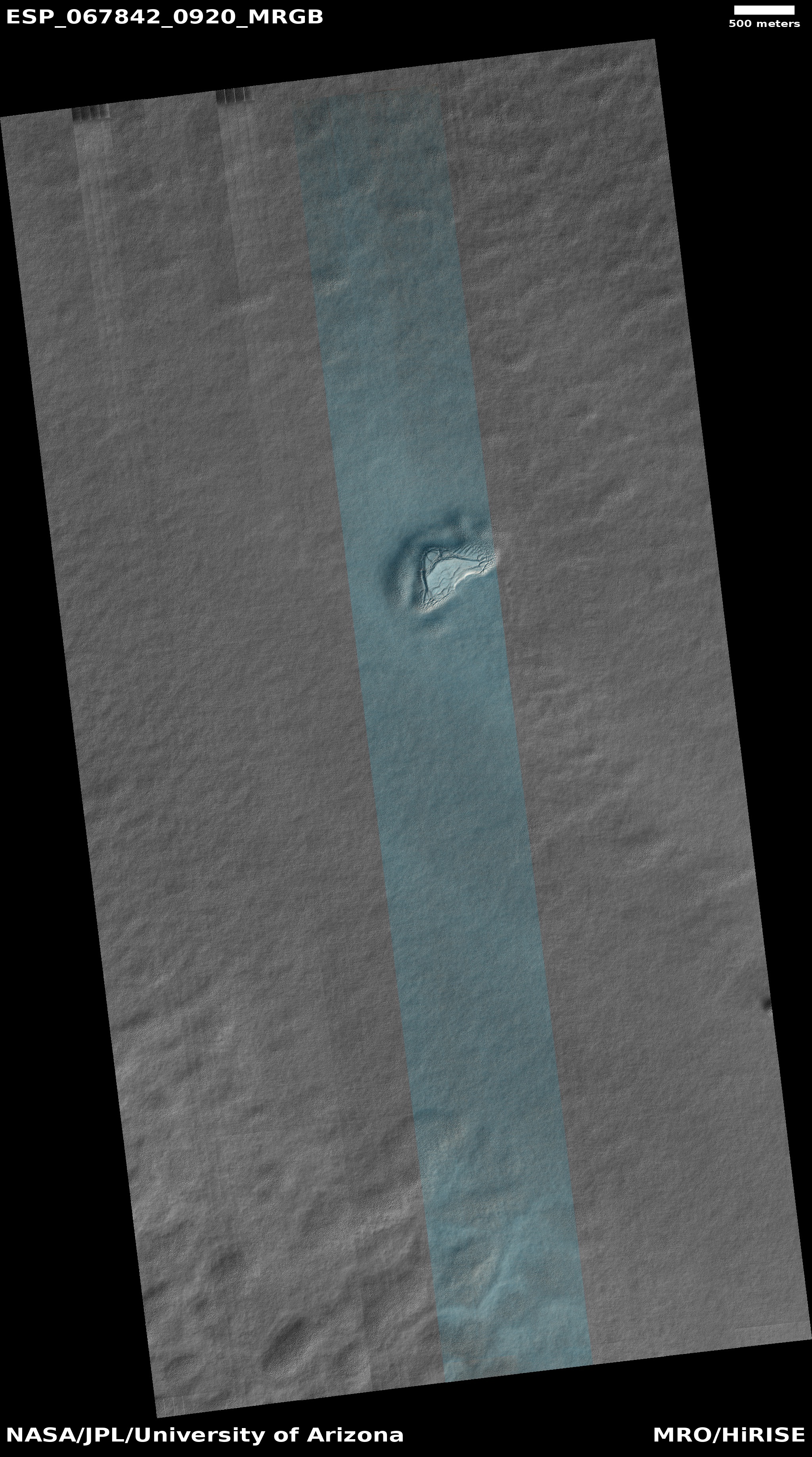
Today’s cool image to the right, cropped to post here, is a fine example of Haldane’s words. It was taken on January 15, 2021 by the high resolution camera on Mars Reconnaissance Orbiter of a single lone mesalike feature sticking up in a flat expanse of Mars’ south polar dry ice/water ice cap.

I emailed Shane Byrne of the Lunar and Planetary Lab University of Arizona, who had requested the photo, to ask him what he thinks we are looking at. His response:

This region has a thick layer of CO2 ice sandwiched between water ice that’s above and below. CO2 ice is denser than water ice so I think a fragment of water ice of the underlying layer has risen up through the denser CO2 ice that covers this area (what geologists call a diapir).

Byrne also admits this remains merely “just a wild theory,” not yet confirmed.

Assuming this theory to be right, in a sense then this mesa is not really a mesa at all but an iceberg of water, floating not in a saltwater liquid ocean as on Earth but on a frozen sea of dry ice. Talk about queer! The wider shot below, taken by MRO’s context camera, illustrates how isolated this water iceberg is on that dry ice sea.
» Read more

4 comments

SpaceX requests FCC permission to expand Starlink service to trucks, ships, & planes

Capitalism in space: SpaceX has submitted a request to the FCC to expand its Starlink customer base by providing the service not only to rural areas but to large moving vehicles, such as trucks, ships, & planes.

In its application to the FCC, filed on Friday, SpaceX said expanding Starlink availability to moving vehicles throughout the U.S. and to moving vessels and aircraft worldwide would serve the public interest. “The urgency to provide broadband service to unserved and underserved areas has never been clearer,” David Goldman, SpaceX’s director of satellite policy, said in the filing.

Goldman said SpaceX’s “Earth Stations in Motion,” or ESIMs, would be “electrically identical” versions of the $499 antenna systems that are already being sold to beta customers. He suggested that they’d be counted among the million end-user stations that have already been authorized by the FCC.

…SpaceX CEO Elon Musk said in a tweet that Starlink’s ESIM terminals would be “much too big” to mount on cars — such as the electric cars that are made by Tesla, the other company that Musk heads — but would be suitable for large trucks and RVs.

The article at the link notes in detail how this request poses a serious competitive threat to two of SpaceX’s biggest rivals, Klymeta and Amazon’s Kuiper constellation. This is true, but it is so mostly because SpaceX has already launched more than a thousand satellites in its constellation, and is simply taking advantage of its advanced position to undercut its rivals.

For example, though Klymeta might be using already orbiting satellites put up by different companies, it is also charging twice what SpaceX wants to charge for its antenna system, making Starlink a more attractive product. Amazon meanwhile appears years away from launching its first satellite. It might have a better design, but such things are worthless if they aren’t built and operational.

These companies have no one to blame but themselves if Starlink grabs their hope-for market share. And the FCC should not block SpaceX just to protect them.

4 comments

Russian astronauts begin work to seal 2nd Zvezda leak on ISS

After successfully sealing the largest crack on the twenty-year-old Zvezda module on ISS, Russian astronauts have now begun work on sealing a second such crack.

The report, from Russia’s state-run news service TASS, is not very informative. It does not report the size of the leaks, their nature, and any other important conclusions the Russians have gathered about Zvezda’s overall condition and future, based on these cracks.

Nor has state-run NASA been very transparent on this subject, releasing little further information. The silence from these government entities about the cracks is very worrisome, as it suggests these fixes are merely bandaids on a more serious issue with Zvezda’s structure, and our dishonest and bureaucratic governments do not wish to reveal this fact to the public.

I hope I am wrong, but suspect I am not. If Russia follows its pattern for the past half century, they will provide a more detailed report only after the problem has been completely solved. If these patches are merely temporary fixes over a more serious problem, don’t expect that detailed report for some time.

4 comments

Meteorite recovered in driveway in UK only days after landing

Meteorite hunters successfully recovered a meteorite only days after it plowed through the atmosphere and landed in a driveway in Gloucestershire in the United Kingdom on February 28th.

The fragment, weighing nearly 300 grams, and other pieces of the space rock were located after scientists reconstructed the flight path of the fireball that unleashed a sonic boom as it tore across the sky shortly before 10pm UK time on Sunday 28 February. The black chunk of rock, a carbonaceous chondrite never seen before in the UK, thumped on to a driveway in the Cotswolds town of Winchcombe, scientists at the Natural History Museum in London said, adding that further fragments were retrieved nearby.

Ashley Green, a scientist at the museum, said it was “a dream come true” to be one of the first people to see and study a meteorite that had been recovered almost immediately after coming down.

Footage of the bright streak captured by the public, and a camera network operated by the Natural History Museum’s UK Fireball Alliance, helped researchers calculate that the meteor had spent most of its orbit between Mars and Jupiter before it ploughed into Earth’s atmosphere.

I seriously doubt that no carbonaceous chondrite asteroids have never been found in Great Britain before. Instead, what the reporter misunderstood was that this was the first such asteroid in the UK recovered immediately after its arrival. Carbonaceous chondrites are very fragile. Much of their material will quickly erode and disappear, preventing researchers from obtaining a complete census of their entire make-up. Grabbing this thing mere days after landing means they will have a sample more closely resembling these kinds of asteroids in space.

In this way this rock is not much different than the samples being brought back from Hayabusa-2 and OSIRIS-REx. It isn’t as pristine, but it certainly carries far more information that meteorites recovered decades or even centuries after landing.

Similar quick recoveries in the past few years have forced some major rethinking about the make-up of the asteroid population. This meteorite will likely add to that revolution.

5 comments

Mars: Planet of many glaciers

Moraines on Mars
Click for full image.

Today’s cool image more than simply cool, it reveals a wider picture of Mars that should be quite exciting to future colonists. The photo to the right, rotated, cropped, and reduced to post here, was taken on January 30, 2021 by the high resolution camera on Mars Reconnaissance Orbiter (MRO). What drew my attention to it was the title given to this uncaptioned photo: “Moraine-Like Ridges in Nereidum Montes.”

Moraines are the debris pile pushed ahead of any glacier. The picture shows what appear to be a series of moraines, likely caused by different periods of glacier activity when the glacier was growing. It also suggests that past active periods were more active than later ones, as with each active period the moraine did not get pushed out quite as far.

The location, Nereidum Montes, intrigued me, as I am not that familiar with it. I emailed the scientist who requested the image, Dan Berman, senior scientist at the Planetary Science Institute in Arizona, and asked him for more information. He suggested I read a very recent paper he co-wrote entitled “Ice-rich landforms of the southern mid-latitudes of Mars: A case study in Nereidum Montes.” From that paper I was able to produce the map of Mars below that shows the regions on the planet where scientists now think hold the greatest concentrations of glaciers.
» Read more

0 comments

OSIRIS-REx begins last approach of Bennu

Approaching Bennu for the last time
Click for full image.

The science team for OSIRIS-REx released today the first picture taken as the spacecraft begins its last approach of the asteroid Bennu. To the right is that picture, cropped and expanded to post here. From the caption:

This image shows a top-down view of asteroid Bennu, with a portion of the asteroid’s equatorial ridge and northern hemisphere illuminated. It was taken by the PolyCam camera on NASA’s OSIRIS-REx spacecraft on March 4, from a distance of about 186 miles (300 km). The spacecraft’s cameras are pointed directly at Bennu’s north pole. Two large equatorial craters are visible on the asteroid’s edge (center and center left).

If all goes well, the probe will fly past the asteroid on April 7th, obtaining high resolution images of its entire surface as it rotates below, including very close-up images of the Nightingale sample grab location during its closest approach.

0 comments

Yutu-2 and Chang’e-4 reactivated for 28th lunar day on Moon

The new colonial movement: Engineers have reactivated both Yutu-2 and Chang’e-4 to begin their 28th lunar day on the far side of the Moon.

The article, from China’s state-run press, provides only one real tidbit of information, that Yutu-2 has now traveled 429 meters (1,378 feet) from the landing site. They still have about a mile to go to reach their next big geological target, which should take years at the pace the rover is setting.

Both spacecraft though have been unmitigated successes. Their nominal mission had been to survive three lunar day-night cycles, about 90 Earth days. They have survived 28, or more than two years since landing in January 2019.

This success suggests that China’s Mars rover has a good chance of doing as well. Its planned mission length is also 90 days, similar to the Spirit and Opportunity rovers, both of which lasted many years.

0 comments
1 97 98 99 100 101 126