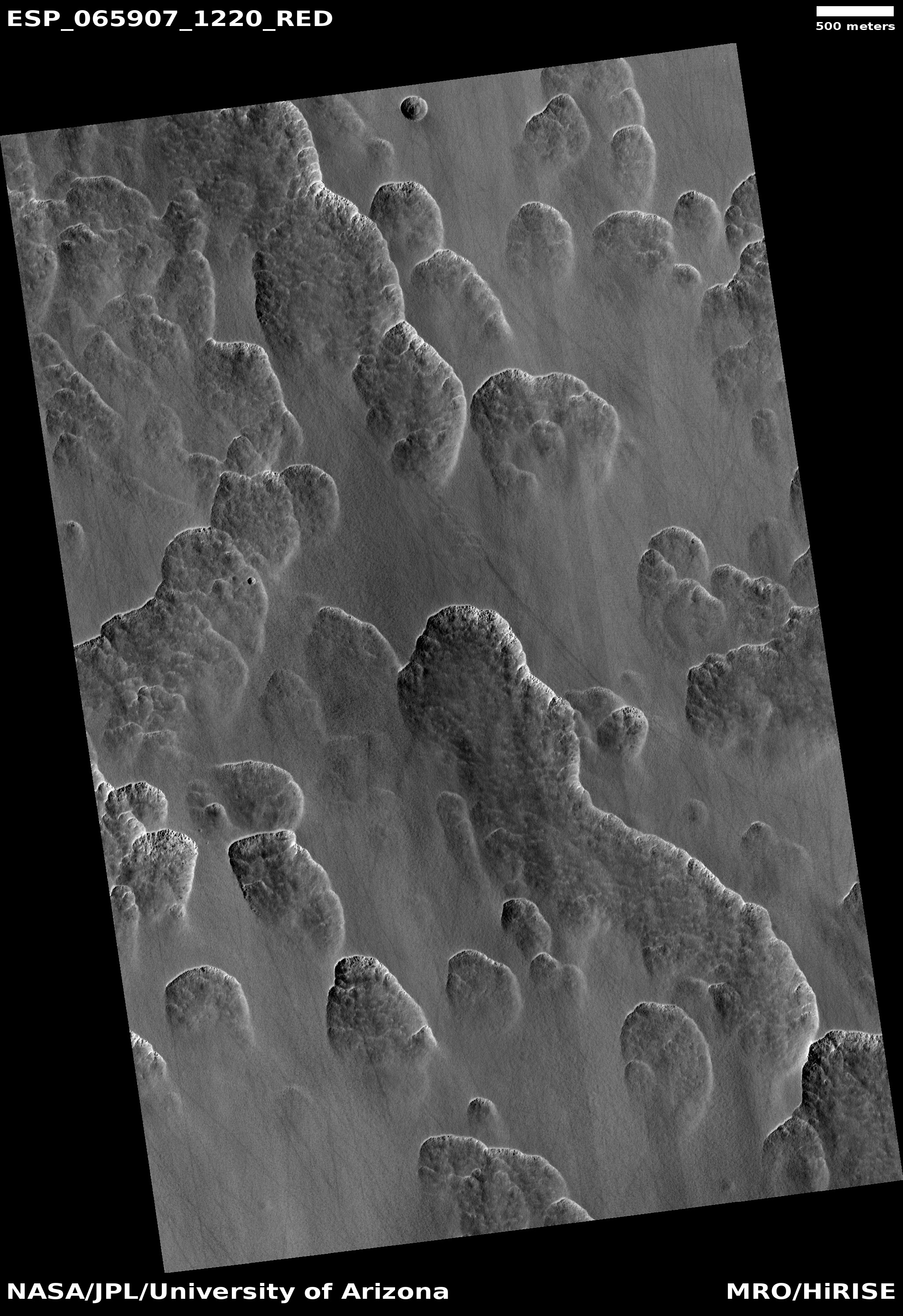
SpaceX narrows Mars landing site for Starship to four prime locations
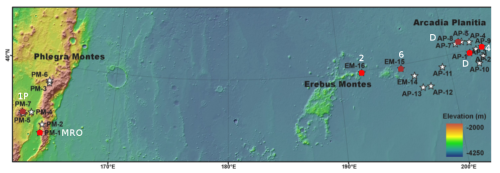
The prime and secondary Martian landing sites for Starship

Capitalism in space: During this week’s 52nd Lunar and Planetary Science Conference, one poster [pdf] caught my eye as something significant. It was titled “SpaceX Starship Landing Sites on Mars.” The map to the right is figure 1 from that poster, annotated slightly by me based my earlier stories about SpaceX’s use of the high resolution camera on Mars Reconnaissance Orbiter (MRO) to research potential Martian landing sites for its Starship spacecraft. The stars indicate MRO images, most of which were described and linked to in my last major post about this SpaceX effort in November 2019.

The red spots covering some stars are the big story: SpaceX has narrowed its choice for its Starship landing site to four prime locations (indicated by the bright red spots) and three backup locations (indicated by the dark red spots). The images under the red spots numbered 2, 4, and 6 were linked to in my November 2019 post. The images under red spots marked by a “D” are earlier images taken by MRO when SpaceX was researching a potential Dragon landing site. The images under red spots labeled 1P and MRO are subsequent images taken by MRO since November 2019, with the 1P image previously linked to in a post in April 2020 entitled “The icy Phlegra Mountains: Marsโ€™ future second city.”

The poster outlined why the prime candidate sites — PM1, EM16, AP1, and AP9 — were favored. For example, PM-1 in the Phlegra Mountains “…has the lowest latitude and elevation of the group, a clear association with LDAs [lobate debris aprons that resemble glacial features], well developed polygons, and has the highest SWIM [Subsurface Water Ice Mapping] score for geomorphic indicators of ice.”

EM 16 “…has a clear association with an LDA with nearby brain terrain and the strongest radar return for shallow ice and the highest combined SWIM score.”

AP1 “…appears to be the safest site and has a moderate combined SWIM score for ice.”

AP9 “…has the thickest ice from radar returns and geomorphology indicating shallow ice. It has the highest combined SWIM score for ice, but appears slightly rocky and rough.”

Below the fold are images, rotated, cropped, and reduced to post here, of the four primary landing sites, as well as links to the full images of all four plus the three back-up sites (AP8, EM15, and PM7).
» Read more

15 comments

SLS core stage successfully completes 8-minute static fire test

NASA and Boeing today successfully completed a full 8-minute static fire test of the core stage of its first SLS rocket.

This was their second attempt, the first terminating prematurely after about one minute in January.

They must now analyze the test to make sure all went well. If it did, they then must figure out how long it will take to get the stage prepped and shipped to Florida and then prepped for launch. The schedule presently calls for a November launch. It is expected that date will be delayed, anywhere from one to three months.

6 comments

The changing seasons of Saturn

Saturn changing
Click for full image.

Images of Saturn taken by the Hubble Space Telescope since 2018 now reveal the slow seasonal changes to the gas giant’s atmosphere during its lengthy year, twenty-nine Earth years long.

The Hubble data show that from 2018 to 2020 the equator got 5 to 10 percent brighter, and the winds changed slightly. In 2018, winds measured near the equator were about 1,000 miles per hour (roughly 1,600 kilometers per hour), higher than those measured by NASAโ€™s Cassini spacecraft during 2004-2009, when they were about 800 miles per hour (roughly 1,300 kilometers per hour). In 2019 and 2020 they decreased back to the Cassini speeds. Saturnโ€™s winds also vary with altitude, so the change in measured speeds could possibly mean the clouds in 2018 were around 37 miles (about 60 kilometers) deeper than those measured during the Cassini mission. Further observations are needed to tell which is happening.

The photo above shows Saturn’s northern hemisphere in 2018, 2019, and 2020. Note how the darker region at the pole grows with time.

This data supplements the data obtained by Cassini when it was in orbit around Saturn, and is presently the best information we can get since the Cassini mission ended.

0 comments

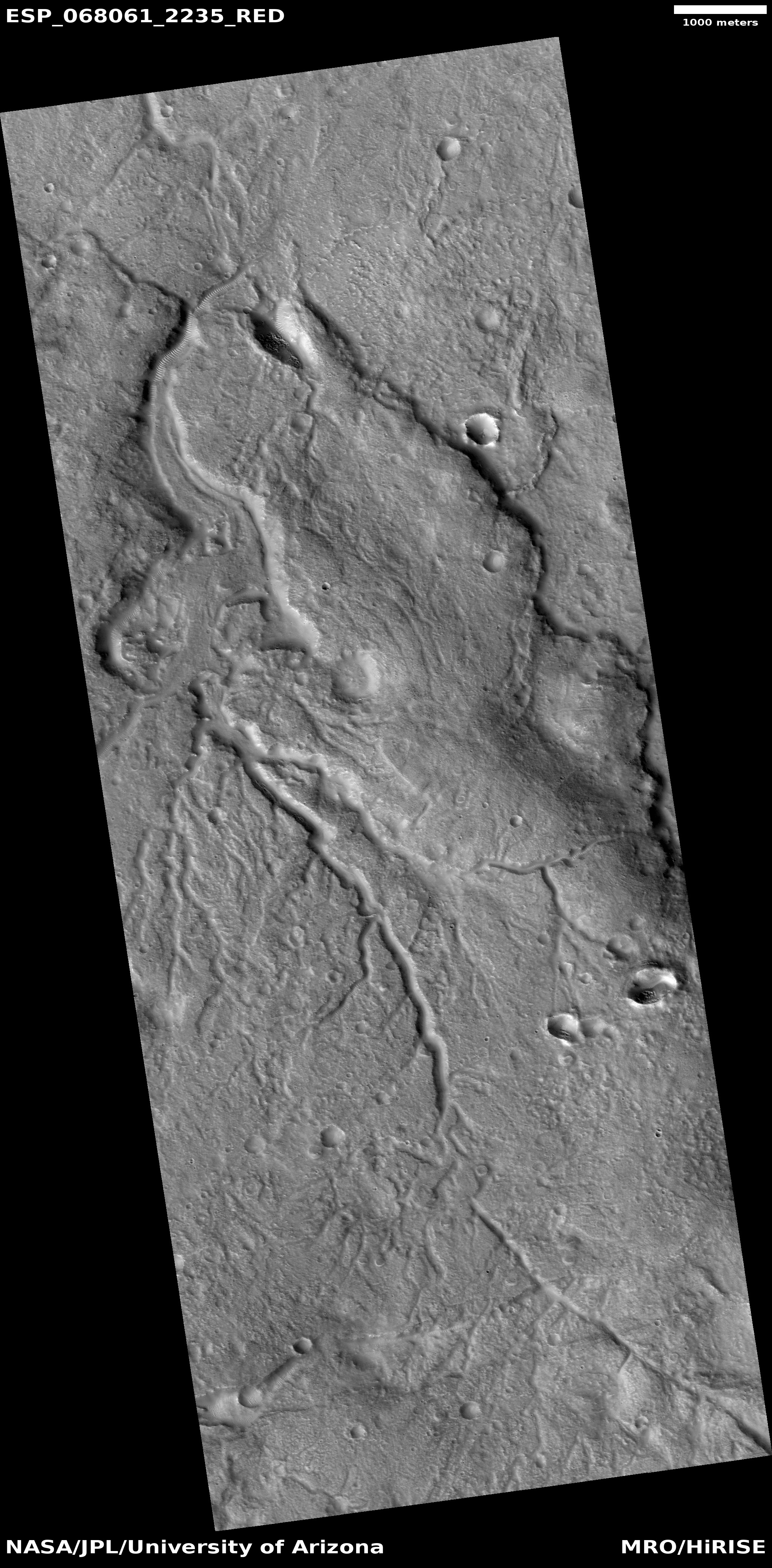
A drainage channel on Mars

A drainage channel on Mars
Click for full image.

Today’s cool image from Mars highlights what is probably the biggest geological conundrum the red planet presents for planetary scientists. The photo to the right, rotated, cropped, and reduced to post here, was taken on February 1, 2021 by the high resolution camera on Mars Reconnaissance Orbiter (MRO). Though I have cropped it, I have cropped out very little, because the entire meandering drainage valley is its most interesting feature, and that takes up almost the entire image.

The photo was simply labeled by the camera team a “terrain sample northwest of Sytinskaya Crater”, so I suspect this was taken not in connection with any specific research but because they must use the camera at a regular intervals to maintain its temperature, and when they have gaps in their schedule they try to pick spots of interest in areas that have not had many high resolution photos taken. In this case however I suspect the location choice was very far from random, as they clearly wanted to capture this drainage system, in its entirety.

I called this merely a drainage channel without indicating what caused the channel, be it liquid water, ice, or wind, because in this case that is a main question. At first glance an Earthman will immediately suspect water, which is what scientists supposed for the last half century. The problem with that conclusion is that the Martian atmosphere is too cold and thin for liquid water to exist on its surface, and though there seems to be plenty of evidence that liquid water once existed there, no scientist has yet come up with a completely accepted climate model that allows for such conditions in anytime in Mars’ past.

The rover Opportunity found that some channels it explored might have been carved by wind, though to our human eyes it seems unlikely that a meandering tributary system such as this could have been carved by wind. The possibility however must not be dismissed out of hand, since Mars is an alien planet and alien things (to Earth) happen there.

The overview map below might provide some context.
» Read more

0 comments

Russia offers to partner in Turkey’s space program

The new colonial movement: Dmitri Rogozin, head of Russia’s Roscosmos, said yesterday that his agency is eager to partner with Turkey in its new effort to develop its own space program.

Explaining that a draft document is being prepared to make these contacts more systematic and comprehensive, Rogozin said that this will be the legal framework of the peaceful space activities cooperation between Ankara and Moscow.

Pointing out that a strong political will and competent management are required for the realization of space programs, Rogozin said, “Provided that the support of experienced partners is also required, a young space power can easily prepare and implement a full-fledged interplanetary mission in a very short time.”

For Turkey such a partnership would make great sense. Russia has done this kind of work many times in the past, for India, China, and the UAE. No reason Turkey can’t gain from Russia’s help. And Russia could use the cash that Turkey will pay for the business.

0 comments

SLS static fire test today

NASA will make its second attempt today complete a full 8 minute long static fire test of the core stage of its SLS rocket.

The two-hour window for the test begins at 3 pm (Eastern). You can watch it on NASA TV.

To put it mildly, a lot rides on this test. If anything should go wrong, the future of the SLS rocket will be grim indeed. And should all go well NASA will still be under grave schedule pressure. Though the actual first launch of SLS using this core stage is presently set for the fall, NASA has admitted that they need to review that schedule once today’s test is completed.

Preparations for the upcoming test are going well, NASA Acting Administrator Steve Jurczyk said in an interview March 17.

,,,If the test does go well, he said the agency should be able to soon confirm a launch date for the Artemis 1 mission, which will use the core stage being tested at Stennis. That mission is currently projected to launch in November. โ€œI think that, within probably just a few weeks, theyโ€™ll take a look at the schedule one more time and confirm whether we can make November of this year or if we need to go out a little bit.โ€

The agency is trying hard to meet that November date, but no one will be surprised if the flight ends up happening in January ’22. Any later than that and they will have a new problem, as the already stacked solid rocket boosters must fly within a year of stacking, and this process began back in December ’20.

4 comments

Quakes on Mars as seen by InSight

Martian quake map as seen by InSight

After completing its first full Martian year on the surface of the Red Planet, the scientists for the lander InSight today gave a report [pdf] of their results at this year’s annual 52nd Lunar and Planetary Science Conference, normally held in Texas but being done virtually this year out of terror of the coronavirus.

All told the lander’s seismometer has, as of just a few days ago, detected just over 500 quakes. The map to the right, showing the most distinct quakes and their locations, was adapted from a different presentation [pdf] at the conference. The numbers indicate the sols after landing when these quakes were detected.

This is essentially the region on Mars that I call volcano country. Some of the lava flood plains here are the youngest on Mars. To the east just beyond the edge of the map is the Tharsis Bulge, which holds Olympus Mons and the string of three giant volcanoes to its east. South of Cereberus Fossae but north of the yellow-colored cratered highlands is the vast Medusae Fossae Formation, the largest volcanic ash deposit on Mars.

The quakes suggest they are occurring as large blocks shift along faults, creating fissures and cracks that geologists call grabens. The long fissures of Cereberus Fossae are considered an example of grabens, so this activity suggests that shifting is still going on in the region.

In addition to outlining the location of the detected volcanoes, the presentation today summarized these other discoveries made by InSight about Mars’ interior structure:

  • The crust of Mars has likely two or three layers either 12 or 24 miles thick, with a total thickness no more than 45 miles. This is much thinner than most scientists had expected.
  • The mantle layer below the crust is estimated at about 250 to 375 miles thick, with a temperature between 1,600 to 1,700 degrees Kelvin. While quite hot, this is a cooler mantle than expected.
  • The core of Mars is somewhere between 1,100 to 1,300 miles in diameter, with a outer layer made of liquid. These results are at the high end of pre-mission expectations.

As already admitted, it was noted that the heat sensor experiment will not be able to provide the interior temperature of Mars, as its digging mole was unable to dig into the ground the 9 to 15 feet planned.

9 comments

Scallops of Martian ice

Scallops of Martian ice
Click for full image.

Cool image time! The photo to the right, cropped to post here, was yesterday’s captioned image from the MRO science team. From the caption, written by Shane Byrne of the Lunar and Planetary Lab University of Arizona,

About a third of Mars has water ice just below the dusty surface. Figuring out exactly where is vital for future human explorers. One of the ways scientists do this is to look for landforms that only occur when this buried ice is present. These scallops are one of those diagnostic landforms.

A layer of clean ice lies just below the surface in this image. As the ice ablates away in some spots the surface dust collapses into the hole thatโ€™s left. These holes grow into the scallops visible here as more and more ice is lost.

You can see those holes near the top of the scallop’s slopes.
» Read more

0 comments

Musk confirms goal of orbital Starship flight this year

Capitalism in space: Musk today confirmed the stories published earlier this week that SpaceX has a target goal of completing the first test orbital flight of Starship before the end of this year, possibly as early as July.

The only new news in the article is Musk’s confirmation. It does outline again the challenges SpaceX faces to meet this goal, recognizing that these dates are thus merely targets that almost certainly will not be met. It also recognizes that the targets tell us that development will continue to move forward swiftly, and that an orbital test flight is also likely not that far in the future.

Who wants to bet that a Starship/Super Heavy rocket reaches orbit before SLS? Right now the odds I’d say are about 50-50.

7 comments

China to build spaceport for its pseudo-commercial space sector

The new colonial movement: According to its newest five year plan, the Chinese government intends to build a new spaceport, the country’s fifth, dedicated solely for the commercial launches of the growing number of pseudo-commercial private Chinese launch companies.

Dou Xiaoyu, a deputy to the National Peopleโ€™s Congress (NPC), the top Chinese legislative body, and a vice chairperson at China Aerospace Science and Industry Corp. (CASIC), a giant state-owned enterprise, called for a Chinese commercial spaceport project in order to meet an expected surge in demand for space launch services.

Dou said China needs to strengthen domestic launch site capacity and continuously improve and optimize facilities. She also noted that launch-related policies and regulations have yet to be promulgated and perfected.

About a half-dozen privately funded entities in China have been using solid and liquid rocket technology in their effort to build commercially affordable rockets. This spaceport would provide them a location to launch devoted exclusively to their needs.

I call these companies “pseudo” however because they are not independent and private in the same sense you would use in the west. Their funding might be private capital, but they do nothing without the approval and supervision of the Chinese government. Thus, each is building only what the government allows them to build, or wants built. They might be able to then sell their rockets on the open market, but their purpose is shaped entirely by governmental orders.

2 comments

New hypothesis: Mars didn’t lose water, it got trapped chemically in its crust

Using data from the many orbiters, landers, and rovers sent to Mars, scientists yesterday proposed a new model for the loss of water on Mars, suggesting that instead of escaping through its thin atmosphere it was instead chemically trapped in the planet’s crust.

New data challenges the long-held theory that all of Mars’s water escaped into space

Billions of years ago, the Red Planet was far more blue; according to evidence still found on the surface, abundant water flowed across Mars and forming pools, lakes, and deep oceans. The question, then, is where did all that water go?

The answer: nowhere. According to new research from Caltech and JPL, a significant portion of Mars’s waterโ€”between 30 and 99 percentโ€”is trapped within minerals in the planet’s crust. The research challenges the current theory that the Red Planet’s water escaped into space.

First, this is only a model. It proves nothing, and carries many assumptions based on our limited knowledge. We mustn’t accept it at face value.

Second, the first sentence quoted above from this Caltech press release is an example of a trick the scientists have played that our ignorant press has fallen far. What the press release implies superficially is that Mars is now a barren dry place, with little water. Researchers (and readers of Behind the Black) know however that this description is not accurate, that the planet apparently has a lot of water still, only that it is confined as buried ice to latitudes above 30 degrees. Only the equatorial regions appear dry, but not the rest of the planet.

Regardless, this new hypothesis is important if true, as it will help provide an explanation for the Red Planet’s entire geological and climatic history. It might even help solve the mystery of the liquid water that appears to have once existed there, on a planet whose atmosphere is too thin and cold to allow for such a thing.

1 comment

A cracking Martian glacier?

A cracking Martian glacier?
Click for entire image.

Cool image time! The photo to the right, cropped to post here, was taken on December 4, 2020 by the high resolution camera on Mars Reconnaissance Orbiter (MRO)

I have cropped it to show at full resolution the area that contains what the scientists apparently consider the most interesting feature in this image, which they have labeled as “pits forming lines.” These are the vertical cracks and strings of holes that can be seen in this glacier-like flow. In addition, you can see that the cracking is not just vertical, but also extends out in horizontal directions, though the widest cracks are all vertical.

The next image below, which is a lower resolution crop of the full photo, shows a wider view to provide a better picture of the glacier itself.
» Read more

2 comments
1 95 96 97 98 99 126