NASA and Roscosmos finalize barter deal for flying astronauts to ISS

As expected, mere hours after the firing of Dmitry Rogozin as head of Roscosmos, the Russians finally signed a barter deal with NASA for flying astronauts on each other’s spacecraft.

U.S. astronaut Frank Rubio will launch to the space station from Kazakhstan with two Russians in September. That same month, Russian cosmonaut, Anna Kikina, will join two Americans and one Japanese aboard a SpaceX rocket flying from Florida. Another crew swap will occur next spring.

No money will exchange hands under the agreement, according to NASA.

It appears that the firing of Rogozin by Putin signals larger strategic goals. Putin wants to defuse the tensions between the west and Russia, and this barter deal indicates Rogozin’s firing has achieved that aim, at least in space. Whether Roscosmos’s new head, Yuri Borisov, can regain Russia’s international commercial rocket customers is more questionable. Roscosmos under Rogozin proved to be a very unreliable partner. Regaining trust so that westerners will be willing to buy its services again could take decades.

12 comments

Rogozin removed as Roscosmos’ head

Dmitry Rogozin, the head of Russia’s Roscosmos space corporation which controls the country’s entire aerospace industry, was fired yesterday and replaced by another former deputy prime minister, Yuri Borisov.

Don’t think Rogozin is out of favor with Putin however. Instead, it appears Putin wants his bull-headedness for running one of the regions Russia has conquered in the eastern Ukraine.

Following its tumultuous tenure as the head of Roskosmos, Rogozin was expected to move to the presidential administration and, possibly, lead it or “curate” the Russian occupation of the Eastern Ukraine, the independent Meduza publication reported.

I wonder if Rogozin’s removal is connected in any way with the ongoing negotiations between NASA and Russia’s foreign ministry for the barter agreement to allow the two to fly each other’s astronauts on each other’s capsules.

That agreement has been in negotiations and reviews for months by the two agencies as well as the U.S. State Department and Russian Foreign Ministry. NASA has long advocated for the agreement to enable what it calls “mixed crews” or “integrated crews” on spacecraft. That would ensure at least one NASA astronaut and one Roscosmos cosmonaut would be on the station should either Soyuz or commercial crew vehicles be unavailable for an extended period.

Rogozin’s bellicose manner has I think made those negotiations difficult. Putin might have decided, especially with the break up of its space partnership with Europe, to tone things down. Moreover, he might have realized that Rogozin’s contentious manner might be better put trying to take control of occupied Ukrainian territory.

10 comments

Cygnus freighter fires engine, adjusts ISS orbit for first time

For the first time the engines on a Cygnus capsule were used successfully yesterday to adjust the orbit of the International Space Station (ISS).

On Saturday, June 25, Northrop Grumman’s Cygnus completed its first limited reboost of the International Space Station. Cygnus’ gimbaled delta velocity engine was used to adjust the space station’s orbit through a reboost of the altitude of the space station. The maneuver lasted 5 minutes, 1 second and raised the station’s altitude 1/10 of a mile at apogee and 5/10 of a mile at perigee. This Cygnus mission is the first to feature this enhanced capability as a standard service for NASA, following a test of the maneuver which was performed in 2018 during Cygnus’s ninth resupply mission.

NASA’s goal is to have this capability without relying on Russia’s Progress capsules, which up until now have been used to adjust the station’s orbit. It appears from yesterday’s test this this goal has now been met.

2 comments

OneWeb to resume satellite launches this year, complete constellation by mid-2023

Capitalism in space: According to one OneWeb official at a conference yesterday, the company now expects to resume launching its satellites on SpaceX and Indian rockets by the fourth quarter of this year and will complete its constellation by the second quarter of next year.

Launches were suspended when Russia refused to do a launch — and confiscated the 36 satellites — after Europe imposed sanctions in response to the Russian invasion of the Ukraine.

Speaking at the Fourth Summit for Space Sustainability by the Secure World Foundation and the U.K. Space Agency, Maurizio Vanotti, vice president of space infrastructure development and partnerships at OneWeb, said new launch agreements with SpaceX and NewSpace India Ltd. (NSIL) would allow the company to launch the remaining satellites of its first-generation system by the second quarter of 2023.

“Our plan is to be back on the launch pad in quarter four, after the summer, and to complete deployment of the constellation by quarter two next year,” he said. It will take several months after that final launch for the satellites to move to their operational orbits, he added. “We’re going to be in service with global coverage, 24/7, by the end of next year,” he said.

At present OneWeb has not revealed the breakdown of launches from the two companies.

0 comments

ISS forced to dodge space junk from Russia’s November ’21 anti-sat test

Last week the Russians were forced to use the engines of the Progress cargo capsule docked to ISS to shift the station’s orbit slightly to avoid a collision with some debris left over from Russia’s anti-satellite test in November 2021.

“I confirm that at 22.03 Moscow time, the engines of the Russian Progress MS-20 transport cargo ship carried out an unscheduled maneuver to avoid a dangerous approach of the International Space Station with a fragment of the Kosmos-1408 spacecraft,” Roscosmos chief Dmitry Rogozin wrote on Telegram (opens in new tab), according to a Google translation, using Roscosmos’ designation for Progress 81.

While the Russians have consistently denied the anti-sat test and the 1,500 satellite pieces it created would cause a collision threat, yesterday’s action was not a surprise, and was predicted by many right after the test.

The concern however is not the debris that has been identified and is being tracked, since collisions from that stuff can be predicted and avoided. The concern is from the smaller pieces that were not identified.

5 comments

Russian scientists defy Rogozin, will not reactivate German instrument on Spektr-RG telescope

It appears that the Russian astronomers who use their instrument on the Spekr-RG space telescope are refusing to follow the orders of Dmitry Rogozin to reactivate the German instrument — dubed eROSITA — which the Europeans shut down in response to the Russian invasion of the Ukraine.

[T]he head of the Russian Space Research Institute, Lev Matveevich Zelenyi, spoke out against the unauthorized activation of eROSITA to Gazeta: “Our institute – all the scientists – categorically object to this. This objection is both for political and technical reasons.”

“This is not a Russian device. I can’t judge how realistic this whole thing is, I don’t know if our specialists have processing codes… But even if they have, it will be simply impossible to publish this data – no journal will accept it and will do it right,” he added.

Rogozin however appears adamant about taking over eROSITA. But then again, Rogozin blusters a lot, with many of this worst blusters having no bite behind them.

1 comment

Russia proposes restart of ExoMars partnership with ESA

Russia’s aerospace corporation Roscosmos has proposed to the European Space Agency (ESA) that its partnership to launch and land ESA’s Franklin rover on Mars be renewed, despite the Ukraine War and Roscosmos’ confiscation of 36 OneWeb satellites.

[According to Roscosmos head Dmitry Rogozin] the equipment and Kazachok landing platform for the mission have the potential for launch in 2024. “ESA colleagues promised to make requests to their patrons, who are ESA member states. If they cooperate and give their consent, the mission may be implemented,” Rogozin said.

He estimates the likelihood of this scenario to be at about 708%. [sic] Roscosmos plans to get the response in late June. [emphasis mine]

It would not be surprising if ESA made this deal, despite its stupidity. Roscosmos’ actions recently, especially related to OneWeb, prove the people running it are very untrustworthy business partners. Yet Europe’s historic willingness to deal with the devil for short term gain — eventually and repeatedly leading to overall disaster — is legendary.

4 comments

Russian government gives Roscosmos permission to negotiate astronaut barter deal

The Russian prime minister yesterday signed a decree giving Roscosmos permission to negotiate a astronaut exchange deal with NASA, whereby for every American that flies on a Soyuz to ISS one Russian would fly on either a Dragon or Starliner capsule.

NASA has been pushing for this arrangement for about a year, but Russia was at first skittish about flying on Dragon. Then its invasion of the Ukraine raised further barriers. Now that it is clear the Russians have no options in space but to stick with ISS for at least the next few years, the Russian government has relented and will allow this barter arrangement to go forward.

NASA had been pushing to put the first Russian on a Dragon in the fall. That flight is now likely to happen.

Of course, all this could change should things change drastically in the Ukraine. The partnership on ISS remains quite fragile politically, even if the astronauts and engineers and workers of both sides continue to work together well.

4 comments

Russia and Venezuela sign space cooperation agreement

Even as the U.S. has gathered nineteen other countries — including most of the world’s space-faring nations — to sign the Artemis Accords protecting property rights in space, Russia yesterday announced that its government has approved its own space agreement with bankrupt and socialist Venezuela.

The agreement between the governments of the two countries was signed in Caracas on March 30, 2021. It is intended to create “organizational and legal foundations for mutually beneficial cooperation between the parties and relevant organizations of both states in the field of exploration and use of outer space for peaceful purposes.”

Russia also has an agreement with China, which like this Venezuela deal is somewhat vague. The countries have agreed to work together, but appear to have few plans for actual joint missions. What is clear is that both oppose the Artemis Accords.

Compared to the American alliance of nations, which includes Australia, Bahrain, Brazil, Canada, Columbia, France, Israel, Italy, Japan, Luxembourg, Mexico, New Zealand, Poland, Romania, Singapore, South Korea, the United Kingdom, the United Arab Emirates, and the Ukraine, the Russian alliance seems quite paltry, except for China.

4 comments

Rogozin suggests Russia will stay on ISS till at least ’24

In remarks this past weekend on Russian television, Roscosmos head Dmitry Rogozin said that Russia now plans to continue its international partnership on ISS till at least 2024.

“The ISS will work exactly as long as the Russian side needs to work on it,” Rogozin said. “There are technical problems. The station has been operating beyond its lifespan for a long time. We have a government decision that we are working until 2024.”

…Earlier this year, it was reported by some media outlets that Russia was planning to quit the ISS, blaming Western sanctions, following comments Rogozin made on state television. Rogozin said: “The decision has been taken already, we’re not obliged to talk about it publicly. I can say this only—in accordance with our obligations, we’ll inform our partners about the end of our work on the ISS with a year’s notice.”

The Russian government is presently attempting to develop its own space station for launch before the end of this decade. Since such Russian projects have for decades routinely been delayed, for decades, it is likely that the Putin government has decided that it is better to stay on ISS for the moment then quit and have no space station at all.

Russia has also been negotiating with China to partner with it on China’s space station. While China says it is willing, it also appears entirely uninterested in committing any of its funds to help Russia. It might allow a Russia astronaut to visit its station at some point, but that would likely be the limit of that space station partnership.

All in all, Russia’s space effort faces a dim future. ISS is going to be replaced with several private commercial stations owned by American companies, none of which want to partner with Russia. And Russia doesn’t really have the funds to build its own station. Nor does it have a competitive aerospace industry capable of developing its own stations.

Unless something significant changes soon, Russia’s place in space will shrink considerably in the next ten years.

5 comments

Russian company S7 ends project to build private rocket

The Russian company S7 has ended its project to build a private rocket, citing lack of funds and a dearth of Russian investors.

Due to a lack of opportunity to raise funding, the project to create a light-class carrier rocket has been suspended,” the press service said.

The company said that was the reason why it let go some of its staff – 30 people out of more than 100 – in June. “Still, S7 Space continues to operate in some areas, such as additive and welding technologies where work is underway,” it said.

S7 first announced this rocket project in 2019. Development was suspended in 2020, however, when the Putin government imposed new much higher fees on the company for storing the ocean launch platform Sea Launch, fees so high that the company was soon negotiating to sell the platform to a Russian state-run corporation.

At the moment it appears that while Russia has possession of the Sea Launch ocean floating launch platform, it has nothing to launch from it. Nor does there appear to be any Russia project that might eventually do so. The Putin government has quite successfully choked off S7 — fearing the competition it would bring to Roscosmos — and with it any other new rocket company.

1 comment

The Ukraine War: After a third month of fighting the battlelines clarify

The Ukraine War as of May 5, 2022
The Ukraine War as of May 5, 2022. Click for full map.

The Ukraine War as of May 5, 2022
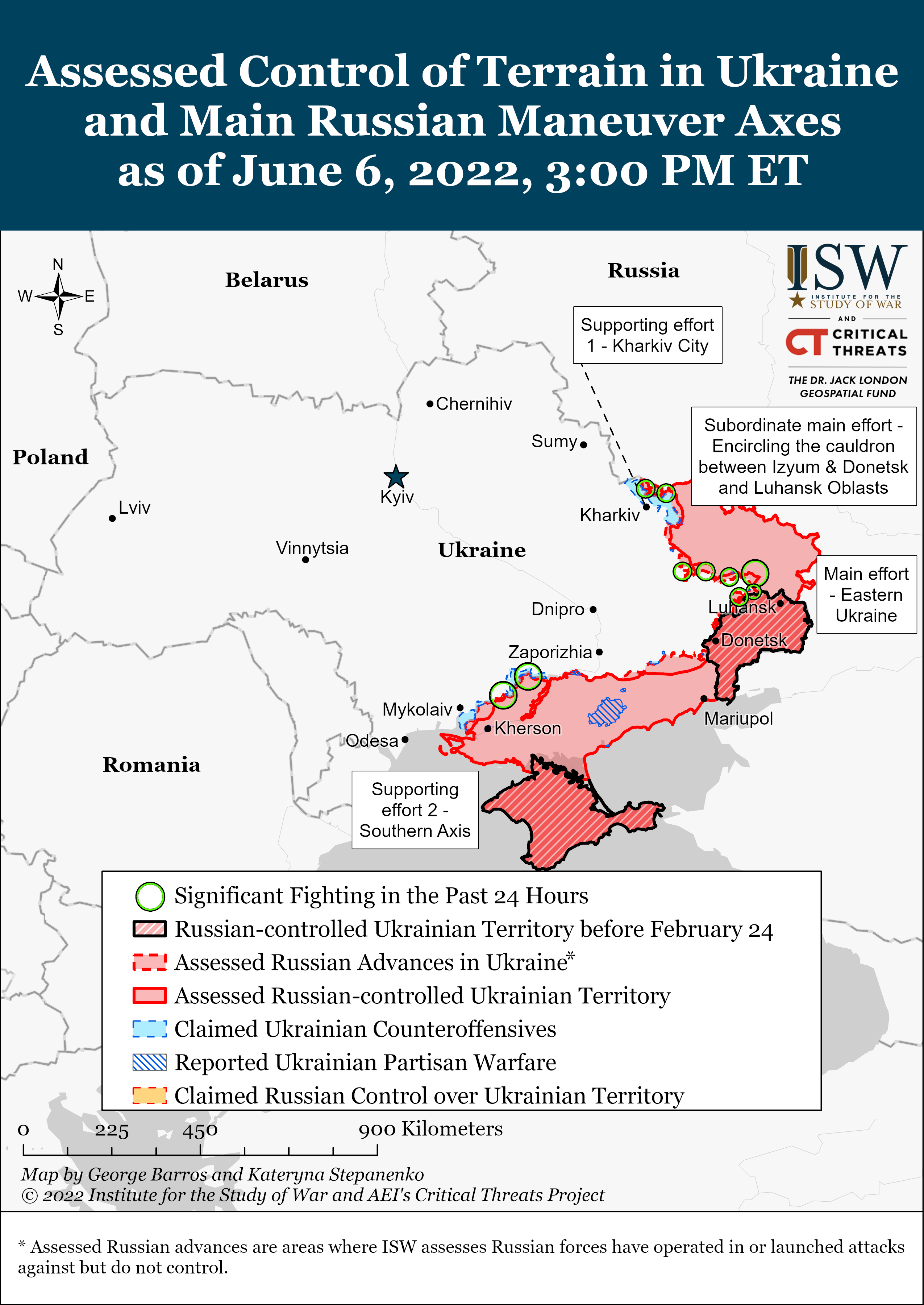
The Ukraine War as of June 6, 2022. Click for full map.

With more than three months of fighting since Russian began its unprovoked invasion of the Ukraine in late February and a full month since my last update on May 6th, it is time to do another follow-up to get a clear assessment of the war.

The two maps to the right are simplified versions of those produced daily by the Institute for the Study of War (ISW). For their full interactive version go here. The top map comes from its May 5th assessment, while the bottom map comes from its assessment on June 6th. The red hatched areas are regions Russia captured in 2014. The red areas are regions the Russians have captured in this invasion and now fully control. The pink areas are regions they have occupied but do not fully control. Blue regions are areas the Ukraine has recaptured. The blue hatched area is where local Ukrainians have had some success resisting Russian occupation.

Though the changes since early May are small, they make clear that the war’s battlelines have now become very clear. While Russia is very slowly but successfully taking ground in the center regions of its invasion, the Ukraine has been just as slowly but successfully retaking territory at the invasion’s outer edges.
» Read more

77 comments

Russia to take control of German telescope on space orbiter

Dmitry Rogozin, the head of Roscosmos, revealed today that he has issued orders for the scientists running the Spektr-RG telescope to figure out how to take over operations of the German instrument on the telescope.

“I gave instructions to start work on restoring the operation of the German telescope in the Spektr-RG system so it works together with the Russian telescope,” he said in an interview with the Rossiya-24 TV channel.

The head of Roscosmos said the decision was necessary for research. “They – the people that made the decision [to shut down the telescope] don’t have a moral right to halt this research for humankind just because their pro-fascist views are close to our enemies,” he said.

The Europeans had shut down operations when it broke off all of its space partnerships with Russia, following the Ukraine invasion and the decision of Russia to confiscate 36 OneWeb satellites rather than launch them as it was paid to do.

22 comments

Ursa Major announces new rocket engine to replace what Russia previously provided

Capitalism in space: The new rocket engine company Ursa Major yesterday announced a new more powerful rocket engine, dubbed Arroway, designed to replace rocket engines that Russia had been selling.

Arroway is a 200,000-pound thrust liquid oxygen and methane staged combustion engine that will serve markets including current U.S. national security missions, commercial satellite launches, orbital space stations, and future missions not yet conceived. The reusable Arroway engine is available for order now, slated for initial hot-fire testing in 2023, and delivery in 2025.

Notably, Arroway engines will be one of very few commercially available engines that, when clustered together, can displace the Russian-made RD-180 and RD-181, which are no longer available to U.S. launch companies.

Arroway could replace the RD-181 engines that Northrop Grumman uses on the first stage of its Antares rocket. Both engines are comparable in size. However, with Arroway available no sooner than ’25 it still will leave a gap, since right now the company only has enough stock on hand to launch two more rockets, both of which should launch before ’24.

Arroway is also about half as powerful as Blue Origin’s BE-4 engine, so if ULA wishes to use it in its Vulcan rocket a major redesign would be required.

Either way, Ursa Major is demonstrating here again the value of freedom and competition, as well as the foolishness and negative consequences of Russia’s invasion of the Ukraine. In response to the international sanctions against it, Russia blocked future rocket engine sales to the U.S. Not only did that not get the sanctions lifted, Russia is now losing that U.S. business, as other American companies are stepping up to replace it.

1 comment

Rogozin: Russia’s first lunar lander in decades to launch by end of September

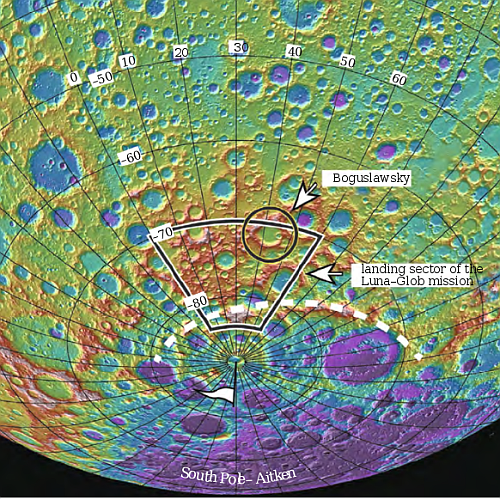
The landing area for Luna-25

The new colonial movement: Dmitry Rogozin, the head of Russia’s Roscosmos space corporation, revealed yesterday that it is now targeting the end of September for the launch of Luna-25, the first Russian lunar lander to the Moon since Luna-24 in 1976.

The Russians hope to land the rover near 60-mile-wide Boguslawsky crater, located about 550 miles from the Moon’s south pole. The map to the right, figure 1 from a 2018 paper, provides the reasoning for picking this location.

The Luna–Glob mission [the title for the entire Russian program of future lunar probes] is designed for investigations in the polar regions of the Moon and targeted primarily on testing a new generation of technologies for landing a descent module. In this regard, the choice of scientific tasks of this mission is rather subordinate. Further realization of our lunar program, inclusive of the Luna–Resource mission with an extended complex of scientific tasks, and subsequently, a new generation of lunar rovers and modules for lunar subsurface sampling and return to the Earth, depends on the results of the present mission [Luna-25]. …The detailed photo geological analysis of the surface in the Luna–Glob mission landing sector (70°–85° S, 0°–60° E) using high-resolution images and topographic data made it possible to select the definite landing site. This site (the eastern landing ellipse, 73.9° S, 43.9° E) on the Boguslawsky floor represents a higher scientific priority and also provides relatively safe landing conditions.

The Russians have been attempting to launch this Luna-Glob program for almost a quarter of a century. Hopefully the first launch will finally happen this year.

4 comments

NASA corrupt safety panel once again blathers on

The corrupt safety panel at NASA that spent years slowing down SpaceX’s manned Dragon capsule development with sometimes absurd demands, including delays caused simply because of paperwork, is now demanding that NASA should slow its approval of Boeing’s Starliner capsule, even if its unmanned demo mission next week succeeds completely.

This quote from the article best illustrates this safety panel’s do-nothing bureaucratic view of the world:

A further concern is that Starliner uses the United Launch Alliance (ULA) Atlas V rocket to get to orbit, but Atlas Vs are being phased out. ULA is building a new rocket, Vulcan, that could see its first launch late this year, but must go through a “human-rating” certification process that [panel member David] West said “could take years” for Starliner. [emphasis mine]

Every demand of this panel for years has demanded years of delays, with many having nothing to do with technical safety — the panel’s original purpose — but with management questions and the panel’s own overblown opinion of itself. Worse, some of its demands never made sense, such as its objection to SpaceX’s launch procedures where it fueled the rocket after the astronauts got on board. This quote from an earlier post about the panel’s recent inappropriate attempt to insert itself into NASA’s policy decisions sums things up well, and provides links to previous failures of the panel:

This panel continues to demonstrate its corrupt and power-hungry attitude about how the U.S. should explore space. For years it did whatever it could to stymie NASA’s efforts to transfer ownership to the private sector, putting up false barriers to the launch of SpaceX’s manned Dragon capsule that made no sense and were really designed to keep all control within the government bureaucracy.

It is now targeting Boeing, though amazingly it is only doing it after many of Starliner’s technical problems have been uncovered. The safety panel was a complete failure in spotting the company’s problems early on, several years ago, when it might have saved everyone a lot of time and money. Instead, it now acts like an annoying back seat driver, only kibitzing about things that went wrong long after everyone else has done the work.

I have been saying for years that it is time to shut this panel down. It is now long past time to do so. The time and money saved might actually improve safety far more than the panel ever has.

9 comments

Yawn: Rogozin tweets threats to Musk, Musk shrugs

In yesterday’s non-news Dmitry Rogozin, the head of Roscosmos which runs Russia’s entire aerospace industry, issued a threat against Elon Musk for supplying the Ukraine Starlink service in its war against the Russian invasion, and Musk responded with an almost cheerful quip.

On Sunday (May 8), Musk posted on Twitter a note that he said Rogozin, the head of Russia’s federal space agency Roscosmos, had sent out to Russian media. The note claimed that equipment for SpaceX’s Starlink satellite-internet system had been delivered to Ukrainian marines and “militants of the Nazi Azov battalion” by the U.S. military. “Elon Musk, thus, is involved in supplying the fascist forces in Ukraine with military communication equipment,” Rogozin wrote, according to an English translation that Musk posted. (He also tweeted out a Russian version.) “And for this, Elon, you will be held accountable like an adult — no matter how much you’ll play the fool.”

This sounds very much like a threat, as Musk acknowledged in a follow-up tweet on Sunday. “If I die under mysterious circumstances, it’s been nice knowin ya,” he wrote. Musk’s mom, Maye, didn’t appreciate that glib response, tweeting, “That’s not funny” along with two angry-face emojis. The billionaire entrepreneur responded, “Sorry! I will do my best to stay alive.” (It was Mother’s Day, after all.)

Musk’s light-hearted response only stands to reason, considering Rogozin’s loud-mouthed track record. Nothing he says really matters, so why should Musk care that much. Musk probably posted Rogozin’s comments out of amusement more than anything else..

8 comments
1 12 13 14 15 16 80