Russia delays launch of its Luna-25 mission one month to August


Click for interactive map.

Russia today announced that it is delaying the July launch of its Luna-25 mission to August.

No reason for the delay was revealed. The mission itself has been under development for almost a quarter century, with numerous delays. It will be the first lunar probe by Russia since the 1970s.

The lunar mission will be launched atop a Soyuz-2.1b carrier rocket with a Fregat booster from the Vostochny space center in the Russian Far East. Under the lunar project, the Luna-25 automatic station will be launched for studies in the area of the lunar south pole. The lander is set to touch down in the area of the Boguslawsky crater.

The green dot on the map shows this crater, with the white cross the Moon’s south pole. The other two missions are also targeting launches this summer, with Chandrayaan-3 set for a July launch and Nova-C in late September.

1 comment

Russia launches radar imaging satellite

Russia today used its Soyuz-2 rocket to place into orbit a radar imaging satellite, lifting off from its Vostochny spaceport in the far east.

The leaders in the 2023 launch race:

34 SpaceX
19 China
8 Russia
5 Rocket Lab

American private enterprise still leads China 39 to 19 in the national rankings, and the entire world combined 39 to 34.

3 comments

Russia launches Progress with cargo to ISS

Russia today used its Soyuz-2 rocket to launch a new Progress freighter to ISS, with its docking to the station to occur shortly.

The leaders in the 2023 launch race:

34 SpaceX
19 China
7 Russia
4 Rocket Lab

The U.S. still leads China 38 to 19 in the national rankings, and the entire world combined 38 to 32. SpaceX by itself now trails the entire world, including American companies, 34 to 36.

0 comments

Two Russian astronauts shift airlock on ISS during 7-hour spacewalk

With the help of the new European robot arm on the Russian half of ISS, two Russian astronauts completed a 7-hour spacewalk yesterday, successfully shifting a Russian airlock module to the new Nauka module on ISS.

The cosmonauts began their spacewalk at 11:01 p.m. Moscow time on Wednesday and spent seven hours and ten minutes outside the International Space Station (ISS). The main objective of their extravehicular activities was to transfer an airlock from the Rassvet module to the Nauka multi-purpose laboratory module. It was done with the help of the ERA robotic arm under the remote control of cosmonaut Andrey Fedyaev, who stayed aboard the ISS.

The work is part of an ongoing series of spacewalks required to complete the installation of Nauka to the station.

3 comments

China once again outlines its lunar base plans; Russia out? Project delayed?

China/Russian Lunar base roadmap
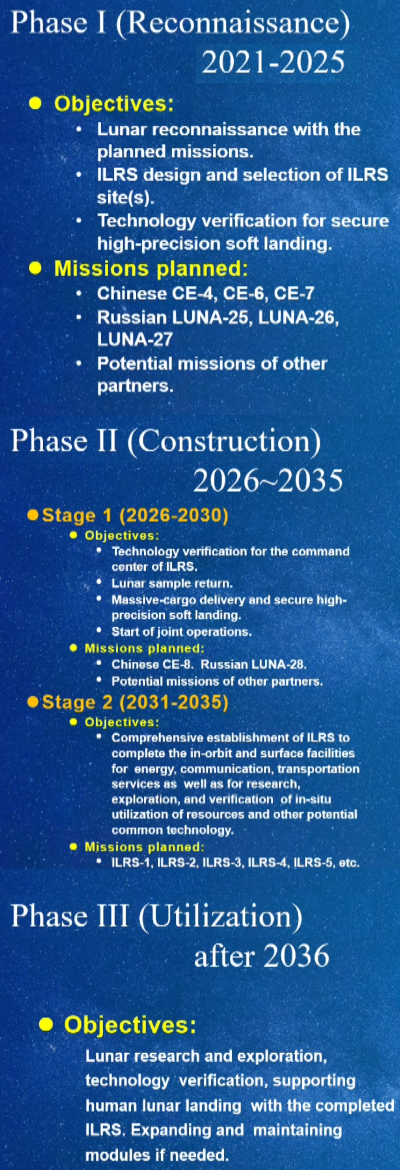
The original Chinese-Russian lunar base plan, from June 2021.

In outlining today China’s long term plans for establishing a manned lunar base near the south pole of the Moon, the project’s chief designer, Wu Weiren, revealed several changes in the program, almost all of which were indicated by what he did not say than what he did.

The graph to the right was released when this program was first announced in June 2021. At that time the plan was announced as a partnership of China and Russia, and was aiming to begin intermittent manned operations on the Moon in 2036.

According to Wu’s presentation today however, China apparently no longer considers Russia to be a full equal partner. It appears instead that Russia was mentioned as part of Wu’s effort to encourage many other countries to join the project. As reported by China’s state-run press:

During Tuesday’s event, Wu also highlighted the cooperation initiative for countries, organizations, and scientists worldwide to join the construction of the research station. In 2021, the China National Space Administration (CNSA) released a partnership guideline for the International Lunar Research Station.

That the state-run press made no mention of Russia in this description indicates strongly China’s devaluation of Russia’s contribution. This devaluation is not a surprise. As I noted in 2021,

[B]ased on Russiaโ€™s recent track record in the past two decades for promised space projects, we have no guarantee they will fly as scheduled, or even fly at all.

Since then Russia invaded the Ukraine and has suffered economically because of it. Its own first contribution to this partnership, Luna-25, has been delayed repeatedly, with its present launch now scheduled for July. It was always obvious that Russia — in its present state — could not match China, nor was it likely it would meet its promised targets.

Wu’s presentation also indicated that the third phase, when intermittent manned operations will begin, has been delayed from 2036 to 2040.

Overall, however, the Chinese plan remains stable and rational, and is likely to be carried out with reasonable success, based on how the country proposed and then achieved construction of its space station. The station was built essentially as described by the plan, with only a delay of a few years.

0 comments

The developing trench war in Ukraine

The developing trench war in Ukraine
For the original maps, go here (November 16, 2022) and here (April 16, 2023)

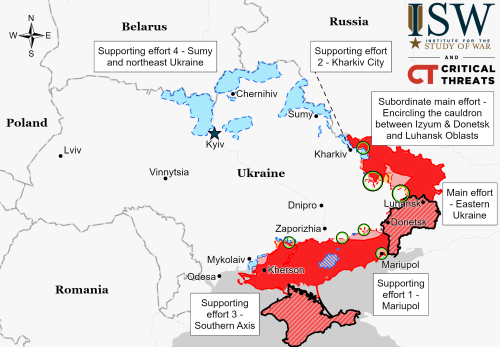
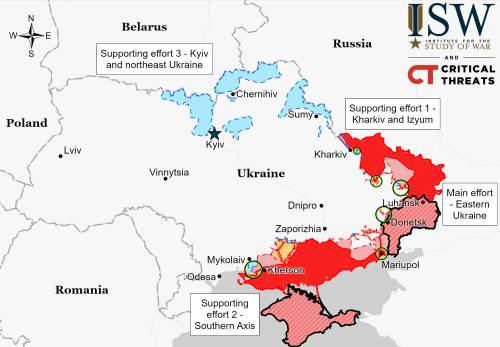
In my last update on the Ukraine War on November 16, 2022, I concluded that the stream of territorial gains by the Ukraine in the previous two months suggested that it was on the march and that in the coming months it would slowly and steadily regain territory from the Russians.

That analysis was wrong, at least in the short run. First, I failed to recognize that the Ukraine would need time to consolidate its large gains in September and October. Continuing the push apparently was beyond its capabilities without significant restocking of its troops and their equipment.

Second, by mid-November the Russians managed to halt the panicked retreat of its army, and forced it to re-establish reasonable lines of defense. It soon announced plans for a winter offensive, with the goal of capturing, at a minimum, the remaining territory of both the Donetsk and Luhansk Oblasts that either had never been taken or had been lost during the Ukraine’s successful fall offensive.

In the subsequent five months, the Russians have pushed hard, and gotten little for their effort. The map above, clipped from detailed maps produced daily by the Institute for the Study of War (ISW), compares the frontlines on November 16, 2022 with the present lines on April 16, 2022. Russian-held territory is indicated in pink, Ukrainian territory is either white or blue, blue indicating territory recaptured from Russia. The striped region is territory Russia grabbed in 2014.

Except for some gains in the south, the Russians have moved that frontline almost not at all.
» Read more

41 comments

Frank Rubio’s flight to ISS will exceed a year, setting a new American record

Frank Rubio
Frank Rubio

Initially, Frank Rubio’s first flight in space was intended to be a standard six month mission on ISS. Launched on September 21, 2022 on a Soyuz-2 rocket inside a Soyuz capsule, the plan was for him and his two crewmates to return in March, 2023.

Then their Soyuz capsule developed a leak in its coolant system in December 2022. Not knowing if it was safe to use this capsule with humans inside, a replacement unmanned Soyuz capsule was launched by the Russians to ISS in February 2023, with the leaking Soyuz capsule brought back unmanned earlier this week.

The Russians however decided that this new capsule, designed for a six month mission, would stay in orbit for six months, so that it would be used to its planned capability. This decision also hinged on the lack of a new crew arriving on this new capsule. If it brought Rubio and his crew home earlier, ISS would be short three crew members for at least several months.

The planned return date, September 27, 2023, now means that Rubio’s mission will be at least 371 days long, making him the first American to fly a full year in space. Previously NASA falsely touted Scott Kelly’s 340-day mission as a year-long mission, when it never was. Later, Mark Vande Hei’s mission, also launched on a Soyuz, was extended to 355 days, still just short of a year, because the Russians wanted to send a film crew to ISS and return them on the capsule which Vande Hei was intended to come home on.

Whether Rubio truly does spend a year in space however remains uncertain. Two different Russian spacecraft — the Soyuz and a Progress freighter — have developed this coolant leak in the past three months. If this problem is a systemic manufacturing error, which Russia is now investigating, the decision might be to return the new capsule sooner than planned, out of fear it will develop its own leak. We shall likely find out sometime in the next three months.

If Rubio does end up in space for a full year, however, it will likely be a dream come true, having become an astronaut in 2017 but waiting six years for his first flight.

6 comments

Russia’s Soyuz-2 rocket launches classified military satellite

Russia today successfully launched a classified military satellite, using its Soyuz-2 rocket lifting off from Plesetsk spaceport in northern Russia.

The rocket traveled north over the Arctic Ocean, so its first stage fell harmlessly into the ocean.

The leaders in the 2023 launch race:

21 SpaceX
11 China
6 Russia
3 Rocket Lab

American private enterprise still leads China 24 to 11 in the national rankings, and the entire world combined 24 to 21. SpaceX now trails the rest of the world, including other American companies, 21 to 24.

0 comments

Leaking Soyuz capsule returns unmanned to Earth

The Soyuz capsule with a leaking coolant system successfully landed in Kazakhstan today, returning to Earth unmanned because of that leak.

Russian engineers will now analyze whether a crew would have been able to come home safely in that spacecraft, despite its damaged coolant system, which will provide information for future such problems. They will not be able to study the leak itself, however, as it was part of the capsule’s service module, which separates upon return and burns up in the atmosphere.

0 comments

Russia launches military satellite

Using its Soyuz-2 rocket, Russia today launched a classified military satellite into orbit, lifting off from its Plesetsk spaceport in northern Russia.

The rocket flew north over the Arctic, with its first and second stages falling into the ocean.

The leaders in the 2023 launch race:

19 SpaceX
11 China
5 Russia
2 Rocket Lab

American private enterprise still leads China in launches 21 to 11 in the national rankings, and the entire world combined 21 to 18. SpaceX now trails the entire world combined, including American companies, 19 to 20.

0 comments

Russia’s Luna-25 unmanned lunar lander to be delivered to Vostochny in early June


Click for interactive map.

According to Russia’s state-run press, its Luna-25 unmanned lunar lander will finally be delivered to its launchsite in Vostochny in the first ten days of June 2023, after many years of delays.

The press announcement made no mention of a launch date after delivery, though according to an earlier report Roscosmos is aiming for a July 13, 2023 launch date.

The landing site on the Moon is Boguslawsky crater, as indicated by the green dot on the map to the right. If it occurs as planned, it will join three other landers now targeting 2023 lunar landings, Ispace’s Hakuto-R1, Intuitive Machines Nova-C, and India’s Chandrayaan-3, with three of four landing in the Moon’s south pole regions. The white cross marks the location of the south pole itself, on the rim of Shackleton Crater.

0 comments

Russia and China launch satellites

Two launches today in Russia and China.

First China used its Long March 2C rocket to launch a “remote sensing satellite” into orbit. No other information about the satellite was released. Nor was any information about whether the rocket’s first stage landed near habitable areas.

Next Russia used its Proton rocket to launch a classified satellite, likely a military surveillance satellite, into orbit. Like China Russia launches from an interior spaceport, with its first stage falling “in Karaganda Region of Kazakhstan,” with the second stage landing in drop zones in Russia. Russia, which has been doing this regularly for more than a half century, has always done a good job either avoiding habitable areas with the first stage crash, or keeping such stories out of the international press.

The 2023 launch race:

16 SpaceX
9 China
4 Russia
1 Rocket Lab
1 Japan
1 India

American private enterprise still leads China 17 to 9 in the national rankings, and the entire world combined 17 to 15. SpaceX alone is now tied with the entire world, including all other American companies, 16 all.

2 comments
1 13 14 15 16 17 133